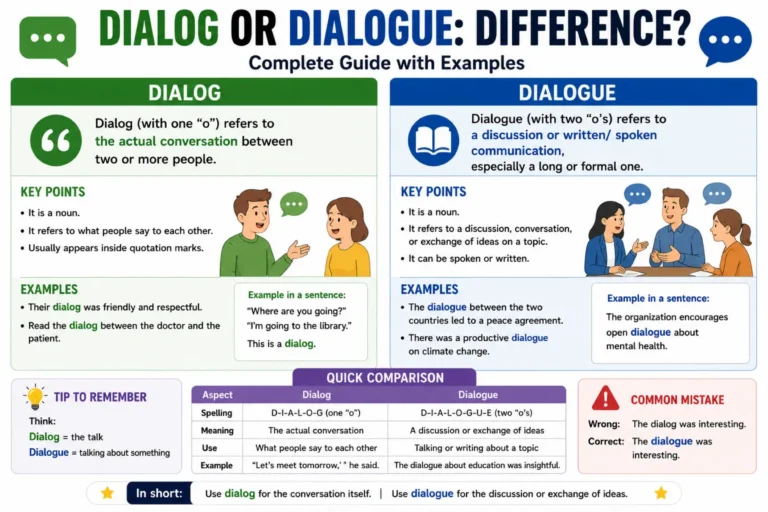
Dialog or dialogue is a common question for writers, students, and English learners. Both words refer to a conversation between two or more people. However, they are not always used in the same way. The difference often depends on the type of English you use and the context of your writing.
Many people wonder which spelling is correct. The good news is that both spellings are correct. American English often prefers dialog, while dialogue is more common in British English and formal writing. In this guide, you will learn the meaning, differences, examples, and best uses of each word. By the end, you will know which spelling fits your writing and why.
Quick Summary
Dialog or Dialogue at a Glance
- Both words mean a conversation between two or more people.
- Dialog is the preferred spelling in American English.
- Dialogue is common in British English.
- Dialogue is more common in books and formal writing.
- Dialog often appears in computer software and technology.
- Both spellings are correct.
- Choose one style and use it consistently.
What Does Dialog or Dialogue Mean?
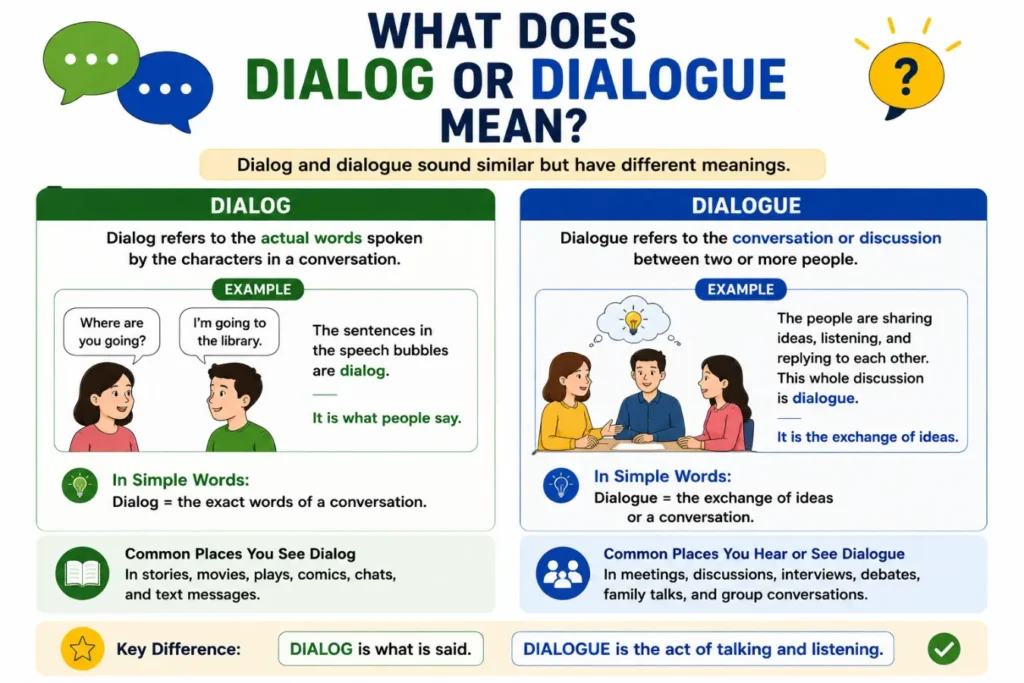
Both dialog and dialogue describe spoken or written conversations.
People use these words when two or more individuals exchange ideas, thoughts, or opinions.
The word also refers to conversations in books, movies, plays, and scripts.
Simple Definition
Dialog or dialogue means a conversation between two or more people.
Examples:
- The movie has realistic dialogue.
- The teacher encouraged open dialog in the classroom.
- The novel includes interesting dialogue between the main characters.
Although the spelling changes, the meaning stays the same.
Why Are There Two Spellings?
English has different spelling rules around the world.
American English and British English often spell words differently.
Examples include:
| American English | British English |
|---|---|
| Color | Colour |
| Honor | Honour |
| Center | Centre |
| Theater | Theatre |
| Dialog | Dialogue |
The spelling dialogue comes from French and Latin influences.
Over time, American English simplified many spellings.
That change led to the shorter form, dialog.
Today, both spellings remain acceptable.
Dialog vs Dialogue Comparison Table
The easiest way to understand the difference is through comparison.
| Feature | Dialog | Dialogue |
| Meaning | Conversation | Conversation |
| Correct Spelling | Yes | Yes |
| American English | More common | Also accepted |
| British English | Rare | Preferred |
| Formal Writing | Less common | Very common |
| Books and Novels | Less common | Standard choice |
| Technology | Frequently used | Less common |
| Screenwriting | Sometimes used | Most common |
Quick Tip
If you write for a global audience, dialogue is usually the safer choice.
If you write software documentation, dialog often fits better.
Dialog vs Dialogue: Main Differences
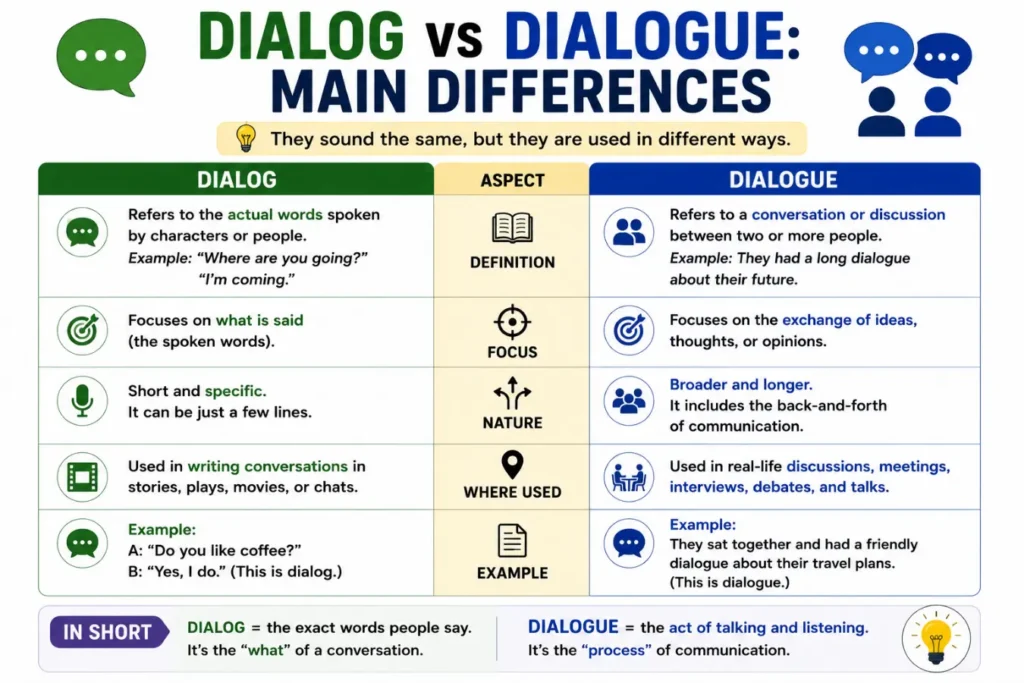
Although the meanings match, their usage differs.
Dialog
- Common in American English
- Popular in software and technology
- Often used for user interface terms
- Appears in phrases like “dialog box”
Dialogue
- Common worldwide
- Preferred in education
- Used in literature
- Common in journalism
- Standard in novels and scripts
The biggest difference is style, not meaning.
When Should You Use “Dialog”?
Use dialog when writing about technology or software.
For example:
- Open the settings dialog.
- The program displays a dialog box.
- Click OK to close the dialog.
Many computer manuals and programming guides use this spelling.
Software developers also prefer it because it is shorter.
When Should You Use “Dialogue”?
Use dialogue in formal writing and creative works.
Examples include:
- The novel contains powerful dialogue.
- Good dialogue makes characters believable.
- Teachers encourage dialogue during discussions.
- Peaceful dialogue can solve conflicts.
Most publishers, universities, and dictionaries recommend this spelling for general writing.
Real-Life Examples
Understanding real situations makes the difference easier.
In Literature
A novelist writes realistic dialogue between characters.
In School
Students participate in classroom dialogue to share ideas.
In Business
Managers encourage dialogue during team meetings.
In Technology
A software engineer creates a dialog box for user settings.
In Movies
Strong dialogue helps viewers understand each character’s personality.
These examples show that context often determines which spelling feels more natural.
Why Context Matters
Choosing between dialog and dialogue depends on your audience.
If your readers expect formal English, use dialogue.
If you write technical documents or software instructions, dialog may be the better option.
The most important rule is consistency.
Do not switch between spellings in the same article unless you are explaining the difference between them.
Common Mistakes When Using Dialog or Dialogue
Many writers use these words incorrectly. Avoid these common mistakes to improve your writing.
Mistake 1: Thinking One Spelling Is Wrong
Both dialog and dialogue are correct. The right choice depends on your audience and writing style.
Mistake 2: Mixing Spellings
Do not switch between dialog and dialogue in the same article. Pick one spelling and stay consistent.
Mistake 3: Ignoring Your Audience
Readers expect different spellings based on location and context. Use dialogue for global or academic audiences. Use dialog when writing software documentation.
Mistake 4: Using the Wrong Context
A dialog box belongs in software. Character dialogue belongs in novels, movies, and plays.
Tips for Choosing the Correct Spelling
Choosing the right spelling becomes easy when you follow a few simple rules.
Use Dialogue If You Write:
- Books
- Blog posts
- Academic papers
- News articles
- Essays
- Scripts
- General English content
Use Dialog If You Write:
- Software documentation
- Programming guides
- User manuals
- Technical documentation
- User interface descriptions
Quick Rule
When unsure, choose dialogue. It is the most widely accepted spelling in general writing.
How Dialog and Dialogue Are Used in Daily Life
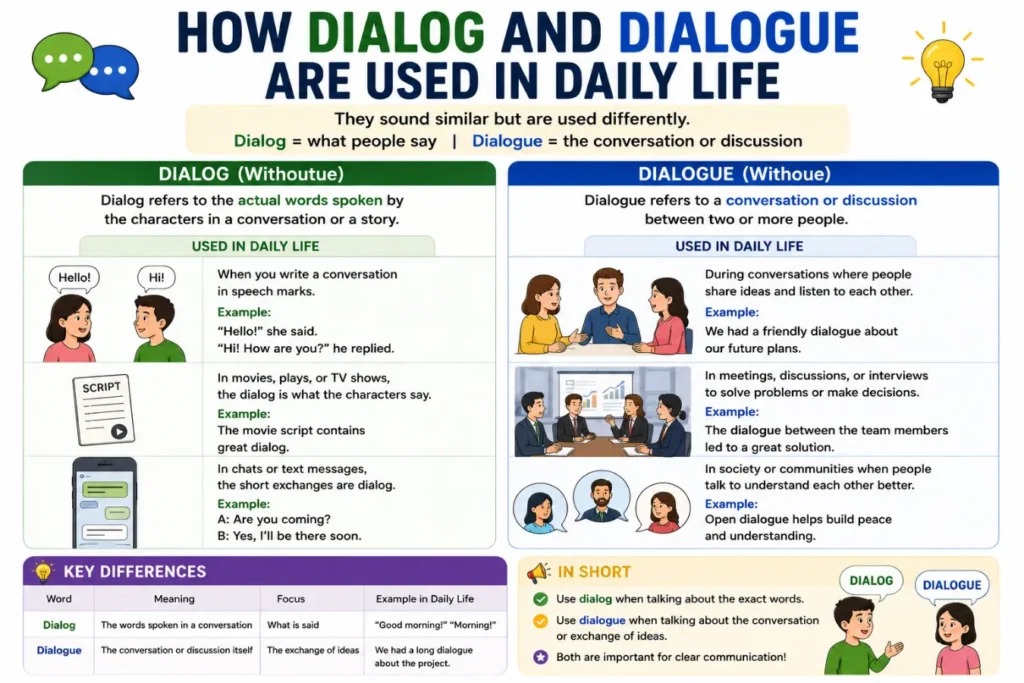
These words appear in many everyday situations.
In Education
Teachers encourage classroom dialogue to help students share ideas.
In Business
Companies use open dialogue to solve problems and improve teamwork.
In Movies
Good dialogue helps audiences understand characters and emotions.
In Technology
Many computer programs display a dialog box before completing an action.
In Relationships
Healthy dialogue helps people communicate clearly and resolve disagreements.
Synonyms and Related Keywords
Using related keywords helps search engines understand your content.
Here are useful synonyms and LSI keywords:
- conversation
- discussion
- communication
- exchange of ideas
- verbal communication
- spoken conversation
- written conversation
- character dialogue
- dialog box
- interactive communication
- script writing
- screenplay dialogue
- dialogue writing
- conversation examples
- effective communication
- dialogue definition
- dialog meaning
- dialogue examples
Use these naturally throughout your content without overusing the main keyword.
Expert Insights
Professional writers focus on clarity before spelling preferences.
Most style guides recommend dialogue for general writing because readers recognize it more easily.
Technical writers often choose dialog because software companies use this spelling in menus and user interfaces.
The best practice is consistency. A consistent writing style improves readability and creates a better experience for readers.
Knowing the difference also helps improve grammar, editing, and professional communication.
Frequently Asked Questions
Is dialog or dialogue correct?
Both spellings are correct. The best choice depends on your audience and writing style.
Which spelling is more common?
Dialogue is more common in books, education, and formal writing.
Is dialog American English?
Yes. Dialog is the preferred American spelling in many technical and software contexts.
Is dialogue British English?
Yes. Dialogue is the standard spelling in British English and many international publications.
Why do software programs use “dialog”?
Software developers often prefer dialog because it is shorter and has become a technical standard.
Can I use dialog in academic writing?
Most academic style guides recommend dialogue instead.
What is a dialog box?
A dialog box is a small window that asks users to provide information or confirm an action in software.
Which spelling should bloggers use?
Most bloggers should use dialogue, especially when writing for a global audience.
Conclusion
Choosing between dialog or dialogue is easier once you understand the context. Both words describe a conversation between two or more people. The main difference lies in spelling and usage. Dialogue is the preferred choice for books, articles, academic writing, and international audiences. Dialog appears more often in software, technology, and technical documents.
The best approach is to know your audience and stay consistent throughout your writing. If you are unsure, dialogue is usually the safest option because it is widely recognized across different types of content. Understanding this small spelling difference can make your writing clearer, more professional, and easier for readers to follow.