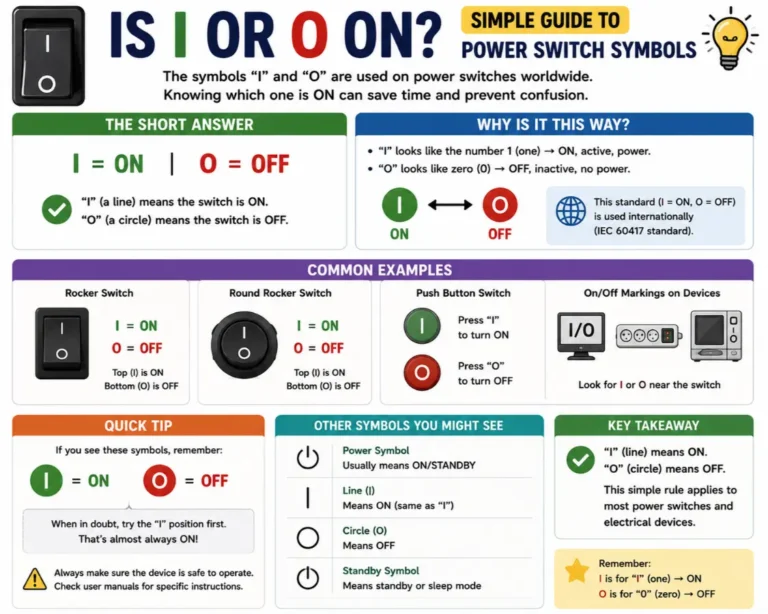
Is I or O on? Many people ask this question when using electronics for the first time. Power switches often show the symbols I and O instead of the words “On” and “Off.” This can confuse users, especially on new devices. The good news is that the symbols follow an international standard. Once you understand their meaning, you can use almost any electronic device with confidence. In this guide, you will learn what the I and O symbols mean, why manufacturers use them, and how to tell whether your device is on or off. We will also cover common mistakes, real-life examples, and simple tips to help you remember the correct position.
Quick Summary
Is I or O On?
- I means ON.
- O means OFF.
- The symbols follow international standards.
- I represents a closed electrical circuit.
- O represents an open electrical circuit.
- Most electronic devices use these symbols.
- They help users understand switches in any language.
What Do the I and O Symbols Mean?
The symbols I and O appear on many electrical switches.
They replace the words “On” and “Off.”
This makes devices easier to use in every country.
Symbol Meanings
- I = ON
- O = OFF
These symbols appear on:
- Computers
- Power supplies
- Kitchen appliances
- Monitors
- Televisions
- Industrial machines
- Medical equipment
Why Do Power Switches Use I and O?
Manufacturers sell products around the world.
Different countries use different languages.
Using symbols instead of words removes language barriers.
The symbols are easy to recognize and save space on small switches.
International standards also make products more consistent.
Where Did the Symbols Come From?
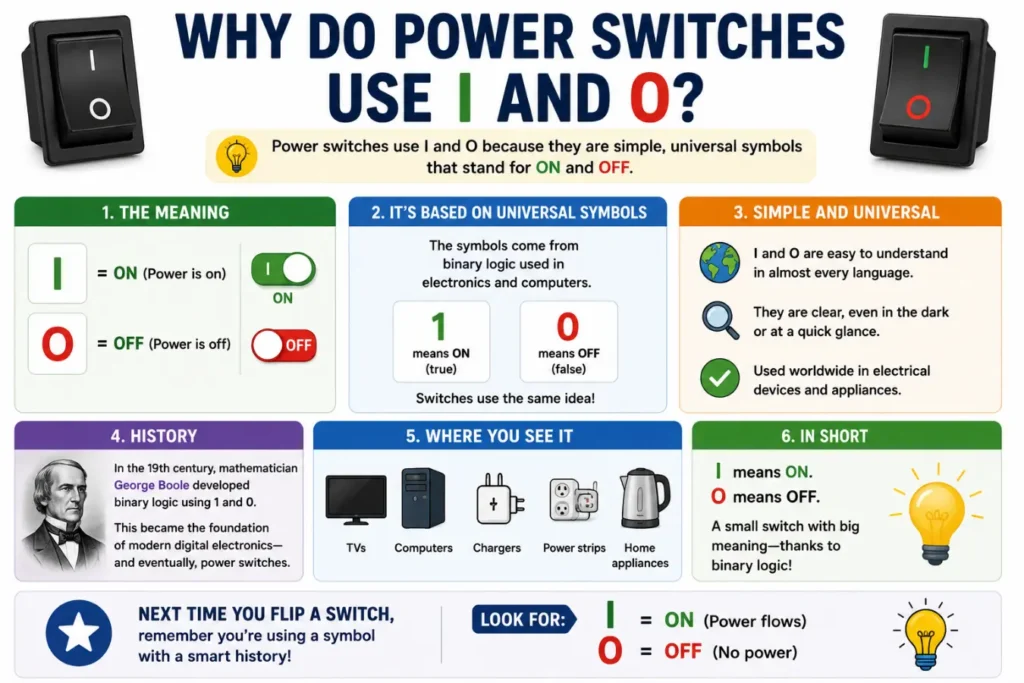
The symbols come from international electrical standards.
They are based on binary numbers.
In binary:
- 1 means active.
- 0 means inactive.
Over time:
- The number 1 became the symbol I.
- The number 0 became the symbol O.
This simple system works in almost every country.
How Do the Symbols Work?
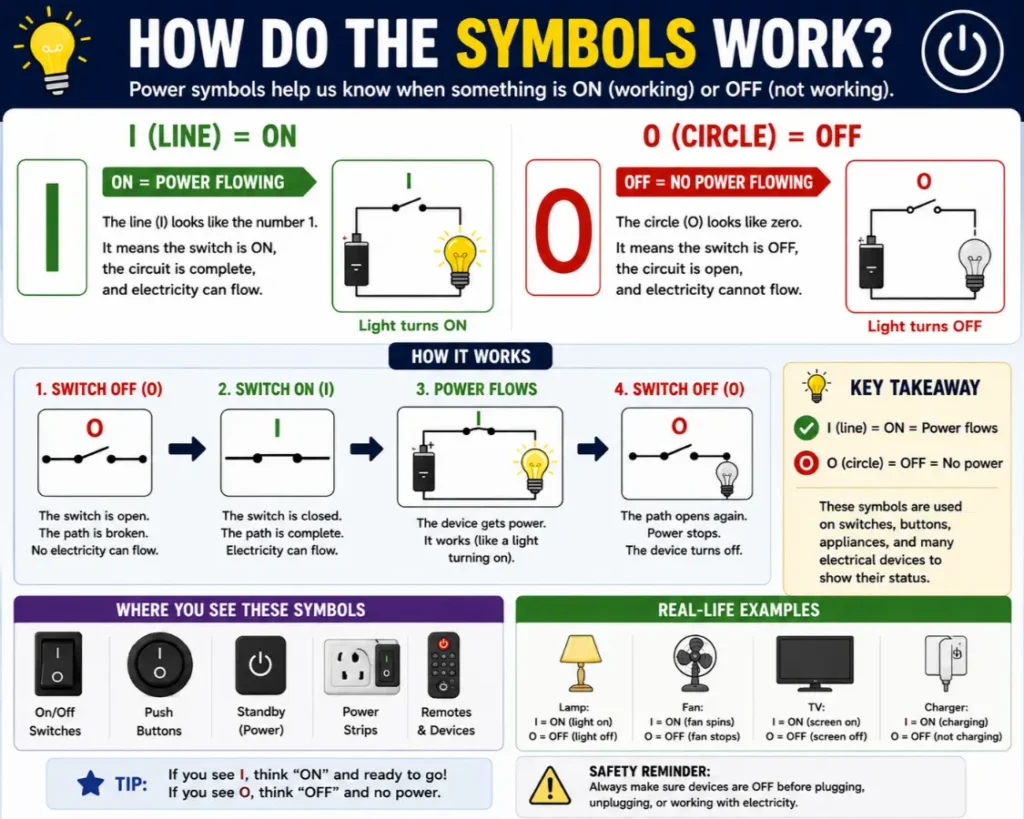
Electricity flows through a circuit.
When the circuit is complete, the device turns on.
When the circuit is broken, the device turns off.
The symbols help explain this idea.
I (ON)
The straight line represents a closed circuit.
Electricity can flow.
The device works normally.
O (OFF)
The circle represents an open circuit.
Electricity stops flowing.
The device turns off.
Difference Between I and O
Although the symbols look simple, they have opposite meanings.
| Symbol | Meaning | Circuit Status | Device Status |
|---|---|---|---|
| I | ON | Closed | Operating |
| O | OFF | Open | Not operating |
This table makes it easy to remember the difference.
Real-Life Examples
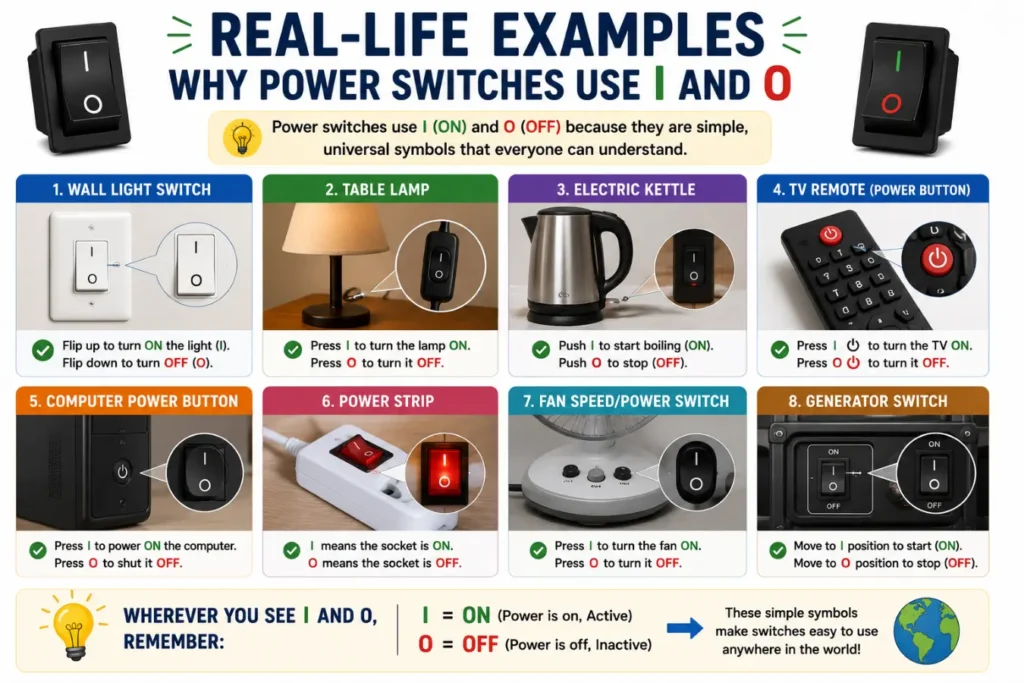
You can find the I and O symbols on many everyday devices.
Computer Power Supply
Most desktop power supplies have an I/O switch.
Move the switch to I to supply power.
Move it to O to cut power.
Television
Many TVs use these symbols on the back panel.
Wi-Fi Router
Routers often include a small power switch labeled I and O.
Coffee Machine
Coffee makers commonly use the same symbols for power.
Printer
Many printers use an I/O rocker switch near the power cable.
These examples show how common the symbols are in daily life.
Are I and O Used Worldwide?
Yes.
Manufacturers around the world use these symbols.
International organizations recommend them for electrical equipment.
This creates a consistent experience for users.
Whether you buy a device in Europe, Asia, North America, or Australia, the symbols usually have the same meaning.
That is why they are trusted around the world.
Common Mistakes People Make
Many people confuse the I and O symbols when using a new device.
Here are the most common mistakes.
Mistake 1: Thinking O Means ON
Some people believe the circle looks like the letter “O” in the word “On.”
This is incorrect.
The circle O always means OFF.
Mistake 2: Guessing Without Checking
Never guess the switch position.
Look for the symbols before pressing the switch.
Mistake 3: Ignoring the Device Indicator
Many devices have a power light.
If the light is on, the device is usually running.
The light helps confirm the switch position.
Easy Tips to Remember I and O
You can remember these symbols with simple tricks.
Think of I as “In”
When the switch is on I, electricity flows into the device.
Think of O as “Out”
When the switch is on O, electricity stops flowing.
Remember the Binary Rule
- 1 (I) = ON
- 0 (O) = OFF
This is the easiest way to remember the symbols.
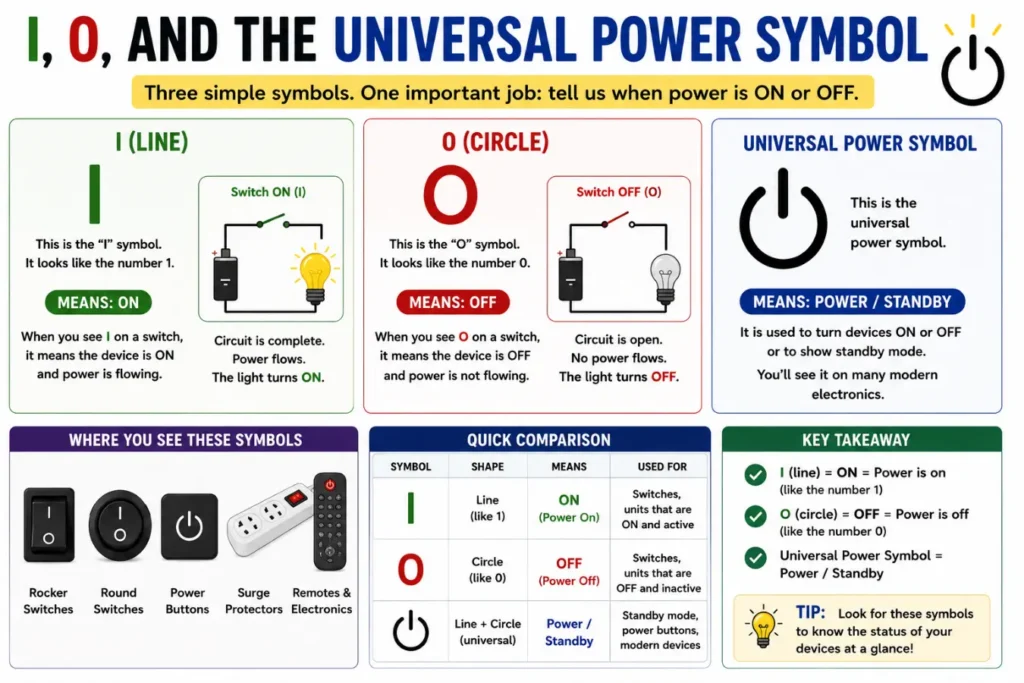
I, O, and the Universal Power Symbol
Some devices use a third symbol.
It looks like this:
⏻
This is the universal power symbol.
It combines the I and O symbols into one icon.
Many modern devices use it for a single power button.
Comparison Table
| Symbol | Meaning | Common Use |
|---|---|---|
| I | ON | Rocker switches |
| O | OFF | Rocker switches |
| ⏻ | Power button | Computers, TVs, game consoles |
How These Symbols Help in Daily Life
The I and O symbols make devices easier to use.
They remove language barriers.
People from different countries understand the same symbols.
You can find them on:
- Washing machines
- Desktop computers
- Gaming consoles
- Air compressors
- Electric kettles
- Laboratory equipment
- Medical devices
- Office printers
Knowing these symbols saves time and prevents mistakes.
Why International Standards Matter
Manufacturers follow international standards to improve safety.
Using the same symbols helps users operate equipment correctly.
It also reduces confusion when products are sold worldwide.
Standard symbols make instruction manuals shorter and easier to understand.
Synonyms and Related Keywords
Using related keywords helps search engines understand the topic.
Here are common semantic keywords:
- power switch symbols
- I and O power switch
- on off switch symbols
- power button symbols
- electrical switch symbols
- I means on
- O means off
- universal power symbol
- binary power symbols
- switch indicator
- electrical controls
- device power switch
- power icon meaning
- ON and OFF symbols
These keywords naturally support the primary keyword without overusing it.
Expert Insight
The I and O symbols are more than simple labels.
They follow internationally recognized electrical standards.
This creates a consistent experience across millions of products.
Understanding these symbols improves safety and reduces user errors.
Whether you use household appliances or industrial equipment, recognizing these symbols helps you operate devices with confidence.
Frequently Asked Questions
Is I or O on?
I means ON, and O means OFF.
Why does I mean ON?
The symbol comes from the binary number 1, which represents an active or powered state.
Why does O mean OFF?
The symbol comes from the binary number 0, which represents an inactive or unpowered state.
What does the power symbol (⏻) mean?
The symbol ⏻ combines I and O. It represents the main power button on many modern devices.
Are these symbols used worldwide?
Yes. Manufacturers use them around the world because they follow international standards.
Are I and O safer than using words?
They reduce language confusion and help people identify switch positions quickly.
Why do computers use I and O switches?
Computer power supplies often include these symbols to indicate whether electrical power is available.
Can a device have both I/O and a power button?
Yes. Many desktop computers have an I/O switch on the power supply and a separate front power button.
Conclusion
If you have ever wondered “Is I or O on?”, the answer is simple. The symbol I means ON, while O means OFF. These symbols come from binary numbers and follow international electrical standards. They appear on computers, televisions, kitchen appliances, medical devices, and many other products. Learning their meaning helps you use electronics safely and confidently. The next time you see an I/O switch, you will know exactly which position powers the device. This small piece of knowledge can prevent mistakes and make everyday technology easier to understand.