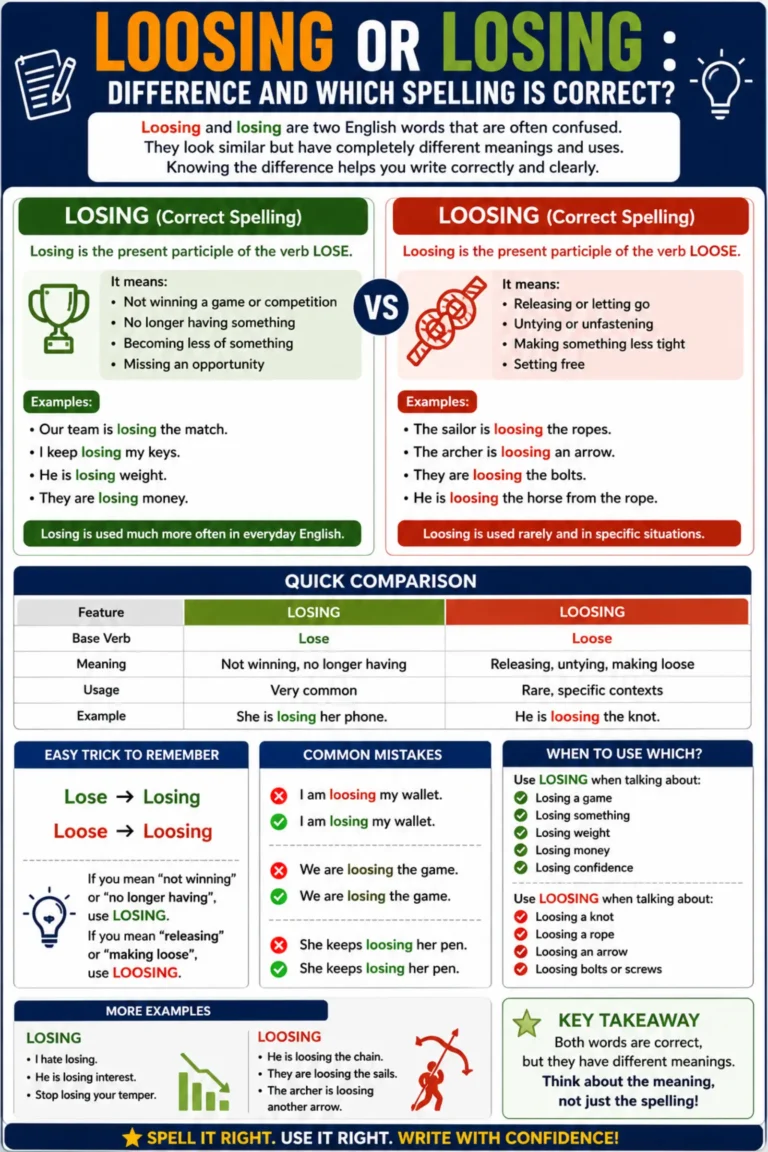
Loosing or losing is a common spelling question that confuses many English learners and native speakers. These two words look almost the same, but they have very different meanings. Using the wrong one can change the meaning of your sentence and make your writing look unprofessional.
The good news is that the difference is easy to understand. Once you learn what each word means, you will know exactly when to use it. This guide explains everything in simple English. You will also find comparison tables, real-life examples, common mistakes, expert tips, and answers to popular questions. By the end, you will feel confident using both words correctly in everyday writing and conversation.
Quick Summary Box
- Losing means failing to win or no longer having something.
- Loosing means releasing, letting go, or making something less tight.
- Losing is much more common in daily English.
- Loosing appears mostly in formal, technical, or historical writing.
- If you mean “not winning,” always use losing.
- If you mean “releasing” or “untieing,” use loosing.
What Does Losing Mean?
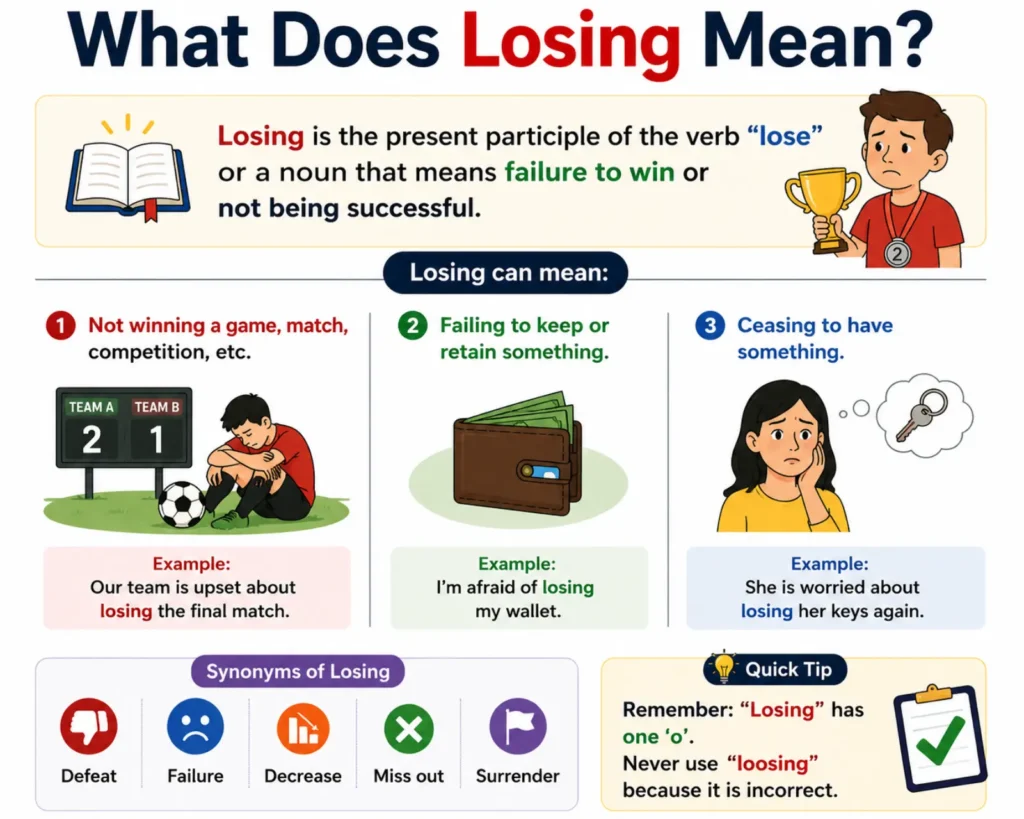
Losing is the present participle of the verb lose.
It means:
- Not winning a game or competition.
- No longer having something.
- Becoming less of something.
- Missing an opportunity.
Examples
- She is losing her keys again.
- Our team is losing the match.
- He is losing confidence every day.
- They are losing money on the project.
In everyday English, losing is the correct word most people need.
What Does Loosing Mean?
Loosing comes from the verb loose, which means to release, untie, or make something less tight.
It is much less common than losing.
Examples
- The sailor was loosing the ropes.
- The knight was loosing an arrow.
- Workers were loosing the bolts carefully.
This word usually appears in older books, technical writing, or specific activities like sailing or archery.
Loosing vs Losing: Key Differences
| Feature | Losing | Loosing |
|---|---|---|
| Meaning | Not winning or no longer having something | Releasing or making something loose |
| Verb Base | Lose | Loose |
| Everyday Use | Very common | Rare |
| Grammar | Present participle | Present participle |
| Example | Losing my wallet | Loosing the rope |
Simple trick:
- Lose → Losing
- Loose → Loosing
Why Do People Confuse Loosing and Losing?
Several reasons cause this mistake.
Similar spelling
Only one extra o separates the words.
Similar pronunciation
Many people pronounce them almost the same.
Spell check may not help
Both are real English words.
Fast typing
People often add an extra o without noticing.
Real-Life Examples of Losing
Here are common situations where losing is correct.
Sports
- Our team is losing by two points.
School
- She is losing interest in science.
Work
- The company is losing customers.
Health
- He is losing weight.
Daily Life
- I keep losing my phone.
These are situations most people experience.
Real-Life Examples of Loosing
Although uncommon, loosing still has correct uses.
Archery
- The archer is loosing another arrow.
Boating
- The crew is loosing the sails.
Construction
- Workers are loosing the chains.
Camping
- They are loosing the tent ropes.
These examples all involve releasing or loosening something.
Common Mistakes People Make
Many writers accidentally use loosing instead of losing.
Incorrect
- I am loosing my wallet.
Correct
- I am losing my wallet.
Incorrect
- We are loosing the game.
Correct
- We are losing the game.
Incorrect
- She keeps loosing her glasses.
Correct
- She keeps losing her glasses.
Remember:
If someone is not winning or cannot find something, always write losing.
Easy Trick to Remember the Difference
Try this simple memory tip.
Losing = Lose
If the base word is lose, remove the e and add -ing.
Lose → Losing
Loosing = Loose
If the base word is loose, simply add -ing.
Loose → Loosing
Think about the sentence.
- Not winning?
- Missing something?
Use losing.
Releasing something?
Use loosing.
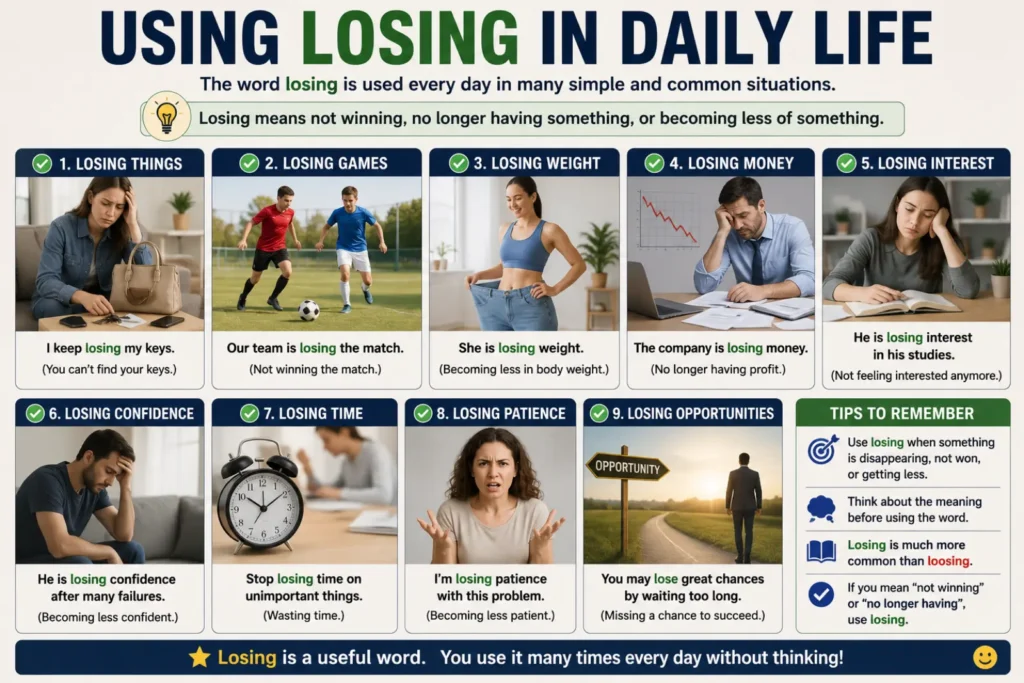
Using Losing in Daily Life
You will use losing often in everyday conversations.
Examples include:
- Losing your wallet
- Losing your phone
- Losing a race
- Losing sleep
- Losing patience
- Losing confidence
- Losing money
- Losing weight
- Losing your job
- Losing an opportunity
Using Loosing in Daily Life
Most people rarely need loosing.
However, it appears in special situations.
Examples include:
- Loosing a horse from its rope
- Loosing an arrow
- Loosing the anchor rope
- Loosing tight knots
- Loosing safety cables
Outside these situations, you probably mean losing.
Synonyms and Related Words
for Losing
- Missing
- Misplacing
- Failing
- Dropping
- Forfeiting
- Surrendering
- Falling behind
- Declining
Synonyms for Loosing
- Releasing
- Untying
- Unfastening
- Freeing
- Unbinding
- Loosening
- Letting go
Expert Insights
Professional editors see loosing used incorrectly every day.
The mistake usually happens because both words exist in English. Spell check often misses it.
To avoid errors:
- Think about the meaning before writing.
- Ask yourself whether something is being released.
- If not, choose losing.
- Proofread important emails and documents.
- Practice with real-life examples.
Small spelling improvements make your writing look more professional and trustworthy.
Frequently Asked Questions
Is it loosing or losing weight?
Losing weight is correct.
Is it loosing or losing a game?
Use losing a game.
Is loosing a real word?
Yes. It means releasing or making something loose.
Why do people write loosing instead of losing?
The words look similar, and both are valid English words.
Which word is more common?
Losing is far more common.
Can spell check catch this mistake?
Not always. Both words are spelled correctly.
How do I remember the difference?
Remember:
- Lose → Losing
- Loose → Loosing
Is “I’m loosing my mind” correct?
No.
The correct sentence is:
I’m losing my mind.
Featured Snippet: Loosing or Losing
Losing means failing to win or no longer having something. Loosing means releasing, untying, or making something loose. In everyday English, losing is almost always the correct choice. Use loosing only when talking about releasing or freeing something.
Conclusion
Understanding loosing or losing is easier than it first appears. Although the words look alike, they have different meanings and uses. Losing refers to not winning, missing something, or having less of it. Loosing means releasing, freeing, or making something loose. Because losing is used in everyday conversations, emails, schoolwork, and business writing, it is the word you will need most often. Loosing appears mainly in specialized situations such as archery, sailing, or historical writing. Before you write, think about the meaning of your sentence. If you mean “not winning” or “no longer having something,” choose losing. If you mean “releasing” or “untieing,” choose loosing. This simple habit will help you write clearly, confidently, and correctly every time.