Can not or cannot is one of the most common grammar questions in English. Many people wonder which spelling is correct. The good news is that the answer is simple once you know the rule.
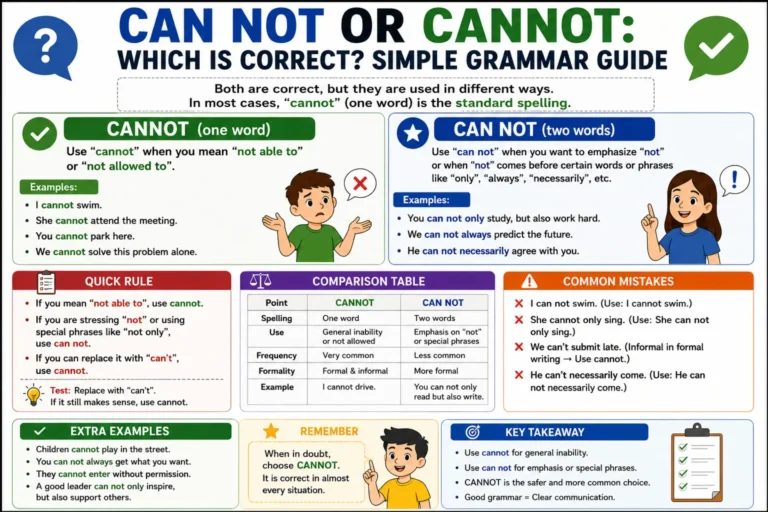
In most situations, cannot is the correct spelling. It means someone is not able to do something or does not have permission to do it. The two-word form, can not, is much less common. Writers use it only in special cases where they want to stress the word not or when not belongs to another phrase.
Understanding this difference will make your writing clearer and more professional. It will also help you avoid common grammar mistakes in school, at work, and in everyday conversations.
This guide explains everything in simple English. You will learn the meaning of both forms, grammar rules, comparison tables, real-life examples, expert tips, and common mistakes. By the end, you will know exactly when to use cannot and when can not is the better choice.
Quick Summary Box
- Cannot is the standard spelling in modern English.
- Cannot means “not able to” or “not allowed to.”
- Can not is correct only in special situations.
- Use cannot in almost all writing.
- Use can not when you want to emphasize not.
- If can’t fits your sentence, cannot is usually the correct choice.
- When in doubt, choose cannot.
What Does “Cannot” Mean?
Cannot means someone is unable to do something or does not have permission to do it.
It combines two words:
- Can = to be able to
- Not = negative
Together they form cannot, which expresses inability, impossibility, or prohibition.
Simple Definition
Cannot means “not able to” or “unable to.”
Examples
- I cannot swim.
- She cannot drive yet.
- We cannot enter this room.
- They cannot finish the project today.
- You cannot park your car here.
In each sentence, cannot simply means the action is impossible or not allowed.
Why Is “Cannot” Written as One Word?
Many learners think can and not should always stay separate. However, English grammar treats cannot as one word in most situations.
Modern dictionaries and grammar guides recommend writing cannot as a single word because it has become the standard spelling over time.
Think of it this way:
✔ can + not = cannot
Although can not exists, it is much less common and has a different purpose.
Examples
Correct:
- I cannot hear you.
- He cannot find his wallet.
- We cannot change the schedule.
Less Natural:
- I can not hear you.
- He can not find his wallet.
Native English speakers almost always choose cannot in these situations
What Does “Can Not” Mean?
The phrase can not is not wrong, but it has a more limited use.
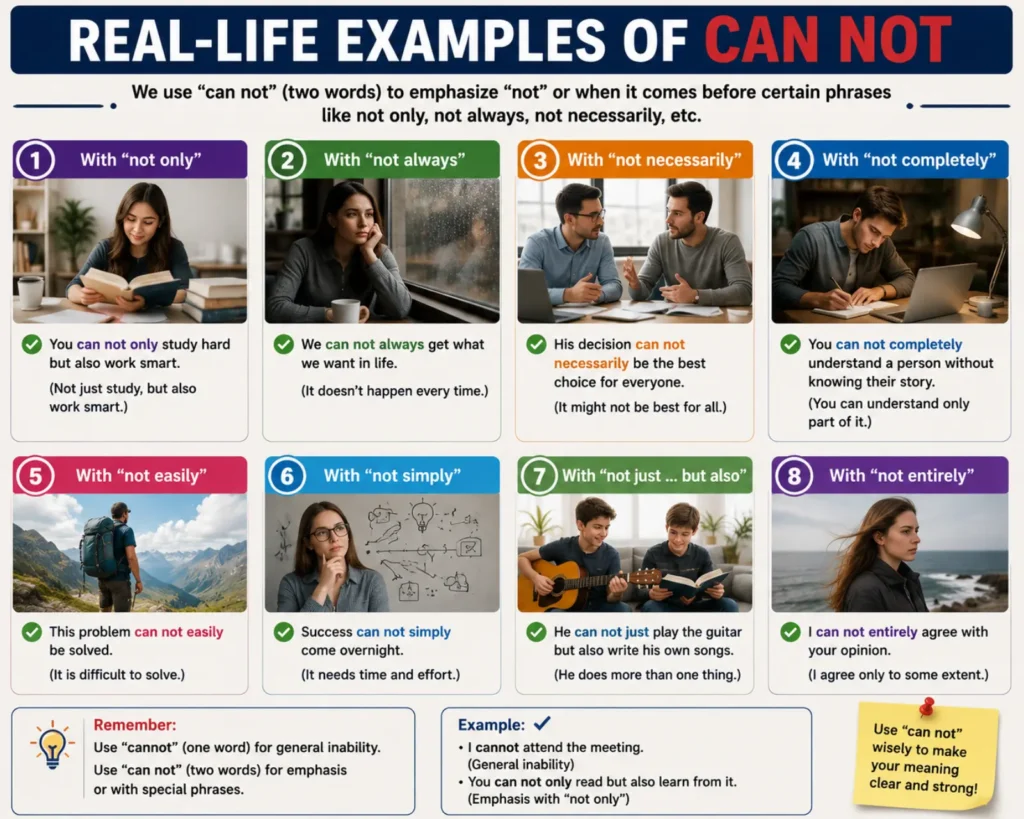
Writers separate the words when they want to place special emphasis on not or when not belongs to another expression.
This often happens with phrases such as:
- not only
- not always
- not necessarily
- not completely
Examples
- You can not only study English but also practice speaking every day.
- We can not always predict the weather.
- She can not necessarily attend every meeting.
- They can not completely solve the problem overnight.
Notice that not modifies another word instead of simply making can negative.
That is why the words stay separate.
Can Not or Cannot: What’s the Difference?
Although the two spellings look similar, they are not always interchangeable.
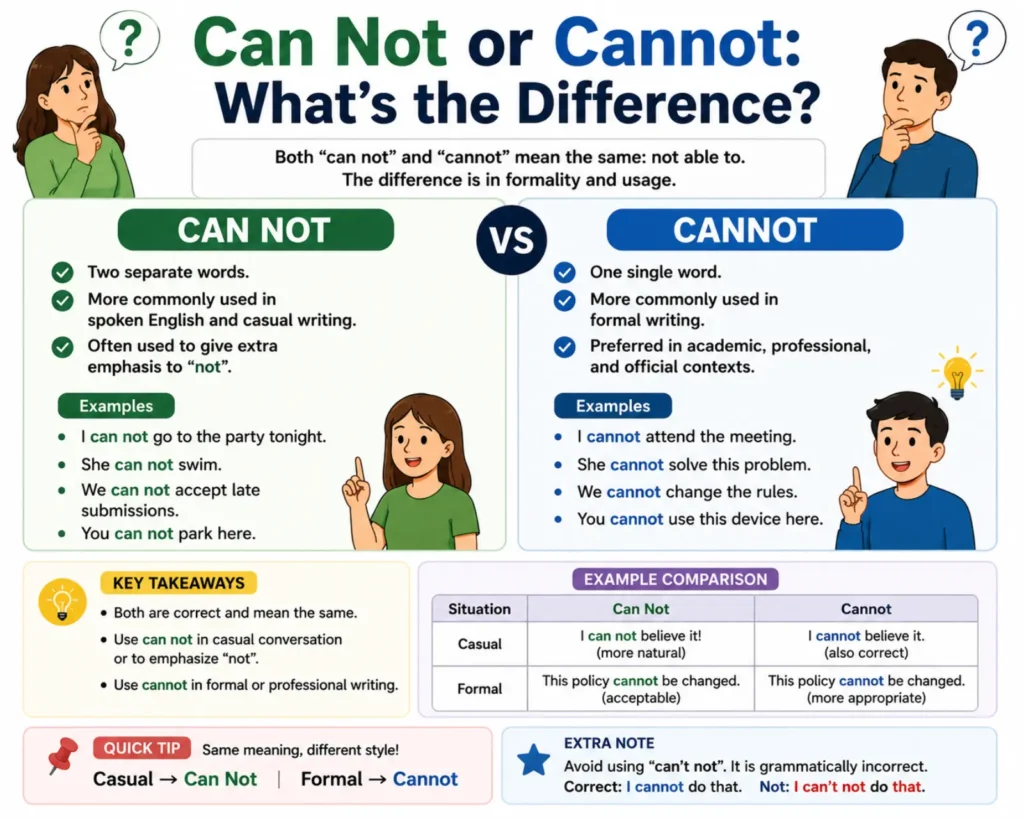
| Feature | Cannot | Can Not |
|---|---|---|
| Standard spelling | ✅ Yes | ❌ No (rare) |
| Means “unable to” | ✅ Yes | Sometimes |
| Common in everyday writing | ✅ Yes | Rare |
| Used in formal writing | ✅ Yes | Rare |
| Used for emphasis | ❌ Usually not | ✅ Yes |
| Recommended by grammar experts | ✅ Yes | Only in special cases |
The Easy Rule
Ask yourself one simple question:
Do I mean “unable to”?
If the answer is yes, use cannot.
Examples:
- I cannot swim.
- She cannot come today.
- We cannot finish this task.
- They cannot open the door.
Now ask another question:
Am I emphasizing the word “not” or using a phrase like “not only”?
If yes, can not may be correct.
Example:
- She can not only sing but also dance beautifully.
This is one of the few situations where separating the words sounds natural.
Why “Cannot” Is More Common
The word cannot appears much more often than can not in books, newspapers, websites, schools, and business writing.
Teachers, editors, and professional writers usually recommend using cannot because it is clear, simple, and widely accepted.
If you ever feel unsure, choosing cannot is almost always the safest option.
Grammar Rules for Using Cannot and Can Not
Learning a few simple grammar rules can help you choose the correct spelling every time. You do not need to memorize complicated grammar terms. Just remember these easy rules.
Rule 1: Use Cannot for Negative Ability
When someone is unable to do something, use cannot.
Examples
- I cannot solve this math problem.
- She cannot speak French.
- We cannot leave early today.
- They cannot find the correct answer.
This is the most common use of cannot.
Rule 2: Use Cannot for Prohibition
Use cannot when something is not allowed.
Examples
- You cannot smoke inside the building.
- Visitors cannot enter without permission.
- Students cannot use phones during the exam.
- Employees cannot share confidential information.
In these sentences, the speaker talks about rules or restrictions.
Rule 3: Use Can Not Only for Special Emphasis
Sometimes, you want to emphasize the word not instead of simply making the sentence negative.
Examples
- She can not only paint but also write beautiful poems.
- We can not always predict the future.
- They can not necessarily agree with every decision.
Here, not belongs with another word or phrase, so writing can not is correct.
Rule 4: Use the “Can’t Test”
A simple trick is to replace the words with can’t.
If the sentence still makes sense, use cannot.
Examples
- I cannot swim.
- I can’t swim. ✅
- She cannot attend the meeting.
- She can’t attend the meeting. ✅
However, this trick does not work with phrases like not only.
For example:
- She can not only sing but also dance.
You cannot replace this with:
- ❌ She can’t only sing but also dance.
So, keep the words separate in these special cases.
Cannot vs Can’t
Many people also wonder whether they should write cannot or can’t.
Both have the same meaning, but they fit different situations.
| Cannot | Can’t |
|---|---|
| Formal writing | Informal writing |
| Essays and reports | Text messages |
| Business emails | Casual conversations |
| Professional documents | Friendly chats |
| Academic writing | Social media posts |
Examples
Formal
- We cannot approve your request today.
- I cannot attend tomorrow’s conference.
- The company cannot guarantee delivery before Friday.
Informal
- I can’t come tonight.
- We can’t find the restaurant.
- She can’t answer the phone right now.
If you are writing for school, work, or a professional audience, cannot is usually the better choice.
Real-Life Examples of Cannot
Understanding grammar becomes easier when you see it in everyday situations.
At School
Teachers often use cannot when explaining classroom rules.
Examples
- Students cannot leave the classroom without permission.
- You cannot use calculators during this test.
- We cannot submit assignments after the deadline.
At Work
Professional communication often uses cannot because it sounds more formal.
Examples
- We cannot process your request today.
- I cannot attend the meeting because of another appointment.
- Our team cannot complete the project without the required documents.
At Home
Family members also use cannot in daily conversations.
Examples
- I cannot find my glasses.
- We cannot watch television until dinner is finished.
- You cannot stay awake all night.
While Traveling
Travel rules often include the word cannot.
Examples
- Passengers cannot board without a valid ticket.
- You cannot carry prohibited items onto the plane.
- Visitors cannot enter the museum after closing time.
While Shopping
Stores often display notices using cannot.
Examples
- Returned items cannot be exchanged without a receipt.
- Customers cannot enter through the emergency exit.
- Gift cards cannot be refunded for cash.
In Sports
Coaches and referees also use cannot.
Examples
- Players cannot remove their safety equipment.
- You cannot score after the final whistle.
- Spectators cannot enter the field during the match.
Online and Technology
Technology gives us many examples of cannot.
Examples
- You cannot access this website.
- The file cannot be opened.
- Your password cannot contain spaces.
- You cannot download the document without logging in.
Real-Life Examples of Can Not
Although rare, can not appears naturally in some sentences.
Example 1
You can not only improve your grammar but also increase your confidence.
Example 2
We can not always control the weather.
Example 3
Employees can not necessarily work from home every day.
Example 4
Children can not completely understand every adult decision.
Example 5
A good leader can not only inspire others but also help them grow.
Notice how not connects with another word instead of simply making can negative.
Common Mistakes People Make
Many English learners make the same mistakes. Learning them now will help you avoid them later.
Mistake 1: Using Can Not Instead of Cannot
❌ I can not swim.
✅ I cannot swim.
Mistake 2: Writing Cannot Only
❌ She cannot only sing.
✅ She can not only sing but also dance.
Mistake 3: Mixing Formal and Informal Writing
❌ I can’t attend the business meeting. (in a formal report)
✅ I cannot attend the business meeting.
Mistake 4: Forgetting the Standard Rule
Some writers separate the words because they think can and not should always stay apart.
That is incorrect.
Remember:
- Cannot is the standard spelling.
- Can not is used only in special grammar situations.
Quick Grammar Checklist
Before you finish writing, ask yourself these questions:
- Does the sentence mean unable to?
- Can I replace it with can’t?
- Am I writing formally?
- Am I using a phrase like not only or not always?
If your answer is yes to the first three questions, choose cannot.
Using Cannot in Daily Life
The word cannot appears in everyday conversations, emails, schoolwork, signs, and professional documents. Once you know the rule, using it becomes easy.
Here are some common situations where cannot fits naturally.
At School
Teachers and students often use cannot when talking about classroom rules or assignments.
Examples
- Students cannot submit homework after Friday.
- You cannot use your phone during the exam.
- We cannot enter the science lab without the teacher.
At Work
Professional writing usually prefers cannot because it sounds clear and formal.
Examples
- I cannot attend today’s meeting.
- We cannot approve your request right now.
- Employees cannot access confidential files without permission.
At Home
Family members use cannot in everyday conversations.
Examples
- I cannot find my keys.
- We cannot leave until everyone is ready.
- You cannot stay up too late on a school night.
While Traveling
Travel rules often include cannot.
Examples
- Passengers cannot board without a ticket.
- You cannot park in this area.
- Visitors cannot enter after closing time.
Online and Technology
Technology also uses cannot in many messages.
Examples
- Your account cannot be verified.
- This file cannot be opened.
- You cannot reset your password without email verification.
- The website cannot load at this time.
Tips to Remember the Difference
Remembering the correct spelling is easier when you follow a few simple tips.
1. Choose Cannot by Default
If you are unsure, write cannot. It is correct in almost every situation.
2. Use the “Can’t Test”
Replace the words with can’t.
If the sentence still makes sense, cannot is the correct spelling.
Example
- I cannot swim.
- I can’t swim.
Both sentences mean the same thing.
3. Watch for “Not Only”
If your sentence includes phrases like not only, not always, or not necessarily, the two-word form can not may be correct.
Example
- She can not only teach English but also Spanish.
4. Think About Formal Writing
Essays, business emails, reports, and articles usually use cannot instead of can’t.
5. Read Your Sentence Aloud
Reading your sentence aloud often helps you hear which form sounds more natural.
Synonyms and Related Words
Depending on the sentence, these words and phrases can have similar meanings to cannot.
Synonyms
- unable to
- incapable of
- not able to
- not permitted to
- forbidden to
- impossible to
- prohibited from
- prevented from
Related (LSI) Keywords
Using related keywords helps search engines understand your content.
- can not vs cannot
- cannot meaning
- cannot definition
- can not meaning
- cannot grammar rule
- when to use cannot
- cannot examples
- can not examples
- cannot or can’t
- English grammar guide
- correct spelling of cannot
- grammar mistakes in English
- common English writing errors
- modal verbs in English
- writing tips for English learners
Expert Insight
Grammar experts and professional editors agree that cannot is the preferred spelling in modern English. Major dictionaries and style guides recommend using it whenever you mean “not able to” or “not allowed to.”
The two-word form can not is not incorrect, but it appears only in special grammatical situations. Because these situations are uncommon, many readers may find the separated form unusual.
If your goal is clear and professional writing, choosing cannot is the safest option. It improves readability, reduces confusion, and matches the style used in books, newspapers, academic writing, and business communication.
A simple rule to remember is this:
(FAQs)
1. Which is correct: can not or cannot?
Cannot is the standard spelling in modern English. Use can not only when not belongs to another phrase, such as not only.
2. Is “cannot” one word or two?
In most cases, cannot is written as one word. It is the preferred spelling in both American and British English.
3. Is “can not” ever wrong?
Not always. It is grammatically correct in certain situations, but it is much less common than cannot.
4. Can I use “can’t” instead of “cannot”?
Yes. Both words have the same meaning. Use can’t in informal conversations and cannot in formal writing.
5. Why do dictionaries include both spellings?
They include both because each has a different purpose. However, cannot is the standard choice for expressing inability.
6. Which spelling should students use?
Students should usually write cannot in assignments, essays, and exams unless a teacher asks for a specific style.
7. Does British English use “cannot”?
Yes. Both American English and British English commonly use cannot.
8. How can I remember the rule?
Remember this simple sentence:
If you mean “unable to,” write “cannot.” If you mean “not only” or another special phrase, “can not” may be correct.
Conclusion
Choosing between can not or cannot is much easier once you understand the grammar rule. In almost every situation, cannot is the correct spelling because it clearly means “not able to” or “not allowed to.” It is the form recommended by dictionaries, grammar experts, teachers, and professional editors. The two-word form, can not, is correct only in special constructions where not modifies another word or phrase, such as “not only.” By remembering this simple difference, you can write with greater confidence and avoid common grammar mistakes. Whether you are writing an email, a school essay, a business report, or a social media post, choosing the correct form makes your writing more natural and professional. Whenever you are uncertain, use cannot. It is the standard spelling and the best choice for clear, accurate English.