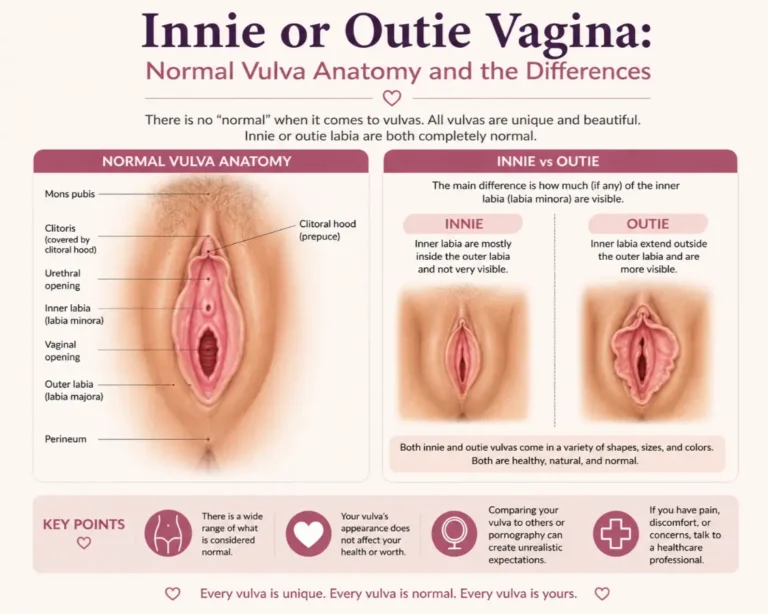
Innie or outie vagina is a common search term, but it is not medically accurate. Most people actually mean the vulva, which is the outside part of the female genital area. The vagina is the internal canal. Every vulva looks different, and these natural differences are completely normal.
Some people have inner lips that stay inside the outer lips. Others have inner lips that extend beyond them. Both appearances are healthy in most cases. Learning about normal anatomy can reduce worry and improve body confidence. This guide explains the differences in simple language. You will also learn common myths, everyday examples, and when it may be helpful to speak with a healthcare professional.
Quick Summary
What Does “Innie or Outie Vagina” Mean?
- The term usually refers to the vulva, not the vagina.
- An “innie” vulva has inner labia that are mostly hidden.
- An “outie” vulva has inner labia that extend beyond the outer labia.
- Both are normal and healthy variations.
- Vulva appearance varies from person to person.
- Size, shape, and color naturally differ.
- Appearance alone does not indicate health or sexual function.
Featured Snippet Answer
Is an Innie or Outie Vagina Normal?
Yes. Both “innie” and “outie” vulva appearances are normal. The terms describe how the inner labia look compared with the outer labia. They are not medical diagnoses. Every person’s vulva has unique features, and natural variation is common. If you have pain, sores, swelling, or sudden changes, consult a qualified healthcare professional.
What Does “Innie or Outie” Mean?
These terms are informal descriptions.
An innie usually means the inner labia (labia minora) are mostly covered by the outer labia (labia majora).
An outie usually means the inner labia extend beyond the outer labia.
Neither term describes a medical condition.
Key Facts
| Feature | Innie | Outie |
|---|---|---|
| Inner labia | Mostly hidden | Extend beyond outer labia |
| Medical concern | Usually none | Usually none |
| Common variation | Yes | Yes |
| Affects health | No | No |
Understanding Vulva Anatomy
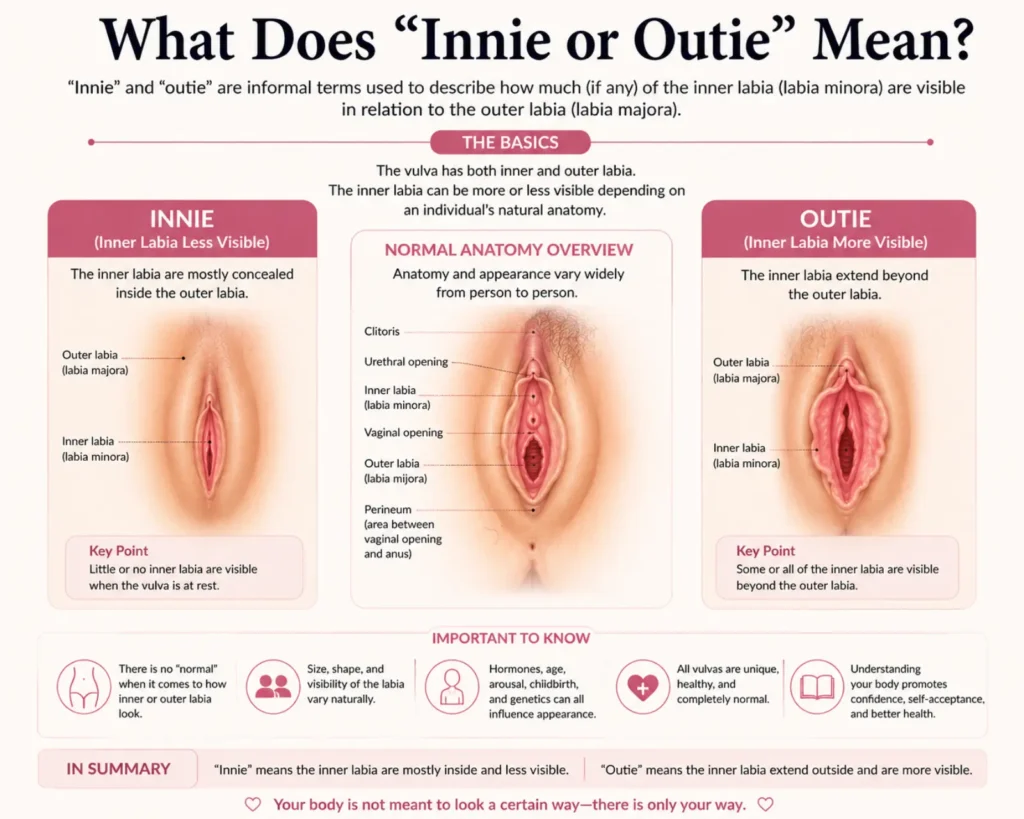
The vulva is the external part of the female genital area.
It includes several structures.
- Labia majora (outer lips)
- Labia minora (inner lips)
- Clitoris
- Urethral opening
- Vaginal opening
The vagina is different. It is the internal muscular canal that connects the vulva to the cervix.
Knowing this difference helps you understand your body more accurately.
Why Do Vulvas Look Different?
Every person’s body develops differently.
Genetics play a major role.
Hormones also influence growth during puberty.
Other normal factors include:
- Age
- Hormonal changes
- Pregnancy
- Childbirth
- Natural aging
These differences create a wide range of healthy appearances.
Is One Better Than the Other?
No.
An innie vulva is not healthier than an outie vulva.
Likewise, an outie vulva is not abnormal.
Neither appearance affects:
- Fertility
- Menstruation
- Urination
- Sexual function
- Personal hygiene
Health depends on how your body functions, not how it looks.
Real-Life Examples
Everyday examples show how much normal variation exists.
Example 1
One person has inner labia that remain inside the outer labia.
This is commonly described as an innie.
Example 2
Another person has inner labia that extend beyond the outer labia.
This is commonly described as an outie.
Example 3
Some people have one inner labium longer than the other.
This asymmetry is also common and usually normal.
These examples show that there is no single “correct” appearance.
Innie vs Outie Vulva Comparison
| Feature | Innie | Outie |
| Appearance | Inner labia mostly covered | Inner labia more visible |
| Normal variation | Yes | Yes |
| Medical problem | Usually no | Usually no |
| Needs treatment | No | No |
| Affects health | No | No |
| Common among adults | Yes | Yes |
The most important point is that healthy vulvas come in many shapes, sizes, and colors.
Common Myths About Innie and Outie Vulvas
Many myths exist about vulva appearance. These myths can create unnecessary worry.
Myth 1: An Outie Vulva Is Not Normal
This is false.
An outie vulva is a common and healthy variation.
Myth 2: An Innie Vulva Is Cleaner
No evidence supports this claim.
Good hygiene matters more than appearance.
Myth 3: Appearance Affects Fertility
The size or shape of the labia does not affect fertility.
Healthy reproductive organs matter, not vulva appearance.
Myth 4: Everyone Should Look the Same
Every body is unique.
Healthy vulvas come in many shapes, sizes, and colors.
Daily Care Tips for a Healthy Vulva
Simple habits help keep the vulva healthy.
- Wash the external area with warm water.
- Avoid harsh soaps or scented products.
- Wear clean, breathable cotton underwear.
- Change out of wet clothing promptly.
- Wipe from front to back after using the toilet.
- Practice safer sex by using protection when appropriate.
- Attend routine gynecological checkups as recommended.
The vagina cleans itself naturally. Internal washing or douching is usually unnecessary and may disrupt its natural balance.
When Should You See a Healthcare Professional?
Most differences in vulva appearance are normal.
However, you should seek medical advice if you notice:
- Severe or persistent pain
- Unusual swelling
- Sores or ulcers
- Heavy bleeding unrelated to menstruation
- A new lump or growth
- Persistent itching
- Foul-smelling or unusual discharge
- Sudden changes in appearance with pain
These symptoms may have many possible causes and deserve professional evaluation.
Common Mistakes People Make
People often misunderstand normal anatomy.
Avoid these common mistakes.
Mistake 1: Comparing Yourself to Online Images
Many online images do not represent the full range of normal anatomy.
Mistake 2: Thinking Symmetry Is Required
It is common for one side of the inner labia to be longer than the other.
Mistake 3: Using the Word “Vagina” for the Entire Area
The vagina is internal.
The vulva is the external genital area.
Using the correct terms improves understanding.
Mistake 4: Assuming Appearance Equals Health
A healthy vulva can look many different ways.
Appearance alone cannot diagnose a medical condition.
Related Terms and LSI Keywords
Using related terms helps readers understand the topic.
Examples include:
- vulva anatomy
- labia minora
- labia majora
- normal vulva appearance
- vulva variations
- female external anatomy
- healthy vulva
- vulva shapes
- labial anatomy
- reproductive anatomy
- gynecological health
- intimate health education
Expert Insight
Healthcare professionals agree that there is no single “normal” vulva appearance.
Medical research shows wide natural variation in:
- Labia size
- Labia shape
- Skin color
- Skin texture
- Symmetry
Understanding these differences can reduce unnecessary anxiety and encourage body confidence.
If you ever have concerns about pain, discomfort, or sudden changes, a qualified healthcare professional can provide an accurate assessment.
Frequently Asked Questions
Is an outie vulva normal?
Yes. Many healthy people have an outie vulva. It is a natural variation.
Is an innie vulva more common?
Both innie and outie vulvas are common. There is no single standard appearance.
Can puberty change vulva appearance?
Yes. Hormonal changes during puberty can affect the size and shape of the labia.
Does childbirth change the vulva?
Pregnancy and childbirth can change the appearance of the vulva. These changes are often normal.
Does vulva appearance affect sexual health?
No. Appearance alone does not determine sexual health or function.
Can one inner labia be longer than the other?
Yes. Mild asymmetry is very common and usually normal.
Should I worry if my vulva looks different?
Not usually. Healthy vulvas vary greatly. Seek medical advice only if you have pain, sores, unusual swelling, or other concerning symptoms.
Conclusion
The phrase “innie or outie vagina” usually refers to differences in the appearance of the vulva, not the vagina itself. Both innie and outie vulvas are normal, healthy variations of human anatomy. Genetics, hormones, age, and life events all contribute to these natural differences. There is no ideal shape, size, or appearance that defines a healthy vulva.
Instead of comparing yourself with others, focus on your overall health and comfort. If you experience pain, persistent itching, sores, unusual discharge, or sudden changes, consult a qualified healthcare professional. Understanding normal anatomy can improve confidence, reduce unnecessary worry, and help you make informed decisions about your health.