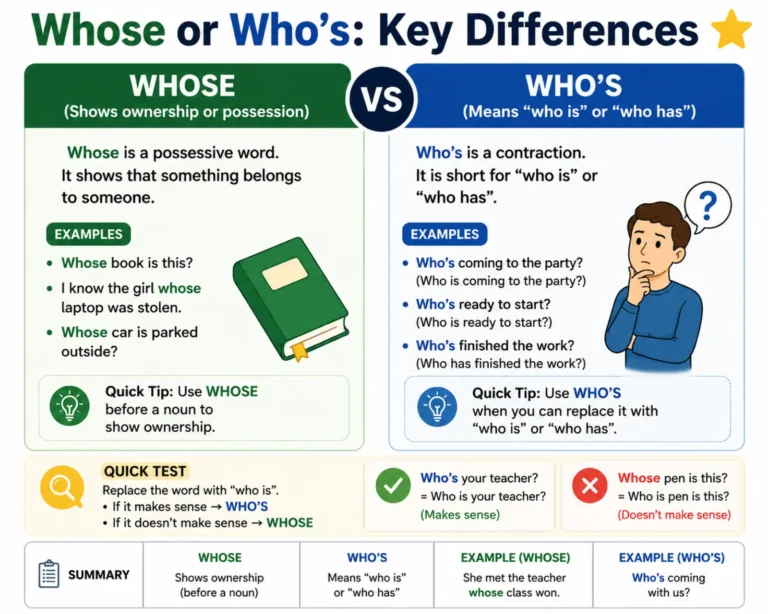
Whose or who’s is one of the most common grammar questions in English. Many people mix these two words because they sound the same. However, they have different meanings and uses.
The good news is that the difference is easy to learn. Once you know one simple rule, you will rarely make this mistake again.
In this guide, you will learn the meaning of whose and who’s, see clear examples, compare both words, and avoid common errors. You will also discover useful grammar tips and answers to common questions.
By the end of this article, you will know exactly when to use whose and when to use who’s with confidence.
Quick Summary Box
- Whose shows ownership or possession.
- Who’s is the short form of who is or who has.
- Use whose before a noun.
- Replace who’s with who is to test your sentence.
- They sound the same but have different meanings.
- Remember: Ownership = whose. Contraction = who’s.
What Does “Whose” Mean?
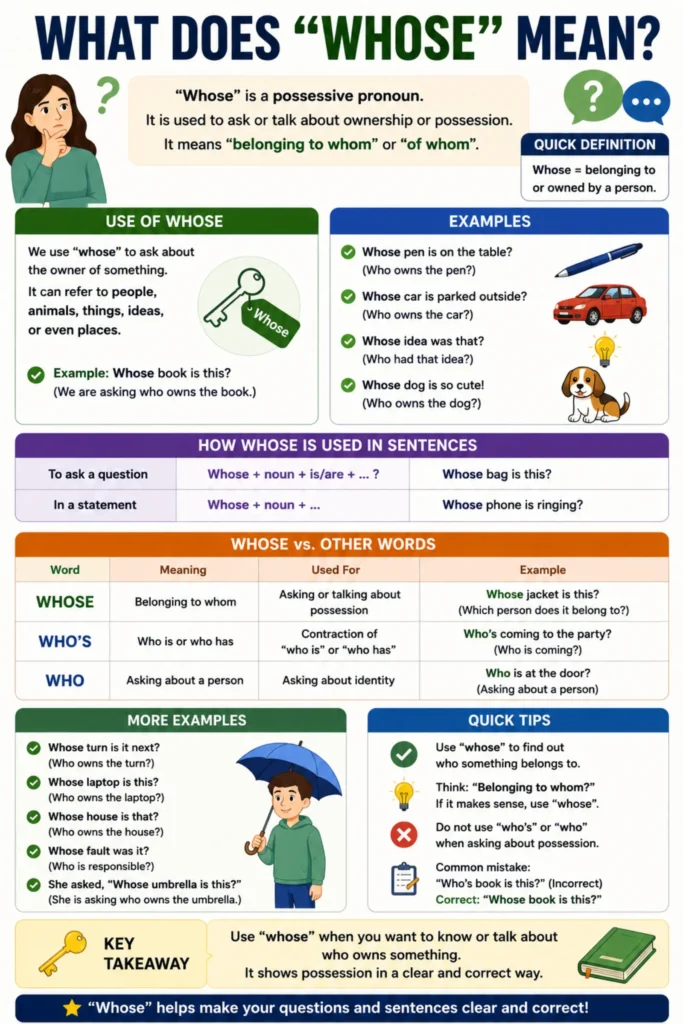
Whose is a possessive pronoun and determiner. It shows that something belongs to someone.
Simple definition
Whose = belonging to whom
Examples
- Whose book is on the table?
- I know the student whose laptop was stolen.
- Whose shoes are these?
- She met the teacher whose class won the award.
In each example, whose shows ownership.
What Does “Who’s” Mean?
Who’s is a contraction.
It means:
- Who is
- Who has
Examples
- Who’s coming to dinner?
- Who’s ready to begin?
- Who’s finished the project?
- Who’s calling me?
You can replace who’s with who is or who has. If the sentence still makes sense, who’s is correct.
Whose or Who’s: The Main Difference
The easiest way to remember the difference is this:
| Feature | Whose | Who’s |
|---|---|---|
| Meaning | Shows ownership | Means who is or who has |
| Grammar | Possessive pronoun | Contraction |
| Used Before | Noun | Verb or adjective |
| Example | Whose car is this? | Who’s driving? |
| Replacement Test | Cannot replace | Replace with “who is” |
How to Remember the Difference
A simple trick helps most learners.
Use this test
If you can replace the word with who is, use who’s.
Example:
Who’s your teacher?
Who is your teacher?
It works.
Now try:
Whose bag is this?
Who is bag is this?
That does not work.
So the correct word is whose.
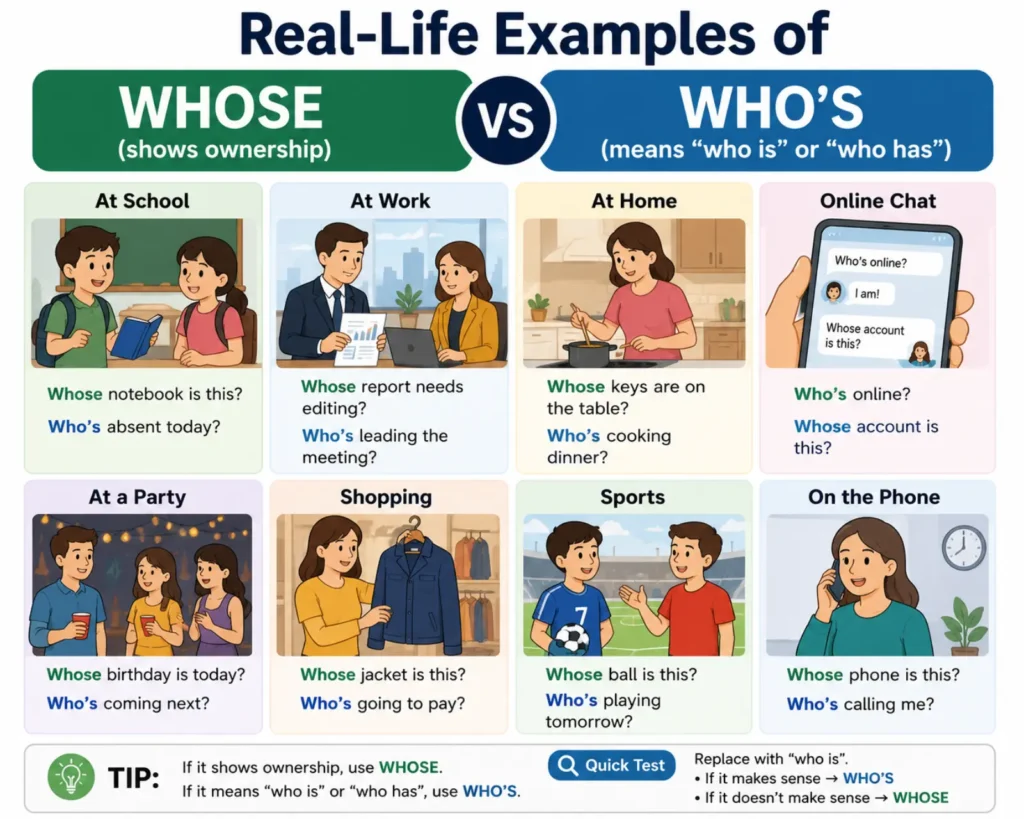
Real-Life Examples of Whose and Who’s
Here are common situations where people use these words.
At school
Correct:
- Whose notebook is missing?
- Who’s absent today?
At work
Correct:
- Whose report needs editing?
- Who’s leading the meeting?
At home
Correct:
- Whose keys are on the table?
- Who’s cooking dinner?
Online
Correct:
- Who’s posting today?
- Whose account is this?
Common Mistakes People Make
Many writers confuse these words because they sound identical.
Incorrect
Who’s jacket is this?
Correct
Whose jacket is this?
Incorrect
Whose coming with us?
Correct
Who’s coming with us?
Incorrect
Whose your favorite singer?
Correct
Who’s your favorite singer?
Incorrect
I know who’s backpack this is.
Correct
I know whose backpack this is.
Grammar Rules You Should Know
Follow these simple rules.
Rule 1
Use whose for ownership.
Example:
Whose phone rang?
Rule 2
Use who’s for who is.
Example:
Who’s waiting outside?
Rule 3
Use who’s for who has.
Example:
Who’s finished the assignment?
Rule 4
Never use an apostrophe to show possession with whose.
Everyday Uses of Whose and Who’s
You will see these words in many situations.
Emails
- Who’s available tomorrow?
- Whose file is attached?
Text messages
- Who’s online?
- Whose turn is it?
Social media
- Who’s live now?
- Whose video is trending?
School assignments
- Whose answer is correct?
- Who’s presenting first?
Tips to Never Confuse Whose and Who’s
Remember these easy tips.
- Think about ownership first.
- Use the who is test.
- Read your sentence aloud.
- Practice with simple examples.
- Watch for the apostrophe.
- Proofread before publishing.
These habits reduce grammar mistakes.
Synonyms and Related Grammar Terms
Although whose and who’s have specific meanings, these related grammar terms help you understand the topic better.
Related keywords
- who is
- who has
- possessive pronouns
- possessive determiners
- English grammar
- grammar rules
- contractions
- apostrophe rules
- common grammar mistakes
- English writing tips
- grammar checker
- punctuation rules
- possessive words
These terms often appear in grammar guides and search results.
Expert Insights: Why This Grammar Rule Matters
Good grammar builds trust.
Readers notice small mistakes. Search engines also reward helpful and well-written content.
Using whose and who’s correctly makes your writing look more professional.
Whether you write emails, blogs, school papers, or business documents, correct grammar improves communication.
Professional editors recommend learning common word pairs because they reduce writing errors and increase reader confidence.
Small improvements create a stronger writing style over time.
Practice Sentence
Choose the correct word.
- _____ backpack is this?
- _____ going to the party?
- I know the person _____ dog escaped.
- _____ finished the report?
- _____ phone keeps ringing?
Answers
- Whose
- Who’s
- Whose
- Who’s
- Whose
Practice helps you remember the rule.
(FAQs)
Is whose the same as who’s?
No. Whose shows ownership. Who’s means who is or who has.
How do I know which one to use?
Replace who’s with who is. If the sentence still makes sense, use who’s.
Does whose need an apostrophe?
No. Whose never uses an apostrophe.
Can who’s mean who has?
Yes. It can stand for who has.
Example:
Who’s completed the task?
Why do people confuse whose and who’s?
They sound exactly alike. They are homophones.
Is whose a possessive pronoun?
Yes. It shows ownership.
Can whose refer to things?
Yes. It can refer to people, animals, and sometimes things.
Example:
The company whose products are popular.
Is this mistake common in English?
Yes. Even experienced writers sometimes confuse these words.
Conclusion
Understanding whose or who’s is easier than many people think. The key difference is simple. Whose shows ownership, while who’s means who is or who has. One quick replacement test can help you choose the correct word every time.
The more you practice, the more natural this grammar rule becomes. Correct usage improves your writing, makes your message clearer, and builds confidence in both academic and professional communication.
Keep this simple rule in mind whenever you write. Soon, choosing between whose and who’s will become second nature.