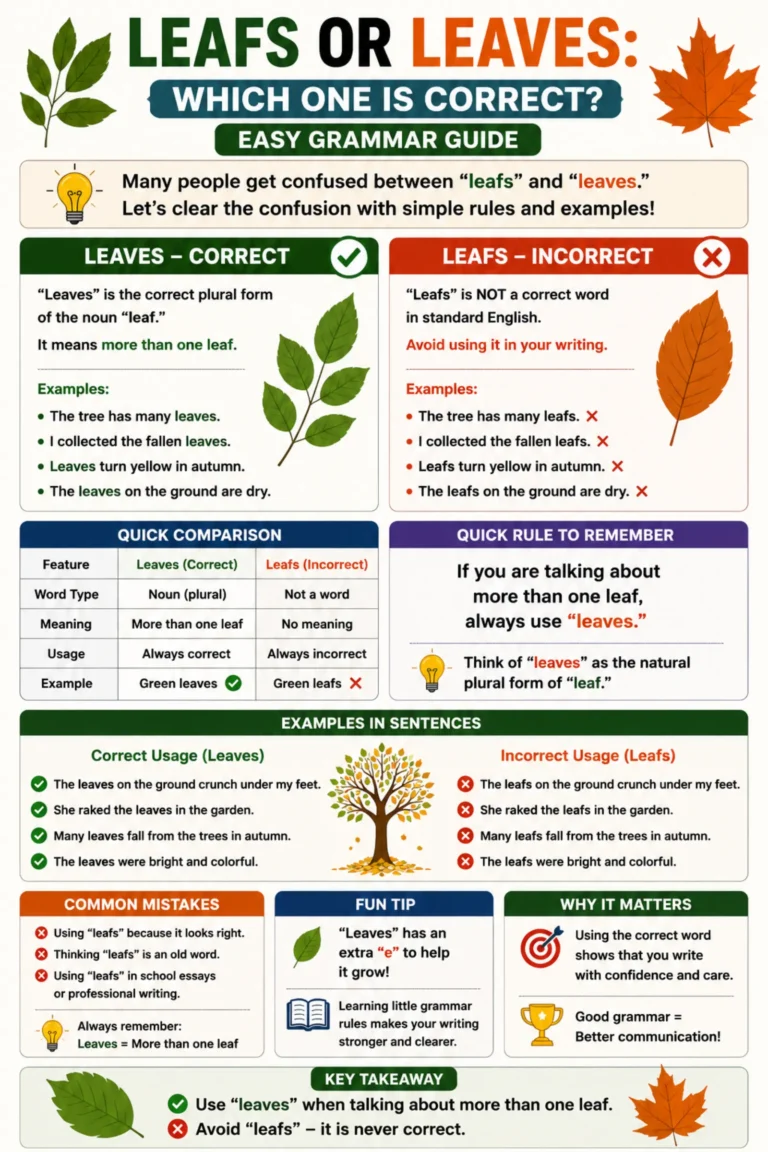
Leafs or leaves is a question many English learners and writers ask. The two words look similar, but they do not always mean the same thing. In most cases, leaves is the correct plural form of leaf. However, leafs is also a real English word. It appears in a few special situations.
Knowing the difference helps you avoid common grammar mistakes. It also makes your writing clearer and more professional. Whether you are writing for school, work, or a blog, using the correct word matters. This guide explains the rules in simple English. You will also see real-life examples, helpful tips, and easy ways to remember the difference. By the end, you will know exactly when to use leafs and when to use leaves with confidence.
Quick Summary Box
- Leaf means one flat green part of a plant.
- Leaves is the correct plural of leaf.
- Leafs is correct only in specific situations.
- Use leaves when talking about trees and plants.
- Use leafs as a verb meaning “turns pages quickly.”
- Toronto Maple Leafs is an official team name.
- Remember: Trees have leaves. People leaf through books.
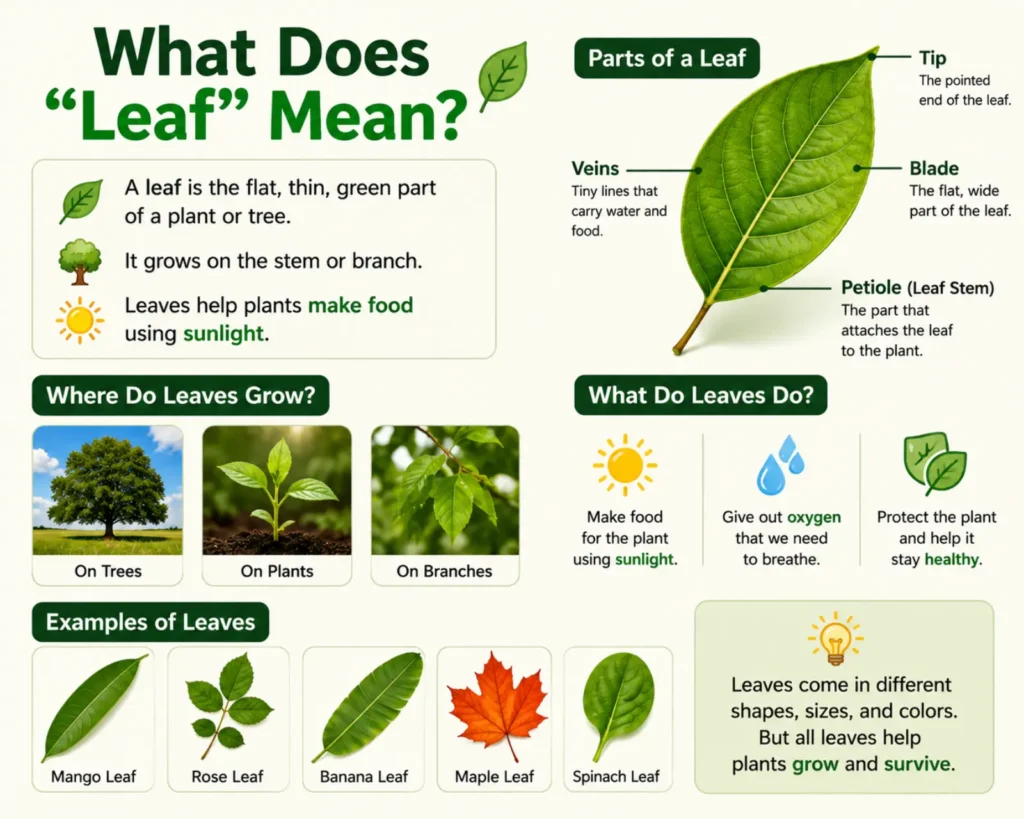
What Does “Leaf” Mean?
A leaf is one of the flat, green parts of a plant or tree. Leaves collect sunlight and help plants make food. Without healthy leaves, most plants cannot grow well.
The word leaf is a noun. It usually refers to nature, gardening, forests, flowers, or crops. People also use the word in science, education, and everyday conversations.
Examples of “Leaf”
- A leaf fell from the tree.
- This leaf has tiny holes.
- I found a large green leaf in the garden.
- The leaf changed color during autumn.
- Every leaf on the plant looks healthy.
In all these examples, leaf refers to only one plant part.
Leafs or Leaves: What Is the Difference?
The main difference is simple. Leaves is the normal plural form of leaf, while leafs has limited uses.
Most people only need leaves in daily writing. You will see it in books, newspapers, websites, and school lessons. The word leafs appears much less often.
Here is an easy comparison.
| Feature | Leaves | Leafs |
|---|---|---|
| Correct plural of leaf | ✅ Yes | ❌ No |
| Used for trees and plants | ✅ Yes | ❌ No |
| Used in everyday writing | ✅ Very common | ❌ Rare |
| Verb meaning “turns pages” | ❌ No | ✅ Yes |
| Official sports team name | ❌ No | ✅ Yes |
Quick Rule
Use leaves when talking about more than one leaf.
Use leafs only when someone quickly turns the pages of a book or when referring to the official name Toronto Maple Leafs.
Why Is the Plural “Leaves” Instead of “Leafs”?
English has many plural rules. Most nouns simply add -s or -es.
For example:
- Book → Books
- Chair → Chairs
- Apple → Apples
However, some nouns ending in -f or -fe follow a different rule. They change f into ves.
Examples include:
| Singular | Plural |
| Leaf | Leaves |
| Wolf | Wolves |
| Knife | Knives |
| Shelf | Shelves |
| Life | Lives |
| Calf | Calves |
This spelling rule developed over many years as English changed. Today, people simply learn these words as irregular plurals.
Still, not every word ending in f changes to ves.
For example:
- Roof → Roofs
- Chief → Chiefs
- Belief → Beliefs
- Proof → Proofs
Because English has many exceptions, learners often confuse leafs and leaves.
When Should You Use “Leaves”?
Use leaves whenever you mean more than one leaf on a plant or tree. This is the correct choice in almost every situation.
Everyday Examples
- The leaves are falling from the trees.
- Green leaves cover the forest floor.
- Autumn leaves create beautiful colors.
- The wind blew the leaves across the road.
- Healthy leaves help plants grow faster.
Nature Example
Imagine you visit a park during fall. Red, orange, and yellow leaves cover the ground. You would never say “autumn leafs.” The correct phrase is “autumn leaves.”
Gardening Example
A gardener may say:
- Remove the damaged leaves.
- Water the plant if the leaves look dry.
- Bright green leaves show healthy growth.
These examples all use the correct plural form.
When Should You Use “Leafs”?
Although uncommon, leafs is still a correct English word.
It has two main uses.
1. As a Verb
The verb leaf means to turn the pages of a book, magazine, notebook, or newspaper quickly.
When used with he, she, or it, the verb becomes leafs.
Examples
- She leafs through a magazine every weekend.
- He leafs through the newspaper before breakfast.
- My teacher leafs through the reports before class.
- The librarian leafs through old books with care.
Notice that leafs is not a plural noun here. It is a verb.
2. As an Official Team Name
One famous exception is the Toronto Maple Leafs, a professional hockey team.
The team kept the spelling Leafs instead of Leaves because it is part of its official name and history.
Examples:
- The Toronto Maple Leafs won the game.
- Many fans support the Toronto Maple Leafs every season.
Outside these situations, you should almost always use leaves instead of leafs.
Real-Life Examples of Leafs and Leaves
Learning grammar becomes easier when you see real examples. The sentences below show how each word works in different situations.
Example 1: In Nature
A family visits a park in autumn. Colorful leaves cover the ground. Children collect red, yellow, and orange leaves for a school project.
Correct: The children picked up beautiful leaves.
Incorrect: The children picked up beautiful leafs.
Example 2: At School
A student opens a textbook before class. He quickly checks one chapter.
Correct: He leafs through the textbook before the lesson starts.
Example 3: In the Garden
A gardener checks the plants every morning.
- The leaves look healthy.
- The leaves are bright green.
- Some leaves need more water.
Example 4: Reading a Magazine
A woman waits for her appointment. She quickly looks at a magazine.
Correct: She leafs through the magazine while waiting.
These examples show that leaves usually refers to plants, while leafs is mainly used as a verb.
Common Mistakes People Make
Many English learners make the same mistakes. Fortunately, they are easy to fix.
Mistake 1: Using “Leafs” as the Plural
❌ The tree has many leafs.
✅ The tree has many leaves.
Mistake 2: Using “Leaves” as a Verb
❌ She leaves through the magazine.
✅ She leafs through the magazine.
Remember that leaves is also the verb form of leave, which has a completely different meaning.
Example:
- She leaves the office at 5 p.m.
This sentence uses the verb leave, not the noun leaf.
Mistake 3: Forgetting the Special Team Name
Some people write:
❌ Toronto Maple Leaves
The official name is:
✅ Toronto Maple Leafs
Proper names always keep their official spelling.
Easy Tips to Remember the Difference
You do not need to memorize many grammar rules. Use these simple tricks instead.
- Trees grow leaves.
- Plants have leaves.
- Readers leaf through books.
- Writers leaf through notebooks.
- The hockey team is the Toronto Maple Leafs.
Another easy memory trick is this:
If you can touch a tree, use “leaves.” If you can turn pages, use “leafs.”
Simple memory tricks help you avoid mistakes while writing.
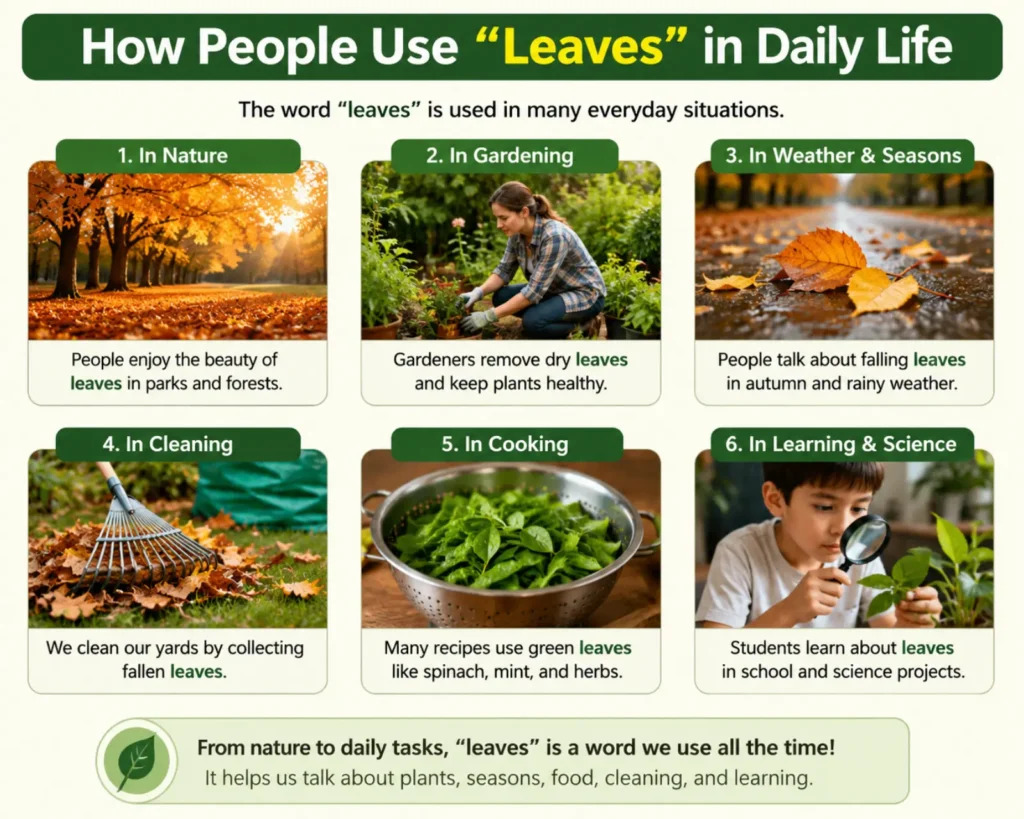
How People Use “Leaves” in Daily Life
The word leaves appears in many everyday situations.
You may hear it when people talk about:
- Gardening
- Nature
- Weather
- Science
- Farming
- Forests
- School lessons
Daily Examples
- Wet leaves can make roads slippery.
- The leaves change color every fall.
- Birds build nests behind large leaves.
- Healthy leaves help plants grow.
- We cleaned the leaves from our yard.
Since plants are everywhere, leaves is much more common than leafs.
Synonyms and Related Keywords
Using related words helps readers understand your content better. It also improves SEO by covering similar search terms.
Synonyms for Leaves
- Foliage
- Greenery
- Plant foliage
- Tree foliage
- Plant growth
Related Search Terms
- leaf plural
- plural of leaf
- leaf vs leaves
- leafs meaning
- leaves meaning
- grammar rules for leaf
- English plural nouns
- when to use leaves
- when to use leafs
- irregular plural nouns
- leaf grammar rule
- leaf plural examples
These related keywords naturally support the main keyword without overusing it.
Expert Insights
Small grammar mistakes can affect how readers see your writing. Choosing the correct word shows attention to detail and improves clarity.
Most grammar experts recommend learning common irregular plurals instead of guessing. The word leaf follows the same pattern as knife, wolf, and shelf. Once you know that rule, remembering leaves becomes much easier.
If you write articles, emails, school assignments, or business documents, using the correct plural helps your writing look more professional. It also builds trust with your readers.
(FAQs)
Is it “leafs” or “leaves”?
Leaves is the correct plural of leaf. Leafs is only correct as a verb or in specific proper names.
Why is the plural of leaf “leaves”?
Many English words ending in -f change to -ves when they become plural.
Is “leafs” a real English word?
Yes. It is the third-person singular form of the verb leaf, meaning to turn pages quickly.
Can I write “tree leafs”?
No. The correct phrase is tree leaves.
Why is it Toronto Maple Leafs instead of Toronto Maple Leaves?
The team chose Leafs as its official name. Proper names do not always follow normal grammar rules.
Is “leaves” also a verb?
Yes. Leaves can be the verb form of leave.
Example:
- She leaves home early every morning.
This meaning is different from the plural noun leaves.
Which form appears more often?
Leaves is far more common because people often talk about plants, trees, and nature.
conclusion
The difference between leafs or leaves is simple once you know the grammar rule. Leaves is the correct plural form of leaf and should be used whenever you talk about plants, trees, or nature. The word leafs is correct only in special situations. It works as a verb that means turning pages quickly, and it also appears in the official name Toronto Maple Leafs.
A simple memory trick makes the rule easy to remember. Trees have leaves, but readers leaf through books. This sentence helps you choose the right word every time. By learning this small grammar rule, you can avoid common mistakes and write with more confidence. Whether you are a student, writer, or English learner, using leafs and leaves correctly will make your writing clearer, more accurate, and more professional.