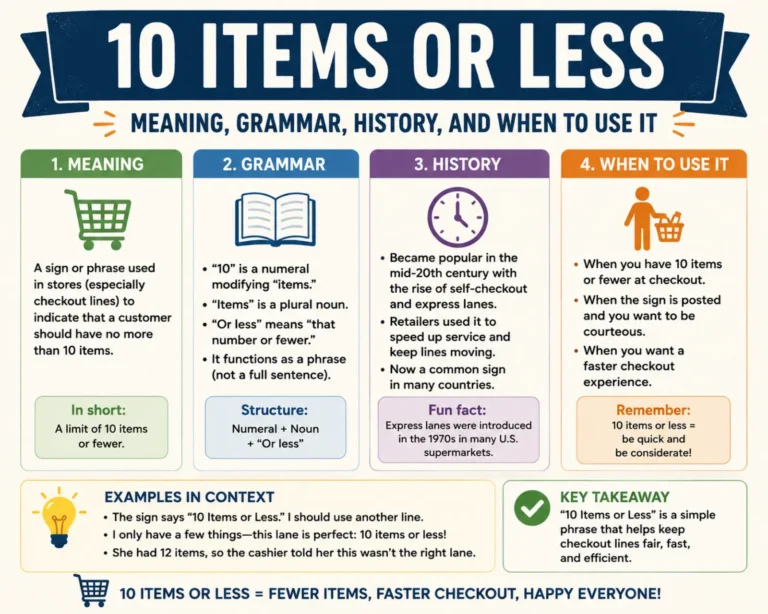
10 items or less is a common sign you see in supermarkets and grocery stores. It tells shoppers that a checkout lane is only for customers with a small number of items. Many people wonder if the phrase is grammatically correct. Some believe the sign should say “10 items or fewer.” Others think “10 items or less” is acceptable because it has become a common expression.
This guide explains the meaning, grammar, history, and everyday use of the phrase. You will also learn why stores choose this wording and how it compares with “10 items or fewer.” By the end, you will understand both the language rule and the practical reason behind this familiar checkout sign.
Quick Summary
What Does “10 Items or Less” Mean?
- It refers to checkout lanes for customers with ten or fewer products.
- The sign helps speed up the checkout process.
- It is common in supermarkets worldwide.
- Many grammar experts prefer “10 items or fewer.”
- Retail stores still widely use “10 items or less.”
- Both phrases are easy for shoppers to understand.
What Does “10 Items or Less” Mean?
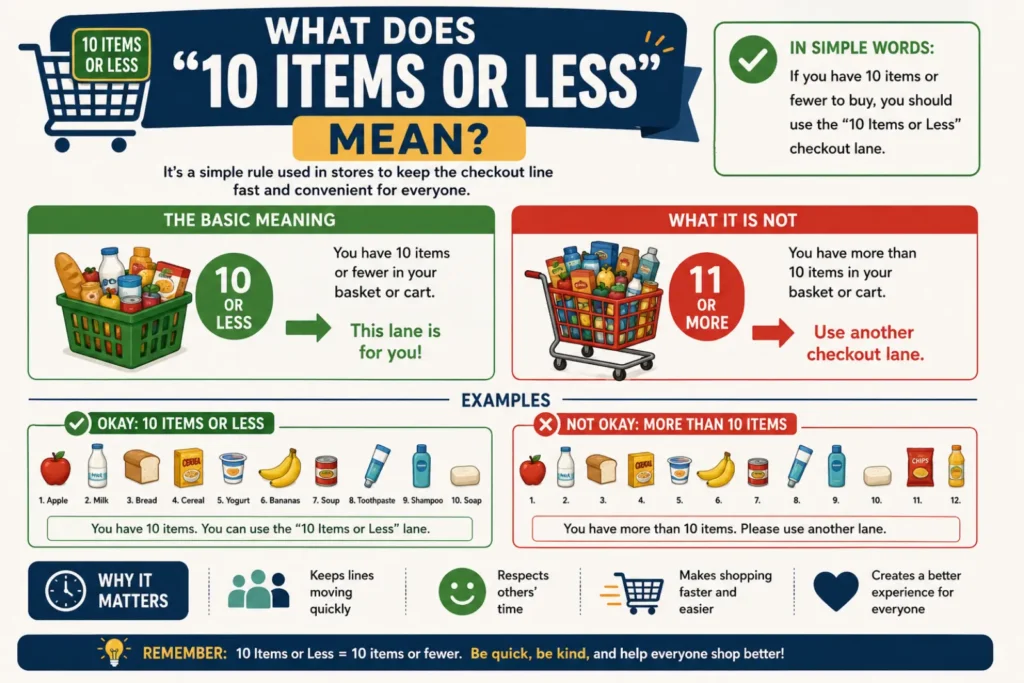
The phrase appears on signs in grocery stores and supermarkets.
It tells customers that the checkout lane is for small purchases.
If you have ten items or fewer, you may use the lane.
If you have more than ten items, you should choose another checkout line.
The goal is simple.
The lane helps shoppers finish their purchases faster.
Why Do Stores Use “10 Items or Less”?
Retail stores want to reduce waiting times.
Customers with only a few products can check out quickly.
This improves customer satisfaction.
It also keeps checkout lines moving smoothly.
Many stores choose the shorter phrase because it fits easily on signs.
Simple wording is also easier to read while shopping.
Is “10 Items or Less” Grammatically Correct?
This question creates many debates.
Traditional grammar says you should use fewer for things you can count.
You should use less for things you cannot count.
For example:
- Fewer apples
- Fewer books
- Less water
- Less milk
Since items are countable, many grammar experts recommend saying:
10 items or fewer
However, language changes over time.
The phrase 10 items or less has become common in everyday English.
Many dictionaries and style guides accept it as a fixed retail expression.
The Difference Between “Less” and “Fewer”
Understanding these two words makes the rule easier.
| Less | Fewer |
|---|---|
| Used with uncountable nouns | Used with countable nouns |
| Less water | Fewer bottles |
| Less sugar | Fewer cookies |
| Less time | Fewer people |
| Less money | Fewer cars |
Easy Rule
Ask yourself one question.
Can you count it?
If yes, use fewer.
If no, use less.
Why Has “10 Items or Less” Become So Popular?
The phrase has appeared in stores for many decades.
Millions of shoppers see it every day.
Because people hear and read it often, the wording feels natural.
Businesses also prefer short, clear signs.
Customers understand the meaning immediately.
That is more important than perfect grammar in many retail settings.
History of the Phrase
Checkout lanes became popular as supermarkets grew larger.
Stores wanted a faster option for customers with only a few products.
Special express lanes solved this problem.
Many early stores used signs reading 10 items or less.
The wording spread to supermarkets around the world.
Today, both versions appear in different stores.
Some stores now use:
- Express Lane
- Quick Checkout
- Basket Lane
- 10 Items or Fewer
- 10 Items or Less
All of these signs have the same purpose.
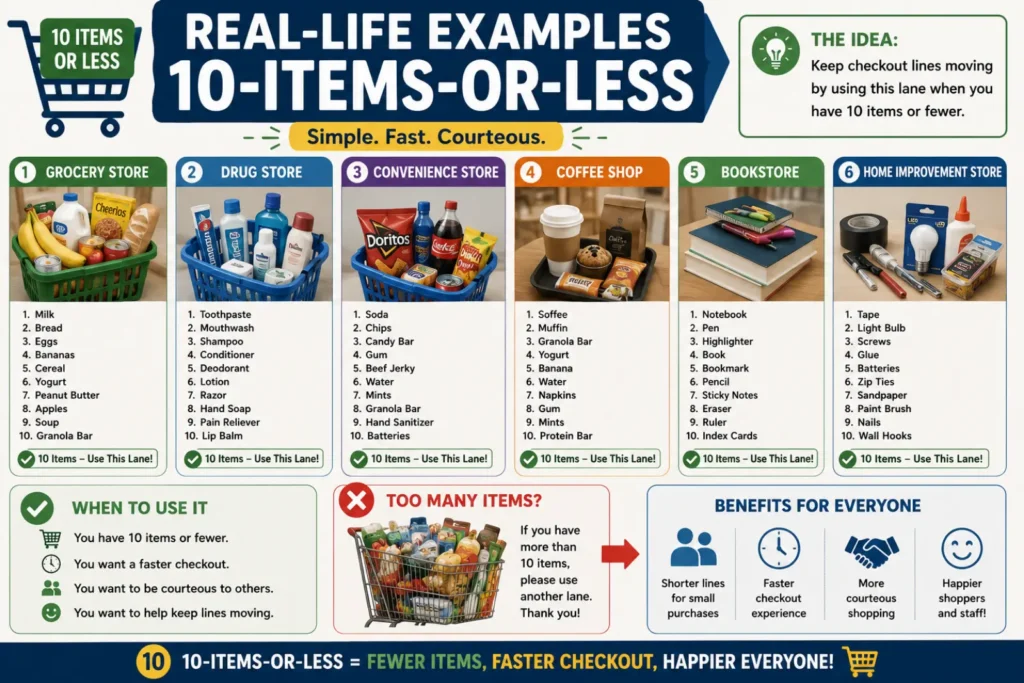
Real-Life Examples
You probably see this phrase during everyday shopping.
Here are some common situations.
Grocery Store
buy bread, milk, eggs, and fruit.
You have only six items.
You use the 10 items or less lane.
Convenience Store
You purchase a drink and a snack.
The express lane helps you leave quickly.
Pharmacy
You buy toothpaste, medicine, and shampoo.
Since you have only three items, you use the faster checkout.
These examples show why express lanes improve shopping experiences.
Benefits of Express Checkout Lanes
Stores and shoppers both benefit.
For Customers
- Shorter waiting times
- Faster shopping trips
- Less frustration
- Convenient service
For Stores
- Better customer flow
- Reduced congestion
- Improved customer satisfaction
- More efficient checkout process
This simple system saves time for everyone involved.
10 Items or Less vs 10 Items or Fewer
Many people ask which phrase is correct. The answer depends on whether you follow strict grammar rules or everyday usage.
| Feature | 10 Items or Less | 10 Items or Fewer |
|---|---|---|
| Grammar | Informal but widely accepted | Grammatically correct |
| Everyday Use | Very common | Common |
| Found on Store Signs | Yes | Yes |
| Easy to Read | Yes | Yes |
| Preferred by Grammar Experts | No | Yes |
| Clear to Customers | Yes | Yes |
Which One Should You Use?
If you are writing a formal document, use 10 items or fewer.
If you are talking about supermarket signs or common expressions, 10 items or less is perfectly understandable and widely recognized.
Common Mistakes
Many people make simple mistakes when using these phrases.
Mistake 1: Using “Less” in Formal Writing
In formal English, use fewer with things you can count.
Correct: 10 items or fewer
Mistake 2: Correcting Store Signs Automatically
Not every sign follows strict grammar rules.
Businesses often choose phrases that are familiar and easy to read.
Mistake 3: Thinking “10 Items or Less” Is Wrong
The phrase is common in everyday English.
Many dictionaries and language experts recognize it as a fixed retail expression.
Tips for Using the Phrase Correctly
These simple tips can help you choose the right wording.
For School or Professional Writing
Use fewer with countable nouns.
Example:
- Fewer books
- Fewer chairs
- Fewer customers
For Everyday Conversations
Either phrase usually works because most people understand the meaning.
When Talking About Store Signs
Use the wording that appears on the sign.
There is no need to “correct” the store unless you are discussing grammar.
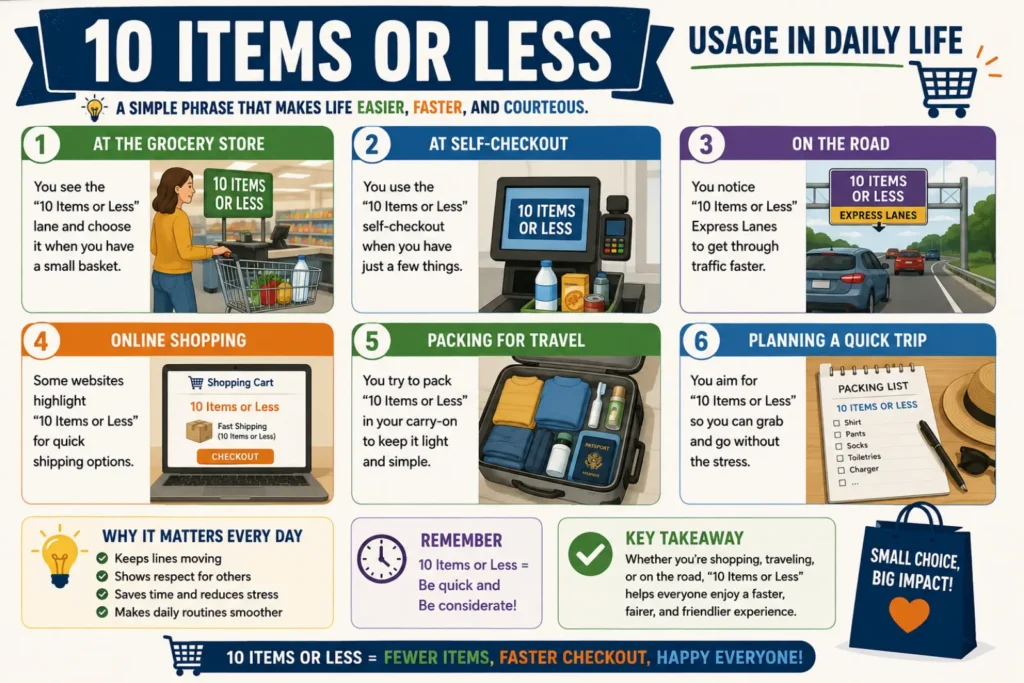
Usage in Daily Life
The phrase appears in many shopping situations.
You may notice it at:
- Grocery stores
- Supermarkets
- Convenience stores
- Discount retailers
- Pharmacies
- Self-checkout areas
Some stores also use similar signs, such as:
- Express Checkout
- Fast Lane
- Quick Checkout
- Basket Only
- Self-Service Checkout
All of these signs help customers complete small purchases more quickly.
Similar Phrases and LSI Keywords
Using related terms helps readers understand the topic better.
Here are some common synonyms and semantic keywords:
- express checkout
- express lane
- checkout lane
- supermarket checkout
- grocery checkout
- quick checkout
- self-checkout lane
- shopping lane
- fewer vs less
- grammar rules
- countable nouns
- uncountable nouns
- retail signs
- supermarket signs
- express shopping
These terms naturally support the main keyword without keyword stuffing.
Expert Insight
Language changes over time.
Many grammar rules remain important, but everyday usage also shapes modern English.
The phrase 10 items or less shows how common expressions can become accepted through frequent use.
From a retail perspective, the sign succeeds because shoppers understand it immediately.
From a grammar perspective, 10 items or fewer follows the traditional rule for countable nouns.
Knowing both viewpoints helps you communicate more effectively in different situations.
Frequently Asked Questions
What does “10 items or less” mean?
It means the checkout lane is for customers with no more than ten items.
Is “10 items or less” grammatically correct?
Many grammar experts prefer 10 items or fewer, but 10 items or less is widely accepted in everyday English.
Why do stores use “less” instead of “fewer”?
The phrase is shorter, familiar, and easy for customers to understand.
Which is better: “10 items or less” or “10 items or fewer”?
Use 10 items or fewer in formal writing.
Use either phrase when discussing supermarket signs.
Why do supermarkets have express lanes?
Express lanes reduce waiting times for customers with only a few items.
Does every store use the same wording?
No.
Some stores use “Express Checkout,” while others use “10 Items or Less” or “10 Items or Fewer.”
Is “less” always wrong with countable nouns?
No.
Although “fewer” is usually preferred, some fixed expressions use “less” and remain widely accepted.
Can I use an express lane with exactly ten items?
Yes.
A lane marked “10 items or less” allows customers with ten items or fewer.
Conclusion
The phrase 10 items or less has become one of the most familiar signs in supermarkets around the world. It directs customers with small purchases to faster checkout lanes and improves the shopping experience. Although grammar experts often recommend 10 items or fewer, the phrase 10 items or less remains widely accepted because people instantly understand its meaning. Both expressions communicate the same idea, but their use depends on the situation. In formal writing, “fewer” is usually the better choice. In everyday conversations and retail settings, “10 items or less” continues to be a practical and recognizable expression. Understanding the difference helps you use both phrases with confidence.