Footnote before or after comma is a common question for students, researchers, and writers. Correct footnote placement makes your writing look professional and easy to read. Many style guides have clear rules about where to place footnote numbers. However, beginners often feel confused when commas, periods, quotation marks, and other punctuation appear in the same sentence.
The good news is that the rule is simple. In most writing styles, the footnote number comes after the comma. Learning this rule helps you avoid formatting mistakes in essays, reports, research papers, and books. This guide explains everything in simple English. You will also find examples, comparison tables, and helpful tips that make footnote placement easy to understand.
Quick Summary
Footnote Before or After Comma?
- A footnote usually comes after the comma.
- Most style guides follow this rule.
- The footnote number appears after punctuation.
- This makes writing cleaner and easier to read.
- Chicago style strongly recommends this placement.
- Always check your required style guide.
- Consistency is important throughout your document..
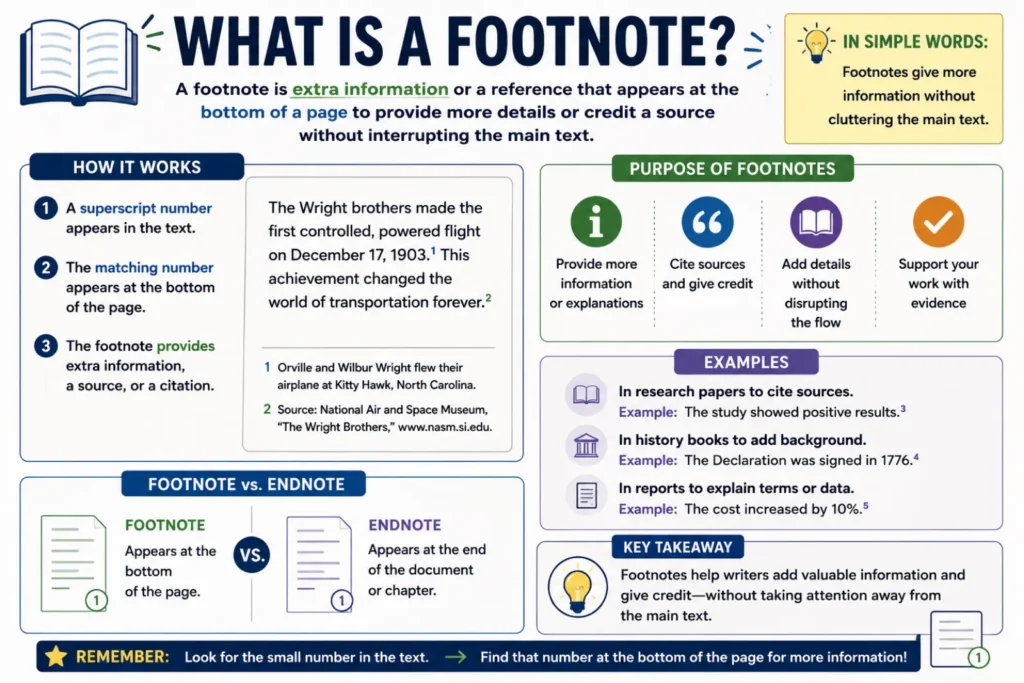
What Is a Footnote?
A footnote is a note placed at the bottom of a page.
It provides extra information without interrupting the main text.
Writers use footnotes to:
- Cite sources
- Add explanations
- Include additional facts
- Credit ideas
- Provide references
Footnotes are common in academic writing, books, legal documents, and research papers.
Why Does Footnote Placement Matter?
Correct footnote placement improves readability.
It also helps readers understand where supporting information belongs.
Incorrect placement can:
- Confuse readers
- Break formatting rules
- Lower academic marks
- Make writing appear unprofessional
Small punctuation details make a big difference in formal writing.
The General Rule for Footnote Placement
The basic rule is easy.
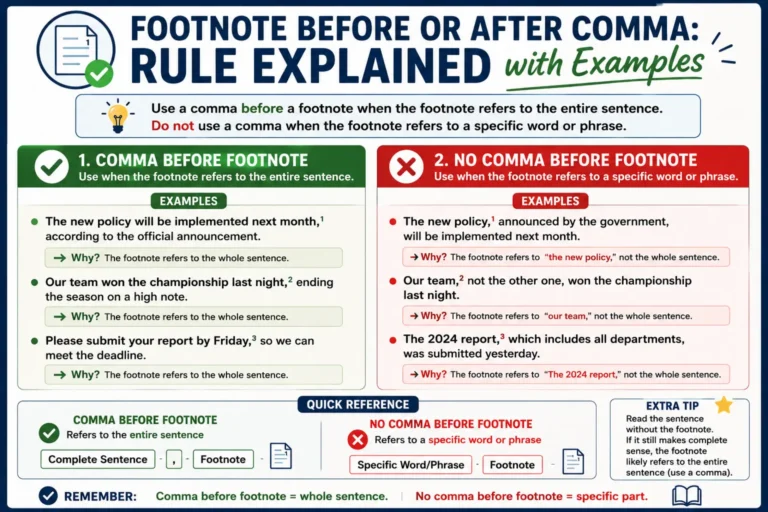
Place the footnote number after the comma.
Correct Example
The experiment produced reliable results,¹ which supported the hypothesis.
Incorrect Example
The experiment produced reliable results¹, which supported the hypothesis.
Most academic publishers and universities prefer the first example.
Why Does the Footnote Go After the Comma?
The footnote refers to the entire phrase or sentence.
The comma belongs to the sentence itself.
The citation should not interrupt normal punctuation.
Keeping punctuation first creates smoother reading.
It also follows standard publishing practices.
Style Guide Rules
Different writing styles have different citation systems.
However, footnote placement remains similar in most cases.
Chicago Manual of Style
Chicago style uses footnotes frequently.
Footnote numbers appear after punctuation.
Turabian Style
Turabian follows Chicago’s footnote rules.
Commas and periods come before the footnote number.
MLA Style
MLA mainly uses parenthetical citations.
When footnotes appear, they normally follow punctuation.
APA Style
APA rarely uses footnotes for citations.
Instead, it uses in-text citations.
If APA includes a footnote, the reference number usually follows punctuation.
Footnote Before or After Comma: Comparison Table
| Situation | Correct Placement | Incorrect Placement |
|---|---|---|
| After a comma | word,¹ | word¹, |
| After a period | sentence.¹ | sentence¹. |
| After a quotation | “quote.”¹ | “quote¹.” |
| After a semicolon | word;¹ | word¹; |
| After a colon | word:¹ | word¹: |
This table shows the most common punctuation rules used in academic writing.
Real-Life Examples
Here are simple examples you may see in everyday writing.
Example 1
The study included 200 participants,¹ and the results were consistent.
Example 2
Many historians agree with this conclusion.²
Example 3
The policy changed in 2023,³ which affected many organizations.
Example 4
She described the process as “highly effective,”⁴ according to the report.
Notice that every footnote appears after the punctuation mark.
This keeps the sentence clean and follows accepted writing standards.
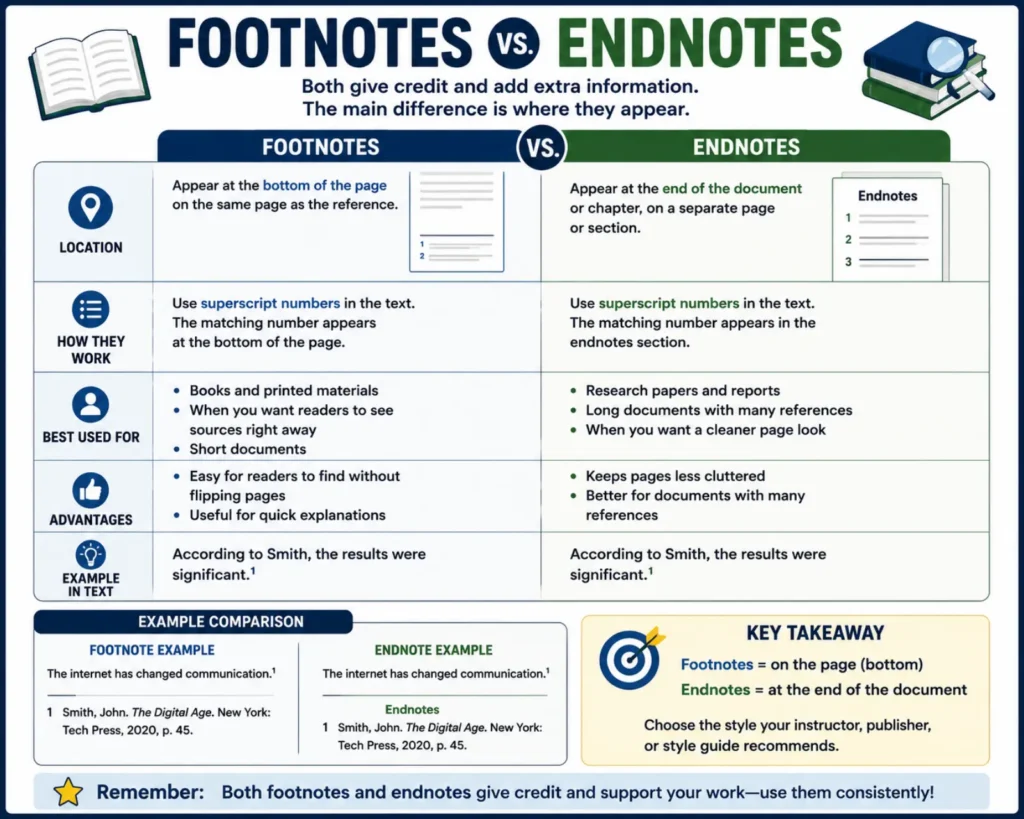
Footnotes vs Endnotes
Many writers confuse footnotes with endnotes.
Both provide extra information.
However, they appear in different locations.
| Feature | Footnotes | Endnotes |
| Location | Bottom of each page | End of chapter or document |
| Easy to Read | Yes | Less convenient |
| Common in Books | Yes | Yes |
| Common in Research | Yes | Sometimes |
| Citation Number | Superscript | Superscript |
Both use similar punctuation rules.
The citation number normally follows commas and periods
Common Footnote Placement Mistakes
Many writers make the same footnote errors. Learning these mistakes helps you avoid them.
Putting the Footnote Before the Comma
This is the most common mistake.
Incorrect:
The results¹, were significant.
Correct:
The results,¹ were significant.
Forgetting to Check the Style Guide
Different style guides have different citation rules.
Always follow the guide your teacher, publisher, or institution requires.
Using Inconsistent Formatting
Do not switch between different footnote styles.
Use the same formatting throughout your document.
Tips to Remember the Rule
Remembering footnote placement is easy when you know one simple rule.
Tip 1
Punctuation comes first.
The footnote follows the punctuation.
Tip 2
Think of the footnote as referring to the complete sentence or phrase.
Tip 3
Use your word processor’s automatic footnote feature.
It places the reference correctly in most cases.
Tip 4
Proofread your document before submitting it.
Small punctuation errors can affect professional writing.
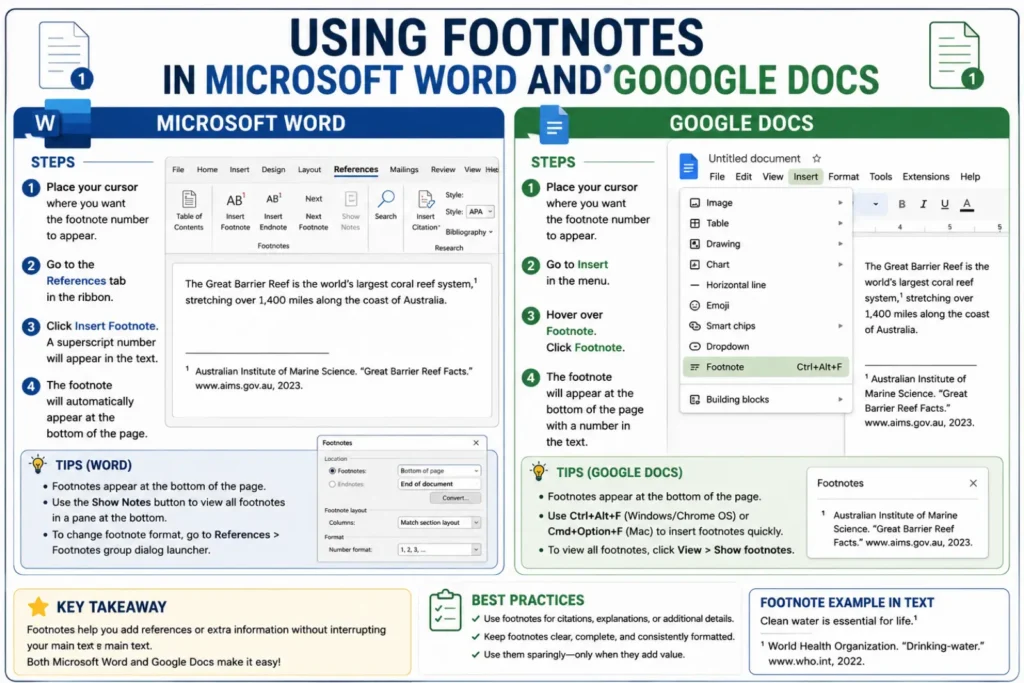
Using Footnotes in Microsoft Word and Google Doc
Modern word processors make footnotes simple to add.
Microsoft Word
- Place the cursor after the comma or other punctuation.
- Select References.
- Click Insert Footnote.
- Word adds the superscript number automatically.
Google Docs
- Place the cursor after the punctuation mark.
- Click Insert.
- Select Footnote.
- Google Docs creates the footnote at the bottom of the page.
Using built-in tools reduces formatting mistakes.
Everyday Examples of Correct Footnote Placement
You may use footnotes in many types of writing.
School Essays
Students often cite books, journals, and websites.
Example:
Climate change affects many regions,¹ according to recent studies.
Research Papers
Researchers use footnotes to cite evidence and explain data.
History Books
Historians often include detailed source references.
Legal Documents
Lawyers use footnotes to cite statutes, cases, and legal opinions.
Correct placement makes all of these documents easier to read.
Synonyms and Related Keywords
Using related keywords helps search engines understand your content.
Here are useful LSI and semantic keywords:
- footnote placement
- footnote punctuation
- footnote after comma
- superscript footnote
- citation punctuation
- Chicago footnote rules
- academic writing
- citation formatting
- punctuation rules
- writing style guide
- endnotes vs footnotes
- research paper citations
- comma before footnote
- footnote formatting
Use these naturally throughout your content.
Expert Insight
Professional editors pay close attention to punctuation and citations.
Correct footnote placement improves clarity and credibility.
Most academic publishers recommend placing footnote numbers after punctuation because it creates a smoother reading experience.
When writing research papers, always check the required style guide before submitting your work.
Developing good citation habits early will improve your academic and professional writing.
Frequently Asked Questions
Does a footnote go before or after a comma?
A footnote usually goes after the comma in most academic writing styles.
Should a footnote come after a period?
Yes. Place the footnote number after the period.
Does Chicago style put footnotes after punctuation?
Yes. Chicago style places footnote numbers after commas, periods, quotation marks, and most other punctuation marks.
Do MLA footnotes follow the same rule?
Yes. When MLA uses footnotes, they generally appear after punctuation.
Can I place a footnote before a comma?
No. Most style guides consider this incorrect.
Are footnotes and endnotes the same?
No. Both provide additional information, but footnotes appear at the bottom of a page, while endnotes appear at the end of a chapter or document.
Why is correct footnote placement important?
It improves readability, maintains consistency, and follows accepted academic standards.
Which writing styles use footnotes most often?
Chicago and Turabian styles rely heavily on footnotes for citations.
Conclusion
If you are wondering “footnote before or after comma,” the answer is simple. In most academic writing styles, the footnote number comes after the comma. This rule also applies to periods, quotation marks, semicolons, and many other punctuation marks. Following the correct placement makes your writing easier to read and helps you meet professional formatting standards.
Whether you are writing a school essay, research paper, thesis, or book, always follow the required style guide and stay consistent. Using automatic footnote tools in Microsoft Word or Google Docs can also reduce mistakes. By mastering this simple punctuation rule, you can create clear, accurate, and professional documents.