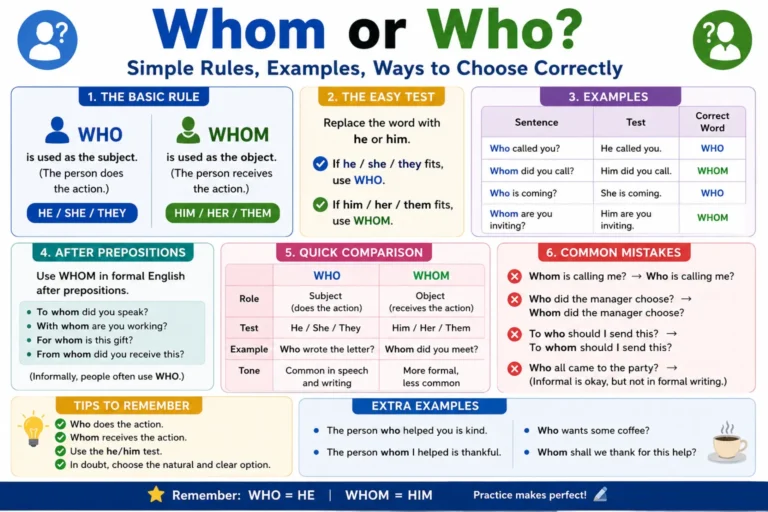
Whom or who is a common English grammar question. Both words refer to people, but they play different roles in a sentence. Who usually acts as the subject. Whom usually acts as the object.
The good news is simple. You can choose the correct word with one easy trick. Replace who with he or whom with him. If he sounds right, use who. If him sounds right, use whom.
This guide explains the difference between who and whom in simple English. You will learn clear rules, real-life examples, common mistakes, and useful tips. You will also learn why many native speakers use who in casual speech. By the end, choosing between who or whom will feel much easier.
Quick Summary: Who or Whom?
- Who usually acts as the subject of a sentence.
- Whom usually acts as the object of a verb or preposition.
- Use who when you can replace it with he or they.
- Use whom when you can replace it with him or them.
- Who sounds more natural in everyday English.
- Whom sounds more formal in many situations.
- In casual speech, many people use who instead of whom.
- The he/him test helps you choose correctly.
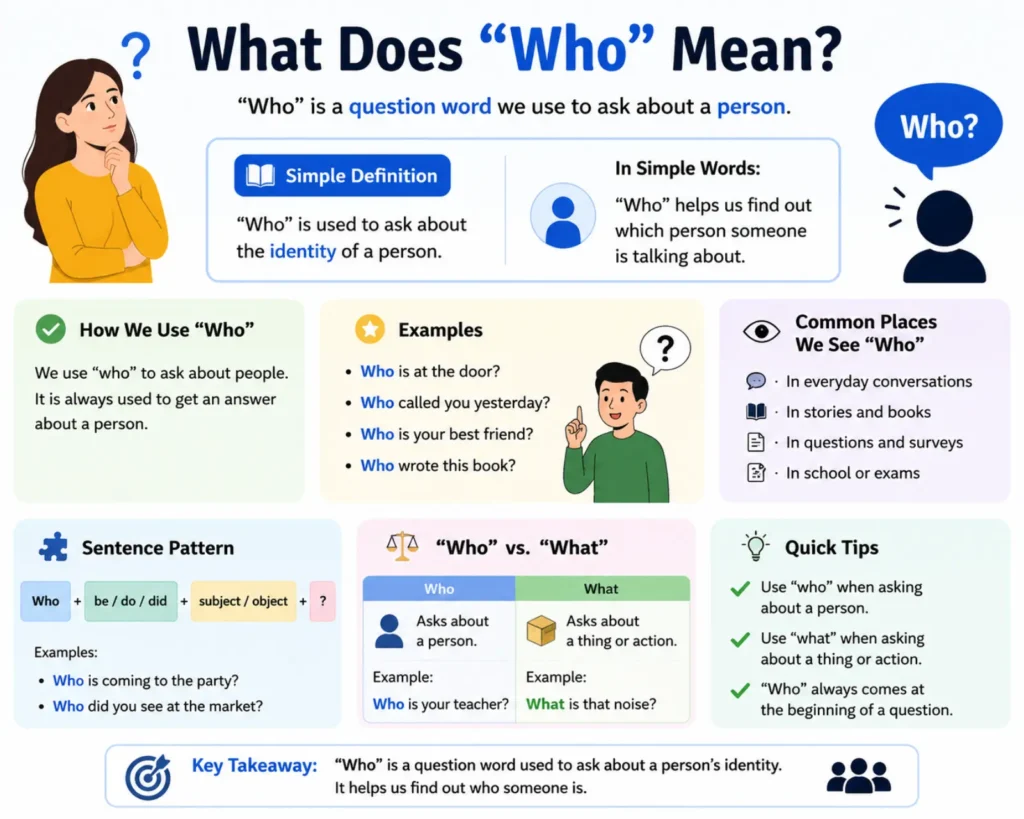
What Does “Who” Mean?
Who is a pronoun that refers to a person or people.
It usually identifies the person performing an action. In grammar, that person acts as the subject.
Examples
- Who called you?
- Who wrote this letter?
- Who wants some tea?
- Who won the match?
In each sentence, who performs the action.
For example:
Who opened the door?
The answer could be:
She opened the door.
Because she works, who works too.
What Does “Whom” Mean?
Whom is also a pronoun for people.
It usually refers to the person receiving an action. That person acts as the object.
Examples
- Whom did you call?
- Whom did the teacher choose?
- To whom should I send the email?
- Whom are you meeting?
For example:
Whom did you invite?
The answer could be:
I invited him.
Because him works, whom works too.
Who vs Whom: The Main Difference
The main difference is simple:
| Word | Grammar Role | Easy Test | Example |
|---|---|---|---|
| Who | Subject | He / she / they | Who called you? |
| Whom | Object | Him / her / them | Whom did you call? |
Think of the sentence this way:
- Who does the action.
- Whom receives the action.
Example
Who helped Sarah?
Answer:
He helped Sarah.
So, who is correct.
Now look at this sentence:
Whom did Sarah help?
Answer:
Sarah helped him.
So, whom is correct.
The Easy “He or Him” Test
The fastest way to choose between who and whom is the he/him test.
Step 1: Replace the word
Try replacing who or whom with:
- he
- him
Step 2: Listen to the sentence
If he sounds correct, use who.
If him sounds correct, use whom.
Examples
Who/Whom called the manager?
Answer:
He called the manager.
Correct:
Who called the manager?
Now try:
Who/Whom did you call?
Answer:
I called him.
Correct:
Whom did you call?
This simple trick works in most cases.
Who or Whom in Real-Life Examples
Grammar becomes easier with everyday examples.
Example 1: Phone Calls
Who called you?
Answer:
She called me.
Use who because she performs the action.
Whom did you call?
Answer:
I called her.
Use whom because her receives the action.
Example 2: Work
Who sent the report?
Answer:
He sent the report.
Correct word: who
Whom did the manager contact?
Answer:
The manager contacted him.
Correct word: whom
Example 3: School
Who answered the question?
Answer:
They answered the question.
Correct word: who
Whom did the teacher praise?
Answer:
The teacher praised them.
Correct word: whom
Example 4: Social Situations
Who is coming to dinner?
Answer:
She is coming.
Correct word: who
Whom are you inviting?
Answer:
I am inviting him.
Correct word: whom
Who or Whom After Prepositions
Whom often follows a preposition.
Common prepositions include:
- to
- for
- with
- from
- by
- about
Formal Examples
- To whom should I speak?
- With whom are you working?
- For whom did you buy this gift?
- From whom did you receive the message?
These sentences sound formal and grammatically traditional.
More Natural Everyday English
Many people say:
- Who should I speak to?
- Who are you working with?
- Who did you buy this gift for?
- Who did you receive the message from?
These versions sound more natural in casual conversation.
Important Tip
Using whom after a preposition often sounds formal. However, it remains grammatically correct.
When Should You Use “Who”?
Use who when the person performs the action.
Common Sentence Pattern
Who + verb + object?
Examples:
- Who broke the window?
- Who wrote the article?
- Who helped you?
- Who wants pizza?
- Who knows the answer?
You can usually replace who with he, she, or they.
Quick Check
Who opened the box?
Try:
She opened the box.
The sentence works. Therefore, who is correct.
When Should You Use “Whom”?
Use whom when the person receives the action.
Common Sentence Pattern
Whom + did + subject + verb?
Examples:
- Whom did you meet?
- Whom did she invite?
- Whom did they choose?
- Whom are you helping?
You can usually replace whom with him, her, or them.
Quick Check
Whom did you meet?
Try:
I met him.
The sentence works. Therefore, whom is correct.
Who or Whom in Questions
Questions often create confusion.
Look at the action in the sentence.
Subject Question
Who called the doctor?
The unknown person made the call.
Answer:
He called the doctor.
Use who.
Object Question
Whom did the doctor call?
The doctor made the call.
The unknown person received the call.
Answer:
The doctor called him.
Use whom.
Compare These Sentences
- Who did the action?
- Whom did someone act upon?
This difference solves many grammar questions.
Who or Whom in Relative Clauses
You can use both words in relative clauses.
Who as the Subject
The woman who lives next door is a doctor.
The woman lives next door.
Therefore, who performs the action.
Whom as the Object
The woman whom I met is a doctor.
I met the woman.
Therefore, whom receives the action.
More Examples
- The student who won the prize smiled.
- The student whom I praised smiled.
- The person who called left a message.
- The person whom we invited arrived early.
In casual English, people often use who instead of whom.
For example:
The person who we invited arrived early.
Many speakers consider this natural. Formal writing may prefer:
The person whom we invited arrived early.
Who vs Whom in Formal and Informal English
The choice often depends on context.
Formal English
Use whom when the word acts as an object.
Examples:
- To whom it may concern
- Whom did you contact?
- The candidate whom we selected accepted the offer.
Informal English
Many speakers use who in both subject and object positions.
Examples:
- Who did you call?
- Who are you talking to?
- The person who I met was friendly.
These sentences sound natural in everyday speech.
Best Writing Advice
Use whom when:
- You write a formal letter.
- You write academic content.
- You write legal or professional documents.
- The sentence clearly needs an object pronoun.
Use who when:
- You write casual messages.
- You speak naturally.
- Whom sounds awkward or overly formal.
Common Mistakes With Who and Whom
Many learners make the same mistakes.
Mistake 1: Using “Whom” for Every Person
Some people think whom sounds more intelligent.
However, that approach can create errors.
Incorrect:
Whom is calling me?
Correct:
Who is calling me?
Why?
The person performs the action.
Mistake 2: Using “Who” in Formal Object Positions
This mistake often appears in formal writing.
Less formal:
Who did you invite?
More formal:
Whom did you invite?
Both forms appear in modern English. The second sounds more formal.
Mistake 3: Forgetting the Preposition
Some sentences need whom after a preposition.
Formal:
To whom did you speak?
Informal:
Who did you speak to?
Both can work. The first sounds more formal.
Mistake 4: Confusing the Subject and Object
Look at this sentence:
Who did the manager choose?
The manager performed the action.
The person received the action.
Therefore, formal grammar uses whom:
Whom did the manager choose?
Tips to Remember Who or Whom
Use these simple memory tricks.
Tip 1: Remember “He” and “Him”
- Who = he
- Whom = him
This is the most useful rule.
Tip 2: Ask “Who Did It?”
If the person did the action, use who.
Who opened the door?
Tip 3: Ask “Who Received It?”
If the person received the action, use whom.
Whom did you invite?
Tip 4: Watch for Prepositions
Words like to, with, and for often introduce whom.
To whom did you send the letter?
Tip 5: Consider Your Audience
Formal writing may need whom.
Casual speech often uses who.
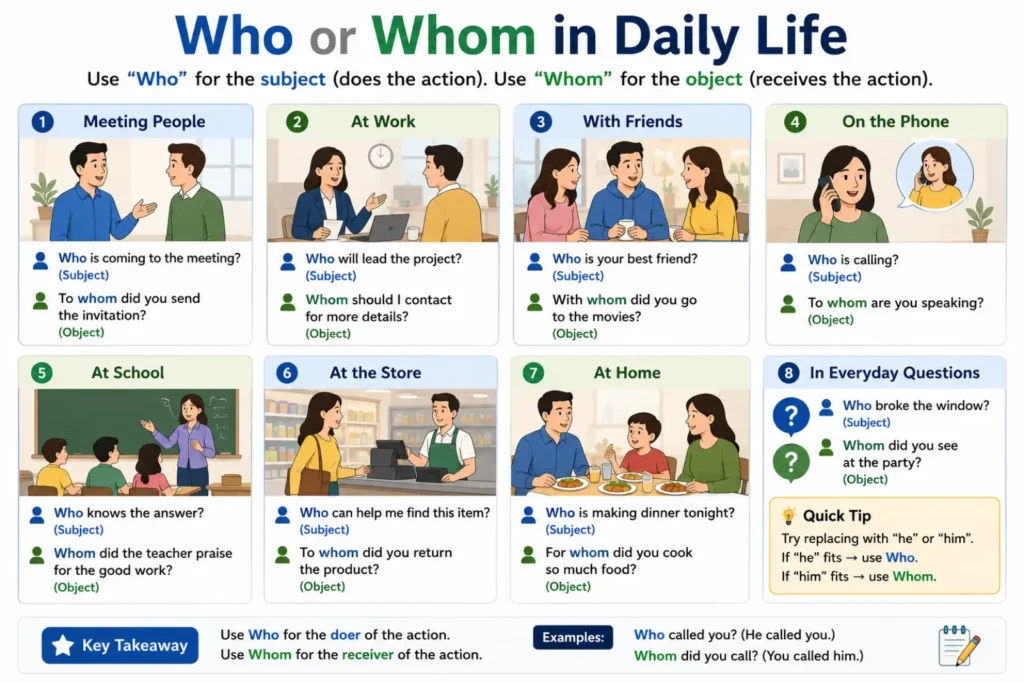
Who or Whom in Daily Life
You will see these words in many situations.
At Work
- Who leads the team?
- Whom should I contact?
- Who approved the plan?
- Whom did the client call?
At School
- Who answered correctly?
- Whom did the teacher select?
- Who wrote the essay?
- Whom did you ask for help?
In Emails
Formal:
To whom it may concern,
Less formal:
Who should I contact about this issue?
In Conversation
Most people naturally say:
Who did you see?
Instead of:
Whom did you see?
Both can communicate the same meaning. The first sounds more conversational.
Synonyms and Related Grammar Terms
The word who does not have a perfect synonym in every sentence. However, several related terms help explain its use.
Related Terms
- person pronoun
- interrogative pronoun
- relative pronoun
- subject pronoun
- object pronoun
- question word
- personal pronoun
Related Search Terms
People often search for:
- who vs whom
- whom or who
- who or whom grammar
- when to use whom
- when to use who
- difference between who and whom
- who vs whom examples
- is whom still used
- who did you call or whom did you call
- to who or to whom
These phrases describe the same grammar topic.
Is “Whom” Still Used in Modern English?
Yes. Whom still appears in modern English.
However, people use it less often in casual conversation. Many speakers prefer who because it sounds more natural.
You will still see whom in formal writing and fixed expressions.
Examples include:
- To whom it may concern
- For whom the bell tolls
- With whom did you speak?
The word has not disappeared. Its use has simply become more formal.
Expert Insight: Why This Difference Matters
Strong grammar improves clarity.
The difference between who and whom can also show your understanding of formal English.
Professional writers should understand both forms. However, they should also consider natural language.
Modern English often values clarity over strict traditional rules.
Therefore, do not force whom into every sentence. First, identify the grammar role. Then, consider your audience and tone.
SEO and Writing Authority Tip
Clear grammar supports trust. Readers notice when professional content sounds polished and natural.
Use traditional grammar rules when they improve clarity. Avoid complicated wording that makes simple ideas harder.
That approach supports strong E-E-A-T signals through helpful, readable content.
Frequently Asked Questions About Who or Whom
1. What is the difference between who and whom?
Who usually acts as the subject. Whom usually acts as the object.
Example:
- Who called you?
- Whom did you call?
2. Is it “who did you call” or “whom did you call”?
Both appear in English.
Whom did you call? follows traditional formal grammar.
Who did you call? sounds more natural in everyday English.
3. Is “whom” still grammatically correct?
Yes. Whom remains grammatically correct when it acts as an object.
Example:
Whom did you invite?
4. How can I quickly choose between who and whom?
Use the he/him test.
If he works, use who.
If him works, use whom.
5. Should I say “to who” or “to whom”?
In formal grammar, use to whom.
Example:
To whom should I send the report?
In casual English, many people say:
Who should I send the report to?
6. Which sounds more natural: who or whom?
Who usually sounds more natural in everyday conversation.
Whom sounds more formal.
7. Can I use who instead of whom?
Often, yes, especially in informal speech.
For example:
Who did you meet?
Many speakers use this sentence naturally.
Formal grammar prefers:
Whom did you meet?
8. What is the easiest way to remember the rule?
Remember this:
Who = he. Whom = him.
That simple test solves most questions.
Conclusion
Understanding whom or who becomes easier when you focus on the person’s role. Use who when the person performs the action. Use whom when the person receives the action.
The easiest test uses he and him. If he fits, choose who. If him fits, choose whom.
Remember the difference between formal and informal English. Whom remains correct and useful in formal writing. However, who sounds more natural in many everyday conversations.
The simple takeaway is this: who does the action, while whom receives the action. When you feel unsure, use the he/him test. With practice, choosing between who and whom will become quick and natural.