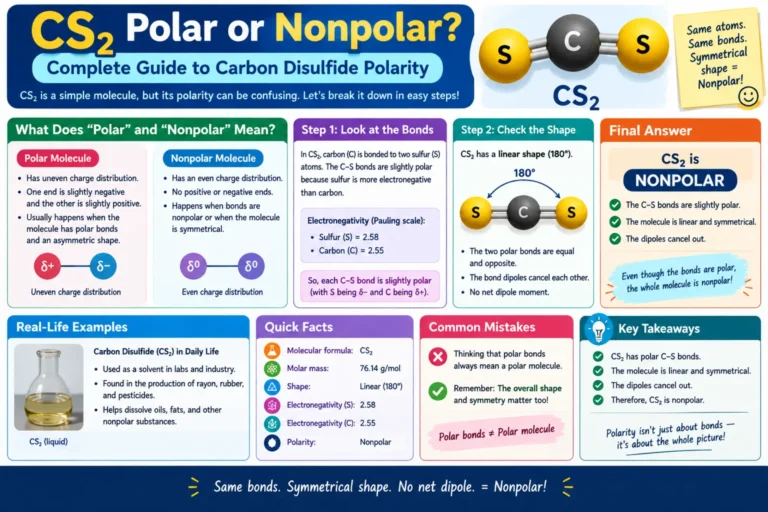
CS2 polar or nonpolar? Carbon disulfide, written as CS₂, is a nonpolar molecule. Many students find this confusing because carbon and sulfur have different electronegativities. However, molecular shape matters as much as bond polarity. CS₂ has a simple, linear shape. The carbon atom sits between two sulfur atoms. The two C=S bonds point in opposite directions. Their bond dipoles cancel each other out. As a result, the molecule has no net dipole moment. This makes CS₂ nonpolar overall. In this guide, you will learn why CS₂ is nonpolar. We will also explain its Lewis structure, molecular geometry, bond polarity, and dipole moment. You will see easy examples and common mistakes. By the end, you can quickly decide whether CS₂ is polar or nonpolar.
Quick Summary: Is CS2 Polar or Nonpolar?
- CS₂ is nonpolar.
- CS₂ stands for carbon disulfide.
- Its molecular shape is linear.
- The carbon atom sits between two sulfur atoms.
- Each C=S bond has some bond polarity.
- The two bond dipoles point in opposite directions.
- These dipoles cancel each other.
- CS₂ has a net dipole moment of zero.
- Its symmetry makes the molecule nonpolar.
- The key rule is simple: polar bonds can form a nonpolar molecule.
What Does CS₂ Mean?
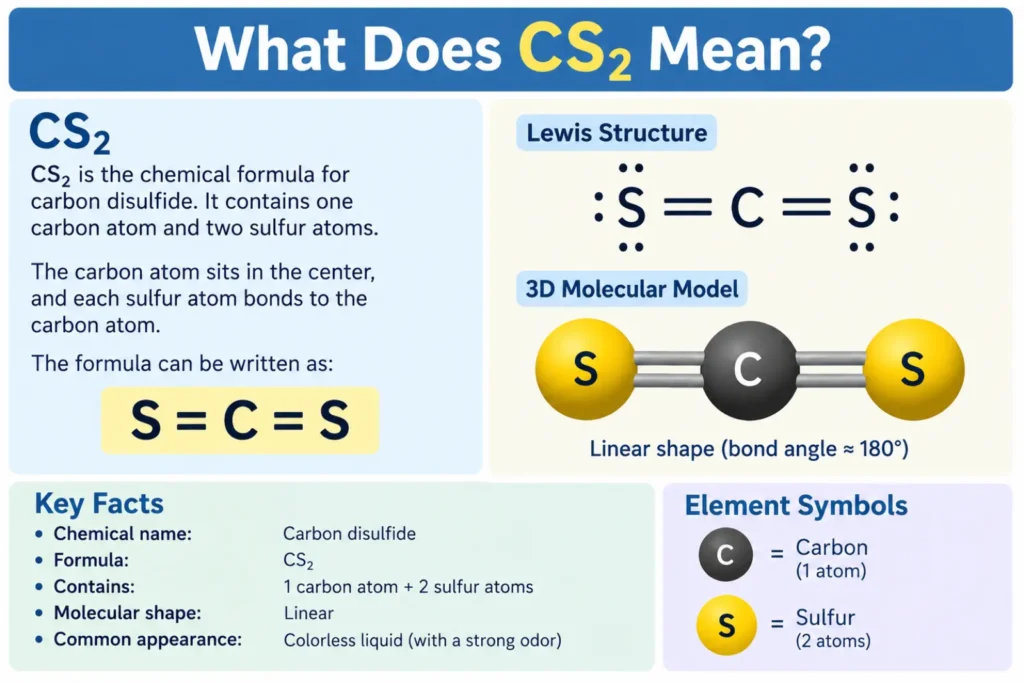
CS₂ is the chemical formula for carbon disulfide. It contains one carbon atom and two sulfur atoms.
The carbon atom stays in the center. Each sulfur atom bonds to the carbon atom.
The formula can be represented as:
S=C=S
This structure helps explain the molecule’s polarity.
Carbon disulfide often appears as a colorless liquid. It has a strong, distinctive odor in many settings.
For chemistry students, CS₂ provides a useful example of molecular symmetry.
It shows why you must examine the whole molecule, not just individual bonds.
Is CS2 Polar or Nonpolar?
CS₂ is nonpolar.
The main reason is its linear and symmetrical molecular structure.
The carbon atom lies between two sulfur atoms. The sulfur atoms sit on opposite sides of carbon.
Both C=S bonds create bond dipoles. However, these dipoles point in opposite directions.
Because the molecule has a symmetrical structure, the dipoles cancel.
Therefore, CS₂ has no overall molecular dipole.
Short Answer for Exams
CS₂ is nonpolar because it has a linear, symmetrical shape. The two C=S bond dipoles cancel each other, giving CS₂ a net dipole moment of zero.
This answer directly addresses the common exam question, “Is CS₂ polar or nonpolar?”
Why Is CS₂ Nonpolar?
The best way to understand CS₂ polarity involves three main ideas:
- Bond polarity
- Molecular geometry
- Dipole cancellation
First, consider the C=S bonds.
Carbon and sulfur do not have exactly the same electronegativity. Therefore, the C=S bonds can show some polarity.
However, bond polarity alone does not determine molecular polarity.
Next, look at the molecule’s shape.
CS₂ has a linear shape. The bond angle is approximately 180°.
The two sulfur atoms lie directly opposite each other.
This arrangement causes the bond dipoles to point in opposite directions.
The dipoles have equal magnitude because the two ends of the molecule are identical.
They therefore cancel.
So, the molecule has no net dipole moment.
This makes CS₂ a nonpolar molecule.
CS₂ Lewis Structure and Polarity
The Lewis structure helps explain the molecule’s shape.
Carbon has four valence electrons. Each sulfur atom has six valence electrons.
CS₂ has a total of 16 valence electrons.
A common Lewis structure is:
S=C=S
Each sulfur atom has two lone pairs. Carbon has no lone pairs in this structure.
The carbon atom forms two double bonds.
This arrangement gives carbon a complete octet. Each sulfur also reaches an octet.
Most importantly, carbon has two electron regions around it.
These regions produce a linear molecular geometry.
The linear structure leads directly to dipole cancellation.
Lewis Structure at a Glance
| Feature | CS₂ |
|---|---|
| Central atom | Carbon |
| Outer atoms | Two sulfur atoms |
| Valence electrons | 16 |
| Main bonding pattern | Two C=S double bonds |
| Lone pairs on carbon | 0 |
| Molecular shape | Linear |
| Bond angle | About 180° |
| Molecular polarity | Nonpolar |
What Is the Shape of CS₂?
CS₂ has a linear molecular geometry.
Its basic structure looks like this:
S = C = S
The carbon atom sits in the center.
The two sulfur atoms sit on opposite sides.
The bond angle is approximately 180°.
This shape results from the electron-domain arrangement around carbon.
According to VSEPR theory, carbon has two electron domains around it.
Two electron domains arrange themselves in a straight line.
This geometry is important because symmetry affects molecular polarity.
If CS₂ had a bent shape, its dipoles would not cancel completely.
But CS₂ remains linear.
Therefore, its symmetrical shape supports its nonpolar nature.
Are the C=S Bonds Polar?
This question causes many mistakes.
The safest explanation is that the C=S bonds have some polarity because carbon and sulfur differ in electronegativity.
However, the entire CS₂ molecule is still nonpolar.
This distinction matters.
A polar bond does not always create a polar molecule.
For example, a molecule can contain polar bonds while remaining nonpolar because of its shape.
In CS₂, the two C=S bond dipoles oppose each other.
Their effects cancel.
Therefore:
Polar bonds + symmetrical shape = nonpolar molecule
This principle also applies to several other molecules.
CS2 Polarity Explained With Dipole Moments
A dipole moment measures charge separation within a molecule.
A molecule with a net dipole moment has an overall uneven charge distribution.
A polar molecule has a nonzero net dipole moment.
A nonpolar molecule has no permanent net dipole moment.
In CS₂, each C=S bond can have a dipole.
The two bond dipoles point in opposite directions.
Because the molecule is symmetrical, they cancel.
The overall dipole moment becomes zero.
You can think of the dipoles as two equal forces pulling in opposite directions.
Neither side wins.
That produces no overall molecular dipole.
Therefore, CS₂ is nonpolar.
CS2 vs CO2: Why Are Both Nonpolar?
CS₂ and CO₂ provide an excellent comparison.
Both molecules have a similar basic structure:
S=C=S
and
O=C=O
Both molecules have a carbon atom in the center.
have two identical atoms attached to carbon.
Both molecules have a linear shape.
Both have bond dipoles that cancel.
Therefore, both molecules are nonpolar.
| Property | CS₂ | CO₂ |
| Central atom | Carbon | Carbon |
| Outer atoms | Sulfur | Oxygen |
| Shape | Linear | Linear |
| Bond angle | ~180° | 180° |
| Symmetrical? | Yes | Yes |
| Net dipole | 0 | 0 |
| Molecular polarity | Nonpolar | Nonpolar |
The key lesson is simple.
Molecular shape can cancel bond dipoles and make the whole molecule nonpolar.
CS2 vs H2S: A Useful Comparison
H₂S creates a useful contrast with CS₂.
H₂S has a bent molecular shape.
CS₂ has a linear molecular shape.
This difference changes their overall polarity.
In CS₂, the bond dipoles point in opposite directions.
They cancel.
In H₂S, the bent shape prevents complete dipole cancellation.
Therefore, H₂S has a net dipole moment.
| Property | CS₂ | H₂S |
| Central atom | Carbon | Sulfur |
| Molecular shape | Linear | Bent |
| Symmetrical shape | Yes | No |
| Dipole cancellation | Complete | Incomplete |
| Overall polarity | Nonpolar | Polar |
This comparison shows why you should always check molecular geometry.
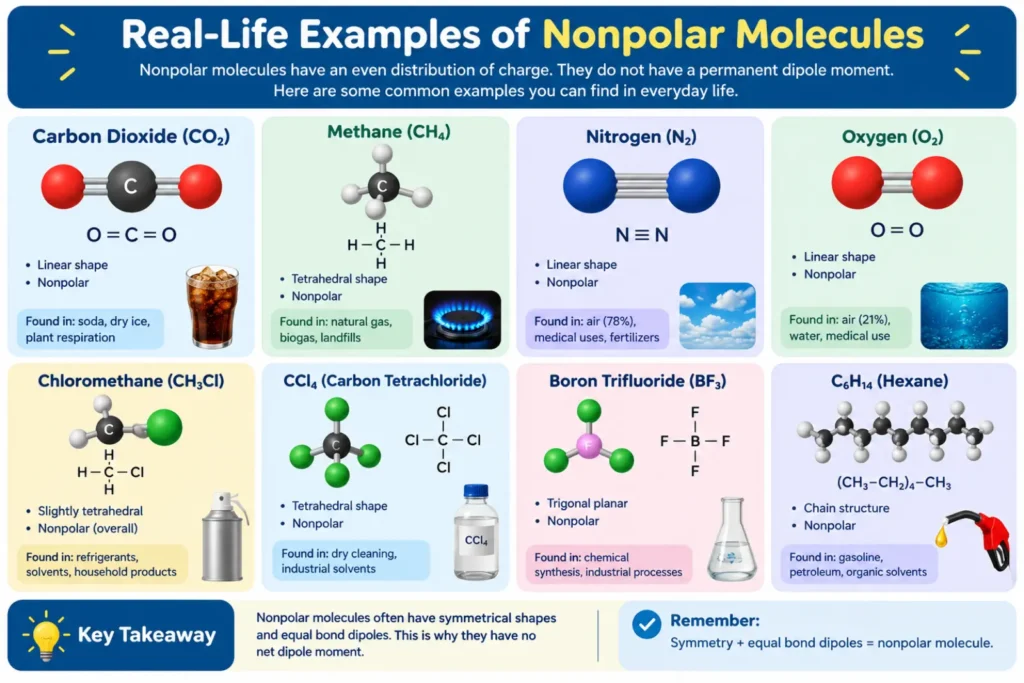
Real-Life Examples of Nonpolar Molecules
CS₂ is one example of a nonpolar molecule.
Other common examples include:
- CO₂
- CH₄
- BF₃
- CCl₄
- N₂
- O₂
These molecules do not all have the same shape.
However, symmetry plays an important role in many of them.
For example, CO₂ has a linear shape.
CH₄ has a tetrahedral shape.
CCl₄ also has a symmetrical tetrahedral arrangement.
Their bond dipoles cancel because of their molecular geometry.
This gives students an important chemistry lesson:
Do not judge molecular polarity from one bond alone.
Always examine the complete three-dimensional structure.
Common Mistakes When Determining CS2 Polarity
Mistake 1: Calling CS₂ polar because C and S differ
Different electronegativities can create bond polarity.
However, bond polarity does not automatically make the entire molecule polar.
CS₂ has symmetrical bonds.
Their dipoles cancel.
Mistake 2: Ignoring molecular shape
Some students look only at the Lewis structure.
The Lewis structure helps, but geometry matters too.
CS₂ is linear with a 180° bond angle.
That geometry explains its nonpolar nature.
Mistake 3: Confusing bond polarity with molecular polarity
These terms describe different things.
Bond polarity describes an individual chemical bond.
Molecular polarity describes the overall charge distribution.
CS₂ demonstrates this difference clearly.
Mistake 4: Thinking every molecule with sulfur is polar
The presence of sulfur does not automatically make a molecule polar.
You must consider bonding, geometry, and symmetry.
Mistake 5: Forgetting dipole cancellation
Dipole cancellation provides the final answer.
In CS₂, the two bond dipoles oppose each other.
Therefore, the net dipole equals zero.
How to Quickly Determine if CS2 Is Polar or Nonpolar
Use this simple four-step method.
Step 1: Draw the Lewis structure
Write CS₂ as:
S=C=S
Step 2: Find the molecular geometry
Carbon has two bonding regions.
The molecule is therefore linear.
Step 3: Check symmetry
Both sides contain the same atom.
The structure is symmetrical.
Step 4: Check dipole cancellation
The two bond dipoles point in opposite directions.
They cancel completely.
Final Answer
CS₂ is nonpolar.
This method works well for many molecular polarity questions.
Expert Insight: Why CS2 Matters in Chemistry
CS₂ provides an important lesson about molecular polarity.
Students often focus too much on electronegativity.
Electronegativity matters, but it is only part of the answer.
Molecular geometry determines how bond dipoles combine.
A molecule can contain polar bonds and still have no overall dipole.
CS₂ demonstrates this principle in a simple way.
When solving polarity problems, experts usually follow a logical order:
Lewis structure → molecular geometry → symmetry → bond dipoles → net dipole
This sequence reduces mistakes.
It also works across many common chemistry examples.
For exam questions, avoid giving only “CS₂ is nonpolar.”
Add the reason.
A strong answer states that CS₂ has a linear, symmetrical structure and opposing bond dipoles.
That explanation shows understanding rather than memorization.
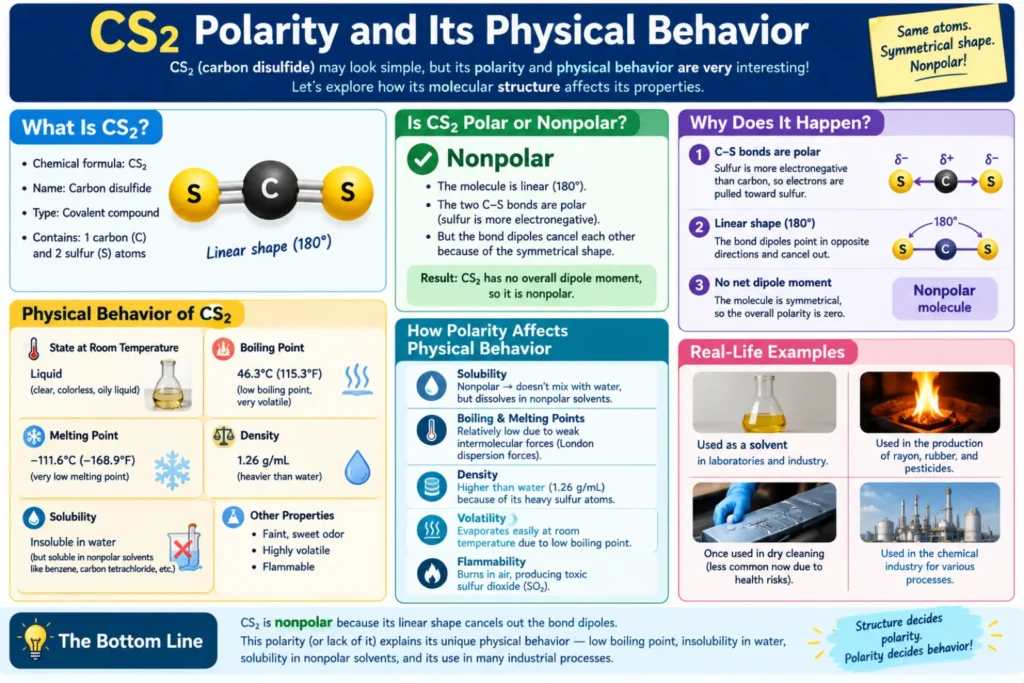
CS2 Polarity and Its Physical Behavior
Molecular polarity can affect many physical properties.
It can influence how substances interact with other molecules.
Polar molecules often interact strongly with other polar substances.
Nonpolar molecules tend to interact more strongly with nonpolar substances.
CS₂ is commonly discussed when students learn the idea of “like dissolves like.”
This principle helps explain why molecular polarity matters in solubility.
However, real solubility depends on several factors.
These include molecular size, intermolecular forces, temperature, and molecular structure.
Therefore, polarity provides useful guidance but does not explain every solubility result alone.
Synonyms and LSI Keywords for CS2 Polar or Nonpolar
Search engines may connect the main keyword with several related terms.
Useful semantic keywords include:
- Is CS₂ polar?
- Is carbon disulfide polar or nonpolar?
- CS2 polarity
- CS₂ molecular polarity
- carbon disulfide polarity
- CS₂ dipole moment
- CS₂ Lewis structure
- CS₂ molecular geometry
- CS₂ shape
- CS₂ bond angle
- C=S bond polarity
- polar vs nonpolar molecules
- molecular dipole moment
- dipole cancellation
- linear molecular geometry
- VSEPR theory
- electronegativity and polarity
- carbon disulfide Lewis structure
Use these terms naturally throughout educational content.
Avoid repeating the primary keyword in every paragraph.
Tips and Tricks for Polarity Questions
Remember these quick chemistry tips:
- Draw the Lewis structure first.
- Identify the central atom.
- Determine the molecular shape.
- Look for symmetry.
- Identify bond dipoles.
- Check whether the dipoles cancel.
- Then decide whether the molecule is polar.
For symmetrical molecules, dipole cancellation often provides the answer.
For bent or asymmetrical molecules, cancellation may not occur.
Do not rely on electronegativity alone.
Instead, combine bonding information with molecular geometry.
This approach makes polarity questions much easier.
Frequently Asked Questions About CS2 Polar or Nonpolar
Is CS₂ polar or nonpolar?
CS₂ is nonpolar. Its linear and symmetrical shape causes the two C=S bond dipoles to cancel.
Why is CS₂ nonpolar?
CS₂ is nonpolar because it has a linear structure. The two identical bond dipoles point in opposite directions and cancel.
Does CS₂ have polar bonds?
The C=S bonds have some polarity because carbon and sulfur have different electronegativities. However, the bond dipoles cancel at the molecular level.
What is the shape of CS₂?
CS₂ has a linear molecular geometry. Its bond angle is approximately 180°.
What is the dipole moment of CS₂?
The net molecular dipole moment of CS₂ is zero because its bond dipoles cancel.
Is carbon disulfide a polar molecule?
No. Carbon disulfide, or CS₂, is a nonpolar molecule.
Is CS₂ more like CO₂ or H₂O in polarity?
CS₂ is more like CO₂. Both are linear and nonpolar. H₂O has a bent shape and is polar.
How can I remember that CS₂ is nonpolar?
Remember the structure S=C=S. The two sides are identical and pull in opposite directions, so the dipoles cancel.
Conclusion: Is CS2 Polar or Nonpolar?
So, is CS₂ polar or nonpolar? The answer is nonpolar. Carbon disulfide has a linear molecular shape with a bond angle near 180°. Its two C=S bonds have some bond polarity. However, the molecule is symmetrical. The two bond dipoles point in opposite directions. They therefore cancel each other. This gives CS₂ a net dipole moment of zero. The biggest lesson is that bond polarity and molecular polarity are not the same. Always check the molecule’s complete shape before deciding. For CS₂, the Lewis structure, linear geometry, symmetry, and dipole cancellation all lead to the same result. CS₂ is a nonpolar molecule. If you remember one rule, remember this: polar bonds can produce a nonpolar molecule when their dipoles cancel.