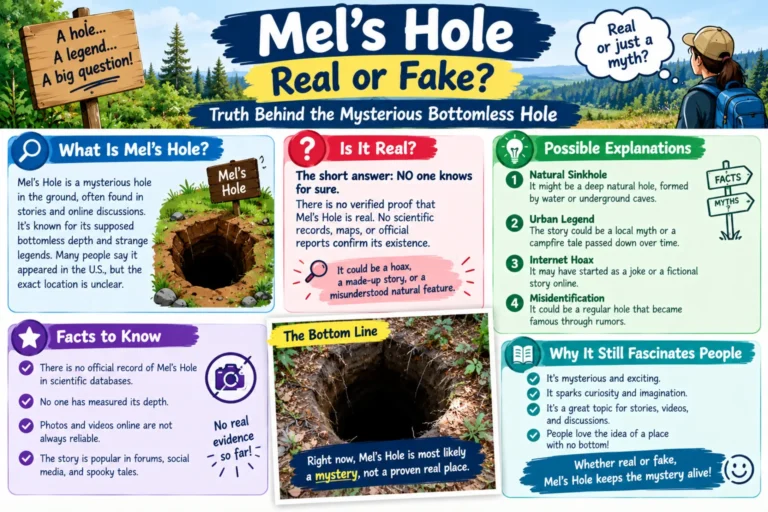
Mel’s Hole real or fake? The mystery began with a strange radio story about a bottomless hole.
A caller named Mel claimed he found the hole near Ellensburg, Washington.
He said the hole seemed impossible to measure.
He also shared stories about strange objects and unusual events.
The story spread quickly across paranormal websites and online forums.
Many people still wonder if the hole truly exists.
Others believe the entire tale started as a radio prank or hoax.
The mystery remains popular because nobody has proved the story conclusively.
However, several details raise serious questions about its truth.
This article examines the claims, evidence, theories, and likely explanation.
We will separate documented facts from stories that lack proof.
So, is Mel’s Hole real or fake?
The answer is more complicated than a simple yes or no.
Quick Summary
- Mel’s Hole refers to a claimed bottomless hole near Ellensburg, Washington.
- The story became famous after a 1997 radio appearance.
- A caller named Mel described the mysterious hole to Art Bell.
- No verified scientific evidence proves that the hole exists.
- The location and physical claims remain unconfirmed.
- Many researchers treat the story as folklore, a hoax, or an unverified legend.
- The tale remains popular because of its unusual paranormal claims.
- Best conclusion: Mel’s Hole has not been proven real.
What Is Mel’s Hole?
Mel’s Hole is the name given to a supposed extremely deep hole in Washington State.
According to the story, the hole lies near Ellensburg, Washington.
The original account came from a man who identified himself as Mel.
He claimed that people could not determine the hole’s true depth.
Some versions of the story describe objects being thrown into it without hearing them land.
The tale later gained supernatural elements.
These included claims about strange animals, unusual objects, and mysterious government interest.
Those additions helped turn a local story into a major paranormal legend.
The phrase “Mel’s Hole” now describes the entire mystery rather than one verified geological site.
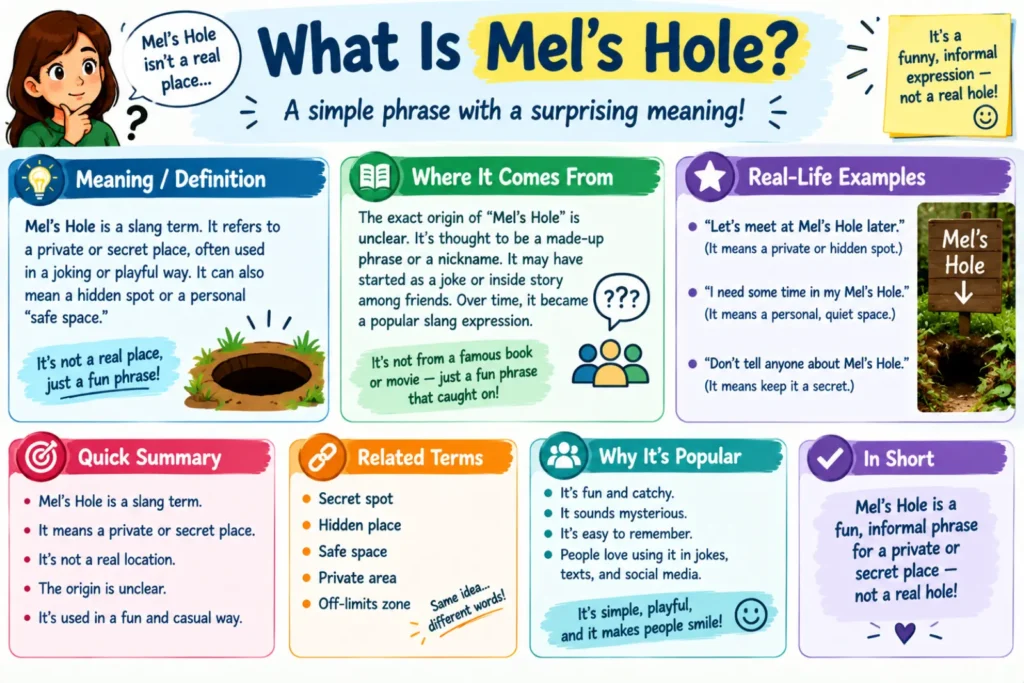
How Did the Mel’s Hole Story Start?
The story became widely known through The Art Bell Show in 1997.
Mel called the program and discussed the alleged hole with radio host Art Bell.
He described the site as unusually deep.
He also claimed that local residents knew about the hole.
The broadcast gave the story a huge audience.
Art Bell’s program often featured paranormal topics and unexplained events.
That format helped unusual stories reach millions of listeners.
Later broadcasts added more claims about Mel’s Hole.
The story eventually appeared on websites, forums, videos, and paranormal programs.
However, a radio interview does not prove a physical location exists.
That distinction matters when judging the evidence.
What Did Mel Claim About the Hole?
Mel’s reported claims vary between different versions of the story.
Some accounts say the hole had an extreme or impossible depth.
Other versions describe objects thrown into the opening.
The most famous claim involves the hole apparently having no measurable bottom.
Some retellings also describe unusual behavior from animals around the site.
Later stories became even more dramatic.
They included claims involving strange objects, mysterious government activity, and possible paranormal effects.
These details made the story more entertaining.
However, the more dramatic claims often lack independent evidence.
That makes them difficult to verify.
Is Mel’s Hole Real or Fake?
There is no reliable evidence proving that Mel’s Hole exists as described.
That does not automatically prove that every part of the story was deliberately fabricated.
Instead, the safest conclusion is that Mel’s Hole remains unverified.
A genuine geological feature should leave physical evidence.
Researchers could normally document its location, dimensions, geology, and surroundings.
No widely accepted scientific record confirms a bottomless hole matching the famous description.
The story also depends heavily on one person’s account.
That creates a major evidence problem.
Extraordinary claims require strong, independent evidence.
Mel’s Hole does not have enough verified evidence to meet that standard.
Therefore, calling it a confirmed real place would be misleading.
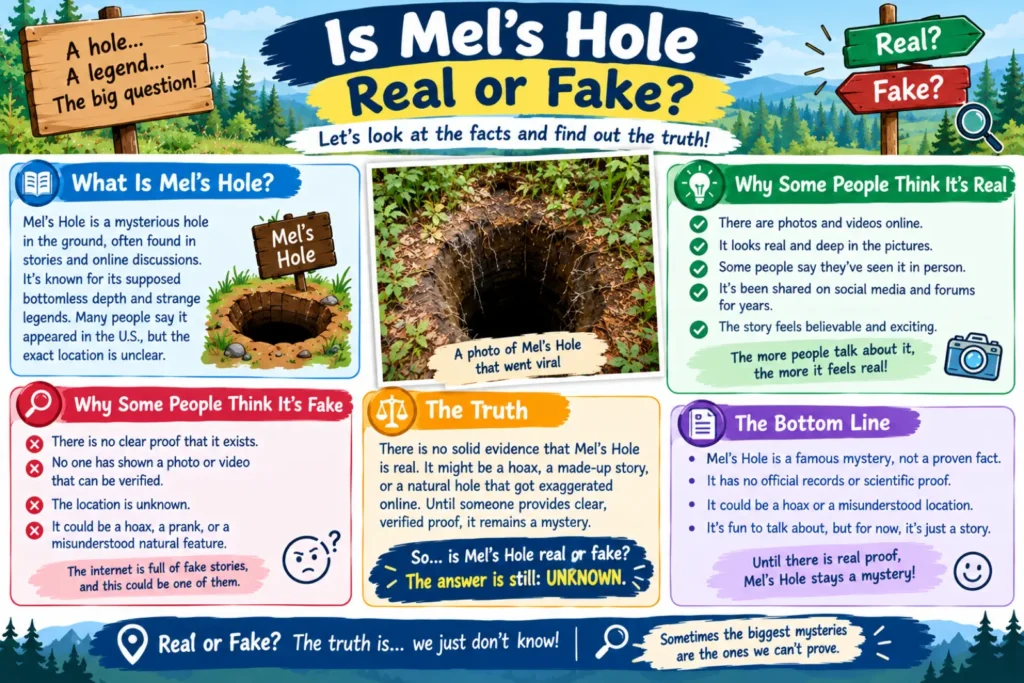
Mel’s Hole: Real vs. Fake
| Question | What the evidence suggests |
|---|---|
| Does the story exist? | Yes |
| Did the radio story become famous? | Yes |
| Was a physical hole scientifically verified? | No |
| Is there reliable proof of a bottomless hole? | No |
| Are paranormal claims confirmed? | No |
| Could the story be folklore or a hoax? | Yes |
| Is there enough evidence to call it real? | No |
| Best current conclusion | Unverified legend |
The table shows an important difference.
The story is real, but that does not mean the hole is real.
That distinction often gets lost online.
Why Do People Believe Mel’s Hole Is Real?
Several factors make the legend convincing.
First, the story came through a real radio program.
Listeners heard a person tell the story directly.
Second, the account included specific details.
Specific details can make a story feel more believable.
Third, later versions added more witnesses and strange events.
However, repetition does not create evidence.
A claim can appear on hundreds of websites without becoming true.
The mystery also benefits from limited physical information.
People cannot easily verify an alleged remote location from a radio broadcast.
That uncertainty leaves room for speculation.
Finally, paranormal stories attract attention because they challenge normal explanations.
Mel’s Hole combines mystery, geography, government rumors, and supernatural ideas.
That combination makes it highly shareable.
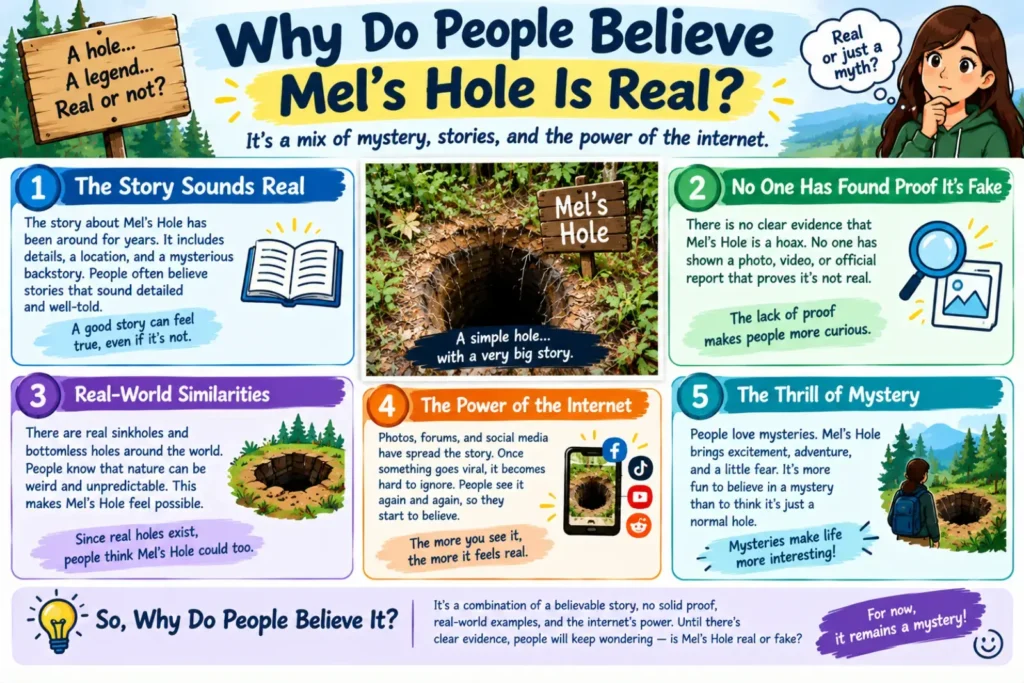
Could Mel’s Hole Be a Natural Feature?
Some people suggest the story could have started with a real geological feature.
Washington contains many unusual geological formations.
The region also includes caves, wells, tunnels, volcanic features, and deep geological structures.
But a natural feature does not need to be supernatural.
A very deep hole could result from human excavation, mining, erosion, or other geological processes.
The problem remains verification.
A truly extraordinary hole should produce measurable physical evidence.
Scientists could examine its rock layers and depth.
They could also map the surrounding area.
Without that evidence, natural explanations remain possibilities rather than solutions.
Could Mel’s Hole Be a Hoax?
A hoax remains one possible explanation.
The original caller could have invented some or all of the story.
Radio programs also encouraged unusual stories because mystery attracted listeners.
However, proving deliberate deception can be difficult.
We should distinguish between three possibilities:
- Mel described a real but ordinary feature.
- Mel exaggerated a real location.
- Mel invented the story.
Available evidence does not conclusively establish which explanation is correct.
That is why “unverified” is more accurate than simply saying “fake.”
Common Mistakes When Researching Mel’s Hole
Mistake 1: Treating rumors as evidence
A website repeating a claim does not independently verify it.
Always look for original evidence.
Mistake 2: Confusing a radio interview with proof
A broadcast documents what someone said.
It does not confirm what they described.
Mistake 3: Believing every later version
Internet stories often gain new details over time.
Those additions may not appear in the original account.
Mistake 4: Assuming missing evidence proves a conspiracy
Lack of evidence does not automatically indicate government secrecy.
It can simply mean the claim remains unsupported.
Mistake 5: Calling everything fake without checking
Skepticism should still rely on evidence.
The correct approach is to identify what researchers can actually verify.
How to Check Whether a Mystery Story Is Real
You can use a simple evidence checklist.
Step 1: Find the original source.
Look for the earliest available interview or report.
Step 2: Separate claims from observations.
Write down exactly what the original source says.
Step 3: Look for independent witnesses.
Independent accounts provide stronger evidence.
Step 4: Search for physical records.
Maps, geological surveys, photographs, and measurements can help.
Step 5: Check expert analysis.
Geologists and other specialists can evaluate physical claims.
Step 6: Watch for story changes.
Major differences between versions can weaken credibility.
Step 7: Avoid confirmation bias.
Do not search only for information supporting your favorite theory.
This method works for many internet mysteries.
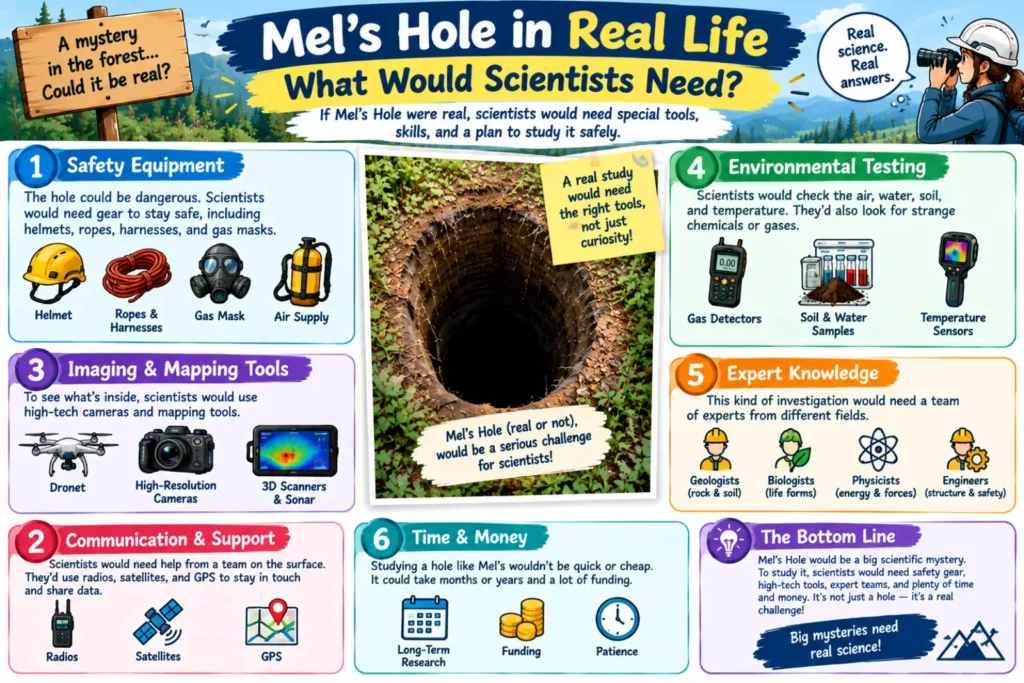
Mel’s Hole in Real Life: What Would Scientists Need?
Scientists would need physical access to the alleged site.
They could first establish its exact location.
Next, they could measure its depth.
They could examine the walls and surrounding geology.
They could also use modern surveying equipment.
Ground-penetrating methods might help study some underground structures.
However, a claimed bottomless hole would require especially strong evidence.
Modern instruments can measure extremely deep geological structures.
A hole with the properties described in the legend would create major scientific interest.
That makes the lack of verified scientific documentation important.
Synonyms and Related Search Terms
People search for the mystery using many related phrases.
Useful semantic keywords include:
- Mel’s Hole mystery
- Is Mel’s Hole real?
- Mel’s Hole hoax
- Mel’s Hole explained
- Mel’s Hole Washington
- Mel’s Hole story
- Mel’s Hole evidence
- Mel’s Hole Art Bell
- bottomless hole Washington
- Ellensburg mystery
- paranormal holes
- mysterious hole stories
- Mel’s Hole location
- Mel’s Hole true story
- Mel’s Hole conspiracy
These terms describe closely related search intent.
They also show why the topic continues to attract online interest.
Expert Insight: Why the Mystery Still Matters
The biggest lesson from Mel’s Hole involves evidence literacy.
People often encounter extraordinary claims online.
A dramatic story can feel true because it contains names, places, and detailed descriptions.
Good research requires more than believable storytelling.
It requires independent evidence.
For a physical mystery, strong evidence could include photographs, measurements, geological records, and multiple independent witnesses.
For Mel’s Hole, the strongest part of the evidence remains the existence of the story itself.
The physical claims remain unverified.
That difference gives readers a useful research habit:
Always ask what can be independently checked.
This approach helps with paranormal claims, viral stories, conspiracy theories, and internet rumors.
FAQs About Mel’s Hole
Is Mel’s Hole a real place?
There is no reliable scientific evidence confirming a hole that matches the famous Mel’s Hole story.
Where is Mel’s Hole supposed to be?
The story places the alleged hole near Ellensburg, Washington.
Who discovered Mel’s Hole?
A man identified as Mel claimed to know about the hole. His identity and account remain part of the mystery.
Did Art Bell visit Mel’s Hole?
The famous connection comes from Mel’s appearance on Art Bell’s radio program. That appearance did not prove the hole existed.
Is Mel’s Hole bottomless?
There is no verified evidence showing that the hole has no bottom.
Is Mel’s Hole a hoax?
A hoax is one possible explanation. However, the available evidence does not prove exactly how the story originated.
Why is Mel’s Hole famous?
The story combines a mysterious location, impossible depth claims, paranormal ideas, and radio storytelling.
Can scientists prove Mel’s Hole exists?
They could test the claim if researchers could identify and access the alleged site. No widely accepted scientific evidence has confirmed it.
Conclusion: Is Mel’s Hole Real or Fake?
So, is Mel’s Hole real or fake? The strongest answer is that the story remains unverified.
The famous tale began with a radio account from a caller named Mel.
It later grew into a larger paranormal legend.
Some versions contain claims about impossible depth, strange events, and mysterious activity.
Yet no reliable scientific evidence confirms those claims.
That does not prove every detail was intentionally invented.
It simply means we should not present the legend as established fact.
The best approach combines curiosity with healthy skepticism.
Mel’s Hole remains fascinating because it shows how quickly a mysterious story can grow online.
It also teaches an important lesson about research.
A compelling story is not the same as verified evidence.
Until credible physical evidence appears, Mel’s Hole is best treated as an intriguing internet mystery, not a confirmed bottomless hole.