In trick or treat 1986, children celebrated Halloween with simple costumes, candy, and neighborhood visits. Many families followed traditions that now feel nostalgic. Children walked from house to house and asked neighbors for treats. Popular costumes included ghosts, witches, vampires, monsters, and movie characters. Candy often came in small pieces or simple bags. Parents usually watched from nearby instead of using modern tracking tools. Halloween decorations also looked different in the mid-1980s. Many homes used carved pumpkins, paper decorations, and homemade designs. The experience depended heavily on local customs and community traditions. Some countries celebrated Halloween widely, while others had different autumn festivals. This guide explores what trick-or-treating looked like around 1986. It also explains the customs, costumes, candy, safety habits, and cultural changes from that era.
Quick Summary: Trick or Treat 1986
- Trick or treat 1986 refers to Halloween customs during the mid-1980s.
- Children usually visited nearby homes for candy.
- Homemade costumes remained popular.
- Ghosts, witches, monsters, and movie characters were common costume ideas.
- Parents often supervised children without smartphones or tracking apps.
- Candy choices depended on local stores and family traditions.
- Halloween looked different across countries and communities.
- Many 1986 customs still influence Halloween today.
What Does “Trick or Treat 1986” Mean?
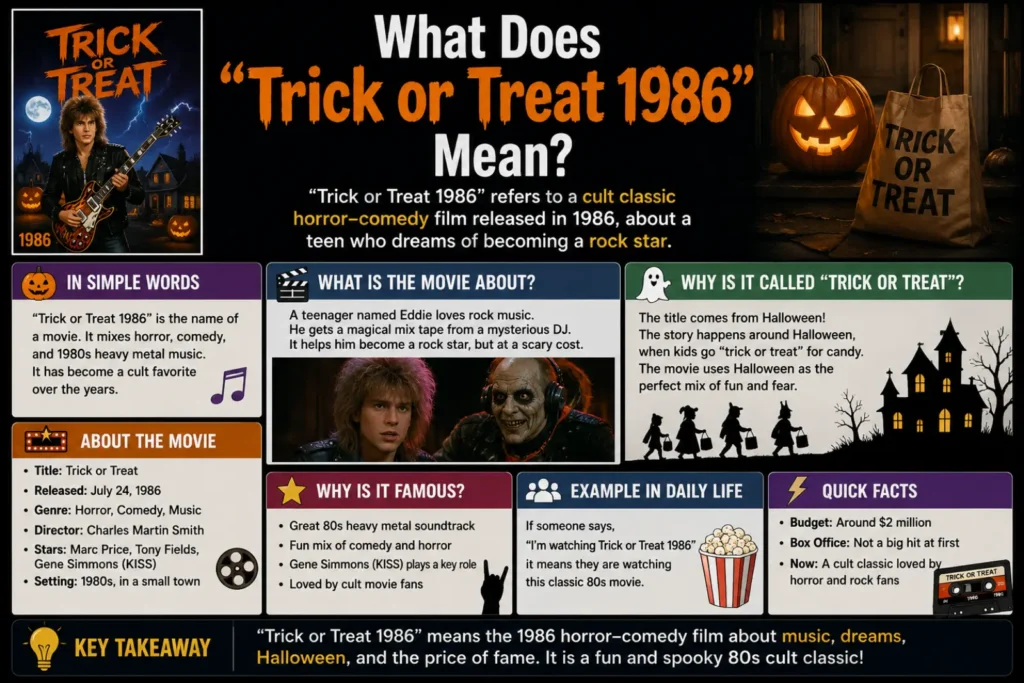
“Trick or treat 1986” describes the experience of Halloween trick-or-treating during 1986.
The phrase can refer to several things. It may describe the customs, costumes, candy, decorations, and community traditions of that year.
The year 1986 sits within a memorable period for Halloween culture. Children enjoyed neighborhood traditions before digital technology changed daily life.
Most trick-or-treating happened locally. Children walked through nearby streets with friends, siblings, or parents.
They knocked on doors and said the familiar phrase, “trick or treat.”
Homeowners then offered candy or other small treats. Some families decorated their homes for the occasion.
The experience varied by country, region, religion, and community. However, many traditions shared similar themes.
Children dressed up, visited homes, collected treats, and enjoyed a special autumn evening.
How Did Trick-or-Treating Work in 1986?
Trick-or-treating in 1986 usually followed a simple routine.
Children first chose a costume. Some families bought costumes from stores. Others made costumes at home.
Children then visited homes in their neighborhood. They often traveled in small groups.
At each door, they asked for treats. The homeowner usually placed candy into a bag, bucket, or pillowcase.
Some children carried plastic pumpkin buckets. Others used ordinary bags from home.
After visiting several homes, children returned home with their treats.
Parents often checked the candy before children ate it. This habit became an important part of Halloween safety.
Many children also compared their candy collections with friends or siblings.
The entire evening felt local and community-focused. Neighbors knew many of the children who visited.
Common Halloween Customs Around 1986
Halloween traditions differed around the world. Still, several customs appeared often in communities that celebrated trick-or-treating.
Door-to-door visits
Children walked from home to home. They usually stayed within familiar neighborhoods.
Costume dressing
Costumes created the central excitement of Halloween. Children wanted to look scary, funny, creative, or recognizable.
Candy collection
Candy remained the most common reward. Some homes also offered small toys or other treats.
Jack-o’-lanterns
Carved pumpkins appeared outside many homes. They created a classic Halloween atmosphere.
Group trick-or-treating
Children often traveled with siblings, friends, or parents.
Home decorations
Families used paper decorations, fake spider webs, lights, and handmade designs.
These traditions created a strong sense of community. They also made Halloween feel different from an ordinary evening.
What Costumes Were Popular in 1986?
Halloween costumes in 1986 reflected classic horror themes and popular entertainment.
Many children chose traditional costumes. These included:
- Ghosts
- Witches
- Vampires
- Skeletons
- Monsters
- Black cats
- Cowboys
- Princesses
- Superheroes
- Movie characters
Homemade costumes also played an important role.
Parents could create costumes using old clothes, cardboard, face paint, sheets, and household materials.
This approach encouraged creativity. It also made costumes more personal.
Some children wore costumes inspired by popular films and television shows.
However, costume choices varied greatly by country. Local culture strongly influenced Halloween celebrations.
What Was Halloween Candy Like in 1986?
Candy played a major role in trick-or-treating during 1986.
Children often received individual pieces of candy. Some homes gave small chocolate bars, hard candy, gum, or other sweets.
The exact selection depended on local shops and family budgets.
Candy packaging also looked different from today’s products. Brands, flavors, and package designs changed over time.
Many children carried their treats in simple containers. Plastic pumpkin buckets became popular in some communities.
Others used paper bags, shopping bags, or pillowcases.
After returning home, children often sorted their candy. They sometimes traded treats with siblings or friends.
This simple ritual remains one of the most memorable parts of classic Halloween.
Trick or Treating in 1986 vs Today
Halloween has changed significantly since 1986.
| Feature | Trick-or-Treating in 1986 | Trick-or-Treating Today |
|---|---|---|
| Communication | Landline phones and face-to-face planning | Smartphones and messaging apps |
| Supervision | Parents often stayed nearby | Parents may use digital location tools |
| Costumes | Homemade and store-bought options | Store-bought, custom, and online options |
| Candy | Local shops and familiar brands | Wider product variety |
| Decorations | Handmade items and simple displays | Advanced lights and large decorations |
| Safety | Basic neighborhood rules | More detailed safety planning |
| Photos | Film cameras | Instant smartphone photos |
| Community | Mostly local neighborhood visits | Neighborhood, events, malls, and organized activities |
The biggest difference involves technology.
Children in 1986 usually had less digital communication. Families planned activities more directly.
Today, parents can use digital tools to organize groups and share updates.
However, the core tradition remains familiar.
Children still dress up, visit homes, and enjoy special treats.
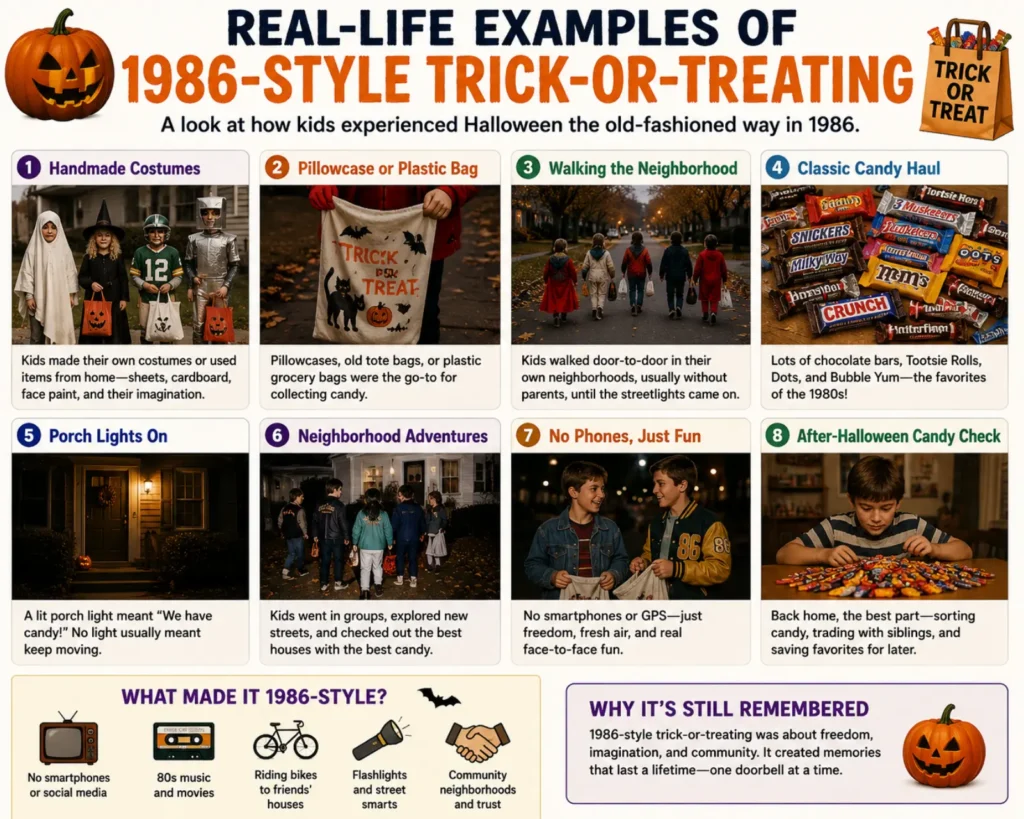
Real-Life Examples of 1986-Style Trick-or-Treating
Example 1: A neighborhood group
A group of children meets after dinner. They wear homemade costumes and carry bags.
They walk together through nearby streets.
At each house, they knock and ask for treats.
A parent stays nearby and watches the group.
Afterward, the children return home and sort their candy.
Example 2: A homemade costume
A child wants to dress as a ghost.
A family uses an old white sheet and simple face paint.
The costume costs very little.
The child still enjoys the evening because the costume feels fun and creative.
Example 3: A quiet neighborhood
Some homes do not participate in Halloween.
Children visit only houses with lights or decorations.
This helps families understand which homes welcome trick-or-treaters.
Example 4: A community celebration
Some communities organize larger Halloween events.
Children may visit several homes together.
They may also attend school parties, church events, fairs, or community gatherings.
This shows how local traditions shaped Halloween experiences in 1986.
How Did Different Countries Celebrate Halloween Around 1986?
Halloween did not have the same meaning everywhere.
The United States and Canada had strong trick-or-treating traditions.
Many children in these countries visited homes for candy.
The United Kingdom and Ireland had different regional traditions.
Halloween customs sometimes mixed with older autumn and seasonal celebrations.
Other countries had smaller Halloween celebrations.
Some communities focused more on local festivals, religious observances, or harvest traditions.
Therefore, “trick or treat 1986” does not describe one worldwide experience.
It describes a broad period of Halloween customs.
Local culture always influenced the way people celebrated.
Common Mistakes When Researching Trick or Treat 1986
Historical Halloween research can create confusion.
Here are common mistakes to avoid.
Mistake 1: Treating 1986 as the same everywhere
Halloween customs differed by country and region.
A tradition in North America may not represent another country.
Mistake 2: Assuming every child trick-or-treated
Some families did not celebrate Halloween.
Some children attended parties instead.
Others followed different cultural or religious traditions.
Mistake 3: Assuming all costumes were homemade
Many homemade costumes existed.
However, store-bought costumes also appeared during the 1980s.
Mistake 4: Using modern habits to describe 1986
Smartphones, social media, and location tracking did not shape Halloween in 1986.
Historical accuracy requires avoiding modern assumptions.
Mistake 5: Confusing nostalgia with fact
Personal memories can feel powerful.
However, one person’s experience does not represent every community.
Tips for Understanding 1986 Halloween Customs
Use these tips when researching or writing about trick or treat 1986.
Focus on local context
Ask where the celebration happened.
Country, city, and neighborhood traditions mattered.
Separate common customs from personal memories
A personal story can provide useful detail.
However, broader claims need wider evidence.
Look at the technology of the time
1986 families used different communication tools.
This affected planning, supervision, and photography.
Study popular culture
Movies, television, toys, and music influenced costume choices.
Remember economic differences
Families had different budgets.
Some children wore expensive costumes.
Others used household materials.
Consider safety practices
Parents used the safety guidance available during that period.
Modern advice may differ.
How Did Children Use Trick-or-Treating in Daily Life?
Trick-or-treating was more than a candy collection activity.
It gave children a chance to spend time with friends.
It also encouraged neighborhood interaction.
Children learned simple social habits.
They knocked on doors, greeted adults, and thanked neighbors.
Many children also enjoyed planning costumes.
They might discuss ideas with friends at school.
After Halloween, children often talked about their favorite costumes and candy.
These small social experiences created lasting memories.
The tradition also connected families within local communities.
Synonyms and LSI Keywords for “Trick or Treat 1986”
Search engines understand related terms around the main keyword.
Useful semantic keywords include:
- Halloween 1986
- Halloween traditions in the 1980s
- 1980s trick-or-treating
- vintage Halloween customs
- classic Halloween traditions
- old-fashioned trick-or-treating
- Halloween costumes from 1986
- Halloween candy in the 1980s
- 1980s Halloween nostalgia
- traditional trick-or-treating
- historical Halloween customs
- childhood Halloween memories
- Halloween neighborhood traditions
- trick-or-treat history
- mid-1980s Halloween
Use these terms naturally.
Avoid repeating the exact keyword too often.
Good SEO writing helps readers first.
Expert Insights: Why 1986 Halloween Customs Still Matter
Historical Halloween research helps explain cultural change.
The 1986 experience shows how traditions can remain stable.
Children still enjoy costumes and candy today.
However, technology has changed how families plan and supervise events.
Community habits have also changed.
Some children now attend organized events instead of visiting homes.
Many families also use larger decorations and digital planning tools.
Still, the basic idea remains familiar.
Children dress up and enjoy a special celebration.
From an SEO perspective, historical topics benefit from clear context.
Readers want dates, examples, comparisons, and simple explanations.
Strong content should also separate documented facts from personal memories.
That approach improves trust and supports better EEAT signals.
Frequently Asked Questions About Trick or Treat 1986
What was trick-or-treating like in 1986?
Children usually visited nearby homes for candy. They often wore homemade or store-bought costumes.
What costumes were popular in 1986?
Ghosts, witches, vampires, monsters, skeletons, superheroes, and movie characters were popular choices.
Did children trick-or-treat everywhere in 1986?
No. Halloween traditions varied by country, region, family, and community.
What did children use for candy bags?
Children used plastic pumpkin buckets, paper bags, ordinary shopping bags, or pillowcases.
Was Halloween different in 1986?
Yes. Families had less digital technology and relied more on local communities and face-to-face planning.
Did children wear homemade Halloween costumes?
Yes. Homemade costumes remained common, although store-bought costumes also existed.
What does “trick or treat 1986” mean?
It refers to Halloween trick-or-treating customs and experiences during the year 1986.
Why do people search for 1986 Halloween traditions?
Many people want historical information, childhood nostalgia, costume ideas, or cultural comparisons.
Conclusion
Trick or treat 1986 represents a simpler era of Halloween for many communities. Children visited nearby homes and collected candy with friends and family. Homemade costumes remained popular. Classic characters filled neighborhoods. Parents supervised children using the tools available at the time. Technology played a much smaller role in the celebration. Still, Halloween customs varied around the world. Some places embraced door-to-door trick-or-treating. Others followed different seasonal traditions. The most important lesson involves the lasting power of simple customs. Costumes, candy, community, and imagination remain central to Halloween. When people search for trick or treat 1986, they often seek more than a date. They want to understand how Halloween felt during a memorable period. That history helps connect past traditions with today’s celebrations.