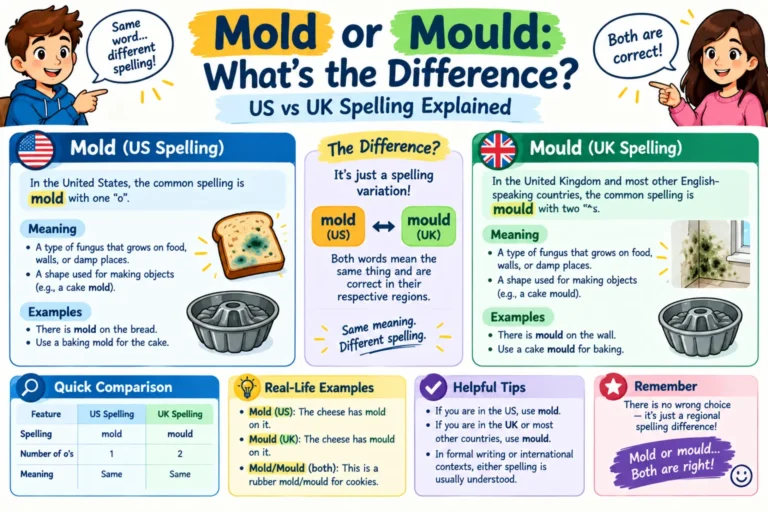
If you wonder whether to write mold or mould, both spellings are correct. The main difference comes from the type of English you use. Mold is the usual spelling in American English. Mould is the usual spelling in British English and many other English varieties.
Both words have the same basic meaning. They can describe a type of fungus that grows in damp places. They can also describe a form or shape used to make an object. The spelling changes, but the meaning usually stays the same.
Knowing the difference helps you write clear and natural English. It also helps when reading websites, books, instructions, or documents from different countries.
In this guide, you will learn when to use mold and when to use mould. You will also see simple examples and common mistakes.
Quick Summary: Mold or Mould?
- Mold is the common American English spelling.
- Mould is the common British English spelling.
- Both words have the same meaning.
- Both spellings can describe fungus or a shaping container.
- Use mold for US-focused content.
- Use mould for UK-focused content.
- Canadian, Australian, and other English varieties often prefer mould.
- The important rule is to stay consistent throughout your writing.
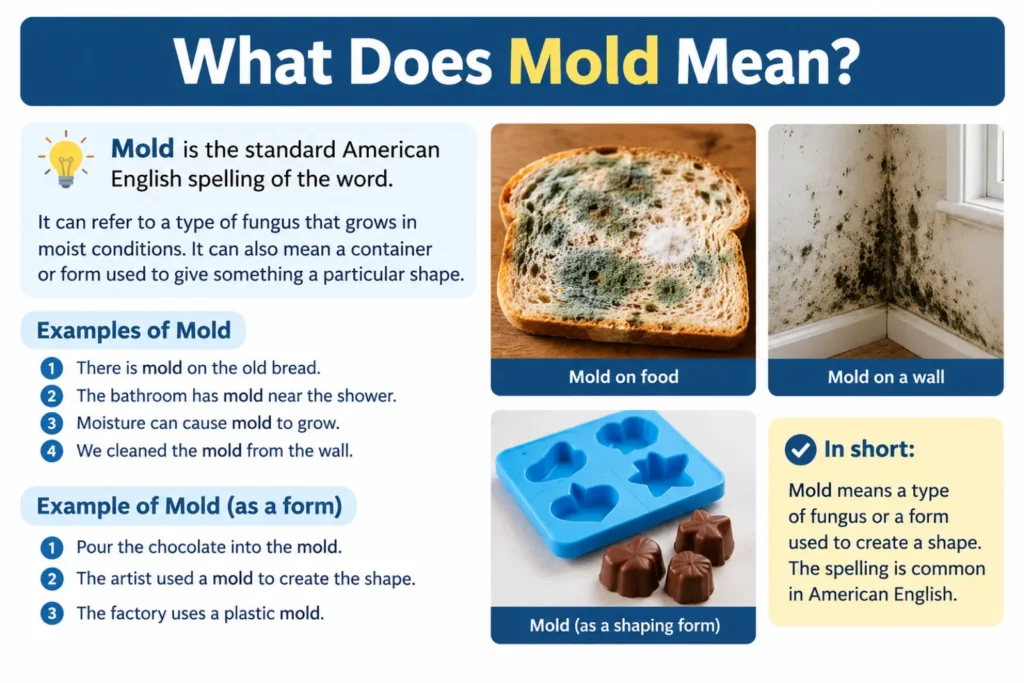
What Does Mold Mean?
Mold is the standard American English spelling of the word.
It can describe a type of fungus that grows in moist conditions. You may see mold on food, walls, ceilings, wood, or other surfaces.
For example:
- There is mold on the old bread.
- The bathroom has mold near the shower.
- Moisture can cause mold to grow.
- We cleaned the mold from the wall.
“Mold” can also have another meaning. It can describe a container or form used to give something a particular shape.
For example:
- Pour the chocolate into the mold.
- The artist used a mold to create the shape.
- The factory uses a plastic mold.
So, mold has more than one meaning. The correct meaning depends on the sentence.
What Does Mould Mean?
Mould has the same meanings as “mold.”
The main difference is spelling.
British English commonly uses mould when referring to fungus.
For example:
- There is mould on the bread.
- The bathroom has mould on the ceiling.
- Damp rooms can develop mould.
- We removed the mould from the wall.
British English also uses mould for a container or form that creates a shape.
For example:
- Pour the mixture into the mould.
- The cake was made using a round mould.
- The factory created a new mould.
Therefore, mold and mould are usually spelling variants of the same word.
Mold vs Mould: The Simple Difference
The easiest way to understand the difference is to look at the English variety.
| Feature | Mold | Mould |
|---|---|---|
| Common in American English | Yes | Less common |
| Common in British English | Less common | Yes |
| Refers to fungus | Yes | Yes |
| Refers to a shaping form | Yes | Yes |
| Meaning | Same | Same |
| Main difference | Spelling | Spelling |
The biggest difference is not meaning. It is regional spelling.
American writers usually choose mold. British writers usually choose mould.
Is Mold American or British English?
Mold is the standard American English spelling.
You will often see it in American newspapers, websites, school materials, product information, and everyday writing.
For example:
The house has mold because of excess moisture.
An American reader would normally expect “mold” without the extra u.
Other American spellings follow a similar pattern.
For example:
- color instead of colour
- favor instead of favour
- labor instead of labour
- honor instead of honour
“Mold” fits this broader American spelling pattern.
Is Mould American or British English?
Mould is the standard British English spelling.
It is also widely used in other varieties of English influenced by British spelling.
For example:
The house has mould because of excess moisture.
A British reader would normally expect “mould.”
You may also see “mould” in writing from countries such as Australia and New Zealand.
However, English spelling can vary by country, publication, company, and style guide. Always check the preferred style when writing for a specific audience.
Mold or Mould: Which Spelling Is Correct?
Both spellings are correct.
There is no need to treat one spelling as wrong.
The correct choice depends mainly on your target audience.
Use mold when writing primarily for an American audience.
Use mould when writing primarily for a British audience.
For example, an American website might say:
How to Remove Mold From Your Bathroom
A British website might say:
How to Remove Mould From Your Bathroom
The meaning remains the same.
The best SEO practice is to follow the spelling used by your target market. More importantly, keep your spelling consistent across the page.
Mold or Mould in Real-Life Examples
Seeing both spellings in context makes the difference easier to remember.
Example 1: Fungus
American English:
Mold can grow in damp areas.
British English:
Mould can grow in damp areas.
Both sentences mean the same thing.
Example 2: Food
American English:
The bread has mold on it.
British English:
The bread has mould on it.
Again, only the spelling changes.
Example 3: Construction
American English:
The contractor found mold behind the wall.
British English:
The contractor found mould behind the wall.
The regional spelling changes, but the meaning stays the same.
Example 4: Shaping object
American English:
Place the mixture into the mold.
British English:
Place the mixture into the mould.
Here, both words refer to a form used to create a particular shape.
Mold or Mould in Different Types of English
English is spoken in many countries. Each variety can have its own spelling preferences.
American English
American English generally uses mold.
Examples include:
- mold growth
- mold removal
- mold damage
- cake mold
- plastic mold
British English
British English generally uses mould.
Examples include:
- mould growth
- mould removal
- mould damage
- cake mould
- plastic mould
Australian English
Australian English generally follows British spelling conventions, so mould is commonly used.
New Zealand English
New Zealand English also commonly follows British spelling, making mould the usual choice.
Canadian English
Canadian English can use both British and American spelling patterns. Mould is commonly seen, although usage can vary.
The safest approach is simple. Check the style preferred by your audience or organization.
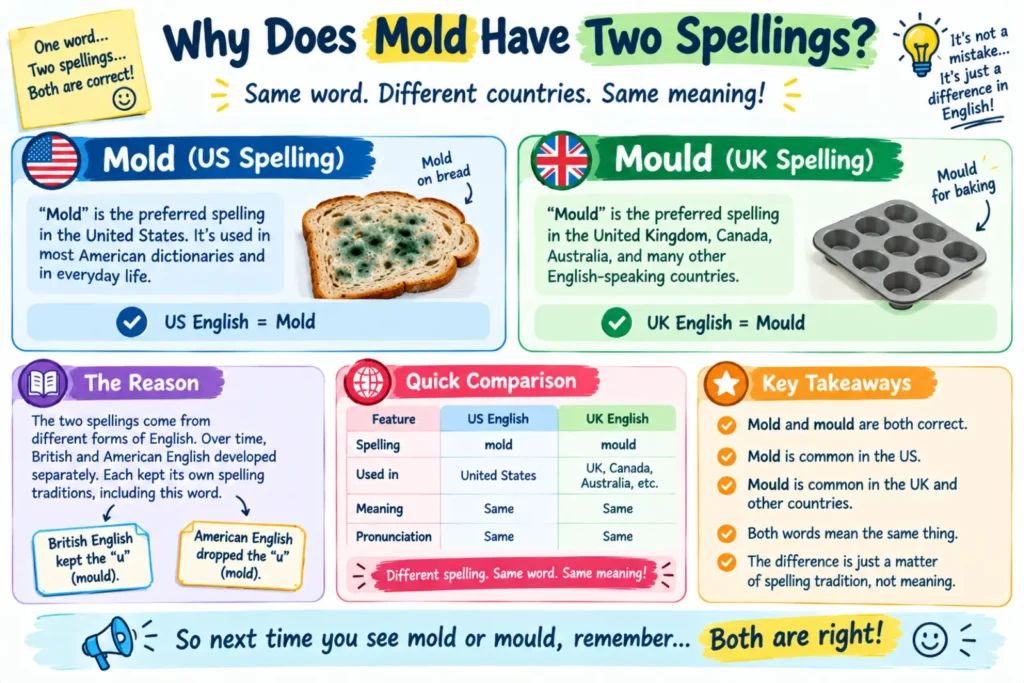
Why Does Mold Have Two Spellings?
The two spellings developed through differences between English varieties.
British spelling generally retained the -ould form.
American English later adopted several simplified spelling forms. This helped create differences such as color/colour, labor/labour, and mold/mould.
These differences do not mean that one version is better.
They simply reflect different spelling traditions.
This is why you can read “mold” on an American website and “mould” on a British website without seeing a difference in meaning.
Common Mistakes When Using Mold and Mould
Writers often make a few simple mistakes with these words.
Mistake 1: Saying one spelling is always wrong
Both forms are accepted.
The choice depends on the English variety.
Mistake 2: Mixing spellings
Avoid switching between American and British spelling without a reason.
For example, using “mold” in one section and “mould” in another can make your content look inconsistent.
Choose one style for your main audience.
Mistake 3: Confusing spelling with meaning
“Mold” and “mould” usually mean the same thing.
The extra u does not create a different definition.
Mistake 4: Using the wrong regional style
A US-focused website should normally use American spelling.
A UK-focused website should normally use British spelling.
Mistake 5: Changing every related word
If you choose British English, keep your overall spelling style consistent.
Do not change only one word while using mixed regional spelling everywhere else.
How to Remember Mold vs Mould
A simple memory trick can help.
Think of mold as the shorter American form.
Think of mould as the British form with an extra u.
You can also remember related spelling differences:
- color → colour
- favor → favour
- labor → labour
- mold → mould
This pattern can make the difference easier to remember.
Mold or Mould: Which One Should You Use for SEO?
SEO does not require you to use only one spelling.
Google can understand spelling variations and related terms. However, your content should still match your audience and search intent.
If your website targets the United States, mold should usually be your primary spelling.
If your website targets the United Kingdom, mould should usually be your primary spelling.
For an article specifically targeting the keyword “mold or mould,” you should naturally use both forms.
Include useful phrases such as:
- mold or mould
- mold vs mould
- mold and mould difference
- American English mold
- British English mould
- mold spelling
- mould spelling
- is mold or mould correct
- difference between mold and mould
Do not repeat these phrases unnaturally. Helpful content matters more than forced keyword repetition.
Synonyms and Related Terms for Mold or Mould
Depending on the meaning, several related words can appear naturally in your content.
When discussing fungus, related terms include:
- fungus
- fungal growth
- mildew
- dampness
- moisture
- spores
- fungal growth
When discussing a shaping form, related terms include:
- form
- cast
- pattern
- template
- container
- shaping tool
Be careful with synonyms. “Mildew,” for example, can have a more specific meaning in some contexts. It should not automatically replace “mold” or “mould.”
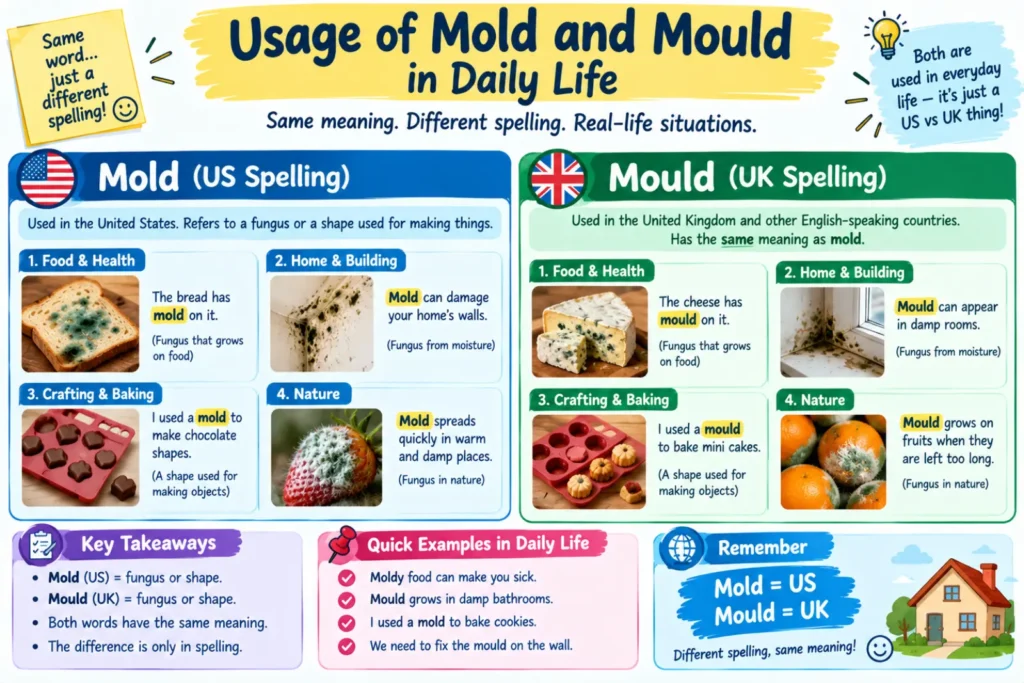
Usage of Mold and Mould in Daily Life
You may encounter these words in many everyday situations.
At home
You might read about mold or mould when discussing damp rooms, bathrooms, kitchens, or basements.
In cooking
Recipes and cooking products may use “mold” or “mould” for shaping food.
In manufacturing
Factories use molds or moulds to produce items with specific shapes.
In construction
Building professionals may discuss mold or mould when talking about moisture problems.
In education
Students may encounter both spellings when reading American and British books.
Online
Websites may use either spelling based on their target country.
Understanding both forms helps you recognize the same word across different sources.
Expert Insight: Which Spelling Is Best?
The best spelling depends on audience, location, and consistency.
US readers, choose mold.
For UK readers, choose mould.
For international content, you can mention both forms when the spelling difference matters.
From an SEO perspective, this approach has another benefit. It allows your page to answer multiple related searches naturally.
For example, someone may search “mold vs mould,” while another person may search “British spelling of mold.”
A useful article can answer both questions without creating separate pages for nearly identical intent.
For stronger EEAT signals, explain the rule clearly and avoid unsupported claims. Use examples that show how the word works in real sentences.
Frequently Asked Questions About Mold or Mould
Is mold or mould correct?
Both are correct. Mold is common in American English, while mould is common in British English.
What is the British spelling of mold?
The British spelling is mould.
What is the American spelling of mould?
The American spelling is mold.
Does mold and mould mean the same thing?
Yes. They normally have the same meaning. The main difference is regional spelling.
Is mould only a British word?
No. “Mould” is used in British English and several other English varieties. Usage can vary by country.
Is mold only an American word?
No. “Mold” is strongly associated with American English, but it can appear in other varieties too.
Should I use mold or mould on my website?
Use mold if your main audience uses American English. Use mould if your audience uses British English.
Does Google recognize mold and mould as the same word?
Search engines can understand spelling variations and related meanings. However, your content should still use natural language that matches your intended audience.
Mold or Mould: The Easy Rule to Remember
The rule is simple:
Mold = American English
Mould = British English
Both forms can refer to fungus or a form used for shaping something.
The extra u mainly signals a different spelling tradition.
If you write for one country, follow that country’s preferred spelling. If you write specifically about the spelling difference, use both forms naturally.
Conclusion: Mold or Mould?
So, should you write mold or mould? The answer depends on your audience.
Mold is the standard spelling in American English. Mould is the standard spelling in British English and is also common in several other English varieties.
Both spellings can describe fungal growth. Both can also describe a form used to shape an object. Their meanings are usually the same.
For SEO, choose the spelling that matches your target audience. Then use it consistently throughout your website. If your page targets the search term “mold or mould,” naturally explain both versions and provide real examples.
The easiest rule is worth remembering: American English uses mold, while British English uses mould. Both are correct.