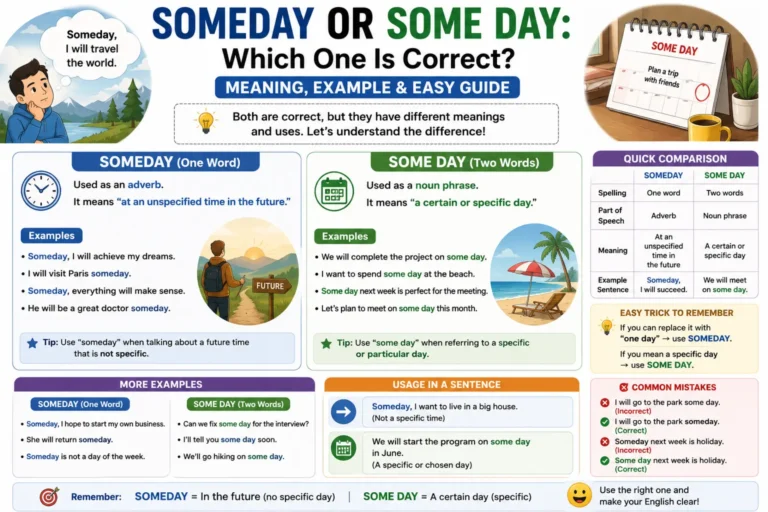
Someday or some day can be confusing because both forms are correct. The difference depends on what you want to say. Someday usually means “at an unknown time in the future.” Some day means “one particular day,” often without naming it. This small space can change the meaning of a sentence.
For example, you might say, “I hope to visit Japan someday.” Here, you mean an unknown future time. However, “Some day next week, we should meet” points to one day. Learning this simple rule can make your writing clearer. It can also help you avoid common grammar mistakes. In this guide, you will learn the meaning, differences, examples, and correct usage of someday or some day. You will also learn an easy trick for choosing the right form.
Quick Summary
- Someday means at an unknown time in the future.
- Some day means one particular or unspecified day.
- Use someday when talking about a future dream or possibility.
- Use some day when “some” directly describes the noun “day.”
- “I will travel someday” is correct.
- “Some day in June, we will meet” is also correct.
- The context usually tells you which form to use.
- A simple replacement test can help you choose.
What Does “Someday” Mean?
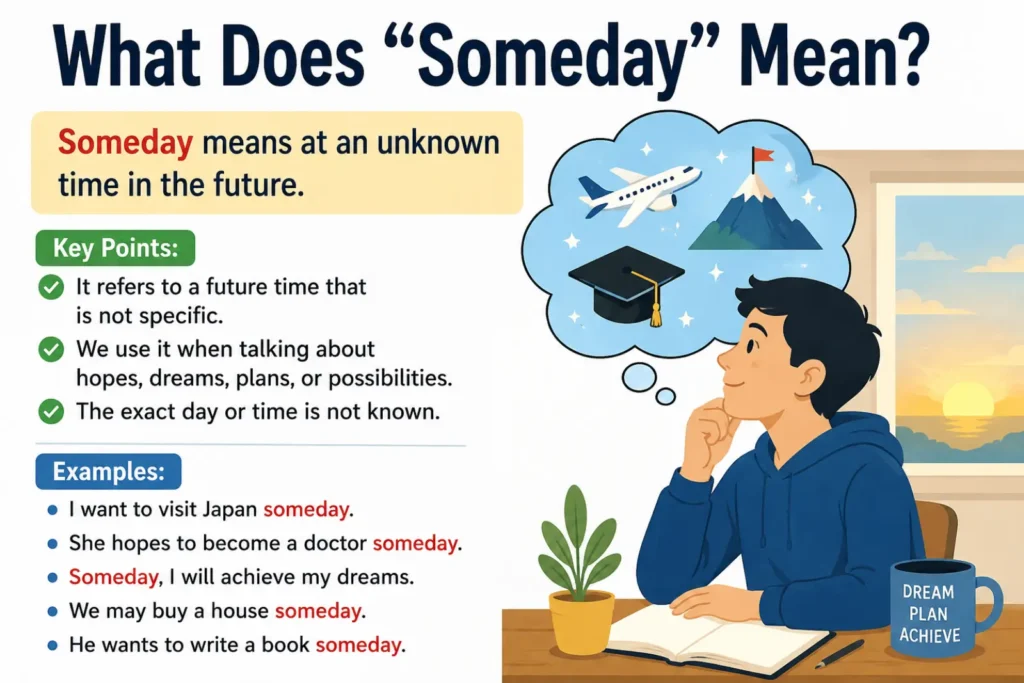
Someday is an adverb. It means “at some unknown time in the future.”
It often describes hopes, plans, dreams, or possibilities. The exact time does not matter.
For example:
- I want to learn Spanish someday.
- She hopes to become a doctor someday.
- Someday, I will visit Australia.
- We may buy a house someday.
- He wants to write a book someday.
In each example, the speaker does not give a specific date or day.
The word someday often sounds hopeful. People use it when talking about things they want to do later.
What Does “Some Day” Mean?
Some day contains two separate words: some and day.
Here, some works as a determiner that describes day. It usually means one unspecified day.
For example:
- We should meet some day next month.
- Some day, I would like to explain what happened.
- I remember some day when everything changed.
- We can discuss it some day when you have time.
The meaning depends on the sentence. However, the phrase often points toward a particular day, even when you do not know its exact date.
Think of it as:
some + day = one day
This structure helps explain why the words sometimes need to stay separate.
Someday vs. Some Day: The Main Difference
The easiest way to understand someday or some day is to focus on meaning.
| Form | Meaning | Grammar role | Example |
|---|---|---|---|
| someday | At an unknown future time | Adverb | I will visit Italy someday. |
| some day | One unspecified day | Determiner + noun | We should meet some day next week. |
There is an important difference in focus.
Someday focuses on an unknown future time.
Some day focuses on a particular day that remains unspecified.
Compare these sentences:
I hope to see you someday.
This means you hope to see the person at some unknown time.
We should choose some day to meet.
This means you need to choose one day.
The meanings can sometimes overlap. Still, the grammar gives you a useful clue.
How to Know Which One to Use
Use someday when you can replace it with:
“at some time in the future.”
Example:
I want to travel the world someday.
You can rewrite it as:
I want to travel the world at some time in the future.
The meaning stays almost the same.
Use some day when you mean:
“one day” or “a particular but unnamed day.”
Example:
We should have lunch some day.
You could say:
We should have lunch one day.
The meaning remains similar.
The Simple Test
Ask yourself:
Am I talking about an unknown future time?
If yes, use someday.
Am I talking about one day or an unspecified day?
If yes, use some day.
This test works well in most everyday situations.
Someday: Real-Life Examples
Here are common examples of someday in daily English:
- I want to visit New York someday.
- She hopes to start her own business someday.
- Someday, we will understand what happened.
- I would like to learn another language someday.
- He wants to see the northern lights someday.
- Maybe we can work together someday.
- I hope to read all these books someday.
- Someday, you may look back and laugh about this.
Notice the pattern. These sentences discuss future hopes, plans, or possibilities.
The exact day does not matter.
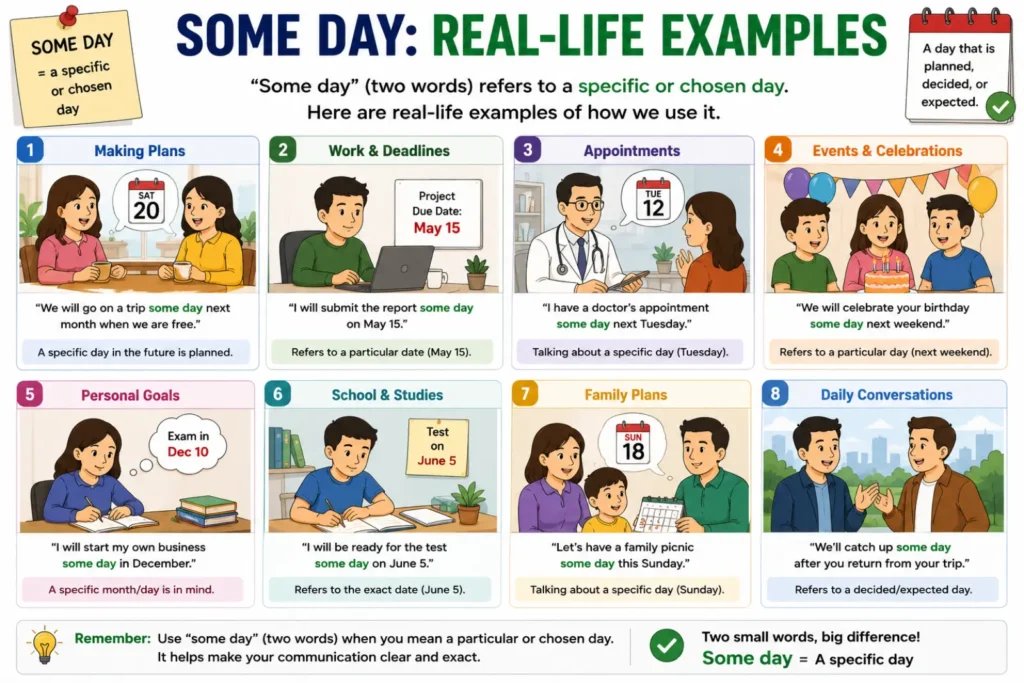
Some Day: Real-Life Examples
Now look at examples using some day:
- We should meet some day next week.
- Some day in the future, people may live on Mars.
- We can talk about it some day when you are free.
- Choose some day that works for everyone.
- I remember some day when the whole family gathered.
- Let’s pick some day in December for the event.
Here, some day works as a phrase rather than a single adverb.
The surrounding words often make this clearer.
Words such as next week, in December, that, and when can provide more information about the day.
Someday or Some Day in Questions
Both forms can appear in questions, but their meanings differ.
Using “someday”
Do you want to visit Europe someday?
This asks about a future possibility.
Using “some day”
Can we choose some day for the meeting?
This asks you to choose a particular day.
Another example:
Will you call me someday?
This means “at some future time.”
But:
Can we choose some day to talk?
This means “Can we choose one day?”
The context makes the difference clear.
Common Mistakes With Someday and Some Day
Many learners use these forms interchangeably. That can sometimes change the meaning.
Mistake 1: Using “some day” for a general future dream
Incorrect or less natural:
I want to become a pilot some day.
Better:
I want to become a pilot someday.
The first version can work in some contexts. However, someday is the natural choice for a general future hope.
Mistake 2: Joining “some day” when a specific day is meant
If you mean one particular day, keep the words separate.
Example:
We need to choose some day for the meeting.
Here, you are talking about choosing one day.
Mistake 3: Thinking “someday” means “soon”
Someday does not mean soon.
It only means an unknown time in the future.
I will learn to play the piano someday.
That could happen next year or much later.
Mistake 4: Thinking “some day” always means the past
It does not.
The phrase can describe a future day, a past day, or an unspecified day.
The surrounding sentence determines the time.
Tips and Tricks to Remember the Difference
Use these simple tricks to remember someday or some day.
Trick 1: Use the “future time” test
If you can replace the word with “at some time in the future,” choose someday.
I will finish it someday.
Trick 2: Use the “one day” test
If “one day” works, some day may be the better choice.
We should meet some day.
Becomes:
We should meet one day.
Trick 3: Look for extra details
A phrase such as some day next week usually refers to one day within a specific period.
For example:
Let’s meet some day next week.
The speaker has a day in mind, but the exact day remains open.
Trick 4: Think about dreams versus dates
Use someday for dreams and general future goals.
Use some day when you are thinking about one day that needs identification.
This is not a perfect rule, but it works in many everyday sentences.
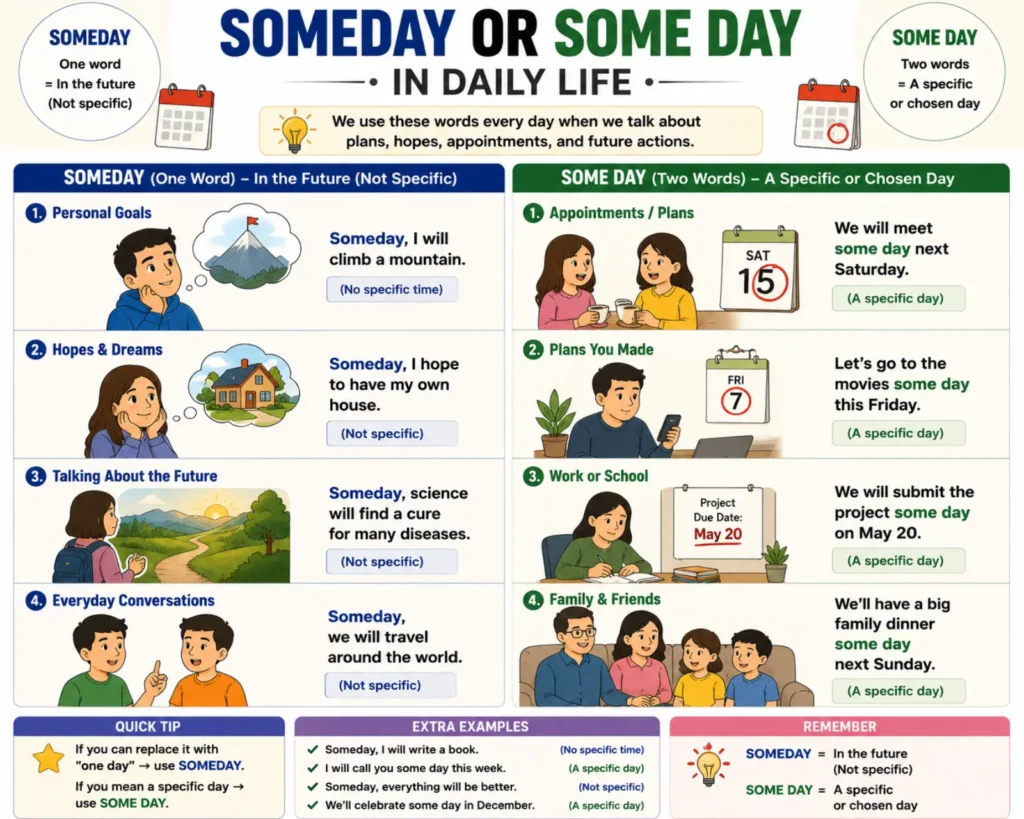
Someday or Some Day in Daily Life
You can see this difference in conversations, emails, schoolwork, and social media.
Imagine a friend says:
“I want to visit your city someday.”
They are sharing a future hope.
Now imagine someone planning a group event:
“Let’s choose some day next month.”
They are discussing a specific day for an event.
The same basic idea appears in many situations.
At school
I hope to study abroad someday.
At work
We should schedule some day for the training.
With friends
We should go hiking someday.
While planning
Let’s pick some day next weekend.
Understanding the difference helps your writing sound natural.
Synonyms and Related Terms
Learning related expressions can make the meaning easier to understand.
Synonyms for “someday”
Depending on the sentence, you can use:
- one day
- at some point
- sometime in the future
- eventually
- in the future
- at a later time
For example:
I hope to visit Canada someday.
You could also say:
I hope to visit Canada one day.
However, these expressions can have slightly different tones.
Related phrases for “some day”
You may see phrases such as:
- one particular day
- one day
- a certain day
- an unspecified day
- a day in the future
- some time on a particular day
These phrases help describe the idea of an unnamed day.
Expert Insight: Why the Difference Matters
Good grammar depends on meaning, not just spelling.
The difference between someday and some day shows how word spacing can affect grammar.
Someday acts as one word. It functions as an adverb.
Some day uses two words. Here, some modifies the noun day.
This distinction matters because strong writing gives readers clear meaning with little effort.
For SEO content, clear grammar also improves readability. Readers can scan short sentences quickly. They can also understand answers without rereading them.
A useful writing principle is simple:
Choose the form that matches your intended meaning.
Do not choose based only on how the phrase sounds.
Frequently Asked Questions
Is “someday” one word?
Yes. Someday is one word when it means an unknown time in the future.
Example:
I hope to travel someday.
Is “some day” also correct?
Yes. Some day is correct when some describes the noun day.
Example:
We need to choose some day for the event.
What is the difference between someday and some day?
Someday means “at an unknown time in the future.” Some day means “one unspecified day.”
Is “someday” formal English?
Yes. Someday is standard English and works in both everyday and formal writing.
However, the exact tone depends on the sentence.
Can I say “one day” instead of “someday”?
Yes, often.
For example:
I hope to visit Spain someday.
You can also say:
I hope to visit Spain one day.
Both can describe a future hope.
Is “some day in the future” correct?
Yes. Some day in the future is grammatically correct.
The phrase refers to one unspecified day in the future.
Which is correct: “I will do it someday” or “I will do it some day”?
I will do it someday is the more natural choice when you mean an unknown future time.
Does “someday” mean “eventually”?
Sometimes, but not always.
Both words can describe an unknown future time. However, eventually often suggests that something will happen after a process or delay.
Conclusion
Understanding someday or some day becomes easy when you focus on meaning. Use someday when you mean an unknown time in the future. Use some day when you mean one particular but unnamed day.
For example, “I hope to travel someday” describes a future dream. “We should choose some day for the meeting” describes one day that still needs a choice.
Remember the two simple tests. If “at some time in the future” fits, use someday. If “one day” fits, use some day.
This small grammar difference can make your English clearer and more natural. Once you understand the pattern, choosing the correct form becomes much easier.