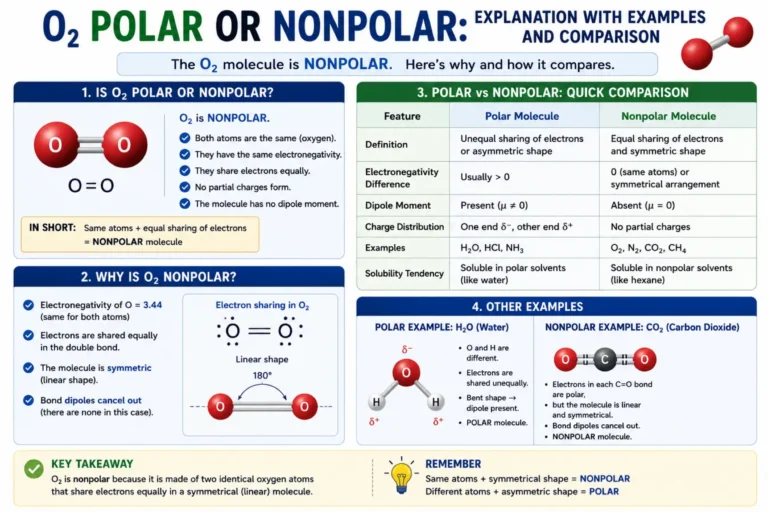
O2 polar or nonpolar is one of the most common chemistry questions students ask. The answer is simple once you understand how molecules share electrons. Oxygen gas (O2) contains two oxygen atoms joined by a double bond. Since both atoms are the same, they pull electrons equally. This equal sharing makes O2 a nonpolar molecule.
Learning about molecular polarity helps you understand chemical reactions, solubility, and bonding. It also explains why some substances mix while others do not. In this guide, you will learn why O2 is nonpolar, how polarity works, and how to identify polar and nonpolar molecules with confidence. The explanations use simple language and practical examples that make chemistry easier to understand.
Quick Summary
Is O2 Polar or Nonpolar?
- O2 is a nonpolar molecule.
- It contains two identical oxygen atoms.
- Both atoms attract electrons equally.
- The molecule has no positive or negative end.
- The electronegativity difference is zero.
- Oxygen atoms form a double covalent bond.
- The dipole moment of O2 equals zero.
What Does O2 Mean?
O2 is the chemical formula for oxygen gas.
It contains:
- Two oxygen atoms
- One double covalent bond
- Equal sharing of electrons
Oxygen gas is essential for life. Humans, animals, and many living organisms use it for breathing.
Key Facts
| Property | Value |
|---|---|
| Chemical Formula | O2 |
| Number of Atoms | 2 |
| Bond Type | Double covalent bond |
| Molecular Shape | Linear |
| Polarity | Nonpolar |
| Dipole Moment | Zero |
Why Is O2 Nonpolar?
O2 is nonpolar because both oxygen atoms are exactly the same.
Each atom has the same electronegativity. That means each atom attracts the shared electrons with equal strength.
Neither oxygen atom becomes more positive or more negative.
The electrons stay evenly distributed across the molecule.
Since there is no unequal charge distribution, O2 has no permanent dipole.
Simple Rule
Same atoms → Equal electron sharing → Nonpolar molecule
How Does Polarity Work?
Polarity depends on how atoms share electrons.
When one atom attracts electrons more strongly, the molecule becomes polar.
When atoms attract electrons equally, the molecule stays nonpolar.
Scientists use electronegativity to measure how strongly an atom pulls shared electrons.
General Rule
- Equal sharing = Nonpolar
- Unequal sharing = Polar
This rule helps predict the polarity of many molecules.
Understanding the O=O Double Bond
The two oxygen atoms connect through a double covalent bond.
A double bond means they share two pairs of electrons.
Even though they share four electrons, each oxygen atom attracts them equally.
The bond stays perfectly balanced.
Because of this balance, the entire molecule remains nonpolar.
Bond Structure
O = O
Each oxygen atom contributes electrons equally.
No side carries a stronger pull.
Electronegativity and O2
Electronegativity tells us how strongly an atom attracts shared electrons.
Oxygen has an electronegativity value of about 3.44.
Since both oxygen atoms have the same value:
- Electronegativity difference = 0
- Electrons are shared equally
- No dipole forms
Electronegativity Calculation
3.44 − 3.44 = 0
A difference of zero indicates a nonpolar covalent bond.
Does O2 Have a Dipole Moment?
No.
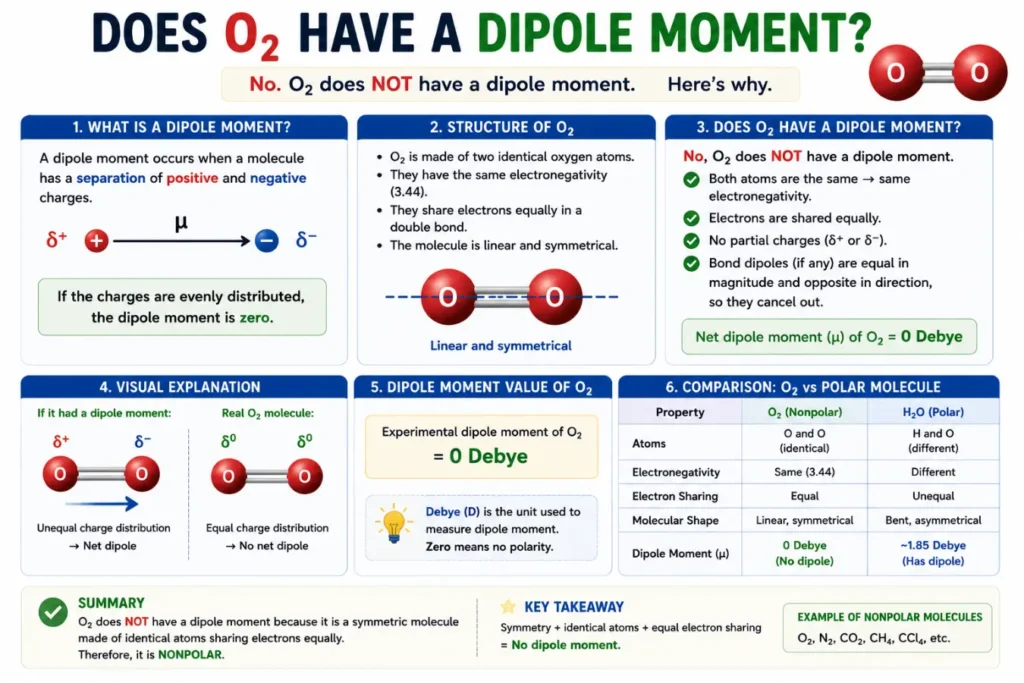
The dipole moment of O2 is zero.
A dipole moment appears only when one side of a molecule has more electron density than the other.
That does not happen in oxygen gas.
The electron cloud stays evenly balanced between the two oxygen atoms.
Therefore:
- No positive end
- No negative end
- No permanent dipole
This is another reason why O2 is classified as a nonpolar molecule.
Real-Life Examples of Nonpolar Molecules
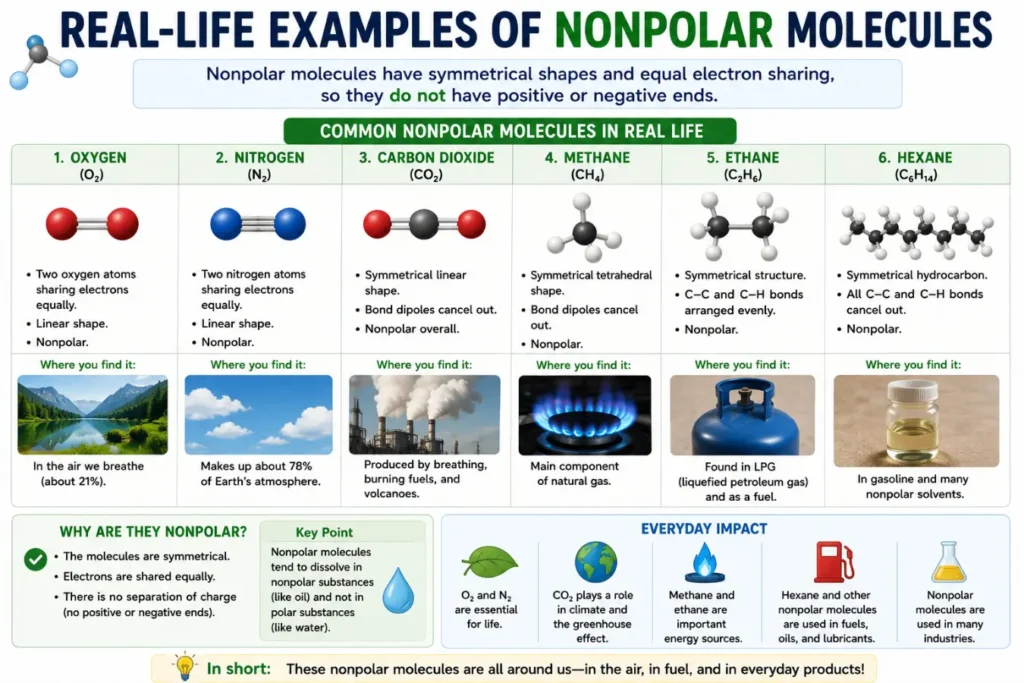
O2 is not the only nonpolar molecule.
Many common substances are also nonpolar because they contain identical atoms or have symmetrical structures.
Some examples include:
| Molecule | Polar or Nonpolar? | Reason |
| O2 | Nonpolar | Identical oxygen atoms |
| N2 | Nonpolar | Identical nitrogen atoms |
| H2 | Nonpolar | Identical hydrogen atoms |
| Cl2 | Nonpolar | Equal electron sharing |
| CH4 | Nonpolar | Symmetrical molecular shape |
These examples make it easier to recognize nonpolar molecules in chemistry.
O2 vs CO2 vs H2O: Polarity Comparison
Many students confuse O2 with CO2 and H2O. Although these molecules all contain oxygen, they do not have the same polarity.
| Molecule | Polar or Nonpolar? | Reason |
|---|---|---|
| O2 | Nonpolar | Two identical oxygen atoms share electrons equally. |
| CO2 | Nonpolar | The molecule is linear. The bond dipoles cancel each other. |
| H2O | Polar | The bent shape creates an uneven charge distribution. |
What Makes the Difference?
O2 is nonpolar because both atoms are identical.
CO2 contains polar bonds, but its symmetrical shape cancels the dipoles.
H2O has a bent shape. This shape prevents the dipoles from canceling. As a result, water is a polar molecule.
Real-Life Uses of O2 and Its Nonpolar Nature
The nonpolar nature of O2 affects how it behaves in many situations.
Here are some everyday examples.
Breathing
Humans and animals breathe oxygen every day. Oxygen enters the lungs and moves into the bloodstream.
Industrial Welding
Pure oxygen supports combustion. It helps create very hot flames for welding and cutting metals.
Medical Oxygen
Hospitals use oxygen cylinders to help patients with breathing problems.
Chemical Reactions
Oxygen participates in many chemical reactions without having a permanent dipole.
Although O2 is nonpolar, it is still highly reactive under the right conditions.
Common Mistakes Students Make
Students often confuse bond polarity with molecular polarity.
Avoid these common mistakes.
Mistake 1: Thinking Every Oxygen Compound Is Polar
Not every molecule containing oxygen is polar.
O2 and CO2 are nonpolar.
H2O is polar.
Mistake 2: Ignoring Molecular Shape
Shape plays an important role.
Some molecules contain polar bonds but remain nonpolar because the dipoles cancel.
Mistake 3: Looking Only at Bonds
Always examine the entire molecule.
Molecular polarity depends on both bond polarity and molecular geometry.
Tips to Identify Polar and Nonpolar Molecules
You can determine molecular polarity by following these simple steps.
Step 1
Look at the atoms.
Identical atoms usually form nonpolar bonds.
Step 2
Compare electronegativity values.
A larger difference means a more polar bond.
Step 3
Check the molecular shape.
Symmetrical molecules often have no overall dipole.
Step 4
Ask whether the dipoles cancel.
If they cancel, the molecule is nonpolar.
If they do not cancel, the molecule is polar.
Synonyms and Related Terms
Search engines recognize related terms that help readers understand the topic.
Some useful related keywords include:
- oxygen polarity
- is oxygen polar
- oxygen molecule polarity
- O2 molecular polarity
- nonpolar covalent bond
- molecular polarity
- covalent bonding
- electronegativity
- dipole moment
- linear molecules
- chemical bonding
- polar vs nonpolar molecules
- why is O2 nonpolar
- oxygen molecule structure
Using these naturally improves topical relevance without overusing the main keyword.
Expert Insight
Chemists determine molecular polarity by examining three important factors.
- Bond polarity
- Molecular geometry
- Overall dipole moment
O2 is one of the simplest examples of a nonpolar molecule because every factor points to the same conclusion.
Understanding O2 helps build a strong foundation for studying more complex molecules such as NH3, SO2, CO2, and H2O.
Learning polarity also makes topics like intermolecular forces, solubility, and chemical reactions much easier.
Frequently Asked Questions
Is O2 polar or nonpolar?
O2 is nonpolar because both oxygen atoms share electrons equally.
Why is O2 not polar?
The two oxygen atoms have the same electronegativity. No permanent dipole forms.
Does O2 have a dipole moment?
No. The dipole moment of O2 is zero.
Is the O=O bond polar?
No. The bond is nonpolar because both atoms are identical.
Why is H2O polar but O2 is nonpolar?
Water has a bent molecular shape and unequal charge distribution. O2 has identical atoms and equal electron sharing.
Is CO2 polar like O2?
No. CO2 contains polar bonds, but its linear shape cancels the dipoles. Therefore, it is also nonpolar.
Does O2 dissolve in water?
Yes. Oxygen dissolves slightly in water. Fish and other aquatic organisms depend on this dissolved oxygen for survival.
Why is polarity important in chemistry?
Polarity affects solubility, intermolecular forces, boiling points, and chemical reactions.
Conclusion
The answer to “O2 polar or nonpolar” is simple. Oxygen gas (O2) is a nonpolar molecule because it contains two identical oxygen atoms that share electrons equally. The electronegativity difference is zero, so no permanent dipole forms. As a result, the molecule has an even charge distribution.
Understanding why O2 is nonpolar also helps you identify the polarity of many other molecules. Always examine the atoms involved, compare their electronegativity values, and consider the molecule’s shape before deciding whether it is polar or nonpolar. With these simple steps, you can solve polarity questions more accurately and build a stronger understanding of chemistry.