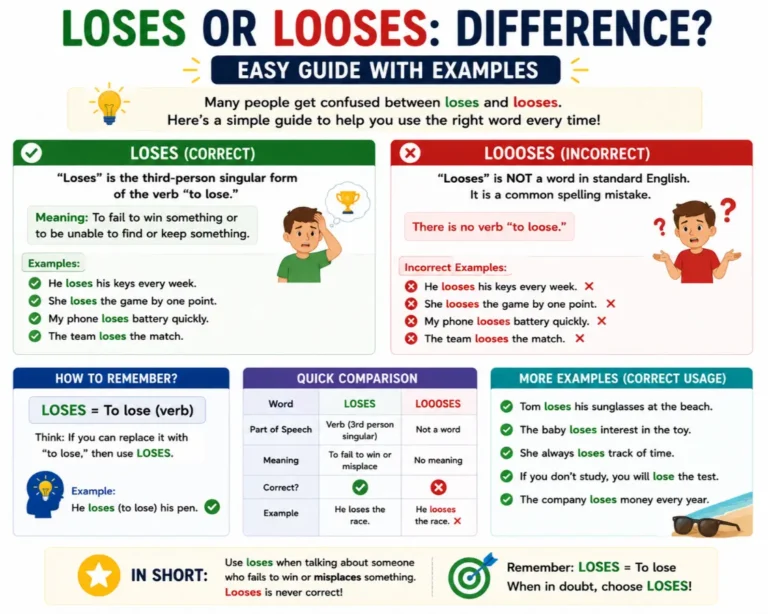
Loses or looses is one of the most common spelling questions in English. Many people mix up these two words because they look similar. However, they have different meanings and uses. Using the wrong word can change the meaning of your sentence.
The good news is that the difference is easy to learn. Once you understand how each word works, you will avoid this mistake in writing and speaking. In this guide, you will discover the meaning of each word, see simple examples, and learn easy tricks to remember the correct spelling. By the end, you will know exactly when to use loses and when to use looses with confidence.
Quick Summary
Loses or Looses at a Glance
- Loses is the correct form of the verb lose.
- Looses comes from the verb loose.
- Loses means to misplace something or fail to win.
- Looses means to release or set free.
- Most people need loses, not looses.
- “Looses” is much less common in everyday English.
What Is the Difference Between Loses and Looses?
Loses is the third-person singular form of the verb lose. It means to fail to keep, fail to win, or no longer have something. Looses is the third-person singular form of loose, which means to release, untie, or let something go. In most everyday writing, loses is the correct choice.
What Does “Loses” Mean?
Loses comes from the base verb lose.
It means someone no longer has something or fails to achieve something.
Common Meanings
- Misplaces an item
- Fails to win
- No longer has possession
- Misses an opportunity
Examples
- She loses her keys every month.
- He loses every chess game.
- The company loses money each year.
- My phone loses battery quickly.
In each sentence, loses means something is gone, missed, or not won.
What Does “Looses” Mean?
Looses comes from the verb loose.
It means to release, free, or let something go.
People rarely use this word in everyday conversation.
Common Meanings
- Releases
- Frees
- Lets go
- Unties
Examples
- The hunter looses an arrow.
- She looses the dog from its leash.
- The captain looses the ropes before sailing.
Although correct, these sentences appear mostly in literature, history, or formal writing.
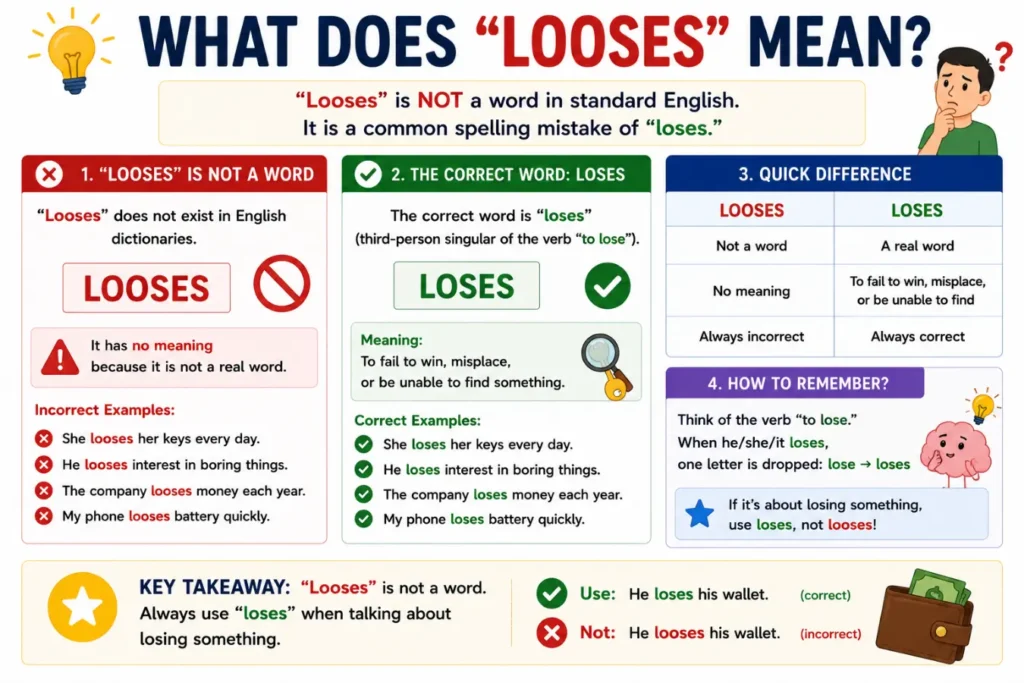
Loses vs Looses: Comparison Table
Understanding the differences becomes easier with a side-by-side comparison.
| Feature | Loses | Looses |
|---|---|---|
| Base Word | Lose | Loose |
| Part of Speech | Verb | Verb |
| Meaning | Fails to keep or win | Releases or sets free |
| Everyday Use | Very common | Rare |
| Example | She loses her wallet. | He looses an arrow. |
Quick Memory Tip
If someone loses something, they no longer have it.
If someone looses something, they let it go.
Why Do People Confuse Loses and Looses?
These words look almost identical.
They also sound similar when spoken.
However, they come from different base words.
Many writers mistakenly believe that adding another “o” creates the correct spelling.
Another reason is pronunciation.
English spelling often does not match pronunciation perfectly.
As a result, many people type looses when they actually mean loses.
Real-Life Examples
Here are examples you may see every day.
Correct Uses of “Loses”
- My team loses every Friday.
- She loses her glasses often.
- He loses interest quickly.
- The store loses customers during winter.
- Our dog loses lots of hair.
Correct Uses of “Looses”
- The archer looses another arrow.
- She looses the horse into the field.
- The sailor looses the anchor rope.
Notice that loses appears much more often in daily communication.
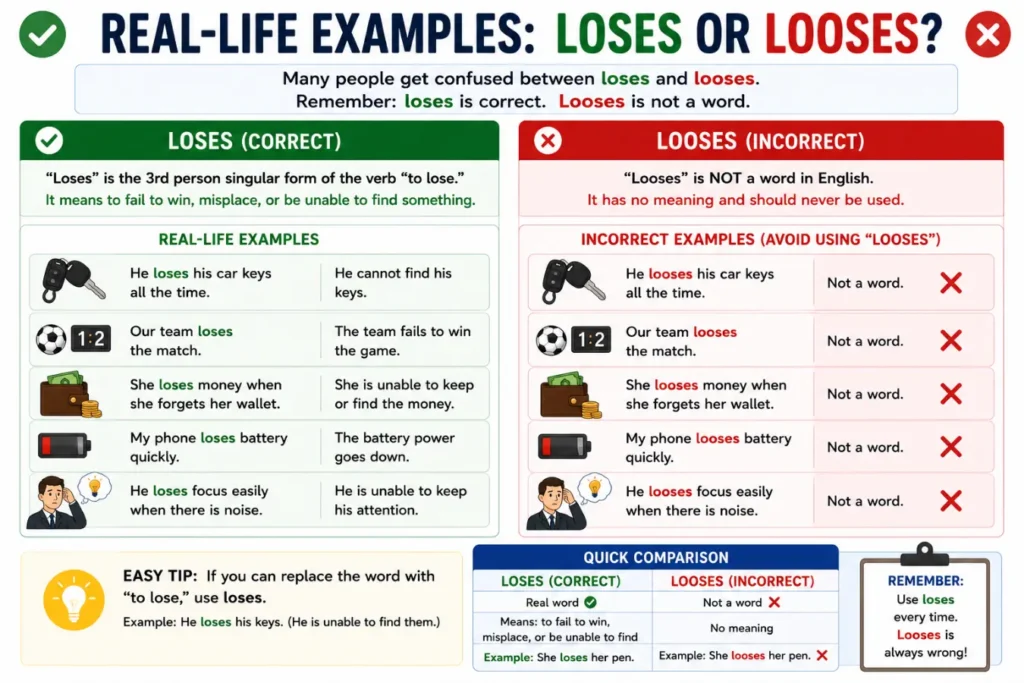
When Should You Use “Loses”?
Use loses whenever someone:
- Cannot find something
- Fails a game
- Misses an opportunity
- Gives up possession
- Experiences a decrease
Everyday Examples
- He loses his homework.
- She loses the race.
- The phone loses signal.
- My plant loses its leaves in winter.
If you mean “no longer has,” the correct word is almost always loses.
When Should You Use “Looses”?
Use looses only when something is released or set free.
This meaning appears less often in modern English.
Examples
- The knight looses his sword from its holder.
- The farmer looses the animals into the field.
- The commander looses the troops.
In modern writing, you will rarely need this word unless you are describing releasing something.
Common Mistakes When Using Loses or Looses
Many writers confuse these words because they look alike. Learning the common mistakes helps you avoid them.
Mistake 1: Using “Looses” Instead of “Loses”
❌ She looses her phone every week.
✅ She loses her phone every week.
The sentence talks about misplacing something. Therefore, loses is correct.
Mistake 2: Thinking “Loose” Is the Same as “Lose”
Loose is an adjective.
Lose is a verb.
Examples:
- The shirt is loose.
- I do not want to lose my shirt.
Mistake 3: Adding an Extra “O”
Many people think the extra “o” makes the spelling correct.
It does not.
Remember:
- Lose → Loses
- Loose → Looses
Easy Tricks to Remember the Difference
You can remember these words with simple memory tricks.
Trick 1: Lose Has One “O”
The word lose has one “o.”
Its third-person form is loses.
Trick 2: Loose Means Not Tight
Think about a loose shoelace.
If you make it loose, you release it.
That idea connects with looses, which means “sets free.”
Trick 3: Everyday Writing Uses “Loses”
Most emails, essays, and messages need loses.
You will rarely need looses.
Usage in Daily Life
You probably use loses much more than looses.
Here are common situations.
School
- She loses her notebook.
- He loses points on the test.
At Work
- The company loses customers.
- The business loses money.
At Home
- Dad loses the TV remote.
- The plant loses leaves.
In Sports
- Our team loses the match.
- The player loses the ball.
These examples show why loses is one of the more common English verbs.
Synonyms and Related Keywords
Using related words helps readers understand the topic better.
Synonyms for “Lose”
- Misplace
- Miss
- Forfeit
- Drop
- Surrender
- Give up
Synonyms for “Loose”
- Release
- Free
- Untie
- Unfasten
- Let go
- Unbind
LSI Keywords
- lose vs loose
- loses meaning
- looses meaning
- lose or loose
- correct spelling
- English grammar
- common spelling mistakes
- grammar tips
- confusing English words
- spelling differences
These related keywords improve topical relevance without overusing the main keyword.
Expert Insight
Grammar experts recommend learning words in context instead of memorizing spelling alone.
Think about the meaning before choosing a word.
Ask yourself a simple question.
Is something being lost or released?
If something is missing or not won, use loses.
If something is being released or set free, use looses.
Building this habit improves your writing accuracy and confidence.
Frequently Asked Questions
Is it loses or looses?
Loses is correct when someone fails to keep or win something. Looses means releases or sets free.
What is the difference between loses and looses?
Loses means to no longer have something. Looses means to release something.
Is “looses” a real word?
Yes. It is a real English word, but people rarely use it in everyday writing.
Why do people spell loses as looses?
The words look and sound similar. This often leads to spelling mistakes.
Which word is more common?
Loses is far more common than looses.
Is “lose” the same as “loose”?
No.
Lose is a verb.
Loose is usually an adjective that means “not tight.”
How can I remember the correct spelling?
Remember that lose has one “o.” Therefore, loses also has one “o.”
Conclusion
Understanding loses or looses is easier than many people think. Loses means someone no longer has something or fails to win. Looses means to release or set something free. Although the words look similar, their meanings are very different. In everyday writing, you will almost always use loses. The word looses appears mainly in historical, literary, or formal contexts.
Before you write, think about what you want to say. If someone misplaces an item, misses an opportunity, or fails to win, choose loses. If someone releases or unties something, choose looses. With this simple rule, you can avoid a common spelling mistake and write with greater confidence.