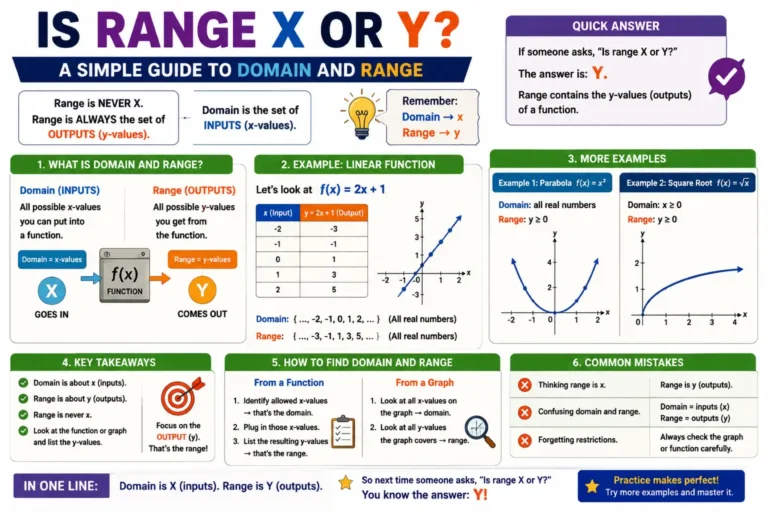
Is range x or y? In math, the range usually refers to the y-values of a function. The domain refers to its x-values. This difference helps you read graphs, solve functions, and understand data. Think of x as the input and y as the output. When you put an x-value into a function, you get a y-value. Those possible y-values form the range.
For example, consider the function (y=x^2). You can use many x-values as inputs. However, the output can never be negative. Therefore, its range is (y\geq0).
This guide explains the difference in simple terms. You will also see examples, tables, tips, and common mistakes.
Quick Summary: Is Range X or Y?
- Domain = x-values, or inputs.
- Range = y-values, or outputs.
- Range tells you which outputs a function can produce.
- On a graph, domain uses the horizontal x-axis.
- Range uses the vertical y-axis.
- A function can have restricted x-values and y-values.
- Always check the function or graph before deciding the range.
What Does Range Mean in Math?
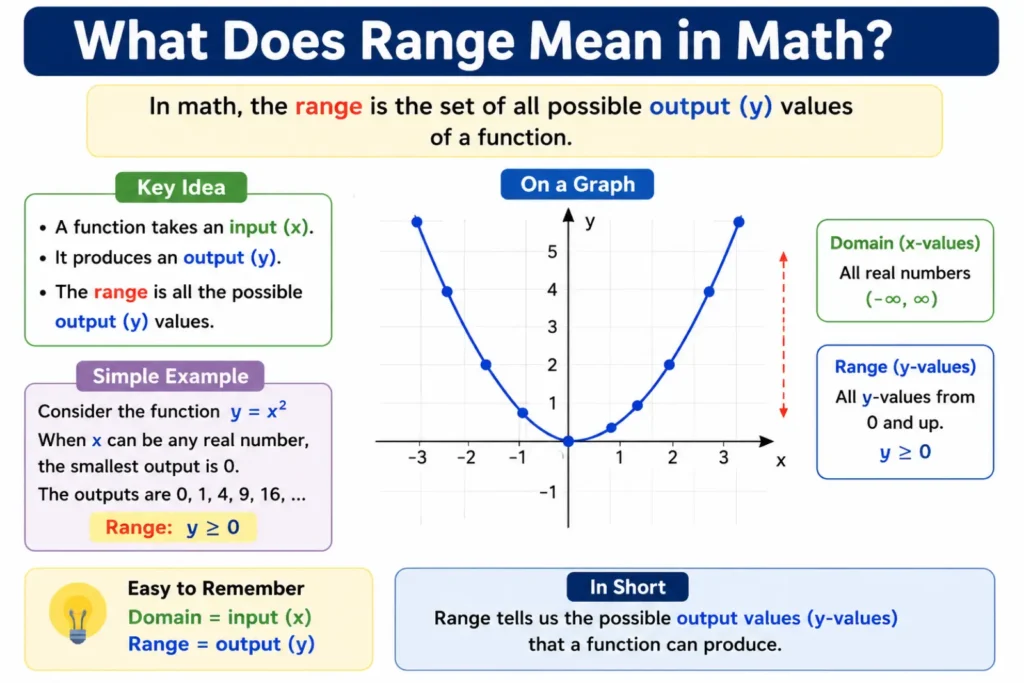
The range is the set of all possible output values from a function.
In most basic functions, we write inputs as x. We write outputs as y or (f(x)).
For example:
[
y=2x+1
]
Here, x is the input. The value of y changes when x changes.
If (x=1):
[
y=2(1)+1=3
]
If (x=2):
[
y=2(2)+1=5
]
If (x=3):
[
y=2(3)+1=7
]
So the outputs are 3, 5, and 7 for those inputs.
In function notation, the range contains the values that the function actually produces.
Is Range X or Y?
The short answer is y.
The range describes the possible y-values in a function.
The domain describes the possible x-values.
A simple way to remember this is:
Domain = x = input
Range = y = output
This rule works for most basic function questions.
For example, if a graph has points with x-values from 1 to 5, those x-values describe the domain. If its y-values run from 2 to 10, those y-values describe the range.
Domain vs. Range: What Is the Difference?
Domain and range describe different parts of a function.
| Feature | Domain | Range |
|---|---|---|
| Meaning | Possible inputs | Possible outputs |
| Common letter | x | y |
| Graph direction | Horizontal | Vertical |
| Question to ask | What x-values work? | What y-values occur? |
| Function role | Input | Output |
OpenStax defines the first components of ordered pairs as the domain. It defines the second components as the range.
For example:
[
{(1,2),(2,4),(3,6),(4,8)}
]
The domain is:
[
{1,2,3,4}
]
The range is:
[
{2,4,6,8}
]
How Can You Remember Which Is the Range?
Use this simple memory trick:
D comes before R.
Think:
Domain → input → x
Range → output → y
You can also remember the graph.
The x-axis runs from left to right. The y-axis runs up and down.
When finding the domain, look side to side.
When finding the range, look up and down.
This method works especially well when you read a graph.
How to Find the Range From a Graph
Finding the range from a graph is often simple.
Follow these steps:
- Look at the graph.
- Ignore the horizontal x-values at first.
- Find the lowest y-value.
- Find the highest y-value.
- Check whether the endpoints count.
- Write the answer using inequalities or interval notation.
Suppose a graph starts at (y=2) and ends at (y=8).
If both endpoints count, the range is:
[
2\leq y\leq8
]
In interval notation, you can write:
[
[2,8]
]
A closed dot means the endpoint counts. An open circle means it does not.
How to Find the Range From a Function
You can also find the range directly from an equation.
Consider:
[
f(x)=x^2
]
A squared number cannot produce a negative result.
For example:
[
(-3)^2=9
]
[
(-2)^2=4
]
[
0^2=0
]
[
2^2=4
]
Therefore, the smallest output is 0.
The range is:
[
y\geq0
]
This is a classic example where the domain contains all real x-values, but the range has a restriction.
Real-Life Examples of Domain and Range
Domain and range appear in many real-life situations.
Example 1: Temperature
Suppose a temperature model uses time as its input.
- x = time
- y = temperature
The domain represents the times you measure.
The range represents the temperatures recorded.
Example 2: School Test Scores
Imagine a function that connects students with their test scores.
The students can act as inputs.
Their scores become outputs.
The possible scores form the range.
Example 3: Distance and Time
Suppose a cyclist travels for two hours.
- x = time
- y = distance
The time values form the domain.
The distances traveled form the range.
These examples show why input and output matter outside the classroom.
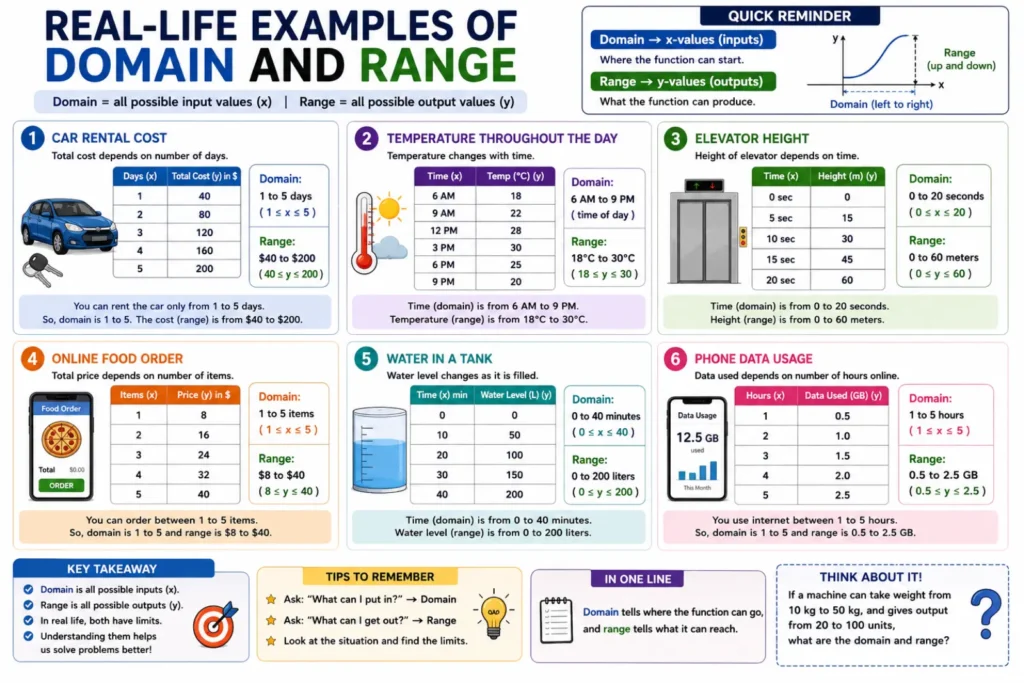
What Is the Range of (y=x^2)?
The range of:
[
y=x^2
]
is:
[
y\geq0
]
Why?
Every real number becomes zero or positive when squared.
The graph also shows this clearly. The parabola has a lowest point at (y=0). It then rises on both sides.
So the range includes zero and every positive number.
This example is useful because it clearly separates domain from range.
The domain is:
[
x\in\mathbb{R}
]
The range is:
[
y\geq0
]
What Is the Range of a Linear Function?
Consider:
[
y=2x+3
]
If x can be any real number, y can also take any real number.
Therefore:
Domain:
[
x\in\mathbb{R}
]
Range:
[
y\in\mathbb{R}
]
A linear function can keep increasing or decreasing without a fixed maximum or minimum.
However, restrictions can change the answer.
For example, if the problem says (x>2), then the possible y-values also become restricted.
So always check the given domain.
Common Mistakes When Finding the Range
Students often make a few simple errors.
Mistake 1: Calling x the range
This usually happens when students confuse input and output.
Remember:
x = domain
y = range
Mistake 2: Looking at the wrong axis
The x-axis helps you find the domain.
The y-axis helps you find the range.
Mistake 3: Ignoring open circles
An open circle means that point does not belong to the graph.
Therefore, that endpoint may not belong in the range.
Mistake 4: Forgetting function restrictions
A function may restrict its outputs.
For example:
[
y=x^2
]
cannot produce negative y-values.
Mistake 5: Confusing range with data spread
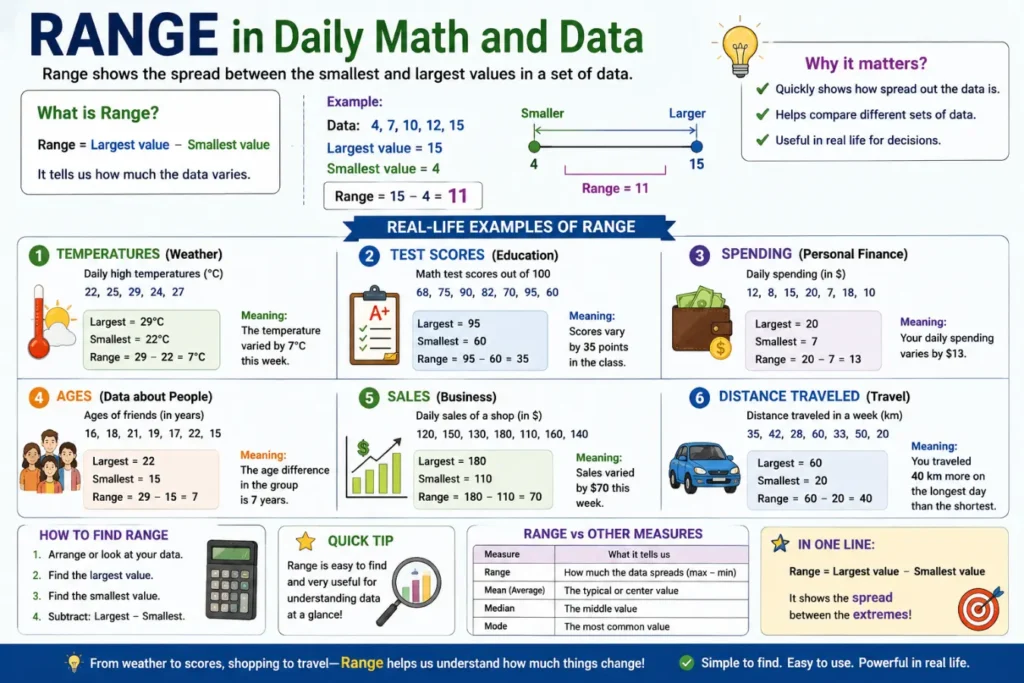
In statistics, “range” can also mean the difference between the largest and smallest data values.
For example:
[
3,7,10,15
]
The statistical range is:
[
15-3=12
]
That meaning differs from the range of a function.
Tips and Tricks for Finding the Range
Use these quick strategies when solving problems.
Tip 1: Ask what comes out.
The output usually represents the range.
Tip 2: Look vertically on graphs.
The vertical direction represents y.
Tip 3: Check the lowest and highest outputs.
These often reveal the range quickly.
Tip 4: Watch for restrictions.
Square roots, fractions, and restricted domains can change the range.
Tip 5: Check endpoint symbols.
Closed dots include values. Open circles exclude them.
Tip 6: Use test values.
Substitute simple x-values into the function.
This can help you spot the possible outputs.
Range in Daily Math and Data
The word “range” does not always mean the same thing.
In functions, range means possible outputs.
In statistics, range often means the difference between the largest and smallest values.
For example:
[
5,8,11,20
]
The statistical range is:
[
20-5=15
]
In a function, however, you might describe the range as a set of possible y-values.
Knowing the context prevents confusion.
Synonyms and Related Terms for Range
You may see several related terms in math resources.
Common terms include:
- Output values
- y-values
- Function outputs
- Set of outputs
- Possible outputs
- Image of a function
- Range of a function
- Dependent variable
The exact wording can change, but the basic idea remains the same.
The range describes the values produced by the function.
Expert Insight: Why Domain and Range Matter
Domain and range form the foundation of function work.
They help you understand what a function accepts and produces.
They also help you read graphs correctly.
A strong approach starts by identifying the input and output.
Then, check any restrictions.
For example, a denominator cannot equal zero. A square root with real outputs cannot contain a negative number.
This matters in algebra, calculus, statistics, science, and data analysis.
Expert tip: Never guess the range from the equation alone. Check the domain too.
A restricted domain can create a restricted range.
Frequently Asked Questions
Is the range x or y?
The range is usually the y-values. The domain is usually the x-values.
Is x the domain or range?
x usually represents the domain. It acts as the input variable.
Is y the domain or range?
y usually represents the range. It acts as the output variable.
How do you find the range?
Look at the possible output values. On a graph, examine the y-values. In an equation, analyze the possible outputs.
What is the range of (x^2)?
For (y=x^2), the range is:
[
y\geq0
]
Can x and y both have the same range?
Yes. The letters do not determine the actual values. Domain and range depend on the function.
Is range always written with y?
Not always. You can write a range using (f(x)), interval notation, words, or set notation. However, y commonly represents the output.
What is the difference between function range and statistical range?
A function’s range contains possible outputs. A statistical range is often the largest value minus the smallest value.
Conclusion
So, is range x or y? In basic functions, the range is the y-values. The domain is the x-values. Think of x as the input and y as the output. The range tells you which outputs the function can produce.
For a graph, inspect the vertical y-values. For an equation, study the possible outputs. Always check restrictions and endpoint symbols. Also remember that “range” has another meaning in statistics. There, it often means the largest value minus the smallest value.
The easiest rule is simple:
Domain = x = input.
Range = y = output.
Keep this rule in mind, and many domain-and-range questions become much easier.