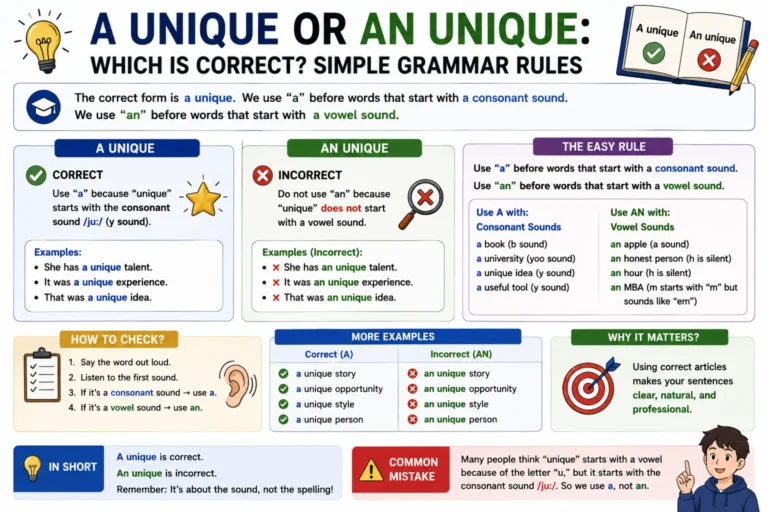
A unique or an unique is a common English grammar question. The correct phrase is “a unique”, not “an unique.” The reason is simple. English uses a before a consonant sound. It uses an before a vowel sound. The word unique starts with the sound /juː/. This sound is similar to the beginning of “you.” So, unique begins with a consonant sound. That makes “a unique” grammatically correct. Many learners choose “an” because u is a vowel letter. However, English articles depend on sound, not only spelling. In this guide, you will learn the rule, see clear examples, and avoid common mistakes. You will also learn when to use a, an, and the with confidence.
Quick Summary
- “A unique” is correct.
- “An unique” is incorrect in standard modern English.
- Use a before a consonant sound.
- Use an before a vowel sound.
- Unique begins with the consonant sound /y/.
- Say “a unique idea,” not “an unique idea.”
- The same rule applies to words like university and uniform.
- The letter u does not always require an.
What Does “A Unique” Mean?
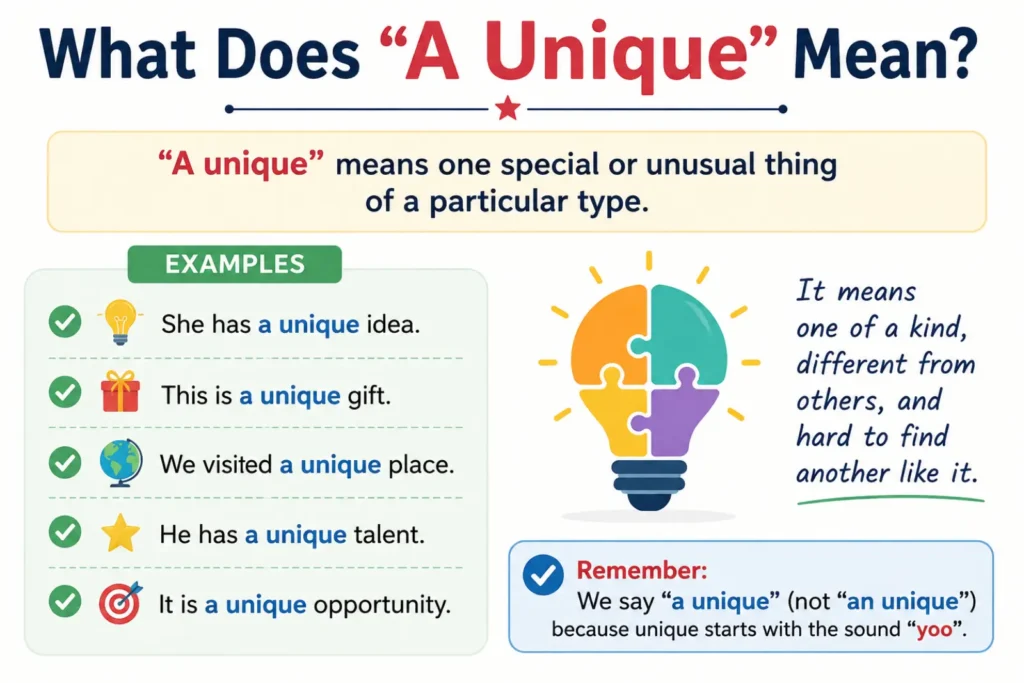
“A unique” means one special or unusual thing of a particular type.
The word unique means one of a kind or different from others.
For example:
- She has a unique style.
- We found a unique solution.
- He owns a unique collection.
- This place has a unique history.
The article a comes before unique because of its sound.
You should pronounce the phrase like “a you-neek.”
That first sound is not a pure vowel sound.
Therefore, “a unique” is the correct choice.
Why Is “A Unique” Correct?
The main rule is easy:
Use a before a consonant sound. Use an before a vowel sound.
Look at these examples:
| Correct phrase | Reason |
|---|---|
| a unique idea | “unique” starts with a /y/ sound |
| a university | “university” starts with a /y/ sound |
| a uniform | “uniform” starts with a /y/ sound |
| a European country | “European” starts with a /y/ sound |
| an umbrella | “umbrella” starts with a vowel sound |
| an unusual idea | “unusual” starts with a vowel sound |
| an honest person | “honest” starts with a vowel sound |
The spelling can sometimes confuse learners.
However, pronunciation determines the article.
A Unique or An Unique: The Basic Grammar Rule
The difference between a and an depends on sound.
Use a when the next word begins with a consonant sound.
Examples include:
- a book
- a car
- a useful tool
- a unique opportunity
- a university
- a uniform
Use an when the next word begins with a vowel sound.
Examples include:
- an apple
- an orange
- an idea
- an hour
- an honest answer
- an unusual event
Notice something important.
Useful starts with the letter u, but we say “a useful tool.”
Unique works the same way.
So, remember this simple rule:
Sound first, spelling second.
How Do You Pronounce “Unique”?
The word unique usually sounds like:
you-neek
Its first sound resembles the word “you.”
That gives it a consonant sound at the beginning.
Therefore:
- a unique idea ✅
- a unique experience ✅
- a unique opportunity ✅
- an unique idea ❌
- an unique experience ❌
- an unique opportunity ❌
This pronunciation rule explains the grammar clearly.
You do not need to memorize every example.
Just listen to the first sound.
Real-Life Examples of “A Unique”
You can use “a unique” in everyday English.
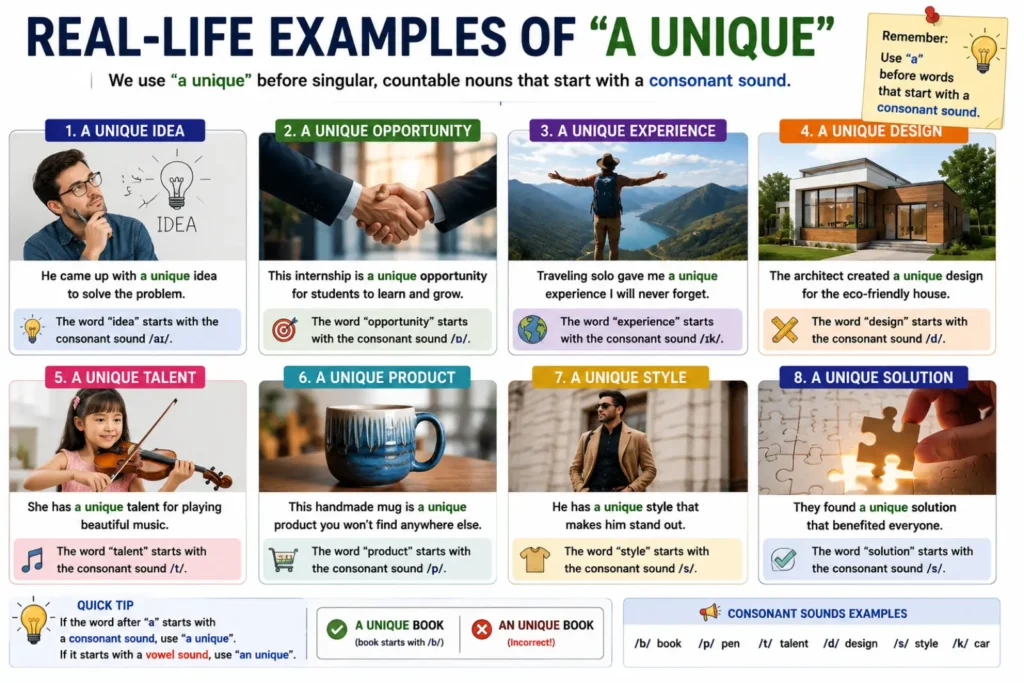
Example 1: Work
Our team developed a unique solution.
The word unique begins with a /y/ sound.
So, a is correct.
Example 2: Travel
We discovered a unique place during our trip.
Again, a unique is correct.
Example 3: School
She presented a unique idea in class.
The article a fits the pronunciation.
Example 4: Business
The company offers a unique service.
The phrase sounds natural and correct.
Example 5: Daily conversation
That is a unique way to solve the problem.
This sentence also follows the same rule.
A Unique vs. An Unique: Comparison Table
| Phrase | Correct? | Explanation |
| a unique idea | ✅ Yes | “Unique” starts with a consonant sound |
| an unique idea | ❌ No | The opening sound is not a vowel sound |
| a unique product | ✅ Yes | Correct article |
| an unique product | ❌ No | Incorrect article |
| a unique experience | ✅ Yes | Correct pronunciation |
| an unique experience | ❌ No | Incorrect standard usage |
| a unique opportunity | ✅ Yes | “Unique” starts with /y/ |
| an unusual opportunity | ✅ Yes | “Unusual” starts with a vowel sound |
The key difference is the sound, not the first letter.
A Unique or An Unique in American and British English
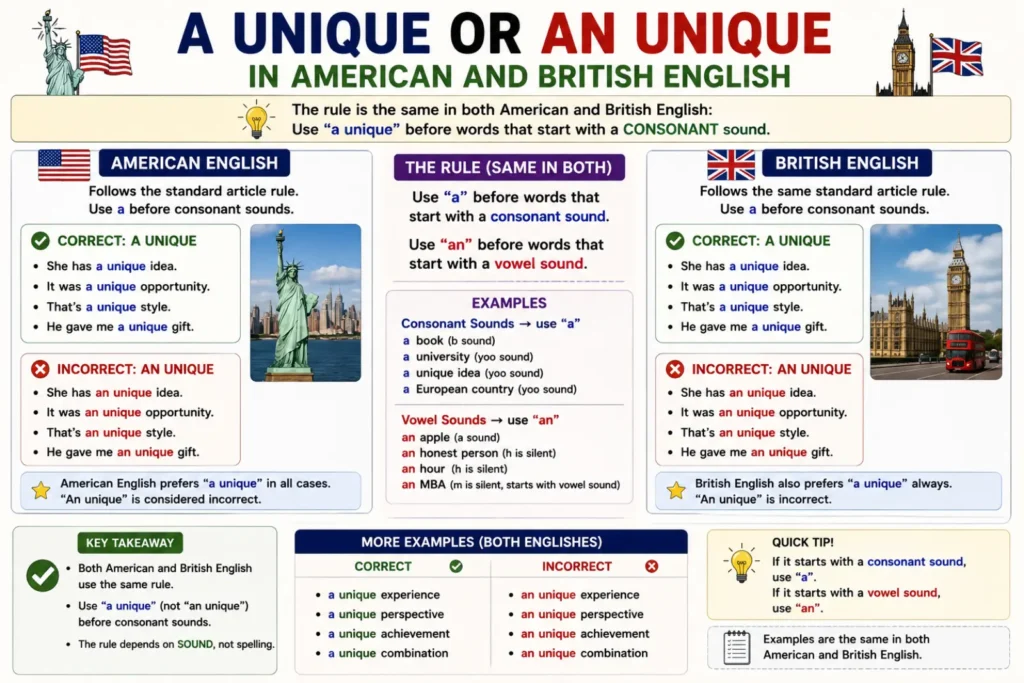
Both American and British English generally use “a unique.”
The article rule does not change simply because of the English variety.
For example:
- American English: a unique opportunity
- British English: a unique opportunity
Both forms are standard.
You may sometimes see “an unique” in older texts or nonstandard writing.
However, modern standard English normally uses “a unique.”
If you are writing for school, work, business, or SEO, choose “a unique.”
Common Mistakes With “Unique”
Learners often make several mistakes with this word.
Mistake 1: Choosing “an” because of the letter U
Some people think every word beginning with u needs an.
That rule is incorrect.
For example:
- a university ✅
- a useful idea ✅
- a unique product ✅
But:
- an umbrella ✅
- an uncle ✅
- an unusual event ✅
The first sound controls the article.
Mistake 2: Thinking “unique” starts with a vowel sound
The spelling begins with u.
However, its pronunciation begins with a sound like “you.”
That creates the difference.
Mistake 3: Writing “an unique” in formal content
This mistake can make writing look less polished.
Use “a unique” in formal English.
Mistake 4: Memorizing letters instead of sounds
English has many words where spelling and pronunciation differ.
Therefore, always consider pronunciation when choosing a or an.
“A Unique” in Daily Life
You will often see a unique in different types of writing.
business
- a unique product
- a unique service
- a unique strategy
- a unique opportunity
education
- a unique idea
- a unique approach
- a unique method
- a unique perspective
In travel
- a unique destination
- a unique experience
- a unique culture
- a unique attraction
In technology
- a unique feature
- a unique design
- a unique solution
- a unique system
These phrases sound natural because they follow the correct article rule.
What About “An Unusual”?
This is an important comparison.
Both unique and unusual start with u.
Yet they use different articles.
We say:
- a unique experience
- an unusual experience
Why?
Unique begins with a “you” sound.
Unusual begins with a vowel sound.
So, the correct forms are:
a unique experience
and
an unusual experience
This example shows why spelling alone cannot determine the article.
What About “A University” and “An Umbrella”?
These examples make the rule easier to remember.
We say:
- a university
- a uniform
- a useful tool
- a unique idea
These words begin with a sound like “you.”
But we say:
- an umbrella
- an uncle
- an urgent message
- an unusual event
These words begin with vowel sounds.
Therefore, the letter u does not automatically decide the article.
Synonyms and Related Keywords
Understanding related words can help improve vocabulary and search relevance.
Common synonyms for unique include:
- one-of-a-kind
- special
- distinctive
- unusual
- original
- rare
- exceptional
- uncommon
- individual
- different
However, these words do not always have exactly the same meaning.
For example, unique traditionally means something that is one of a kind.
Unusual means something that is not common.
So, you should choose the word that matches your intended meaning.
Related grammar keywords include:
- a unique or an unique
- is it a unique or an unique
- should I use a or an before unique
- a unique meaning
- a unique example
- correct article before unique
- grammar rule for unique
- a unique experience
- a unique idea
- a unique opportunity
Expert Insight: Why the Sound Matters
A strong grammar habit is to listen before choosing an article.
English articles follow pronunciation more closely than spelling.
This rule also explains words such as:
- a European
- a university
- a useful book
- an hour
- an honest person
- an MBA
The letters can look similar, but their sounds differ.
Professional writers should therefore check pronunciation when a word seems confusing.
This small habit improves grammar, clarity, and natural English style.
It also helps avoid mistakes in academic writing, websites, emails, and business content.
Tips to Remember “A Unique”
Use these simple memory tricks.
Tip 1: Say the word aloud
Say unique slowly.
You will hear “you-neek.”
That first sound takes a.
Tip 2: Remember “you”
Think:
a unique = a you-neek
This makes the rule easier to remember.
Tip 3: Focus on sound
Do not ask:
“Does the word start with a vowel letter?”
Ask:
“Does the word start with a vowel sound?”
That question gives you the correct answer.
Tip 4: Compare it with “unusual”
Remember:
a unique
an unusual
This pair makes the difference easy to recall.
Tip 5: Read good English regularly
Reading helps you notice natural grammar patterns.
Pay attention to articles before unfamiliar words.
Frequently Asked Questions
Is “a unique” grammatically correct?
Yes. “A unique” is grammatically correct because unique begins with a consonant sound.
Is “an unique” correct?
No. “An unique” is not standard modern English. Use “a unique” instead.
Why do we say “a unique”?
We say “a unique” because unique starts with a sound like “you.” That sound begins with a consonant sound.
Is it “a unique experience” or “an unique experience”?
The correct phrase is “a unique experience.”
Is it “a unique idea” or “an unique idea”?
The correct phrase is “a unique idea.”
Does the letter U always take “an”?
No. The sound determines the article. For example, we say “a university” but “an umbrella.”
Is “a unique” correct in British English?
Yes. “A unique” is standard in both British and American English.
What is the easiest way to remember the rule?
Think of the pronunciation “you-neek.” Because it starts with a consonant sound, use a.
conclusion
The correct phrase is “a unique,” not “an unique.” The reason comes from pronunciation. The word unique begins with a sound like “you.” That sound acts as a consonant sound. Therefore, we use a before it. Remember that English articles depend on sounds, not simply letters. This rule also explains phrases such as “a university” and “a useful tool.” In contrast, words like “umbrella” and “unusual” begin with vowel sounds. So, they take an. When you are unsure, say the word aloud. Listen to its first sound. This simple method will help you choose the correct article naturally. The easy rule is: a unique is correct; an unique is not.