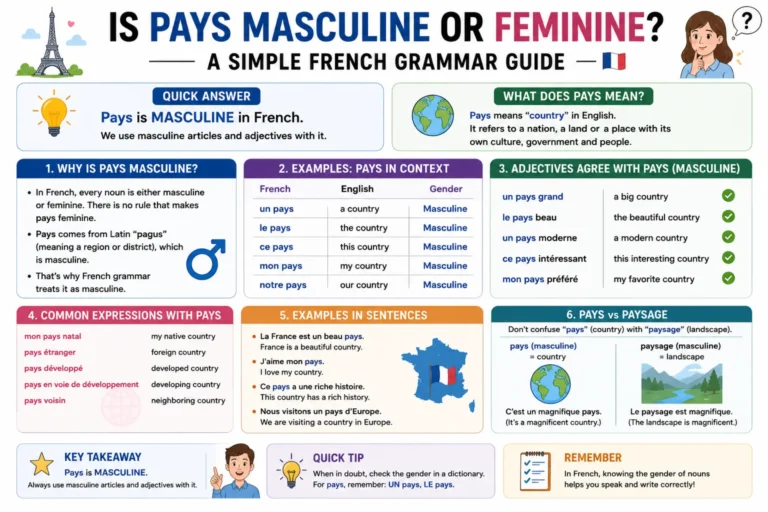
Is pays masculine or feminine? In French, pays is masculine. You say un pays and le pays when you use the singular form. The word means “country” in English. It can describe a nation, state, or land. However, French country names can have different genders. This fact often causes confusion for French learners. The good news is that pays itself is always masculine. You can also recognize it through common articles and adjectives. For example, you can say un beau pays for “a beautiful country.” You can say le pays est grand for “the country is large.” This guide explains the gender of pays in simple terms. It also shows how to use the word in real French sentences. By the end, you will know the correct forms and avoid common mistakes.
Quick Summary
- Pays is masculine in French.
- The singular form uses un or le.
- Say un pays for “a country.”
- Say le pays for “the country.”
- Say ce pays for “this country.”
- Say mon pays for “my country.”
- The plural form is des pays or les pays.
- The word pays keeps the same spelling in singular and plural.
- The gender of a country name can differ from the gender of pays.
- French uses different prepositions with masculine and feminine countries.
What Does “Pays” Mean in French?
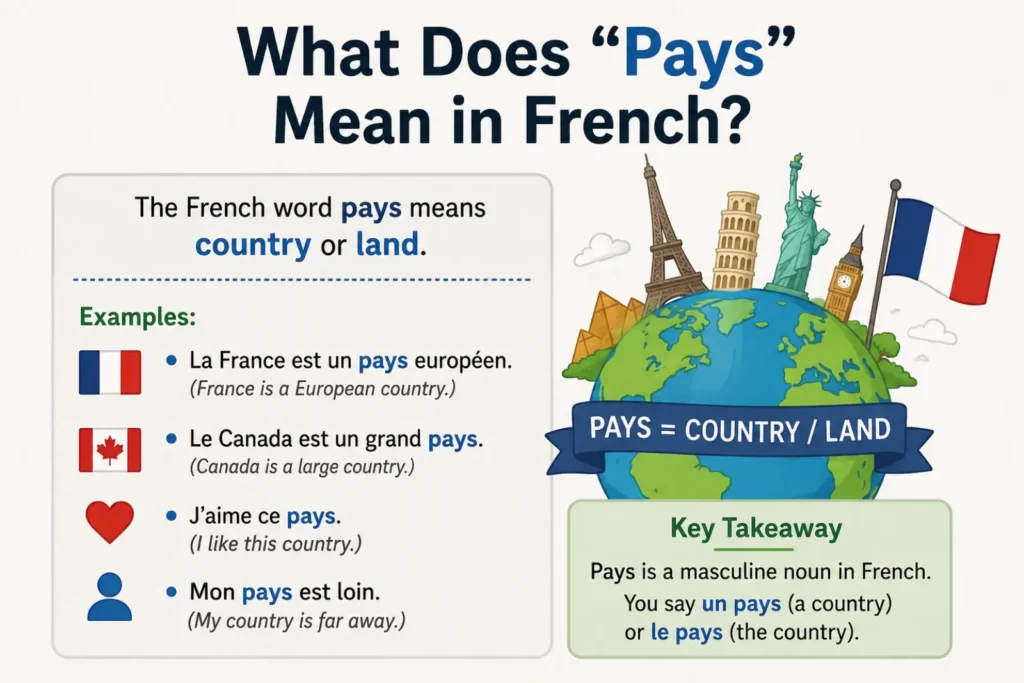
The French word pays means country or land.
It refers to a nation or a specific area of land.
Here are some simple examples:
- La France est un pays européen. — France is a European country.
- Le Canada est un grand pays. — Canada is a large country.
- J’aime ce pays. — I like this country.
- Mon pays est loin. — My country is far away.
The word pays has a masculine grammatical gender.
Therefore, French speakers use masculine articles and adjectives with it.
Is “Pays” Masculine or Feminine?
Pays is masculine.
This is the main grammar rule to remember.
You can test the gender by using common French articles.
| English | French |
|---|---|
| a country | un pays |
| the country | le pays |
| this country | ce pays |
| my country | mon pays |
| your country | ton pays |
| that country | ce pays-là |
Each form uses a masculine determiner.
For example:
C’est un pays magnifique.
This is a beautiful country.
The adjective magnifique does not show gender clearly. However, the article un confirms that pays is masculine.
Why Is “Pays” Masculine?
French nouns have grammatical gender.
A noun can be masculine or feminine.
The gender does not always follow a logical rule. Therefore, learners often need to memorize it.
For pays, the correct gender is simply masculine.
You should remember this basic combination:
un pays = a country
This phrase gives you a useful memory shortcut.
When you see pays, think of un pays.
That will help you choose other masculine forms correctly.
How Do You Use “Pays” in a Sentence?
You can use pays in many everyday sentences.
Here are some common examples:
Je connais ce pays.
I know this country.
Il visite un nouveau pays.
He is visiting a new country.
Le pays est très beau.
The country is very beautiful.
Mon pays est en Asie.
My country is in Asia.
Quel pays préfères-tu ?
Which country do you prefer?
Notice the masculine forms around pays.
You can also use adjectives after the noun:
C’est un pays riche.
It is a rich country.
C’est un pays intéressant.
It is an interesting country.
The adjective must agree with the noun when its form changes.
For example:
un pays développé
a developed country
Here, développé uses its masculine singular form.
“Pays” Singular vs. Plural
One unusual feature of pays is its spelling.
The word looks the same in singular and plural.
Compare these examples:
- un pays — a country
- des pays — countries
- le pays — the country
- les pays — the countries
The spelling pays does not change.
The article tells you whether the noun is singular or plural.
Examples
Un pays est intéressant.
A country is interesting.
Des pays sont intéressants.
Some countries are interesting.
Le pays est grand.
The country is large.
Les pays sont différents.
The countries are different.
This pattern makes pays easy to recognize once you learn the articles.
Pays vs. Country Names
This distinction causes many mistakes.
Pays is masculine.
However, individual country names can be masculine or feminine.
For example:
- la France — France
- l’Espagne — Spain
- l’Italie — Italy
- le Canada — Canada
- le Japon — Japan
- le Pakistan — Pakistan
- les États-Unis — the United States
So, the gender of pays does not automatically determine the gender of every country name.
Think of these as two separate grammar questions:
What is the gender of pays?
Masculine.
What is the gender of France?
Feminine.
This distinction helps prevent many grammar errors.
Common Prepositions With Country Names
Country names often appear with French prepositions.
The correct preposition depends on the country’s grammatical gender and number.
For many feminine countries, French uses en.
Examples:
- en France — in France
- en Espagne — in Spain
- en Italie — in Italy
For many masculine countries, French uses au.
Examples:
- au Canada — in Canada
- au Japon — in Japan
- au Pakistan — in Pakistan
For plural countries, French often uses aux.
Example:
- aux États-Unis — in the United States
This rule applies to country names, not to the noun pays itself.
For example:
Je vis dans un pays magnifique.
I live in a beautiful country.
Here, dans un pays means “in a country.”
Real-Life Examples of “Pays”
You will often hear pays in everyday French.
Here are several practical examples.
Talking About Your Home Country
J’aime mon pays.
I love my country.
Je viens de mon pays.
I come from my country.
A more natural sentence often uses the country’s name:
Je viens du Canada.
I come from Canada.
Talking About Travel
Je veux visiter un nouveau pays.
I want to visit a new country.
Quel pays veux-tu visiter ?
Which country do you want to visit?
J’ai visité plusieurs pays.
I visited several countries.
Talking About Culture
Chaque pays a sa propre culture.
Each country has its own culture.
Les pays ont des traditions différentes.
Countries have different traditions.
These examples show how useful the word is in everyday French.
Comparison: Pays and Similar French Words
Some French words may look or sound related to pays.
However, they do not have the same meaning.
| French word | Meaning | Example |
| pays | country | un pays |
| patrie | homeland | ma patrie |
| nation | nation | une nation |
| État | state | un État |
| région | region | une région |
| ville | city | une ville |
Notice the gender differences.
Pays is masculine.
Nation is feminine.
Région is feminine.
Ville is feminine.
This means you cannot choose an article based only on meaning.
You must learn the gender of each French noun.
Common Mistakes With “Pays”
French learners often make a few predictable mistakes.
Mistake 1: Saying “une pays”
❌ une pays
✅ un pays
The noun pays is masculine.
Mistake 2: Saying “la pays”
❌ la pays
✅ le pays
Use the masculine definite article le.
Mistake 3: Changing the Spelling for Plural
Some learners write paies or another plural form.
The correct plural remains:
pays
For example:
les pays
The pronunciation can also help you recognize the word.
Mistake 4: Assuming Every Country Is Masculine
The noun pays is masculine.
Country names can still be feminine.
For example:
la France is feminine.
le Canada is masculine.
Do not confuse the two rules.
Tips for Remembering the Gender of “Pays”
Here are some simple memory tricks.
Tip 1: Memorize “Un Pays”
Do not memorize only pays.
Learn the phrase:
un pays
This gives you the gender immediately.
Tip 2: Learn a Full Example
Try remembering:
C’est un beau pays.
This means:
“This is a beautiful country.”
The phrase connects the noun with a masculine adjective form.
Tip 3: Practice With Articles
Create short pairs:
- un pays
- le pays
- ce pays
- mon pays
- ton pays
- son pays
This practice builds automatic recognition.
Tip 4: Separate Noun Gender From Country Gender
Remember:
un pays is masculine.
But la France is feminine.
Keeping these ideas separate makes French grammar much easier.
Synonyms and Related Keywords
Several words connect naturally with pays.
These terms can help expand your French vocabulary:
- country — pays
- nation — nation
- homeland — patrie
- state — État
- territory — territoire
- region — région
- country name — nom de pays
- French country names — noms de pays en français
- masculine noun — nom masculin
- feminine noun — nom féminin
- French grammar — grammaire française
- French gender rules — règles du genre en français
These related terms are useful when studying French vocabulary and grammar.
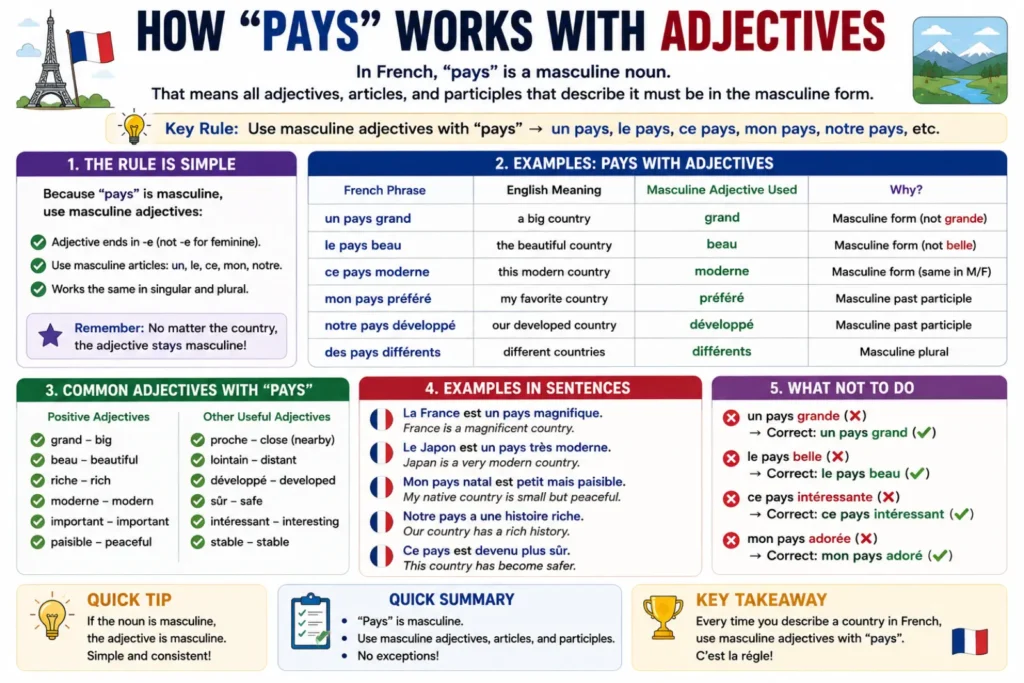
How “Pays” Works With Adjectives
French adjectives usually agree with the noun.
Since pays is masculine singular, use the masculine singular adjective form.
For example:
pays développé
developed country
un pays moderne
modern country
un pays riche
a rich country
With a plural noun, the adjective becomes plural when its spelling changes:
des pays développés
developed countries
pays modernes
modern countries
des pays riches
rich countries
The noun stays pays, while the adjective can change.
This provides another useful clue when reading French.
Expert Insights: Why the Gender Matters
Knowing noun gender helps you build accurate French sentences.
Gender affects articles, adjectives, pronouns, and other grammar structures.
For example, knowing that pays is masculine helps you choose:
- un pays
- le pays
- ce pays
- mon pays
- quel pays
It also helps with adjective agreement.
The best learning strategy involves memorizing nouns with their articles.
Instead of learning:
pays = country
Learn:
un pays = a country
This small habit can improve accuracy across many areas of French grammar.
Another useful strategy involves learning common phrases instead of isolated words.
For example:
dans un pays
ce pays
mon pays
les pays
These chunks make natural French easier to remember.
Usage in Daily French
You can use pays in conversations about travel, culture, geography, and personal identity.
Here are useful daily phrases:
Quel est ton pays ?
What is your country?
Dans quel pays habites-tu ?
Which country do you live in?
Quel pays veux-tu visiter ?
Which country do you want to visit?
Je veux découvrir ce pays.
I want to discover this country.
C’est un pays très intéressant.
It is a very interesting country.
Je connais plusieurs pays.
I know several countries.
These phrases are useful for beginners because they cover common conversation topics.
Frequently Asked Questions
Is “pays” masculine or feminine in French?
Pays is masculine. The correct basic form is un pays.
Do you say “un pays” or “une pays”?
You say un pays. The noun has masculine grammatical gender.
Is “le pays” correct?
Yes. Le pays means “the country.”
What is the plural of “pays”?
The plural is pays. The spelling stays the same.
You say des pays or les pays.
Is every country name masculine in French?
No. French country names can be masculine, feminine, or plural.
For example, la France is feminine, while le Canada is masculine.
Why does “pays” stay the same in the plural?
Pays already ends in -s. Its spelling remains unchanged in the plural.
The article shows the number.
What does “pays” mean in English?
Pays usually means country.
Depending on context, it can also refer to a land or homeland.
How can I remember that “pays” is masculine?
Memorize the phrase un pays instead of learning the noun alone.
This makes the gender easier to recall.
Conclusion
So, is pays masculine or feminine? The answer is simple: pays is masculine. Use un pays for “a country” and le pays for “the country.” The plural forms are des pays and les pays. The spelling stays the same in singular and plural. However, remember that individual country names can have different genders. For example, la France is feminine, while le Canada is masculine. This distinction is important for correct French grammar. The easiest learning trick is to memorize un pays as one phrase. Then practice it in useful expressions like mon pays, ce pays, and les pays. With these simple patterns, you can use pays correctly and confidently in everyday French.