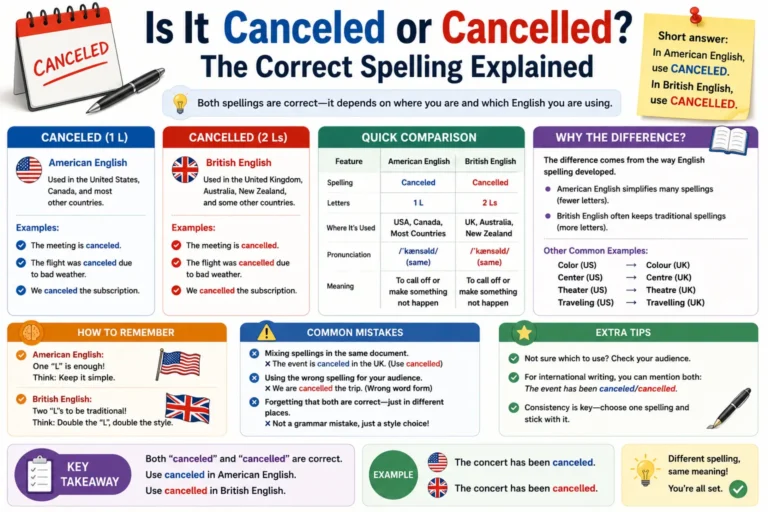
Is it canceled or cancelled? Both spellings are correct, but they follow different English spelling rules. The main difference comes from regional English usage. “Canceled” is common in American English. “Cancelled” is standard in British English and many other varieties. The meaning stays the same in both forms. Both words describe something that will not happen or has been stopped. The same spelling pattern appears in words like “canceling” and “cancelling.” This guide explains when to use each spelling. You will also learn why the spellings differ. We will cover examples, common mistakes, and easy memory tips. By the end, you will know which form fits your audience. You can then write with confidence in school, work, or everyday messages.
Quick Summary
- Canceled is the usual American English spelling.
- Cancelled is the usual British English spelling.
- Both spellings have the same meaning.
- American English usually uses one l before the ending.
- British English usually uses two l’s before the ending.
- Use one spelling consistently in the same piece.
- Your audience should guide your spelling choice.
- Neither spelling is wrong when used in the right English variety.
What Does “Canceled” or “Cancelled” Mean?
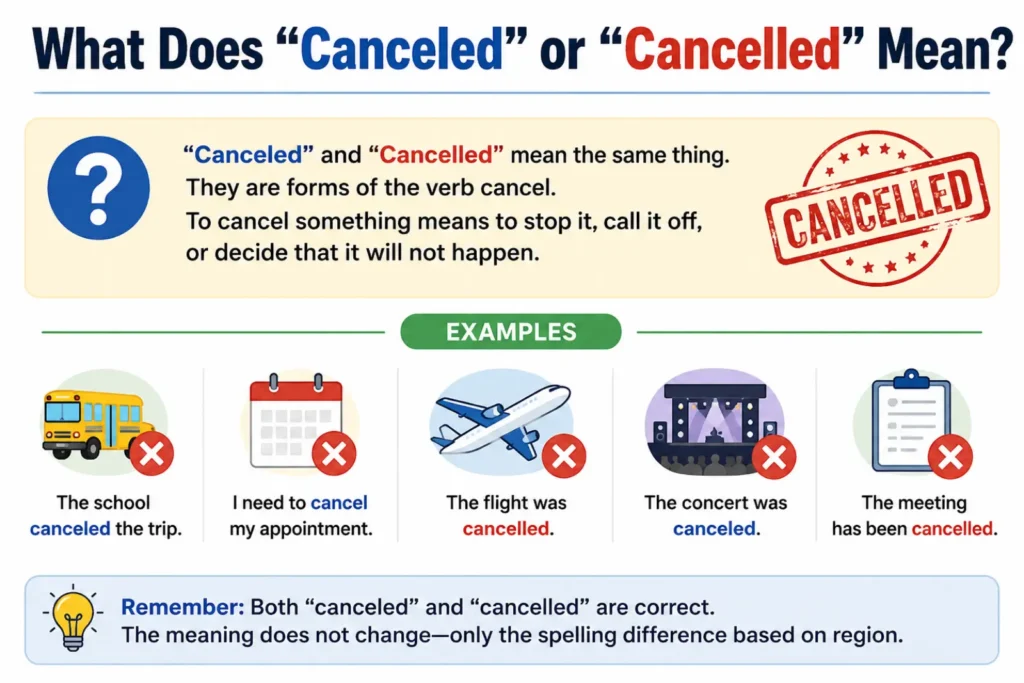
Canceled and cancelled mean the same thing.
They are forms of the verb cancel.
To cancel something means to stop it, call it off, or decide that it will not happen.
For example:
- The school canceled the trip.
- The school cancelled the trip.
- The concert was canceled.
- The concert was cancelled.
- I need to cancel my appointment.
The meaning does not change based on the number of l’s.
The spelling changes because English has different regional rules.
Is “Canceled” or “Cancelled” Correct?
Both forms are correct.
The correct choice depends on the type of English you use.
Canceled is preferred in American English.
Cancelled is preferred in British English.
Canadian, Australian, and other English varieties often follow British spelling patterns. However, usage can vary by country and style guide.
So, neither word is automatically more correct.
The key is consistency.
If you write for American readers, choose canceled.
If you write for British readers, choose cancelled.
Canceled vs Cancelled: The Main Difference
The easiest way to understand the difference is by region.
| Spelling | Common English Variety | Example |
|---|---|---|
| Canceled | American English | The flight was canceled. |
| Cancelled | British English | The flight was cancelled. |
| Canceling | American English | We are canceling the meeting. |
| Cancelling | British English | We are cancelling the meeting. |
American English often drops the second l.
British English usually keeps the second l.
This difference also appears in related forms.
For example:
- canceled / cancelled
- canceling / cancelling
However, the noun cancellation uses two l’s in both forms.
That means you write cancellation, not “cancelation,” in standard usage.
Why Does American English Use “Canceled”?
American English often follows a spelling pattern that uses one l before certain endings.
This pattern appears in words such as:
- canceled
- canceling
- labeled
- labeling
- traveled
- traveling
British English often doubles the final consonant in similar words.
For example:
- cancelled
- cancelling
- labelled
- labelling
- travelled
- travelling
These differences developed through changes in English spelling conventions.
They do not create different meanings.
The important point is simple: American English favors “canceled,” while British English favors “cancelled.”
Why Does British English Use “Cancelled”?
British English commonly doubles the final l before endings such as -ed and -ing.
That gives us:
- cancel → cancelled
- cancel → cancelling
This pattern is also common in several other British spellings.
For example:
- travel → travelled
- label → labelled
- model → modelled
However, English spelling rules can vary between words.
That is why you should not assume every word follows exactly the same pattern.
When in doubt, check the style guide used by your school, employer, or publication.
Canceled or Cancelled in American English
If you are writing for an American audience, canceled is usually the best choice.
Here are some examples:
- The game was canceled because of rain.
- She canceled her appointment.
- The airline canceled the flight.
- We are canceling the event.
- The company canceled the order.
American English generally uses one l in these forms.
This spelling works well for:
- U.S. websites
- American schools
- U.S. businesses
- American newspapers
- General online content for U.S. readers
If your website targets American searchers, use canceled consistently.
Cancelled or Canceled in British English
If you write for a British audience, cancelled is usually the preferred form.
Examples include:
- The match was cancelled because of rain.
- She cancelled her appointment.
- The airline cancelled the flight.
- We are cancelling the event.
- The order was cancelled yesterday.
British English commonly keeps the double l.
This spelling is also common in several English-speaking countries.
Always consider the audience before choosing your spelling.
Real-Life Examples
Spelling differences become easier when you see them in everyday sentences.
Example 1: A Flight
American English:
“The airline canceled my flight.”
British English:
“The airline cancelled my flight.”
Both sentences mean exactly the same thing.
Example 2: A Meeting
American English:
“The manager canceled the meeting.”
British English:
“The manager cancelled the meeting.”
Again, the meaning does not change.
Example 3: An Event
American English:
“The concert was canceled.”
British English:
“The concert was cancelled.”
The only difference is spelling.
Example 4: A Subscription
American English:
“I canceled my subscription.”
British English:
“I cancelled my subscription.”
Both forms are grammatically correct.
Canceled vs Cancelled: Which One Should You Use?
Use the spelling that matches your target audience.
Here is a simple rule:
Writing for Americans? Use “canceled.”
Writing for British readers? Use “cancelled.”
If your audience includes people from several countries, choose one standard and stay consistent.
For example, a global website might use British spelling throughout its content.
Another site might follow American English because most readers live in the United States.
Consistency matters more than choosing one form as universally correct.
Common Mistakes to Avoid
Many writers make small mistakes with these spellings.
Here are the most common ones.
Mistake 1: Mixing Both Spellings
Avoid switching between canceled and cancelled without a reason.
For example:
The event was canceled. The meeting was cancelled.
This looks inconsistent if both sentences follow the same English style.
Choose one spelling system.
Mistake 2: Thinking One Spelling Is Wrong
Both spellings are accepted.
The difference comes from regional English conventions.
Do not mark cancelled as wrong in British English.
Likewise, do not assume canceled is incorrect in American English.
Mistake 3: Writing “Cancelated”
“Cancelated” is not the standard past-tense form.
Use:
- canceled
- cancelled
Mistake 4: Misspelling “Cancellation”
The standard noun is cancellation.
It contains two l’s.
For example:
- Your cancellation was confirmed.
- We received your cancellation request.
Mistake 5: Changing Spelling Without Checking Your Style
Businesses and publications often have a preferred style.
Check your organization’s style guide before editing the spelling.
Canceled or Cancelled in Different Forms
The spelling difference does not appear in every form of the word.
Here is a useful comparison:
| Word Form | American English | British English |
| Base verb | cancel | cancel |
| Past tense | canceled | cancelled |
| Present participle | canceling | cancelling |
| Noun | cancellation | cancellation |
| Third-person form | cancels | cancels |
Notice something important.
The word cancellation stays the same in both forms.
This makes it easier to remember.
How to Remember the Difference
Use this simple memory trick:
U.S. = one L
Think:
Canceled = American English
Then remember:
Cancelled = British English
You can also remember the related forms together.
American English:
- canceled
- canceling
British English:
- cancelled
- cancelling
When writing professionally, consistency is the best rule.
Canceled or Cancelled in Daily Life
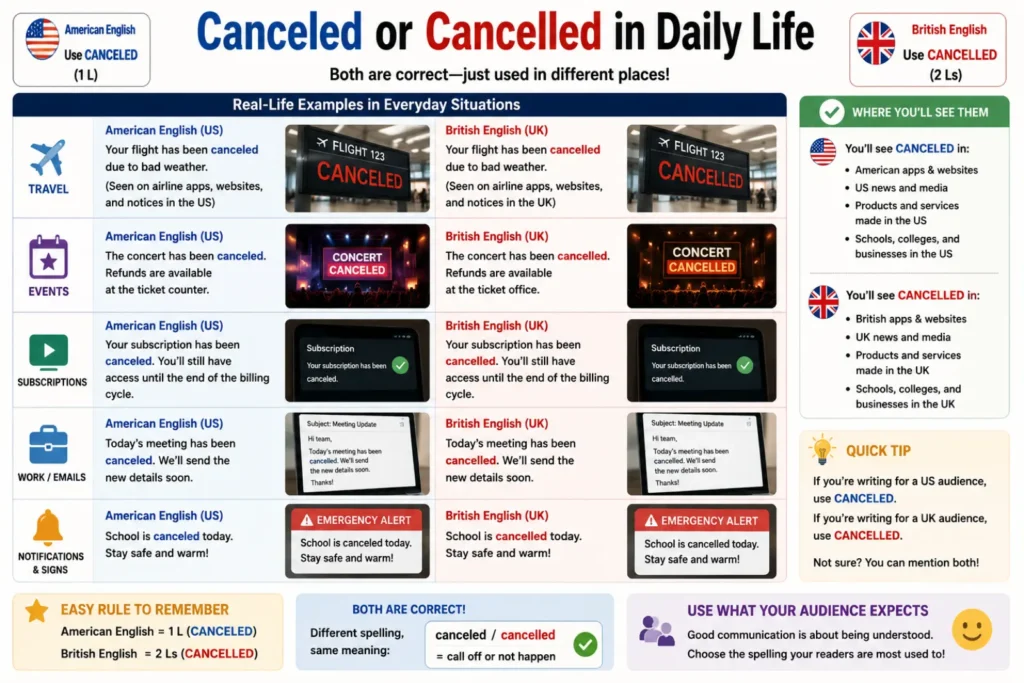
You will see these words in many everyday situations.
They can describe:
- flights
- meetings
- appointments
- sports games
- concerts
- subscriptions
- orders
- classes
- events
- reservations
- memberships
For example:
American English:
“My appointment was canceled.”
British English:
“My appointment was cancelled.”
The sentence remains clear in both versions.
The spelling simply tells readers which English convention you follow.
Synonyms and Related Keywords
Writers sometimes need alternatives to canceled or cancelled.
Useful synonyms and related terms include:
- called off
- stopped
- withdrawn
- abandoned
- postponed
- terminated
- discontinued
- revoked
- scrapped
- ended
However, these words do not always have exactly the same meaning.
For example, postponed usually means something will happen later.
Canceled means the planned event will not happen as scheduled.
For SEO, related phrases may include:
- is it canceled or cancelled
- canceled vs cancelled
- cancelled vs canceled
- American spelling of canceled
- British spelling of cancelled
- how to spell canceled
- how to spell cancelled
- canceling or cancelling
- cancellation spelling
- canceled meaning
- cancelled meaning
- canceled British or American
- cancelled American or British
Use these phrases naturally.
Avoid forcing them into every paragraph.
Is “Canceled” or “Cancelled” Better for SEO?
Neither spelling is automatically better for SEO.
Google can understand spelling variations and related language.
Your main goal should be clarity.
Choose the spelling that matches your audience and content style.
For a U.S.-focused website, canceled may fit your editorial style.
For a U.K.-focused website, cancelled may fit better.
You can also mention both forms when the topic requires a comparison.
That approach helps readers understand the difference without keyword stuffing.
Expert Insights
Professional writers should focus on audience, consistency, and context.
First, identify your main audience.
Then choose the English variety they expect.
Next, apply that spelling consistently.
For example, a U.S. business might use:
- canceled
- traveling
- labeled
A British business might use:
- cancelled
- travelling
- labelled
Your spelling choices can support a consistent brand voice.
They can also make your content feel more natural to local readers.
For SEO content, avoid changing regional spelling just to target a keyword.
Write naturally.
Cover the search intent clearly.
Answer the reader’s question early.
Then provide useful examples and related information.
These practices create stronger, more helpful content.
Frequently Asked Questions
Is canceled or cancelled correct?
Both are correct. Canceled is common in American English. Cancelled is common in British English.
Is canceled American or British?
Canceled is the standard American English spelling.
Is cancelled American or British?
Cancelled is the standard British English spelling.
Which is correct, canceled or cancelled?
Both are correct. Your choice depends on the English variety you use.
Is “canceling” or “cancelling” correct?
Both are correct. Canceling is common in American English. Cancelling is common in British English.
Is cancellation spelled with one L or two?
Cancellation is normally spelled with two l’s.
Does canceled and cancelled mean the same thing?
Yes. Both forms have the same meaning.
Should I use canceled or cancelled in formal writing?
Use the form that matches your audience or required style guide. Then use it consistently.
Conclusion
So, is it canceled or cancelled? The answer depends on the English variety you use. Canceled is the common American English spelling. Cancelled is the common British English spelling. Both words have the same meaning. The same difference appears in canceling and cancelling. However, cancellation keeps two l’s in both varieties. The best choice depends on your readers and your style guide. If you write for Americans, choose canceled. If you write for British readers, choose cancelled. Most importantly, stay consistent throughout your content. You do not need to worry about one form being universally correct. Both spellings are valid in the right regional context. The simple takeaway is clear: one L for American English, two L’s for British English.