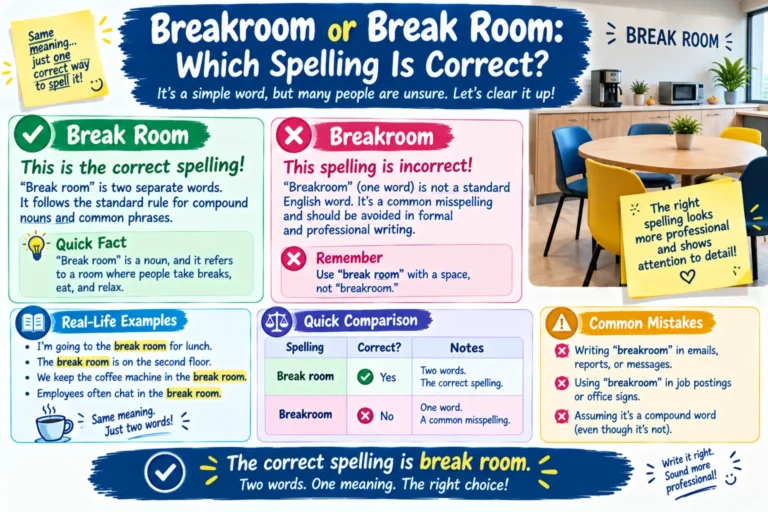
Breakroom or break room is a common spelling question in American English. Both forms refer to the same place.
A break room is a space where workers can relax, eat, drink, or take a short rest. You may see this space in an office, factory, school, hospital, or store.
But which spelling should you use?
The answer depends on your style guide and audience. “Break room” is the more traditional two-word form. “Breakroom” also appears often, especially in workplace writing and modern business content.
This guide explains the meaning of both forms. It also shows when to use each spelling.
You will find simple examples, common mistakes, and useful writing tips. By the end, you will know how to use breakroom or break room with confidence.
Quick Summary
- Break room means a place where employees take breaks.
- Breakroom has the same basic meaning.
- Break room is the traditional two-word spelling.
- Breakroom is also common in modern workplace writing.
- Both forms can describe an employee rest or eating area.
- Use one spelling consistently within the same document.
- Check your company’s style guide if it has one.
- In formal writing, break room is often the safest choice.
What Does Break Room Mean?
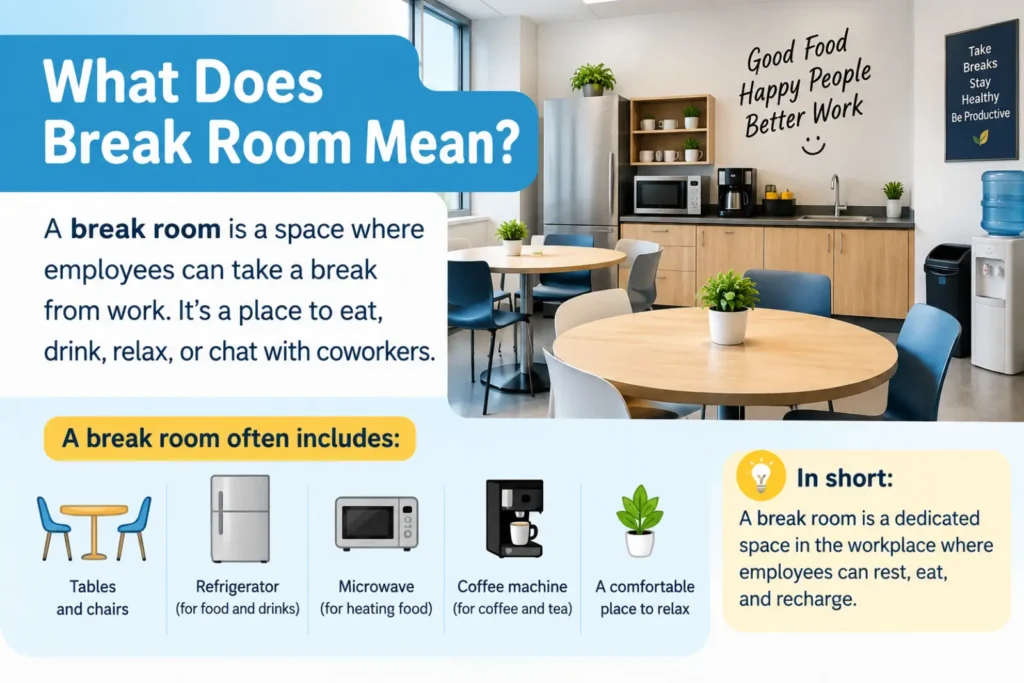
A break room is a room or area where employees can take a break from work.
People may use a break room to eat lunch, drink coffee, talk with coworkers, or rest for a few minutes.
Many workplaces provide basic items in this space. These may include tables, chairs, a refrigerator, a microwave, or a coffee machine.
For example:
“I left my lunch in the break room.”
Here, break room means the workplace area where employees can eat or relax.
The term can describe both small and large spaces. A small office may have a simple kitchen area. A large factory may have a dedicated employee lounge.
Is It Breakroom or Break Room?
Both breakroom and break room are used in English.
However, break room is generally the safer spelling for standard American English writing.
The two-word form clearly combines the words break and room. Major dictionaries and style resources may vary in how they treat compounds.
English often changes over time. Words that begin as separate terms can later become closed compounds.
For example, words such as website and online have changed in common usage over time.
The same type of language change can affect workplace terms.
So, if you are writing a formal document, break room is a clear and widely understood choice.
Breakroom vs. Break Room: What Is the Difference?
There is usually no major difference in meaning between breakroom and break room.
The main difference is spelling.
| Term | Meaning | Common use |
|---|---|---|
| Break room | Employee area for rest or meals | Formal and general writing |
| Breakroom | Employee area for rest or meals | Workplace and modern usage |
| Employee lounge | Area for employees to relax | More formal or descriptive |
| Staff room | Room for staff members | Common in some regions |
| Lunchroom | Room where people eat lunch | Focuses on meals |
The choice often depends on your audience and writing style.
For example, a company handbook might consistently use break room. A workplace website might use breakroom throughout its content.
Consistency matters more than switching between forms.
Why Do People Write Breakroom as One Word?
English often combines words that people use together frequently.
This process creates what linguists call a compound word.
A compound can appear in three common forms:
- Two separate words
- A hyphenated word
- One combined word
The phrase break room remains widely understood as two words. However, breakroom has also become common in workplace contexts.
People may prefer the closed form because it looks shorter and more convenient.
Search behavior can also influence online writing. Businesses may use breakroom in product names, workplace pages, or search-focused content.
Still, frequent usage does not mean every style guide recommends the same form.
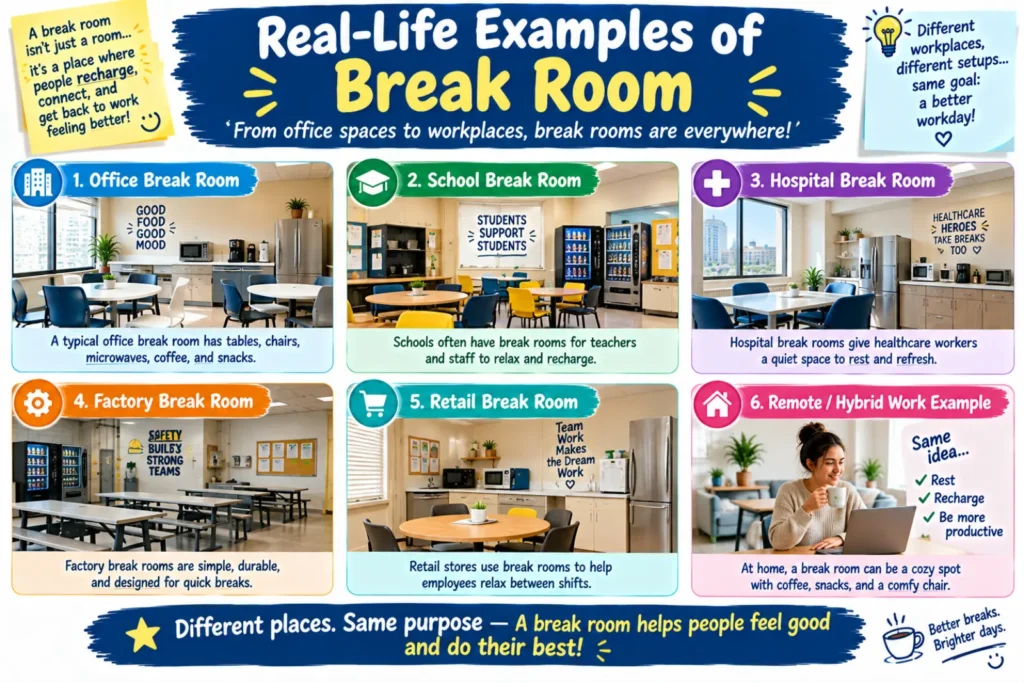
Real-Life Examples of Break Room
You can use break room in many everyday sentences.
Example 1: Office
“The new coffee machine is in the break room.”
The sentence refers to an employee area inside an office.
Example 2: Factory
“Employees can eat lunch in the break room.”
Here, the break room provides a place for workers to eat.
Example 3: School
“The teachers met in the break room after class.”
The room gives staff a place to relax between duties.
Example 4: Hospital
“The nurses took their meal breaks in the staff break room.”
The phrase describes a designated rest area.
Example 5: Retail Store
“Please keep your belongings in the break room.”
Again, the term describes an employee-only area.
How Is Break Room Used in Daily Life?
The term appears in many workplace conversations.
You might hear someone say:
- “I will meet you in the break room.”
- “My lunch is in the break room.”
- “The break room needs cleaning.”
- “There is coffee in the break room.”
- “Please do not leave food in the break room.”
- “The new microwave is for the break room.”
These examples show why the phrase remains useful.
It describes a specific place without needing a long explanation.
Break Room vs. Lunchroom vs. Employee Lounge
These terms can overlap, but they are not always identical.
A break room usually supports short work breaks. Employees may eat, drink, or relax there.
A lunchroom focuses more on eating. It may include tables and food-related facilities.
An employee lounge often suggests a larger or more comfortable relaxation area.
Consider the context before choosing a term.
| Term | Main purpose | Typical setting |
|---|---|---|
| Break room | Rest and short breaks | Offices and workplaces |
| Lunchroom | Eating meals | Schools, factories, workplaces |
| Employee lounge | Rest and socializing | Offices, hospitals, large workplaces |
| Staff room | Staff use | Schools and institutions |
A workplace can even use more than one of these spaces.
Common Break Room Spelling Mistakes
The phrase looks simple, but writers often make small errors.
1. Changing the spelling throughout a document
Do not write break room in one section and breakroom in another without a reason.
Choose one form and stay consistent.
2. Using unnecessary capitalization
You normally do not need to capitalize break room.
Correct:
“The meeting will take place near the break room.”
Incorrect:
“The meeting will take place near the Break Room.”
You may capitalize it if it forms part of an official room name.
3. Confusing break room with break-room
Some writers add a hyphen automatically.
However, you usually do not need a hyphen when using the phrase as a noun.
For example:
“The employees cleaned the break room.”
Follow the style guide used by your organization.
4. Treating breakroom and break room as different places
In most contexts, they mean the same thing.
The spelling does not normally create a different type of room.
When Should You Use “Break Room”?
Choose break room when you want a clear, conventional form.
It works well in:
- Business documents
- Employee handbooks
- Workplace policies
- Formal emails
- General articles
- Educational writing
- Professional reports
For example:
“Employees must keep the break room clean.”
This spelling is easy to understand and fits standard professional writing.
If your organization has a house style, follow that style instead.
When Can You Use “Breakroom”?
Breakroom can work well when your audience or organization already uses that form.
You may see it in:
- Workplace websites
- Company materials
- Product descriptions
- Office design content
- Workplace technology content
- Informal business writing
For example:
“Our new breakroom includes comfortable seating.”
The meaning remains clear.
The most important rule is consistency.
If your company calls the space a breakroom, changing it to break room in every document may create unnecessary inconsistency.
Expert Tips for Choosing the Right Spelling
Good professional writing does not always require the newest spelling.
It requires a spelling that fits the audience and stays consistent.
Here are several useful tips.
Follow your style guide
Your company may have a preferred writing style.
Follow it when one exists.
Consider your audience
Use familiar language for general readers.
Break room is immediately clear to most English speakers.
Keep terminology consistent
Choose one form for the page or document.
Avoid unnecessary variations.
Check official names
Some companies use Breakroom as part of a branded name.
Do not change official names without checking the company’s preferred spelling.
Think about search intent
If you write for search engines, include natural variations.
For example, an article can naturally address:
- breakroom or break room
- break room meaning
- break room definition
- breakroom spelling
- break room spelling
- breakroom vs break room
Avoid repeating the same keyword in every sentence.
Synonyms and Related Terms
Search engines understand related words and concepts.
You can use relevant terms naturally throughout your content.
Useful variations include:
- employee break room
- staff break room
- workplace break room
- employee lounge
- staff room
- lunchroom
- employee rest area
- workplace lounge
- staff lounge
- break area
- employee common area
- office break room
These terms can help explain the topic without forcing the primary keyword.
However, they are not always exact synonyms.
For example, an employee lounge may be larger than a typical break room.
Use each term according to its actual meaning.
Why Does a Workplace Need a Break Room?
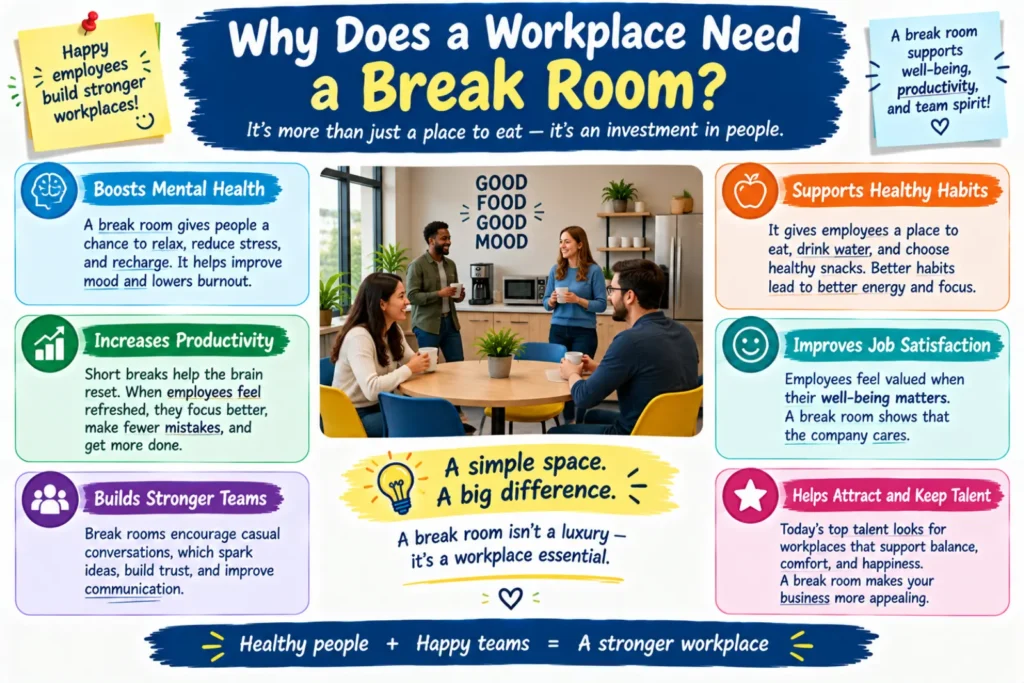
A break room gives employees a dedicated place away from their normal workstations.
This separation can make breaks easier to manage.
Workers can eat without sitting at their desks. They can also store food and drinks in one shared area.
A well-maintained break room can also support workplace cleanliness.
For example, employees have a clear place to:
- Store lunches
- Make coffee
- Heat food
- Eat meals
- Talk with coworkers
- Take short breaks
- Store personal items temporarily
The exact facilities depend on the workplace.
A small office may only need a table and coffee maker. A large workplace may provide refrigerators, microwaves, sinks, and seating.
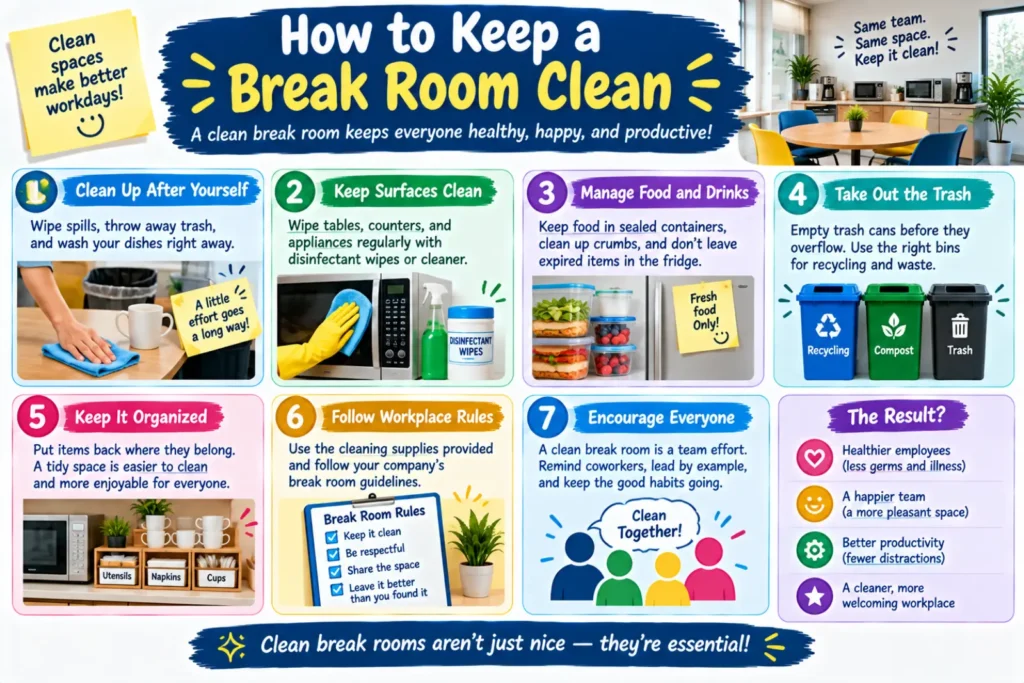
How to Keep a Break Room Clean
A clean break room benefits everyone who uses it.
Simple rules can prevent many problems.
Clean up after eating
Do not leave plates, cups, or food on tables.
Wipe shared surfaces
Clean counters after preparing food.
Label personal food
Labels can help prevent confusion.
Remove old food
Do not leave spoiled food in a shared refrigerator.
Empty the trash
Food waste can quickly create odors.
Respect shared equipment
Clean microwaves, coffee machines, and other appliances after use.
Clear workplace rules can make these habits easier to follow.
Break Room Etiquette: Simple Rules
Good break room etiquette helps everyone share the space.
Follow these basic rules:
- Clean your area after eating.
- Avoid leaving food in shared spaces.
- Label food stored in the refrigerator.
- Do not take another person’s food.
- Keep noise at a reasonable level.
- Clean spills quickly.
- Follow workplace food policies.
- Respect other employees’ break time.
These rules are simple, but they can prevent many workplace conflicts.
Common Questions About Breakroom or Break Room
Is “break room” one word or two?
Break room is commonly written as two words. Breakroom is also used in modern workplace writing.
Is “breakroom” grammatically correct?
Yes. Breakroom is a recognized usage in many workplace contexts. However, spelling preferences vary by dictionary and style guide.
Which is more professional, breakroom or break room?
Both can appear in professional writing. Break room is often the safer general choice because the meaning is immediately clear.
Is break room hyphenated?
Usually, break room is written as two words when it functions as a noun.
What is another word for break room?
Possible alternatives include employee lounge, staff room, lunchroom, staff lounge, and break area.
The best choice depends on the room’s purpose.
What is the difference between a break room and a lunchroom?
A break room supports general employee breaks. A lunchroom focuses more specifically on eating meals.
Should Break Room be capitalized?
Usually, no. Capitalize it when it appears in an official name or heading that uses title capitalization.
Expert Insight: Why This Small Spelling Choice Matters
Small language choices can affect professional communication.
A workplace term should be easy to understand and consistent across documents.
That matters for employee handbooks, signs, websites, policies, and internal messages.
The best approach is simple.
First, identify your audience. Next, check your preferred style guide. Then, use the selected form consistently.
For general professional writing, break room provides a clear and familiar option.
For workplace branding, follow the organization’s established terminology.
From an SEO perspective, you can also cover both forms naturally. This helps answer users who search for either spelling.
Avoid keyword stuffing. Search engines value useful content that answers the reader’s question.
Conclusion
The question of breakroom or break room is mainly a question of spelling style. Both forms describe a place where employees can rest, eat, drink, or take a short break.
For general and formal writing, break room is a clear and familiar choice. You may also see breakroom in modern workplace content.
The most important rule is consistency. Check your company’s style guide if one exists. Follow official names when a business uses a specific spelling.
You should also consider your audience. Simple language makes workplace communication easier to understand.
When writing for search engines, cover related questions naturally. Explain the meaning, spelling, examples, and common usage.
In short, break room is a safe choice for most professional writing. Breakroom can also work when your style or organization prefers it.