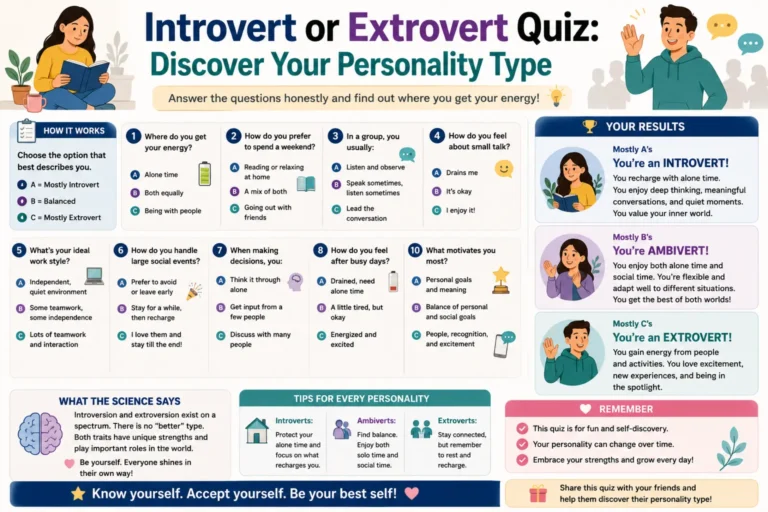
Introvert or extrovert quiz questions can help you understand how you use your social energy.
Some people feel refreshed after spending time with others.
Others feel better after quiet time alone.
Many people enjoy both social time and personal space.
Your personality can also change across different situations.
That is why a simple quiz can offer useful clues.
It can help you notice your social habits and preferences.
You may learn why some settings feel easy or tiring.
You may also understand how you communicate with other people.
This guide explains introverts, extroverts, and people between both types.
You will also find examples, comparisons, tips, and common mistakes.
Remember, a personality quiz is not a medical or psychological diagnosis.
Use your results as a tool for self-reflection, not a fixed label.
Quick Summary
- An introvert often prefers calm settings and smaller groups.
- An extrovert often enjoys social activity and group interaction.
- Ambiverts show traits from both personality styles.
- Introversion does not mean someone dislikes people.
- Extroversion does not mean someone talks all the time.
- A quiz can reveal common social preferences.
- Personality traits can vary across situations.
- Quiz results should support self-awareness, not define you.
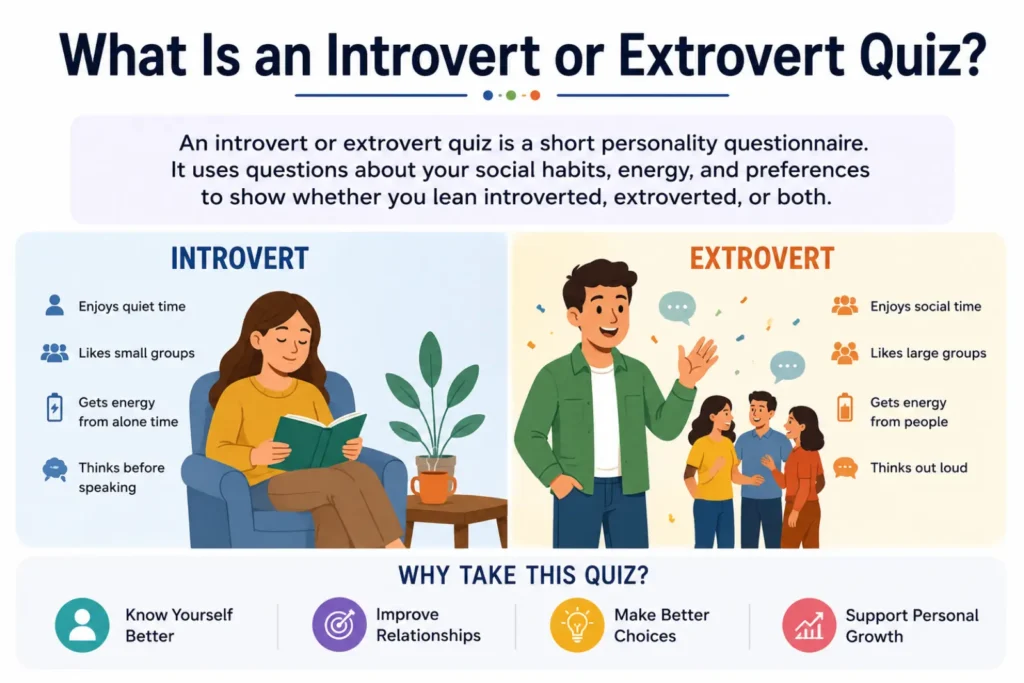
What Is an Introvert or Extrovert Quiz?
An introvert or extrovert quiz is a short personality questionnaire.
It asks about your social habits, energy, communication, and preferences.
Your answers can suggest whether you lean introverted or extroverted.
Some quizzes also include a third group called ambiverts.
Ambiverts show a balance of introverted and extroverted traits.
A good quiz should avoid strict labels.
People rarely fit perfectly into one personality group.
Your answers may also change as your life changes.
For this reason, treat quiz results as general guidance.
They can help you understand yourself without placing you in a box.
What Does Introvert Mean?
An introvert often feels comfortable with quiet settings.
They may enjoy spending time alone or with close friends.
They often prefer deeper conversations over large social gatherings.
An introvert may need quiet time after a busy event.
This break can help them feel rested and focused.
Introversion does not mean shyness.
An introvert can speak confidently and enjoy meeting new people.
The key difference often involves how someone manages social energy.
For example, an introverted student may enjoy group work.
However, they may prefer studying alone afterward.
What Does Extrovert Mean?
An extrovert often enjoys active social environments.
They may feel energized by conversations, groups, and shared activities.
Extroverts often enjoy meeting new people.
They may also think aloud while discussing ideas.
However, extroversion does not mean constant talking.
An extrovert can enjoy quiet moments too.
For example, an extroverted student may enjoy classroom discussions.
They might also look forward to group projects and social events.
The main idea involves social preference and energy.
It does not measure confidence, intelligence, kindness, or ability.
What Is an Ambivert?
An ambivert shows both introverted and extroverted traits.
Many people identify with this middle range.
An ambivert may enjoy parties with friends.
They may also enjoy quiet evenings alone.
Their preference can depend on the situation.
They might speak often in familiar groups.
They may stay quieter around unfamiliar people.
Ambiversion shows why personality cannot always fit two simple boxes.
Many people move between different social styles.
Introvert vs Extrovert: What Is the Difference?
The biggest difference involves social energy and preferred environments.
| Trait | Introvert | Extrovert |
|---|---|---|
| Social setting | Often prefers smaller groups | Often enjoys larger groups |
| Quiet time | Often feels refreshing | May feel less stimulating |
| Communication | May prefer thoughtful replies | May enjoy quick discussion |
| Social energy | Can tire after long social events | May gain energy from social activity |
| Friendships | Often prefers close connections | May enjoy wider social circles |
| Group activities | May enjoy them in smaller doses | May seek them more often |
| Reflection | Often spends more time thinking | May process ideas through discussion |
| New people | May need time to feel comfortable | May approach people more easily |
These traits describe general patterns.
They do not predict every person’s behavior.
How Does an Introvert or Extrovert Quiz Work?
Most quizzes use questions about everyday situations.
You choose the answer that best matches your usual behavior.
Questions may ask about parties, friendships, teamwork, or free time.
For example, a quiz may ask:
After a busy social event, what sounds best?
- Spending quiet time alone
- Talking with a close friend
- Joining another activity
- It depends on the situation
Your answers create a general personality pattern.
A quality quiz should use clear questions.
It should also avoid confusing or overly extreme choices.
Try to answer honestly.
Do not choose answers based on what sounds impressive.
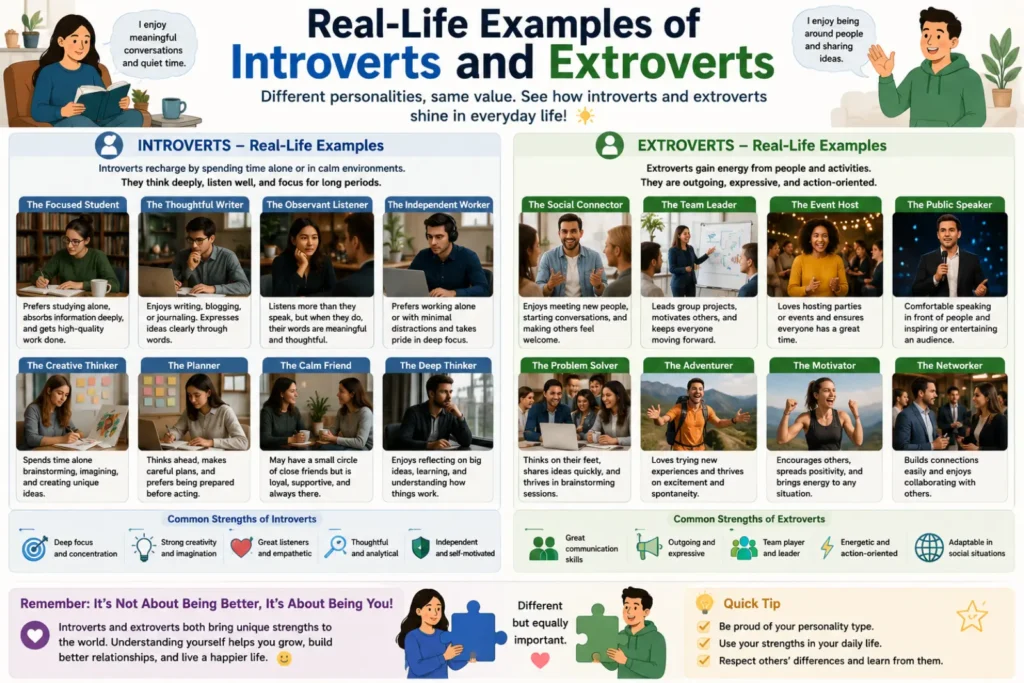
Real-Life Examples of Introverts and Extroverts
Personality traits often appear in ordinary situations.
At School
An introverted student may enjoy independent study.
They may prefer smaller group discussions.
An extroverted student may enjoy class debates.
They may also feel comfortable meeting new classmates.
Both students can perform well academically.
At Work
An introverted worker may prefer focused tasks.
They may prepare ideas before speaking during meetings.
An extroverted worker may enjoy brainstorming sessions.
They may quickly share ideas with the team.
Both approaches can support successful teamwork.
At Social Events
An introvert may enjoy talking with two close friends.
A large crowd may feel tiring after several hours.
An extrovert may enjoy moving between different conversations.
They may feel energized by the busy environment.
Neither approach is better.
During Free Time
An introvert may choose reading, drawing, gaming, or quiet hobbies.
An extrovert may choose sports, clubs, or group activities.
However, either person can enjoy both types of activities.
Signs You May Lean Introverted
You may lean introverted if several statements feel familiar.
- You enjoy quiet time after social events.
- You prefer meaningful conversations.
- You enjoy independent activities.
- You think before answering difficult questions.
- You prefer smaller groups.
- You feel comfortable spending time alone.
- You often need breaks during busy social days.
These signs do not prove that you are an introvert.
They simply suggest a possible preference.
Signs You May Lean Extroverted
You may lean extroverted if several statements feel familiar.
- You enjoy meeting new people.
- You like group activities.
- You often start conversations.
- You enjoy lively environments.
- You like sharing ideas aloud.
- You often seek social activities.
- You feel energized by friendly gatherings.
Again, these signs do not define your entire personality.
Common Mistakes When Taking a Personality Quiz
Personality quizzes work best when you answer naturally.
Avoid these common mistakes.
Choosing Your Ideal Answer
Some people choose answers that sound more confident.
That can make results less useful.
Instead, choose what matches your normal behavior.
Thinking About One Bad Experience
One difficult party does not define your personality.
Think about your usual behavior across many situations.
Assuming Introvert Means Shy
Introversion and shyness are different concepts.
A confident person can still prefer quiet settings.
Assuming Extrovert Means Loud
Extroverts can be calm, thoughtful, and good listeners.
Social energy does not equal loud behavior.
Treating Results as Permanent
Personality traits can change with experience and circumstances.
Your quiz result represents a general pattern, not a permanent identity.
How to Get Better Quiz Results
Use these simple tips before taking an introvert or extrovert quiz.
- Answer based on your normal behavior.
- Think about several recent situations.
- Avoid choosing answers that seem socially desirable.
- Read every question carefully.
- Consider your behavior with friends and strangers.
- Look for patterns across your answers.
- Avoid judging yourself based on the result.
Most importantly, do not worry about getting a particular result.
There is no winning personality type.
How Personality Type Can Help in Daily Life
Understanding your social preferences can improve self-awareness.
You may learn when you need quiet time.
You may also discover which social settings feel comfortable.
This knowledge can help with planning your day.
For example, you might schedule focused work after a busy meeting.
You could also plan social activities when you have more energy.
Personality awareness can also improve communication.
You may understand why someone prefers messages instead of phone calls.
Another person may prefer talking face to face.
These differences do not mean someone is rude or unfriendly.
Introvert and Extrovert Synonyms and Related Terms
People use several related terms when discussing personality.
Common semantic keywords include:
- introverted personality
- extroverted personality
- introvert personality type
- extrovert personality type
- ambivert personality
- social energy
- personality traits
- social preferences
- personality test
- personality quiz
- introvert test
- extrovert test
- introvert vs extrovert
- social behavior
- self-awareness
- personality assessment
These terms describe related ideas.
However, they do not always mean exactly the same thing.
Expert Insights
Personality labels can provide useful language for self-reflection.
They can help people notice patterns in their behavior.
However, experts generally view personality as more complex than two categories.
Human behavior depends on many factors and situations.
A person can act differently at school, home, and work.
Mood, experience, culture, and relationships can also influence behavior.
That makes flexible thinking important.
Use an introvert or extrovert quiz as a starting point.
Then look at your answers and reflect on your habits.
A useful question is simple:
“What situations help me feel comfortable and focused?”
That question can reveal more than a single label.
Frequently Asked Questions
Is an introvert or extrovert quiz accurate?
A quiz can offer useful clues about your social preferences.
However, it cannot describe your complete personality.
Can an introvert become an extrovert?
People can develop different social skills and habits.
However, personality preferences may remain fairly consistent over time.
Can someone be both an introvert and extrovert?
Yes. Many people show traits from both groups.
These people often use the term ambivert.
Are introverts shy?
No. Introversion and shyness are different.
An introvert can feel confident in social situations.
Are extroverts always outgoing?
No. Extroverts can also enjoy quiet activities.
Extroversion describes general social preferences, not constant behavior.
Which personality type is better?
Neither type is better.
Both personality styles can have useful strengths.
Can my quiz result change?
It can. Your answers may change as your experiences and circumstances change.
Your result should not feel like a permanent label.
Should I take a personality quiz seriously?
Use it for self-reflection rather than diagnosis.
A short quiz cannot explain every part of your personality.ck here.”
Conclusion
An introvert or extrovert quiz can help you explore your social preferences.
It may show whether you lean introverted, extroverted, or somewhere between both.
Introverts often enjoy quiet settings and smaller social groups.
Extroverts often enjoy active social environments and group interaction.
Ambiverts can show traits from both styles.
Still, no short quiz can describe your whole personality.
Your behavior can change across people, places, and situations.
Your results should therefore guide reflection rather than define you.
The best approach is simple.
Answer honestly, notice your patterns, and stay open to change.
There is no better personality type.
The goal is understanding yourself and communicating better with others.