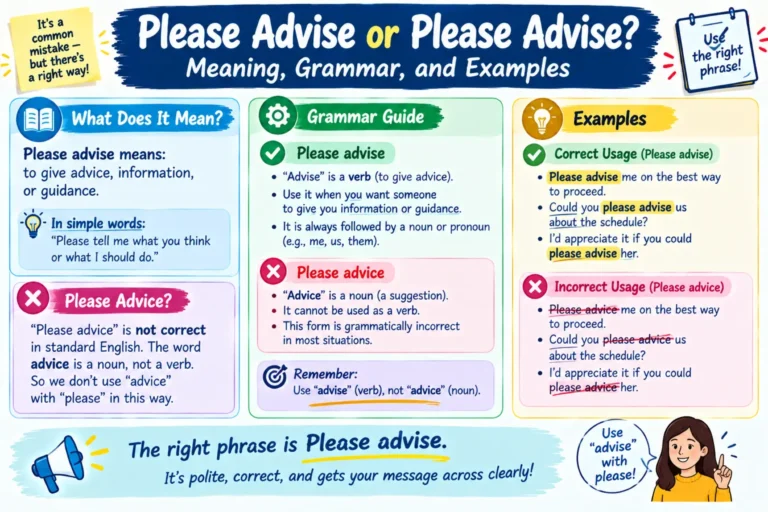
Please advise or please advice? Many people ask this question when writing emails, messages, or formal letters. Both words look similar, but they have different meanings. Using the wrong word can make your writing sound less clear. The good news is that the correct choice is easy to remember.
“Please advise” is correct when you ask someone for help, guidance, or information. “Please advice” is incorrect in standard English because advice is a noun, not a verb. However, you can use advice in sentences like “Please give me advice.”
In this guide, you will learn the difference between advise and advice. You will also see simple examples, common mistakes, and useful email phrases. By the end, you will know which word to use in everyday writing.
Quick Summary: Please Advise or Please Advice?
- Please advise is correct when asking someone for guidance or information.
- Advise is a verb. It means to give guidance or suggest what someone should do.
- Advice is a noun. It means a suggestion, opinion, or helpful guidance.
- Please advice is incorrect in standard English.
- Correct example: “Please advise me on the next steps.”
- Correct example: “Please give me your advice.”
- Remember: Advise is an action. Advice is the thing you receive.
1. What Is the Meaning of Please Advise?
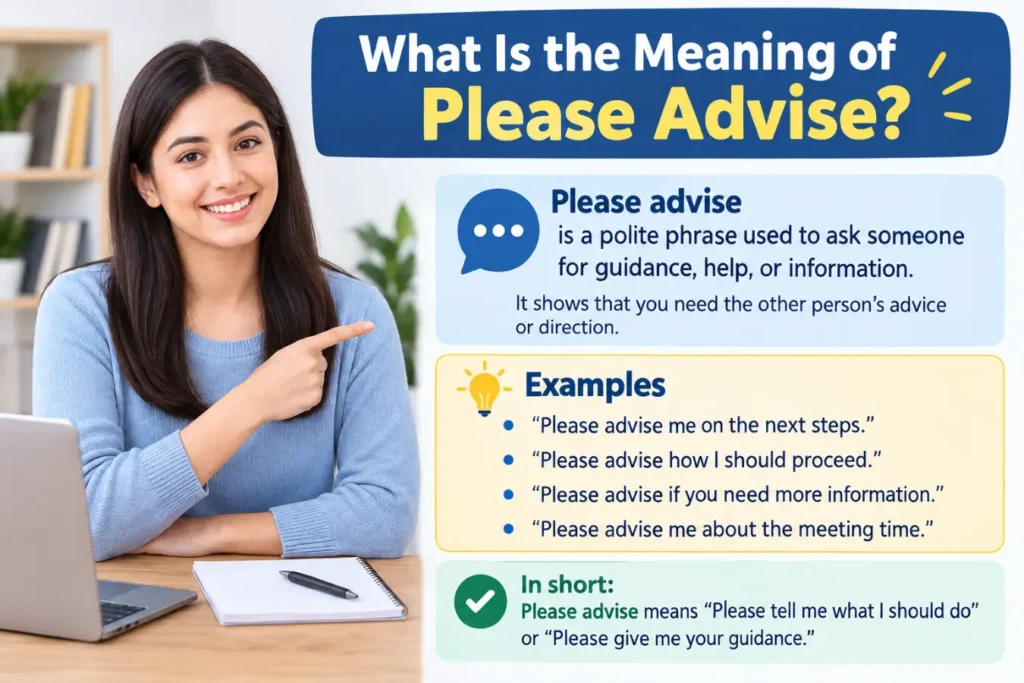
“Please advise” is a polite phrase used to ask someone for help, guidance, or information.
People often use it in emails, business letters, and formal messages. It tells the reader that you need their advice or direction.
For example:
- Please advise me on the next steps.
- Please advise how I should proceed.
- Please advise if you need more information.
- Please advise me about the meeting time.
In each example, the speaker asks someone to provide guidance or information.
The word “please” makes the request sound more polite. The word “advise” tells the reader what action you want.
Simple definition
Please advise means “Please tell me what I should do” or “Please give me your guidance.”
You can use it when you need help with a problem, decision, or task.
2. What Is the Meaning of Advice?
Advice is a noun that means guidance, suggestions, or recommendations.
People give advice when they want to help someone make a decision. You can receive advice from a teacher, friend, doctor, manager, or family member.
For example:
- My teacher gave me useful advice.
- I need your advice about my career.
- Her advice helped me solve the problem.
- Thank you for your advice.
Notice that advice names the guidance itself. It does not describe the action of giving guidance.
You can use advice with words like “some,” “good,” “helpful,” and “useful.”
For example:
“Please give me some advice about my studies.”
Here, advice is the thing you want to receive.
Is advice countable or uncountable?
Advice is an uncountable noun in standard English.
Therefore, do not say “an advice” or “two advices.”
Instead, use these phrases:
- A piece of advice
- Some advice
- A bit of advice
- Two pieces of advice
Correct: She gave me a piece of advice.
Incorrect: She gave me an advice.
3. Advise vs Advice: What Is the Difference?
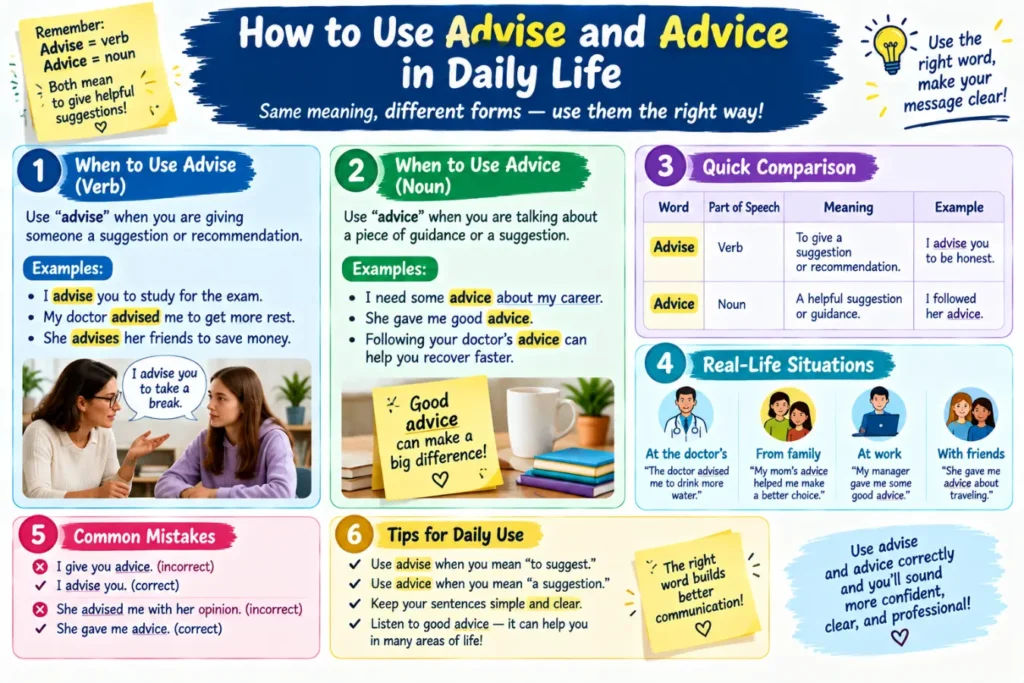
The main difference is simple. Advise is a verb, while advice is a noun.
A verb describes an action. A noun names a person, place, thing, or idea.
| Word | Part of speech | Meaning | Example |
|---|---|---|---|
| Advise | Verb | To give guidance | Please advise me. |
| Advice | Noun | Guidance or suggestions | Please give me advice. |
How to remember the difference
Think of advise as something you do. Think of advice as something you give or receive.
For example:
- I advise my friend to study.
- My friend asks for advice.
- The teacher advised us to practice.
- The teacher gave us useful advice.
Both words relate to guidance, but they work differently in a sentence.
4. Why Is Please Advise Correct?
“Please advise” is correct because advise is a verb.
When you say “Please advise,” you ask someone to perform an action. You want them to guide you or tell you what to do.
The sentence follows a common English pattern:
Please + verb
Examples include:
- Please help.
- Please explain.
- Please confirm.
- Please respond.
- Please advise.
In each example, the word after “please” is a verb.
This is why “Please advice” does not work. Advice is a noun, so it cannot perform the same role.
If you want to use advice, change the sentence structure.
Incorrect: Please advice me.
Correct: Please advise me.
Also correct: Please give me advice.
5. Real-Life Examples of Please Advise
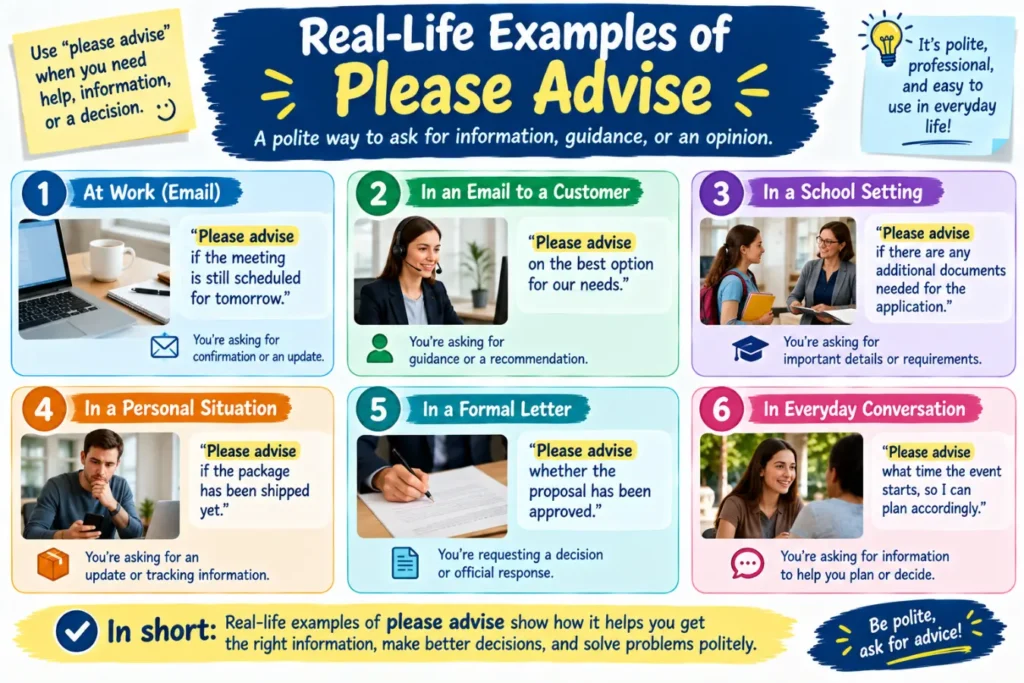
People use “please advise” in many situations. Here are examples from daily life and professional communication.
Example 1: Asking your manager
“Dear Sir, I have completed the report. Please advise on the next steps.”
This sentence asks the manager what to do next.
Example 2: Asking a teacher
“Please advise me on how to improve my English.”
This sentence asks the teacher for guidance.
Example 3: Asking a customer
“Please advise whether you would like to continue with the order.”
This sentence asks the customer to share a decision.
Example 4: Asking for technical help
“My laptop keeps restarting. Please advise how I can fix this issue.”
This sentence asks someone to suggest a solution.
Example 5: Asking for information
“Please advise if the meeting time has changed.”
This sentence asks someone to confirm information.
Example 6: Asking for professional guidance
“Please advise me on the best way to complete this task.”
This sentence asks for help with a work-related decision.
These examples show how “please advise” works in different situations.
6. Please Advise or Please Advice in Emails?
“Please advise” is common in professional emails. It can help you ask for guidance without using a long sentence.
However, the phrase may sound formal or direct in some situations.
You can choose a phrase that matches your relationship with the reader.
| Situation | Suggested phrase |
|---|---|
| Formal business email | Please advise on the next steps. |
| Asking a manager | Could you please advise me? |
| Asking a colleague | Could you share your thoughts? |
| Asking a customer | Please let us know your preference. |
| Asking for a decision | Please confirm how you would like to proceed. |
| Asking for help | Could you please guide me? |
Professional email example
Subject: Request for Guidance
Dear Mr. Ahmed,
I have completed the assigned task and reviewed the details.
Could you please advise me on the next steps?
Thank you for your time and support.
Best regards, Ali
This email uses the correct word and makes the request clear.
A more natural alternative
You do not always need to write “Please advise.”
For example:
“Could you please let me know what I should do next?”
This phrase sounds friendly and clear. It may work better when writing to someone you know well.
7. Common Mistakes With Advise and Advice
Many English learners confuse these words because they have similar spellings and meanings.
Here are common mistakes and their corrections.
Mistake 1: Writing “Please advice me”
Incorrect: Please advice me about the issue.
Correct: Please advise me about the issue.
Why? Advise is the verb that describes giving guidance.
Mistake 2: Writing “Give me an advice”
Incorrect: Please give me an advice.
Correct: Please give me some advice.
Why? Advice is an uncountable noun.
Mistake 3: Writing “He advice me”
Incorrect: He advice me to study.
Correct: He advises me to study.
Why? The verb advise changes to advises with he, she, or it in the present tense.
Mistake 4: Writing “She gave me many advices”
Incorrect: She gave me many advices.
Correct: She gave me a lot of advice.
Why? Advice is uncountable in standard English.
Mistake 5: Confusing advise with advice in formal letters
Incorrect: I need your advise on this matter.
Correct: I need your advice on this matter.
Why? The sentence needs a noun after “your.”
Mistake 6: Using advice after “to”
Incorrect: I want to advice you.
Correct: I want to advise you.
Why? The word after “to” is the base form of a verb in this sentence.
8. Tips to Remember Advise and Advice
You can remember the difference with a few simple tricks.
Tip 1: Look at the ending
Advice ends with “ice.” Advise ends with “ise.”
In standard English pronunciation, advice ends with an “s” sound. Advise ends with a “z” sound.
Tip 2: Ask what the sentence needs
If you need an action, use advise.
If you need a thing or idea, use advice.
Examples:
- I will advise you.
- I need your advice.
Tip 3: Try replacing the word
Replace advice with “guidance.”
If the sentence still makes sense, advice is probably correct.
Example:
“I need your guidance.”
Therefore: “I need your advice.”
Replace advise with “guide.”
Example:
“Please guide me.”
Therefore: “Please advise me.”
Tip 4: Remember the word “give”
The phrase “give advice” is correct.
The phrase “give advise” is incorrect.
However, “advise someone” is correct.
For example:
- Please give me advice.
- Please advise me.
Both sentences ask for guidance.
9. How to Use Advise and Advice in Daily Life
You can use these words in school, work, family conversations, and personal decisions.
At school
A student may ask:
“Could you please advise me on how to prepare for my exam?”
A teacher may reply:
“My advice is to practice every day.”
At work
An employee may write:
“Please advise me on the project deadline.”
A manager may respond:
“My advice is to finish the first draft today.”
With friends
You may say:
“Can you give me some advice about my new job?”
Your friend may answer:
“I advise you to learn about the company first.”
In customer service
A customer may write:
“Please advise me about the delivery status.”
The company may reply:
“Our advice is to check your tracking number.”
These examples show how both words fit into normal communication.
10. Synonyms and Related Words
Understanding related words can help you write more clearly.
Synonyms for advice
These words have similar meanings, depending on the sentence:
- Guidance
- Suggestion
- Recommendation
- Counsel
- Tip
- Opinion
Examples:
“Thank you for your guidance.”
“Can you give me a suggestion?”
“I appreciate your recommendation.”
These words are not always interchangeable. Choose one that fits your meaning.
Synonyms for advise
You can sometimes replace advise with:
- Guide
- Suggest
- Recommend
- Counsel
- Inform
Examples:
“Please guide me through the process.”
“I recommend that you review the report.”
“Please inform me about any changes.”
The best choice depends on what you want the reader to do.
11. Expert Insights: How to Write More Clearly
Correct grammar helps readers understand your message. However, clear writing also depends on tone, context, and word choice.
Here are practical tips for professional writing.
Use direct language
Instead of writing:
“Please advise regarding the aforementioned matter.”
Write:
“Please advise me about this matter.”
The second sentence is easier to understand.
Explain what you need
“Please advise” can sometimes sound vague.
If possible, tell the reader what guidance you need.
For example:
“Please advise whether I should submit the report today or tomorrow.”
This gives the reader a clear question to answer.
Choose the right level of formality
“Please advise” often suits formal emails and business communication.
For a friendly message, you can write:
“What do you think I should do?”
Both phrases can work. The situation decides which one fits.
Check your sentence before sending
Ask yourself three questions:
- Am I asking someone to give guidance?
- Do I need a verb or a noun?
- Does the sentence sound clear and polite?
These questions can help you avoid common grammar mistakes.
12. Frequently Asked Questions
1. Is it please advise or please advice?
“Please advise” is correct when asking someone for guidance.
“Please advice” is incorrect in standard English.
2. Is advice a noun or a verb?
Advice is a noun. It means guidance or suggestions.
Advise is the verb. It means to give guidance or suggestions.
3. Can I say “Please give me advice”?
Yes. This sentence is grammatically correct.
You can also say, “Please give me some advice.”
4. Is “Please advise me” correct?
Yes. “Please advise me” is correct and polite.
It means you are asking someone to guide you or suggest what you should do.
5. Is “Please advice accordingly” correct?
No. The correct phrase is “Please advise accordingly.”
However, you can make the sentence clearer by explaining what action you need.
For example: “Please advise me on how to proceed.”
6. What is the plural of advice?
Advice is uncountable, so it does not normally have a plural form.
Use “pieces of advice” when you need to count separate suggestions.
7. How do you pronounce advise and advice?
Advice ends with an “s” sound, like “ice.”
Advise ends with a “z” sound, like “eyes.”
The spelling and final sound can help you tell them apart.
Conclusion
The difference between “please advise” and “please advice” is simple. Advise is a verb, while advice is a noun. Use “please advise” when asking someone for guidance, information, or a suggestion. Use advice when talking about the guidance itself.
For example, “Please advise me on the next steps” is correct. “Please give me some advice” is also correct. However, “Please advice me” is not correct in standard English.
Remember this easy rule: advise is an action, and advice is the thing you receive. This small grammar tip can improve your emails, messages, and everyday writing.
When you are unsure, check whether your sentence needs an action or a thing. That simple step will help you choose the right word every time.