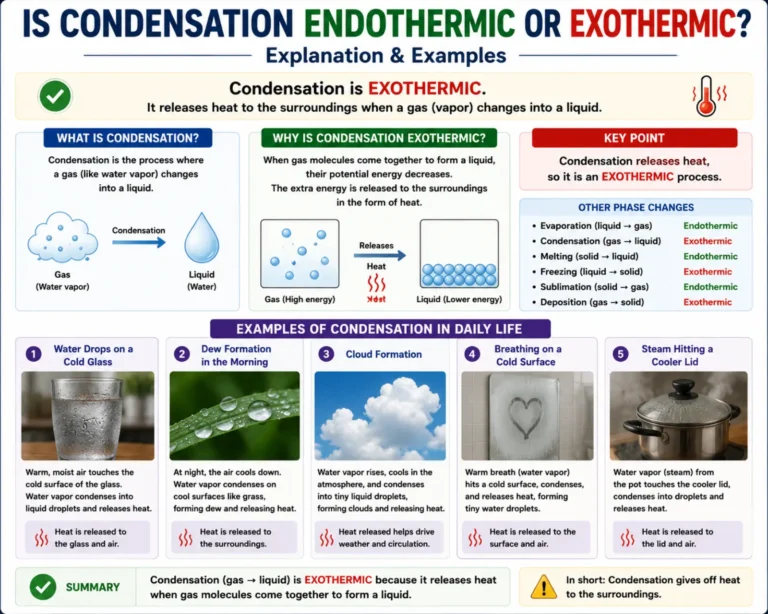
Condensation is exothermic. When a gas changes into a liquid, it releases heat energy into its surroundings. This happens because gas particles lose energy and move closer together as they form a liquid.
For example, when water vapor turns into liquid water on a cold window, condensation occurs and heat is released. The opposite process, evaporation, is endothermic because it requires energy to change a liquid into a gas.
Understanding this difference is important in chemistry, physics, weather science, and everyday life. In this guide, we will explain why condensation is exothermic, compare it with evaporation, examine particle behavior, and answer common questions.
Quick Answer: Is Condensation Endothermic or Exothermic?
Condensation is an exothermic phase change. During condensation, a gas loses energy and changes into a liquid. The lost energy is released as heat into the surroundings.
Example: Water vapor → liquid water + heat
What Is Condensation?
Condensation is the process in which a gas changes into a liquid.
Water provides the most familiar example. Water exists as a gas called water vapor. When that vapor cools enough, it can change into liquid water.
You can see condensation in many everyday situations:
- Water droplets forming on a cold glass
- Fog forming near the ground
- Dew appearing on grass
- Clouds forming in the atmosphere
- Steam becoming water droplets
- Moisture appearing on a bathroom mirror
During this phase change, the substance does not simply disappear or lose particles. Instead, the particles lose energy and become more closely associated.
Why Is Condensation Exothermic?
Condensation is exothermic because the substance releases energy when its gas particles become a liquid.
Gas particles generally have more freedom of movement than liquid particles. As a gas cools, its particles lose kinetic energy.
Eventually, attractive forces between particles can bring them closer together.
When particles move from the gas state to the liquid state, they release energy.
That released energy goes into the surroundings.
Therefore:
Condensation = exothermic
The key idea is energy leaves the substance during condensation.
What Happens to Energy During Condensation?
Energy plays an important role in every phase change.
During condensation, gas particles lose energy. That energy is transferred to the surrounding environment.
For water, the process can be represented as:
Water vapor → liquid water + energy
The water itself becomes more condensed, while the surrounding environment receives the released energy.
This is why condensation is classified as an exothermic process.
What Happens to Particles During Condensation?
The particle-level explanation makes the process easier to understand.
Before condensation
In the gas state:
- Particles are relatively far apart.
- They move freely.
- They have relatively high kinetic energy.
- Attractive interactions are less significant.
During condensation
As the gas loses energy:
- Particle movement slows.
- Particles move closer together.
- Attractive forces become more important.
- The gas begins forming liquid.
After condensation
In the liquid state:
- Particles are much closer together.
- They can still move around.
- Their movement is more restricted than in a gas.
- The substance has a definite volume.
The change in particle energy is central to understanding why condensation releases heat.
Condensation vs. Evaporation
Condensation and evaporation are opposite phase changes.
| Feature | Condensation | Evaporation |
|---|---|---|
| Starting state | Gas | Liquid |
| Ending state | Liquid | Gas |
| Energy change | Releases energy | Absorbs energy |
| Type | Exothermic | Endothermic |
| Particle energy | Decreases overall | Increases for escaping particles |
| Example | Water vapor → water | Water → water vapor |
A useful memory trick is:
Condensation cools the gas and releases energy.
Evaporation requires energy to produce gas.
Is Evaporation Endothermic?
Yes. Evaporation is endothermic.
A liquid needs energy for some particles to escape from the liquid surface and become a gas.
This energy comes from the liquid and its surroundings.
That is why evaporation can produce a cooling effect.
For example, sweat evaporating from your skin takes energy from your body. This helps cool you.
Condensation works in the opposite direction.
When water vapor becomes liquid, energy is released.
Condensation vs. Freezing
Both condensation and freezing are exothermic phase changes, but they involve different states.
Condensation
Gas → liquid
Example:
Water vapor → liquid water
Freezing
Liquid → solid
Example:
Liquid water → ice
Both processes involve particles moving toward a lower-energy state and releasing energy to the surroundings.
However, condensation occurs between a gas and a liquid, while freezing occurs between a liquid and a solid.
Condensation vs. Melting
Melting and condensation have opposite energy behaviors.
Melting
Solid → liquid
Melting requires energy, so it is endothermic.
Condensation
Gas → liquid
Condensation releases energy, so it is exothermic.
| Phase Change | Direction | Energy |
|---|---|---|
| Melting | Solid → liquid | Endothermic |
| Evaporation | Liquid → gas | Endothermic |
| Condensation | Gas → liquid | Exothermic |
| Freezing | Liquid → solid | Exothermic |
| Sublimation | Solid → gas | Endothermic |
| Deposition | Gas → solid | Exothermic |
This table gives you a simple way to remember the energy changes involved in phase transitions.
Is Condensation a Physical or Chemical Change?
Condensation is a physical change.
The substance changes its physical state but does not become a different chemical substance.
For example:
Water vapor → liquid water
Both are still H₂O.
The molecules remain chemically the same.
Only their physical state changes.
This is why condensation does not produce a new substance.
Does Condensation Release Heat?
Yes.
Condensation releases heat energy.
When a vapor becomes a liquid, the particles move into a lower-energy arrangement. The energy difference is released to the surroundings.
This released energy is called the latent heat of condensation.
For water, this energy transfer is particularly important in atmospheric science because condensing water vapor can release large amounts of energy into the atmosphere.
What Is Latent Heat of Condensation?
Latent heat of condensation is the amount of energy released when a substance changes from a gas to a liquid at constant temperature.
The word latent means that the energy is associated with a phase change rather than a simple temperature change.
For a given mass, the energy transferred can be represented by:
Where:
- Q = energy transferred
- m = mass of the substance
- Lᵥ = specific latent heat of vaporization
During condensation, the same magnitude of latent heat is released rather than absorbed.
Does Condensation Increase or Decrease Temperature?
This question needs a little care.
Condensation itself is an exothermic phase change, so it releases heat. However, the temperature of the substance can remain constant during the phase change if conditions are appropriate.
For example, when water vapor condenses at its condensation point, energy can be released while the phase change occurs.
So it is important to distinguish between:
- Heat transfer
- Temperature change
A substance can release latent heat during a phase change without its temperature changing in the same way you might expect during ordinary cooling.
Why Does Water Condensation Form on Cold Surfaces?
Condensation often occurs when warm, moist air contacts a surface that is cold enough.
For example, imagine placing a cold glass of water on a table.
The air around the glass contains water vapor.
When that moist air touches the cold glass, it cools.
If the air near the glass reaches its dew point, water vapor can condense into liquid droplets.
The droplets you see are not usually water leaking through the glass.
They are water from the surrounding air.
Is Cloud Formation Condensation?
Yes, condensation is an important part of cloud formation.
Warm, moist air can rise into the atmosphere.
As the air rises, it generally expands and cools.
When the air cools enough, water vapor can condense onto tiny particles called condensation nuclei.
This produces tiny liquid water droplets or, depending on atmospheric conditions, contributes to the formation of ice particles.
Large collections of these particles can form clouds.
Therefore, condensation plays a major role in the water cycle and weather.
Why Is Condensation Important in the Water Cycle?
Condensation is one of the major stages of the water cycle.
A simplified cycle looks like this:
Evaporation → condensation → precipitation → collection
Water evaporates from oceans, lakes, rivers, soil, and other surfaces.
The water vapor rises and can cool.
Eventually, some water vapor condenses into tiny droplets or ice particles.
These particles can contribute to clouds.
When conditions are suitable, precipitation can occur.
Therefore, condensation helps move water through Earth’s atmosphere.
Condensation in Everyday Life
You encounter condensation regularly without thinking about it.
Cold Drinks
Water droplets form on the outside of a cold drink because water vapor in the surrounding air condenses.
Bathroom Mirrors
Warm, moist air can contact a cooler mirror. Water vapor then condenses on the surface.
Morning Dew
Water vapor can condense onto cool grass and other outdoor surfaces.
Car Windows
Moisture can condense on windows when the temperature difference between the air and glass is large enough.
Refrigerators
Condensation can occur when humid air meets sufficiently cold surfaces inside or around refrigeration systems.
These examples all demonstrate the same basic process:
Gas → liquid
Is Condensation Always Exothermic?
Yes. Condensation is classified as an exothermic phase change because the substance releases latent heat when gas becomes liquid.
However, the amount and direction of heat transfer depend on the overall system and surrounding conditions.
In standard chemistry, the phase change itself is considered exothermic.
Common Misconception: “Condensation Needs Cooling, So It Must Be Endothermic”
This is one of the most common mistakes.
People sometimes reason:
“The gas must cool down for condensation to happen, so condensation must absorb heat.”
That conclusion is incorrect.
The cooling of the gas and the energy released during condensation are related but not identical ideas.
A vapor may need to lose energy before condensation occurs.
Once condensation takes place, the phase change releases latent heat.
Therefore, condensation is still exothermic.
Common Misconception: “Exothermic Means Temperature Must Rise”
Not necessarily.
Exothermic means that energy is released from the system to the surroundings.
It does not mean that the temperature of every part of the system must increase.
During a phase change, energy can be transferred as latent heat while temperature remains constant under appropriate conditions.
That distinction is important in chemistry.
How to Remember Endothermic and Exothermic Phase Changes
A simple rule can help.
Endothermic
These changes generally move toward a more energetic state:
- Melting
- Evaporation
- Sublimation
Think:
Solid → liquid → gas
Energy is absorbed.
Exothermic
These changes move toward a lower-energy state:
- Freezing
- Condensation
- Deposition
Think:
Gas → liquid → solid
Energy is released.
A Simple Phase-Change Energy Chart
| Phase Change | Energy Direction | Type |
|---|---|---|
| Solid → Liquid | Absorbed | Endothermic |
| Liquid → Gas | Absorbed | Endothermic |
| Solid → Gas | Absorbed | Endothermic |
| Gas → Liquid | Released | Exothermic |
| Liquid → Solid | Released | Exothermic |
| Gas → Solid | Released | Exothermic |
This is one of the easiest ways to remember the answer for chemistry tests.
Is Condensation Endothermic or Exothermic in Chemistry?
In chemistry, condensation is exothermic.
When particles change from gas to liquid, they lose energy.
That energy is released to the surroundings.
Therefore:
Condensation = exothermic
If you see a chemistry question asking whether condensation absorbs or releases heat, the correct answer is:
It releases heat.
Is Condensation Endothermic or Exothermic in Physics?
The answer is also exothermic.
Physics describes condensation as a phase change in which a gas becomes a liquid and releases latent heat.
The same principle applies regardless of whether you study the process through chemistry, physics, or atmospheric science.
Is Steam Condensation Exothermic?
Yes.
When steam or water vapor condenses into liquid water, it releases latent heat.
This is why steam can transfer a significant amount of thermal energy during condensation.
For example, steam contacting a cooler surface can condense and release heat energy to that surface.
This principle is used in various heating and industrial systems.
Why Is Condensation Important in Weather?
Condensation is essential to many atmospheric processes.
When water vapor condenses, it releases latent heat into the surrounding air.
That energy can influence atmospheric circulation and convection.
Condensation is therefore more than just the formation of water droplets on a window.
It is a major physical process in weather and climate systems.
Quick Tips for Remembering the Answer
Use these simple memory tricks:
- Condensation = gas to liquid
- Gas loses energy
- Heat is released
- Therefore, condensation is exothermic
- Evaporation is the opposite
- Evaporation is endothermic
A useful phrase is:
“Condensation comes down and gives off energy.”
Frequently Asked Questions
1. Is condensation endothermic or exothermic?
Condensation is exothermic because a gas releases energy as it changes into a liquid.
2. Does condensation absorb or release heat?
Condensation releases heat into the surroundings.
3. Why is condensation exothermic?
Gas particles lose energy as they move closer together and form a liquid. The lost energy is released as heat.
4. Is evaporation endothermic or exothermic?
Evaporation is endothermic because energy is absorbed when liquid particles escape and become gas.
5. Is condensation the opposite of evaporation?
Yes. Condensation changes gas to liquid, while evaporation changes liquid to gas.
6. Is freezing exothermic?
Yes. Freezing is exothermic because a liquid releases energy as it becomes a solid.
7. Is melting endothermic?
Yes. Melting is endothermic because a solid absorbs energy as it becomes a liquid.
8. Does condensation cause cooling?
Condensation itself releases heat, although the vapor may need to cool to reach the conditions required for condensation.
9. Is condensation a physical change?
Yes. Condensation is a physical change because the substance changes state without changing its chemical identity.
10. Does condensation release latent heat?
Yes. Condensation releases the latent heat associated with the gas-to-liquid phase change.
11. Is cloud formation caused by condensation?
Condensation is a major process in cloud formation. Water vapor cools and condenses around tiny particles in the atmosphere.
12. Is water condensation exothermic?
Yes. Water vapor releasing energy as it becomes liquid water is an exothermic process.
13. What happens to particle energy during condensation?
The particles lose energy overall as the gas changes into a liquid.
14. Why does water form on cold glasses?
Water vapor in the surrounding air cools near the cold glass and can condense into liquid droplets.
15. What is the opposite of condensation?
The opposite phase change is vaporization, which includes evaporation and boiling.
16. Is deposition exothermic?
Yes. Deposition, where a gas changes directly into a solid, releases energy.
17. Is condensation a chemical reaction?
No. Condensation is a physical phase change rather than a chemical reaction.
18. Does condensation increase or decrease energy?
The substance releases energy during condensation, so its internal energy decreases as it moves to the liquid state.
Final Verdict
So, is condensation endothermic or exothermic?
Condensation is exothermic. When a gas changes into a liquid, its particles lose energy and move into a lower-energy state. The energy released during this process transfers to the surroundings as heat.
The easiest way to remember it is:
Condensation: Gas → Liquid → Energy Released → Exothermic
By contrast:
Evaporation: Liquid → Gas → Energy Absorbed → Endothermic
Once you understand the direction of the phase change and what happens to particle energy, the answer becomes much easier to remember. Condensation is not only an important chemistry concept; it also explains everyday events such as water droplets on cold glasses, dew, fog, and cloud formation.