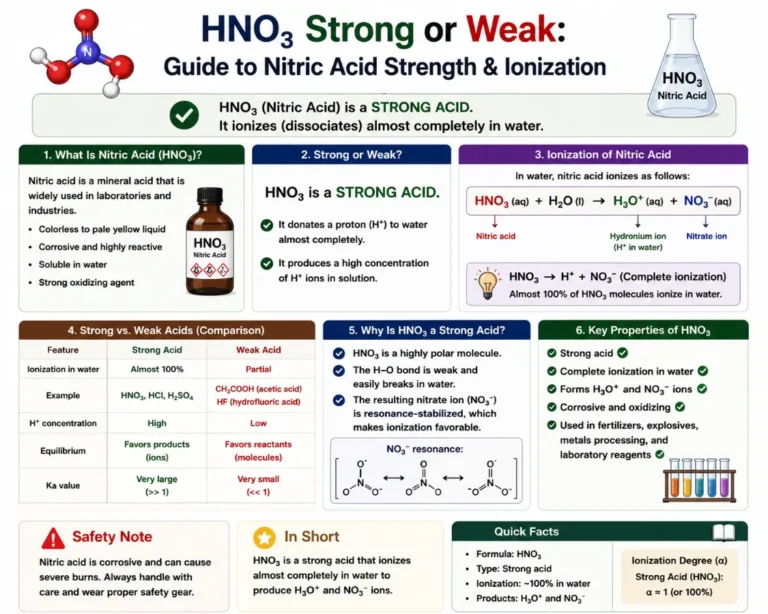
HNO3 strong or weak? The answer is simple. HNO3, also called nitric acid, is a strong acid. It breaks apart almost completely when dissolved in water. This allows it to release a large number of hydrogen ions (H⁺), making it highly reactive.
Many students find this topic confusing. They often think acid strength depends on concentration. However, acid strength and concentration are two different concepts. A strong acid ionizes almost completely in water, while a weak acid only ionizes partly.
In this guide, you will learn why HNO3 is a strong acid in simple words. We will explain how it ionizes, compare it with weak acids, and discuss its real-life uses. You will also discover common mistakes to avoid, expert tips, and answers to frequently asked questions. By the end of this article, you will clearly understand why nitric acid is classified as a strong acid.
Quick Summary Box
- HNO3 is a strong acid.
- HNO3 is the chemical formula for nitric acid.
- It ionizes almost 100% in water.
- It releases hydrogen ions (H⁺) very easily.
- Strong acids conduct electricity well.
- HNO3 reacts quickly with metals, bases, and many other chemicals.
- Acid strength depends on ionization, not concentration.
- Nitric acid is widely used in industries, laboratories, and fertilizer production.
What Is HNO3?
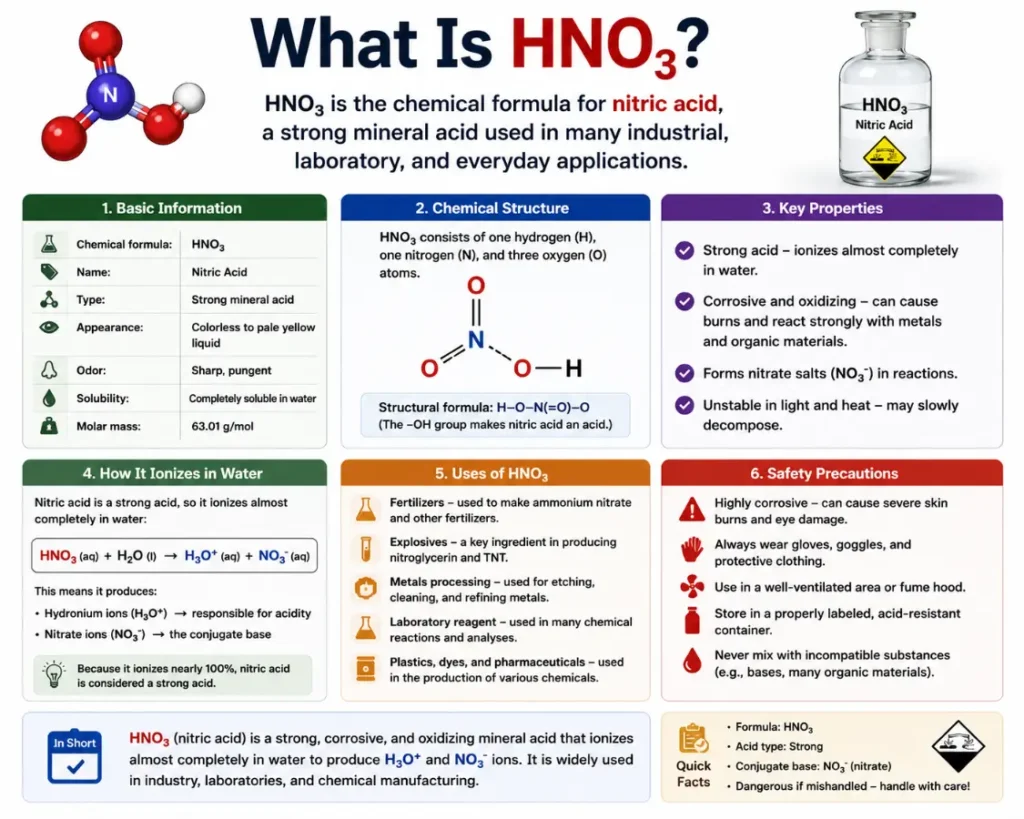
HNO3 is the chemical formula for nitric acid, one of the most important mineral acids used around the world. It is a clear, colorless liquid when pure. However, it may become yellow over time because it slowly decomposes and forms nitrogen dioxide gas.
Nitric acid is highly corrosive and reacts with many substances. Because of its strong acidic nature, it plays a key role in chemical manufacturing, scientific research, and industrial production.
Basic Facts About HNO3
| Property | Details |
|---|---|
| Chemical Name | Nitric Acid |
| Chemical Formula | HNO3 |
| Acid Type | Strong Acid |
| Molecular Weight | 63.01 g/mol |
| Appearance | Colorless to Pale Yellow Liquid |
| Odor | Sharp, Pungent |
| Solubility | Completely Soluble in Water |
| Common Uses | Fertilizers, explosives, laboratories, metal cleaning |
Nitric acid belongs to a group known as strong mineral acids. These acids release hydrogen ions almost completely when dissolved in water.
Is HNO3 Strong or Weak?
The answer is HNO3 is a strong acid.
Chemists classify acids based on how much they ionize in water. HNO3 ionizes almost completely, meaning nearly every nitric acid molecule breaks into ions.
Ionization Equation
HNO₃ → H⁺ + NO₃⁻
This reaction shows that nitric acid releases hydrogen ions (H⁺) and nitrate ions (NO₃⁻). Since almost all HNO3 molecules separate into ions, the solution becomes highly acidic.
Featured Snippet Answer
HNO3 is a strong acid because it ionizes almost completely in water. It releases nearly all of its hydrogen ions (H⁺), resulting in high electrical conductivity, low pH, and strong chemical reactivity.
Unlike weak acids, HNO3 leaves very few undissociated molecules in solution. This complete ionization is the main reason it is classified as a strong acid.
Why Is HNO3 a Strong Acid?
The strength of an acid depends on how easily it releases hydrogen ions (H⁺) in water. A strong acid gives away almost all of its hydrogen ions. HNO3 does this very efficiently.
When nitric acid dissolves in water, almost every HNO3 molecule separates into ions. Very few molecules stay together. This complete ionization is the main reason HNO3 is called a strong acid.
Several chemical properties also make nitric acid highly acidic.
Reasons Why HNO3 Is a Strong Acid
1. Complete Ionization
HNO3 ionizes almost 100% in water. This means nearly every molecule releases a hydrogen ion.
2. Stable Nitrate Ion
After releasing a hydrogen ion, HNO3 forms the nitrate ion (NO₃⁻). This ion is very stable, making the reaction easy to occur.
3. High Hydrogen Ion Concentration
The more hydrogen ions an acid produces, the stronger it becomes. HNO3 produces a very high concentration of H⁺ ions.
4. Excellent Electrical Conductivity
Because it produces many ions, nitric acid conducts electricity very well in water.
5. Very Low pH
Strong acids have very low pH values. Nitric acid solutions usually have a pH close to 1, depending on their concentration.
Key Characteristics of HNO3
- Releases H⁺ ions almost completely
- Forms stable nitrate ions
- Conducts electricity efficiently
- Reacts quickly with bases and metals
- Has a very low pH
How Does HNO3 Ionize in Water?
Understanding ionization helps explain why nitric acid is so strong.
When HNO3 enters water, water molecules attract the hydrogen atom. The bond between hydrogen and the nitrate group breaks easily.
The reaction happens almost immediately.
Chemical Equation
HNO₃ + H₂O → H₃O⁺ + NO₃⁻
In this reaction:
- HNO₃ is nitric acid.
- H₂O is water.
- H₃O⁺ is the hydronium ion.
- NO₃⁻ is the nitrate ion.
Hydronium ions make the solution acidic. Since almost every nitric acid molecule forms hydronium ions, the solution becomes strongly acidic.
What Does “Complete Ionization” Mean?
Complete ionization means almost all acid molecules separate into ions after dissolving in water.
For HNO3, the percentage of ionization is nearly 100%.
Weak acids behave differently. Only a small percentage of their molecules ionize, leaving many unchanged molecules in solution.
Strong Acid vs Weak Acid
Many students confuse strong acids with weak acids. The difference is based on ionization, not concentration.
A strong acid releases almost all of its hydrogen ions.
A weak acid releases only a small portion.
Comparison Table
| Feature | Strong Acid | Weak Acid |
|---|---|---|
| Ionization | Nearly 100% | Partial |
| Hydrogen Ion Release | Very High | Low |
| Electrical Conductivity | High | Lower |
| pH Value | Very Low | Higher |
| Reaction Speed | Faster | Slower |
| Examples | HNO3, HCl, H2SO4 | CH3COOH, HF, H2CO3 |
Simple Example
Imagine two classrooms.
In the first classroom, every student leaves when the bell rings. This represents a strong acid.
In the second classroom, only a few students leave while the rest stay seated. This represents a weak acid.
HNO3 behaves like the first classroom because almost every molecule separates into ions.
HNO3 vs Other Common Acids
Comparing nitric acid with other acids makes it easier to understand its strength.
| Acid | Chemical Formula | Strong or Weak |
| Nitric Acid | HNO3 | Strong |
| Hydrochloric Acid | HCl | Strong |
| Sulfuric Acid | H2SO4 | Strong |
| Hydrobromic Acid | HBr | Strong |
| Hydroiodic Acid | HI | Strong |
| Acetic Acid | CH3COOH | Weak |
| Hydrofluoric Acid | HF | Weak |
| Carbonic Acid | H2CO3 | Weak |
What Makes HNO3 Different?
Nitric acid ionizes almost completely. Weak acids such as acetic acid ionize only partly.
For example, vinegar contains acetic acid. Although it tastes sour, it is much less acidic than nitric acid because it releases far fewer hydrogen ions.
Hydrochloric acid and sulfuric acid behave similarly to nitric acid because they also ionize almost completely in water.
Easy Memory Trick
A simple way to remember strong acids is to learn the six most common ones:
- Hydrochloric acid (HCl)
- Hydrobromic acid (HBr)
- Hydroiodic acid (HI)
- Nitric acid (HNO3)
- Sulfuric acid (H2SO4)
- Perchloric acid (HClO4)
If HNO3 appears in a chemistry question, you can confidently identify it as a strong acid.
Real-Life Uses of HNO3
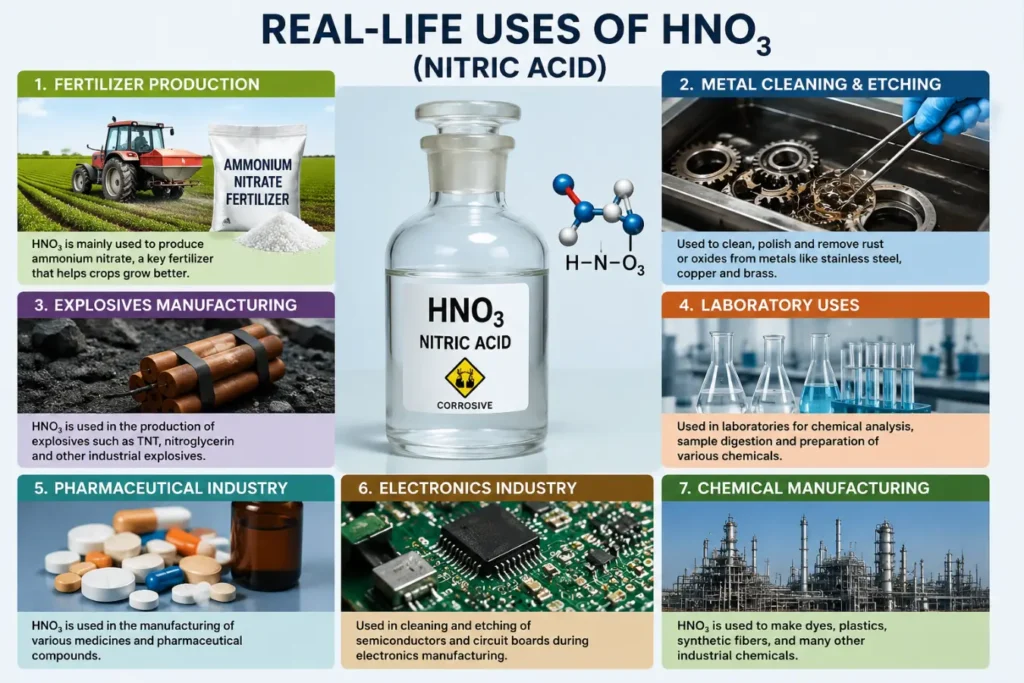
Nitric acid is one of the most widely used acids in the world. Its strong acidic nature makes it useful in many industries and laboratories.
Here are some common applications of HNO3.
1. Fertilizer Production
Most nitric acid is used to produce ammonium nitrate, an important fertilizer. This fertilizer helps crops grow faster and increases food production.
2. Laboratory Experiments
Scientists use nitric acid for chemical analysis and research. It helps prepare samples and clean laboratory equipment.
3. Metal Cleaning
Nitric acid removes rust, dirt, and other impurities from metals. It also helps polish stainless steel before manufacturing.
4. Explosives Manufacturing
Industries use nitric acid to make explosives for mining, road construction, and demolition projects.
5. Pharmaceutical Industry
Some medicines and chemical compounds require nitric acid during production.
6. Electronics Manufacturing
Nitric acid helps clean and etch electronic components such as circuit boards and semiconductor materials.
7. Chemical Manufacturing
Many industrial chemicals, dyes, plastics, and synthetic materials depend on nitric acid during production.
Common Mistakes About HNO3
Students often misunderstand acid strength. Avoid these common mistakes.
Mistake 1: Confusing Strength with Concentration
This is the most common mistake.
A strong acid ionizes completely.
A concentrated acid simply contains more acid in a given amount of solution.
A dilute HNO3 solution is still a strong acid because it ionizes almost completely.
Mistake 2: Thinking All Acids Behave the Same
Not every acid releases hydrogen ions completely.
Strong acids ionize nearly 100%.
Weak acids ionize only partly.
Mistake 3: Memorizing Without Understanding
Some students memorize acid names without learning why they are strong.
Understanding ionization makes chemistry much easier.
Mistake 4: Ignoring Chemical Equations
Chemical equations show how acids behave in water.
Writing the ionization equation helps you remember why HNO3 is classified as a strong acid.
Tips to Remember That HNO3 Is a Strong Acid
Simple tricks make chemistry easier to learn.
Learn the Common Strong Acids
Memorize the six common strong acids.
HNO3 is always on that list.
Practice Ionization Equations
Writing equations regularly improves understanding.
Compare with Weak Acids
Compare nitric acid with acetic acid or carbonic acid.
The differences become easier to remember.
Remember the Rule
Strong acids ionize almost completely in water.
Since HNO3 follows this rule, it is a strong acid.
HNO3 in Daily Life
You may not see nitric acid at home, but many everyday products depend on it.
Examples include:
- Agricultural fertilizers
- Industrial cleaning chemicals
- Laboratory reagents
- Metal finishing products
- Rocket propellants
- Pharmaceutical manufacturing
- Plastic and dye production
Without nitric acid, many modern industries would not operate efficiently.
Synonyms and Related Search Terms
Using related keywords helps readers understand the topic better.
Synonyms
- Nitric acid
- Strong mineral acid
- Mineral acid
- Inorganic acid
Related Search Terms (LSI Keywords)
- Is nitric acid strong or weak
- HNO3 acid strength
- Nitric acid properties
- Strong acid examples
- HNO3 ionization
- Nitric acid dissociation
- Strong vs weak acids
- Why is HNO3 a strong acid
- Nitric acid in water
- HNO3 chemical properties
- List of strong acids
- Acid ionization explained
Expert Insight
Chemistry experts classify HNO3 as a strong acid because experimental evidence consistently shows that it ionizes almost completely in water.
Understanding this concept is important because acid strength affects many chemical reactions. It also helps predict pH, electrical conductivity, reaction rates, and equilibrium.
Students who understand acid strength usually perform better in topics such as chemical equations, equilibrium, electrochemistry, and analytical chemistry.
Always remember one important idea:
Acid strength depends on ionization, not concentration.
(FAQs)
Is HNO3 a strong or weak acid?
HNO3 is a strong acid because it ionizes almost completely in water.
Why is nitric acid considered a strong acid?
It releases nearly all of its hydrogen ions (H⁺) when dissolved in water.
Does HNO3 completely dissociate in water?
Yes. Under normal conditions, nitric acid dissociates almost completely.
Is HNO3 stronger than acetic acid?
Yes.
Nitric acid is much stronger because acetic acid only partially ionizes.
Is concentrated HNO3 stronger than dilute HNO3?
No.
Both are strong acids.
The difference is concentration, not acid strength.
What ion forms after HNO3 dissociates?
Nitric acid forms the nitrate ion (NO₃⁻) and the hydronium ion (H₃O⁺) in water.
Does HNO3 conduct electricity?
Yes.
Because it produces many ions in water, it is an excellent conductor of electricity.
What are the main uses of nitric acid?
Nitric acid is used in:
- Fertilizer production
- Chemical manufacturing
- Metal cleaning
- Laboratory research
- Electronics manufacturing
- Explosives production
Conclusion
Now you know the answer to the question “HNO3 strong or weak?” Nitric acid is a strong acid because it ionizes almost completely when dissolved in water. This complete ionization produces many hydrogen ions, giving nitric acid its low pH, high electrical conductivity, and strong chemical reactivity. Understanding this concept also helps you distinguish between acid strength and acid concentration, two ideas that many students confuse. Whether you are preparing for an exam or learning basic chemistry, remembering how HNO3 behaves in water will make many other chemistry topics easier to understand. Keep practicing ionization equations and comparing strong and weak acids. These habits will strengthen your chemistry skills and improve your confidence in solving scientific problems.