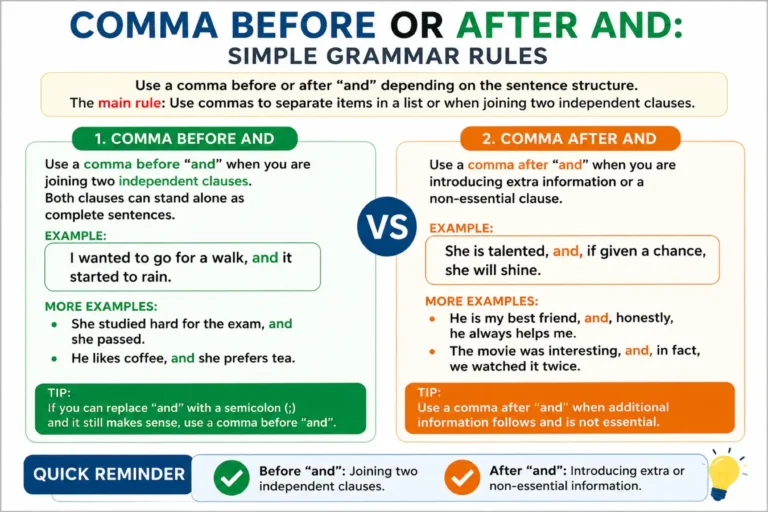
Comma before or after and is a common grammar question. Many writers feel confused about where a comma belongs. The good news is that the rule is easy to learn. You only need to know a few simple cases.
Sometimes you should place a comma before and. Other times, you should not use one at all. A comma after and is much less common. It usually appears only in special situations.
This guide explains each rule in simple English. You will find clear examples, helpful tips, and common mistakes to avoid. By the end, you will know exactly when to use a comma before or after and with confidence.
Quick Summary
- A comma before and often joins two independent clauses.
- A comma before and may appear in a list when using the Oxford comma.
- A comma after and is usually incorrect.
- Use a comma after and only when another grammar rule requires it.
- Read your sentence aloud to check if the punctuation feels natural.
What Does “Comma Before or After And” Mean?
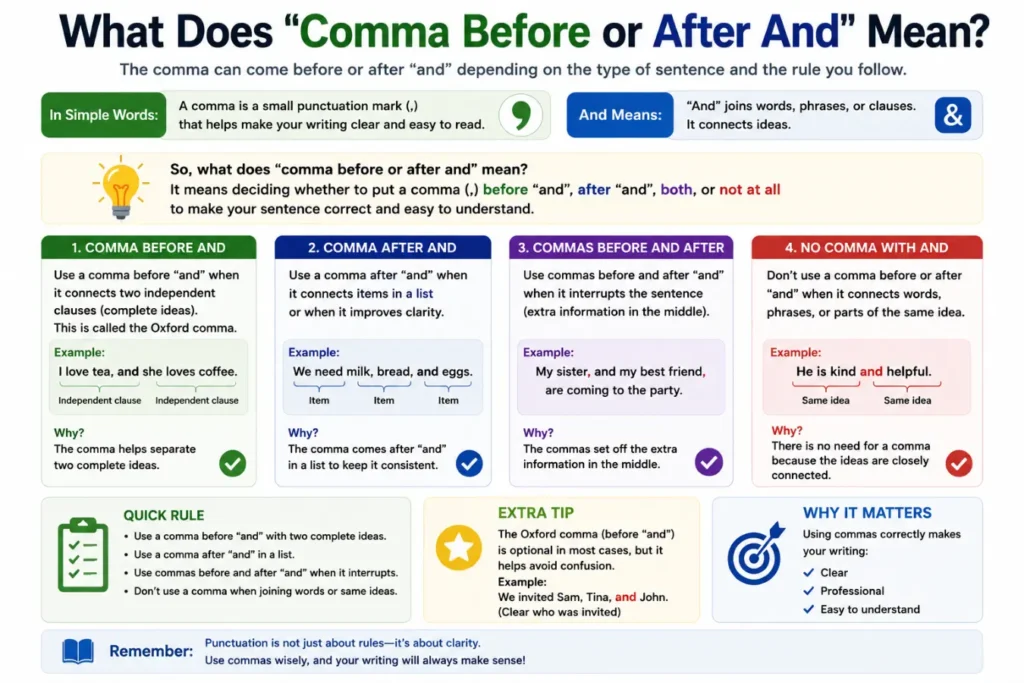
The phrase comma before or after and refers to where a comma should appear when using the word and.
Many people ask this question because and connects words, phrases, or complete sentences. The correct comma placement depends on what and joins.
Here are the three main situations:
- No comma before and in most simple sentences.
- A comma before and when joining two complete sentences.
- A comma after and only in rare cases.
Learning these patterns makes writing clearer and easier to read.
When Should You Use a Comma Before And?
You should use a comma before and when it joins two independent clauses.
An independent clause has its own subject and verb. It can stand alone as a complete sentence.
Examples
- I finished my homework**, and** I watched a movie.
- Sarah baked cookies**, and** Tom made coffee.
- We arrived early**, and** the meeting started on time.
Each part of these examples could become a sentence by itself. That is why the comma is correct.
Quick Tip
Ask yourself this question:
Can both parts stand alone as complete sentences?
If the answer is yes, use a comma before and.
When Should You Not Use a Comma Before And?
Most simple sentences do not need a comma before and.
If and joins words or short phrases instead of complete sentences, skip the comma.
Examples
- Jack and Emma went shopping.
- I bought apples and oranges.
- She opened the door and smiled.
- We cleaned the house and painted the fence.
In these examples, and simply connects words or actions. No comma is needed.
Adding a comma here makes the sentence look awkward and can confuse readers.
Should You Ever Use a Comma After And?
In most cases, the answer is no.
A comma should not come directly after and.
Incorrect Examples
- I bought bread and, milk.
- She opened the window and, looked outside.
- They studied hard and, passed the test.
These sentences contain unnecessary commas.
Rare Exceptions
Sometimes another punctuation rule places a comma after and.
For example:
- And, to everyone’s surprise, the team won.
- We visited Paris and, after a long delay, finally reached Rome.
In these examples, the comma belongs to the interrupting phrase, not to the word and itself.
This is why a comma after and is uncommon in everyday writing.
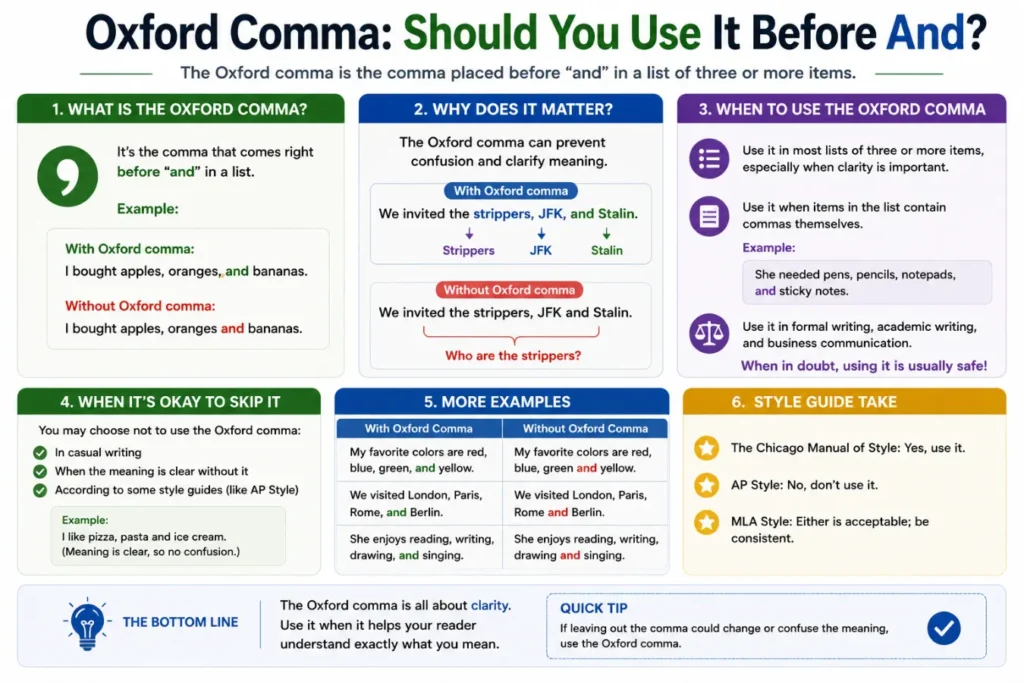
Oxford Comma: Should You Use It Before And?
The Oxford comma is the comma that comes before and in a list of three or more items.
Some style guides require it. Others make it optional. Both choices are correct if you stay consistent.
Examples with the Oxford Comma
- I bought apples, oranges**, and** bananas.
- We invited Sam, Mia**, and** Noah.
- She enjoys reading, swimming**, and** painting.
Examples Without the Oxford Comma
- I bought apples, oranges and bananas.
- We invited Sam, Mia and Noah.
- She enjoys reading, swimming and painting.
Which Style Is Better?
The Oxford comma often makes writing clearer. It can prevent confusion in complex lists.
For example:
- I would like to thank my parents, Oprah, and Taylor Swift.
Without the Oxford comma, the sentence could suggest that Oprah and Taylor Swift are the writer’s parents.
For formal writing, many editors recommend using the Oxford comma.
Comma Before And vs Comma After And
The table below explains the difference.
| Situation | Use a Comma Before And | Use a Comma After And |
|---|---|---|
| Joining two complete sentences | ✅ Yes | ❌ No |
| Joining two words | ❌ No | ❌ No |
| Joining two short phrases | ❌ No | ❌ No |
| Lists with the Oxford comma | ✅ Optional or required by style | ❌ No |
| Interrupting phrase after and | Sometimes | ✅ Only if another grammar rule requires it |
Key Takeaway
A comma before and is common. A comma after and is rare.
Real-Life Examples
Seeing grammar in everyday writing makes the rule easier to remember.
At School
Correct:
- I finished my project, and my teacher checked it.
Incorrect:
- I finished my project and, my teacher checked it.
At Work
Correct:
- We reviewed the report, and everyone agreed.
Correct:
- We printed the report and sent it to the client.
In Daily Conversations
Correct:
- Mom cooked dinner and baked a cake.
Correct:
- Dad washed the car, and my brother cleaned the garage.
These examples show that the comma depends on the sentence structure, not simply on the word and.
Common Mistakes to Avoid
Many writers make the same punctuation errors.
1. Adding a Comma Before Every And
Incorrect:
- I like pizza, and burgers.
Correct:
- I like pizza and burgers.
2. Forgetting the Comma Between Two Complete Sentences
Incorrect:
- It started raining and we went inside.
Correct:
- It started raining, and we went inside.
3. Placing a Comma After And
Incorrect:
- She smiled and, waved.
Correct:
- She smiled and waved.
4. Mixing Oxford Comma Styles
Choose one style and use it throughout your document.
Consistency improves readability.
Tips for Using Commas Correctly
These simple tips help you avoid grammar mistakes.
- Check whether both parts are complete sentences.
- Do not place a comma before every and.
- Use the Oxford comma if your style guide recommends it.
- Read the sentence aloud.
- Keep your punctuation consistent.
- Review long sentences carefully.
- When unsure, simplify the sentence.
Small grammar choices can make your writing look more professional.
Using These Rules in Everyday Writing
You use and every day. That means these comma rules matter in many situations.
Emails
Correct punctuation makes your message easy to understand.
School Assignments
Teachers often notice comma errors. Using commas correctly can improve your writing.
Business Writing
Professional emails, reports, and proposals look more polished with proper punctuation.
Social Media
Even short posts become clearer when commas appear in the right places.
Learning this simple grammar rule helps you communicate with confidence.
Synonyms and Related Terms
People often search for this topic using different words. These related terms help you understand the subject and improve SEO.
Synonyms
- Comma with and
- Comma before and rule
- Comma after and rule
- Grammar punctuation rules
- English comma rules
- Proper comma usage
LSI Keywords
- when to use a comma before and
- should there be a comma before and
- comma before and in a list
- Oxford comma examples
- punctuation before conjunctions
- comma rules in English
- grammar tips for commas
- using and correctly
Use these terms naturally in your writing. Avoid repeating the same keyword too often.
Frequently Asked Questions
1. Do you always put a comma before and?
No. Use a comma before and only when it joins two independent clauses or when your style uses the Oxford comma.
2. Is a comma after and correct?
Usually, no. A comma after and appears only when another punctuation rule requires it, such as with an interrupting phrase.
3. What is the Oxford comma?
The Oxford comma is the comma placed before and in a list of three or more items.
Example:
- Red, blue, and green.
4. Can I skip the Oxford comma?
Yes. Many style guides allow you to omit it. However, using it can make your writing clearer.
5. How do I know if I need a comma before and?
Check whether and joins two complete sentences. If both parts can stand alone, use a comma.
6. Why do people confuse this rule?
The word and has many uses. It joins words, phrases, and complete sentences. Each case follows a different comma rule.
7. Does this rule apply in formal writing?
Yes. Correct comma placement is important in academic, business, and professional writing.
Expert Insights
Good punctuation improves readability. It also helps readers understand your message faster.
Professional editors focus on sentence structure instead of memorizing random comma rules. They first identify what and connects. Then they decide whether a comma is necessary.
For SEO content, clear grammar also improves user experience. Readers stay on the page longer when sentences are easy to follow. Search engines reward content that provides a positive reading experience.
Instead of adding commas by habit, learn the basic grammar rules. This approach makes your writing stronger and more natural.
conclusion
Knowing the rules for comma before or after and can make your writing clearer and more professional. In most cases, you do not need a comma before and unless it joins two independent clauses or your writing style uses the Oxford comma. A comma after and is uncommon and appears only in special grammatical situations.
The easiest way to remember the rule is to look at what and connects. If it joins two complete sentences, use a comma before it. If it connects simple words or phrases, leave the comma out. With regular practice, these punctuation rules will become second nature, helping you write with greater confidence in school, at work, and in everyday communication.