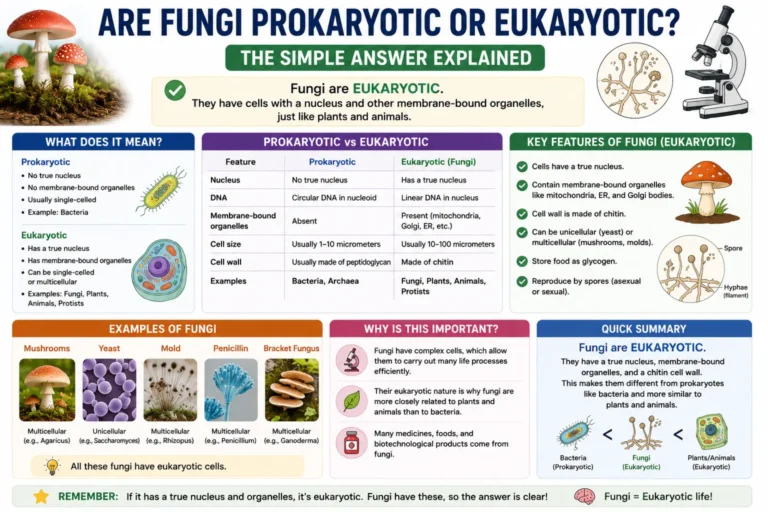
Are fungi prokaryotic or eukaryotic? Fungi are eukaryotic organisms. This means their cells contain a true nucleus. The nucleus stores the cell’s DNA and controls many cell activities. Fungi also contain other membrane-bound organelles. These structures help fungal cells perform different jobs.
You can find fungi in many places around you. Mushrooms, yeasts, and molds are common examples. Some fungi help make bread, cheese, and medicines. Others break down dead plants and animals in nature.
Understanding fungal cells helps explain how fungi grow and reproduce. It also helps you compare fungi with bacteria and other organisms.
In this guide, you will learn what makes fungi eukaryotic. You will also see simple examples and key differences between fungi and prokaryotes.
Quick Summary: Are Fungi Prokaryotic or Eukaryotic?
- Fungi are eukaryotic organisms.
- Fungal cells contain a true nucleus.
- Fungi have membrane-bound organelles.
- Their cells contain mitochondria and other organelles.
- Mushrooms, yeasts, and molds are fungi.
- Bacteria are prokaryotic organisms.
- Fungal cell walls mainly contain chitin.
- Fungi can live as single cells or many-celled organisms.
- The simple answer is: fungi are eukaryotic, not prokaryotic.
What Does Eukaryotic Mean?
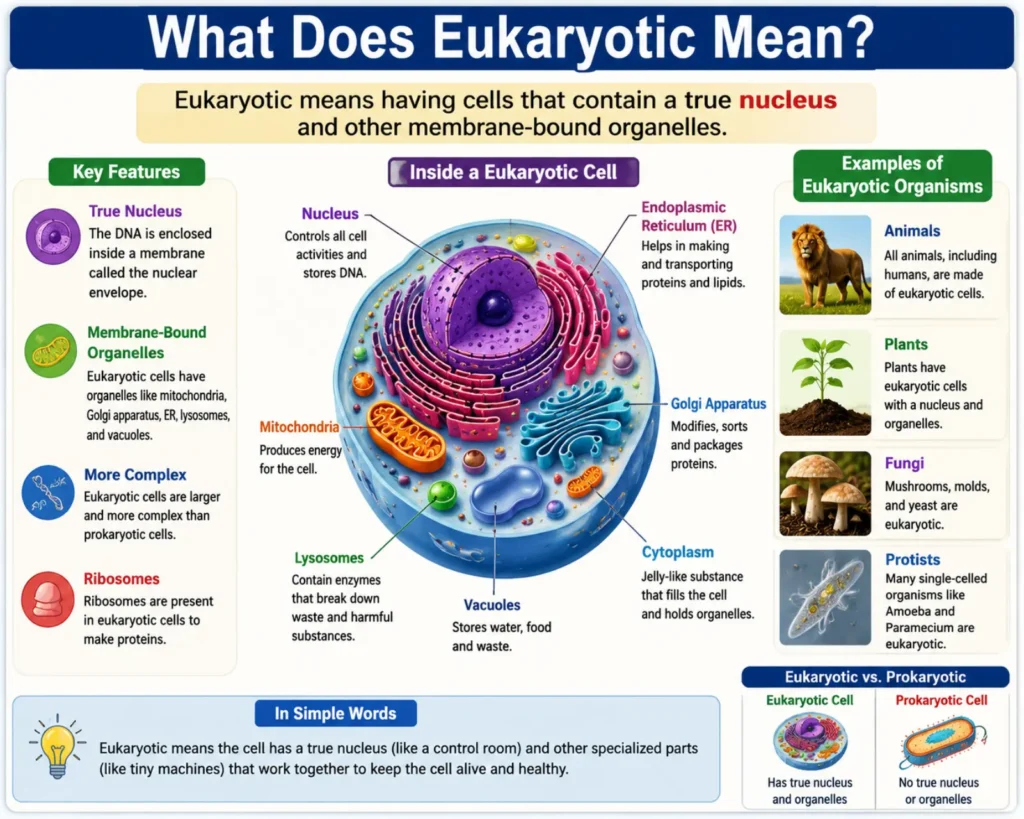
A eukaryotic organism has cells with a true nucleus. A membrane surrounds this nucleus.
The nucleus stores the organism’s genetic material, or DNA. Other organelles also sit inside the cell.
For example, mitochondria help release energy from food. The endoplasmic reticulum helps make and move certain cell materials.
Plants, animals, protists, and fungi are eukaryotic organisms. Their cells share several important features.
However, their cells also have major differences. These differences help scientists classify living organisms.
What Does Prokaryotic Mean?
Prokaryotic organisms have a simpler cell structure. Their DNA does not sit inside a membrane-bound nucleus.
Bacteria and archaea are the main groups of prokaryotes.
Prokaryotic cells still contain genetic material and ribosomes. However, they lack many membrane-bound organelles found in eukaryotic cells.
This difference helps answer the question, “Are fungi prokaryotic or eukaryotic?”
Fungi have a true nucleus. Therefore, scientists classify them as eukaryotes.
Why Are Fungi Eukaryotic?
Fungi meet several important features of eukaryotic cells.
First, fungal cells contain a membrane-bound nucleus. This nucleus holds their DNA.
Second, fungi contain membrane-bound organelles. These include mitochondria and the endoplasmic reticulum.
Third, fungal cells have a more complex internal structure than bacterial cells.
Fungi also use different cellular processes to grow and reproduce.
These features clearly place fungi in the eukaryotic group.
So, if you need a one-line answer, remember this:
Fungi are eukaryotic because their cells contain a true nucleus and membrane-bound organelles.
What Is a Fungal Cell Like?
A fungal cell contains several important structures.
The cell wall gives the cell support and protection. Unlike plant cell walls, fungal cell walls mainly contain chitin.
The cell membrane controls what enters and leaves the cell.
The nucleus stores the fungal DNA.
Mitochondria help produce usable energy for the cell.
Ribosomes help build proteins.
Fungi may also contain structures such as vacuoles and the endoplasmic reticulum.
Together, these structures allow fungal cells to grow, respond to their surroundings, and reproduce.
Fungi vs. Prokaryotes: Key Differences
The biggest difference involves the nucleus.
Fungi have a membrane-bound nucleus. Prokaryotes do not.
Fungi also contain membrane-bound organelles. Most prokaryotic cells lack these structures.
Here is a simple comparison:
| Feature | Fungi | Prokaryotes |
|---|---|---|
| Cell type | Eukaryotic | Prokaryotic |
| True nucleus | Yes | No |
| Membrane-bound organelles | Yes | No |
| DNA location | Inside nucleus | Nucleoid region |
| Cell structure | More complex | Simpler |
| Cell wall | Mainly chitin | Often peptidoglycan in bacteria |
| Examples | Mushrooms, yeast, molds | Bacteria, archaea |
| Typical size | Usually larger | Usually smaller |
This comparison makes the answer clear. Fungi belong to the eukaryotic group.
Fungi vs. Bacteria: What Is the Difference?
People often confuse fungi with bacteria. Both can grow in similar places. Both can also cause disease.
However, they belong to different biological groups.
Fungi are eukaryotes. Bacteria are prokaryotes.
Fungal cells contain a true nucleus. Bacterial cells do not.
Fungal cell walls mainly contain chitin. Bacterial cell walls often contain peptidoglycan.
Their growth patterns also differ. Many fungi grow as long structures called hyphae. A network of hyphae forms a mycelium.
Some fungi, such as yeast, exist as single cells.
Real-Life Examples of Eukaryotic Fungi
You encounter fungi in many everyday situations.
Mushrooms are familiar multicellular fungi. They produce spores and often grow in soil or on decaying material.
Yeast is another type of fungus. Bakers use yeast to help bread dough rise.
Molds are fungi that grow on many organic materials. Some molds help produce foods and medicines.
Penicillium is a well-known fungal genus. Certain species have helped scientists develop important antibiotics.
These examples show that fungi are not limited to mushrooms. Fungi include many different organisms with different shapes and lifestyles.
Are Mushrooms Prokaryotic or Eukaryotic?
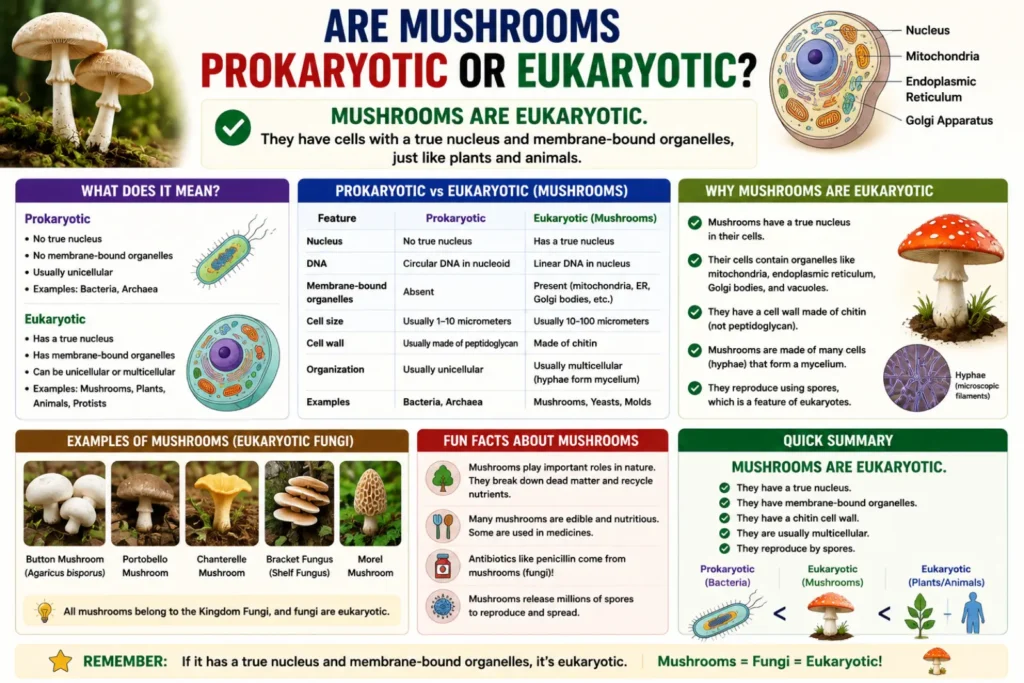
Mushrooms are eukaryotic.
A mushroom is the reproductive structure of certain fungi. The fungus itself often grows through a network of hyphae.
The cells within these fungi contain nuclei and membrane-bound organelles.
Therefore, mushrooms belong to the eukaryotic group.
A common mistake involves thinking that small organisms must be prokaryotic. Size does not determine whether an organism is prokaryotic or eukaryotic.
Cell structure determines the classification.
Are Yeast Cells Prokaryotic or Eukaryotic?
Yeast cells are eukaryotic.
Yeast may look simple because many species consist of single cells. However, being single-celled does not mean being prokaryotic.
Yeast cells contain a true nucleus. They also contain membrane-bound organelles.
This makes yeast different from bacteria.
For example, baker’s yeast is a single-celled fungus. It uses nutrients to grow and reproduce.
Therefore, remember this useful fact:
Single-celled does not always mean prokaryotic. Yeast proves this rule.
Common Mistakes About Fungi
Several misconceptions can make this topic confusing.
Mistake 1: Thinking all single-celled organisms are prokaryotic
This is false. Some eukaryotes are single-celled.
Yeast provides a clear example.
Mistake 2: Thinking fungi are plants
Fungi are not plants. Scientists place fungi in their own biological kingdom.
Fungi also have different cell walls and ways of getting nutrients.
Mistake 3: Thinking fungi lack a nucleus
Fungal cells have nuclei. This feature helps classify them as eukaryotes.
Mistake 4: Confusing fungi with bacteria
Both can grow on food and cause infections. However, fungi are eukaryotic, while bacteria are prokaryotic.
Mistake 5: Using size as the main clue
Cell structure matters more than size.
Always check for a true nucleus when comparing these groups.
Tips for Remembering the Answer
Use a simple memory trick.
Fungi = Eukaryotic.
You can also remember the word “nucleus.”
If the cell has a membrane-bound nucleus, it belongs to the eukaryotic group.
Another useful trick involves common examples:
- Fungi: mushrooms, yeast, molds
- Prokaryotes: bacteria and archaea
- Eukaryotes: fungi, animals, plants, and protists
For school exams, focus on the main distinction. Fungi have a true nucleus and membrane-bound organelles.
How Fungi Matter in Daily Life
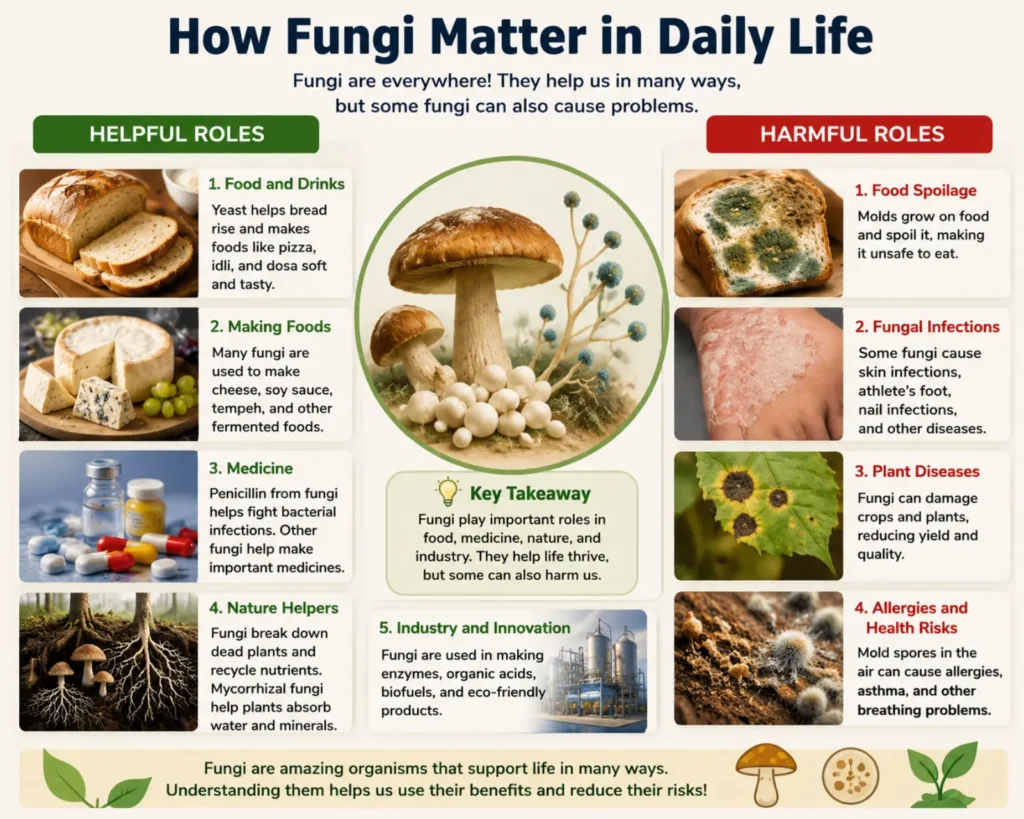
Fungi play important roles in everyday life.
Yeast helps make bread and some fermented foods.
Certain fungi help create foods such as some cheeses.
Fungi also help recycle nutrients in ecosystems. They break down dead organic material.
Scientists use fungi in biotechnology and medicine. Some fungi produce useful substances.
Fungi also form relationships with plants. Mycorrhizal fungi can connect with plant roots and help plants obtain nutrients.
At the same time, some fungi can spoil food or cause infections.
Thus, fungi can have helpful and harmful effects.
Synonyms and Related SEO Keywords
People use several search terms when learning this topic.
Useful related keywords include:
- are fungi eukaryotic
- are fungi prokaryotes
- fungal cell type
- fungi eukaryotic organisms
- fungi prokaryotic or eukaryotic cells
- fungal cell structure
- eukaryotic fungi
- prokaryotic vs eukaryotic
- fungi vs bacteria
- are mushrooms eukaryotic
- is yeast prokaryotic or eukaryotic
- fungal nucleus
- examples of eukaryotic organisms
- examples of prokaryotic organisms
These terms describe closely related questions. They also help explain the topic without repeating one keyword too often.
Expert Insight: Why This Classification Matters
The prokaryotic or eukaryotic classification helps scientists understand cell organization.
It also explains why fungi differ from bacteria.
For example, many medicines work differently against fungal and bacterial cells. Their different cell structures can affect treatment choices.
This distinction also matters in biology, microbiology, medicine, agriculture, and biotechnology.
A useful expert approach starts with cell structure.
Ask three questions:
- Does the cell have a true nucleus?
- Does it contain membrane-bound organelles?
- What features does its cell wall have?
For fungi, the first two answers are yes.
That provides strong evidence for their eukaryotic classification.
Frequently Asked Questions
Are fungi prokaryotic or eukaryotic?
Fungi are eukaryotic organisms. Their cells contain a true nucleus and membrane-bound organelles.
Do fungi have a nucleus?
Yes. Fungal cells contain a membrane-bound nucleus that stores their DNA.
Are mushrooms eukaryotic?
Yes. Mushrooms are eukaryotic fungi. Their cells contain nuclei and membrane-bound organelles.
Is yeast prokaryotic or eukaryotic?
Yeast is eukaryotic. Even though many yeast species are single-celled, their cells contain a true nucleus.
Are bacteria and fungi the same?
No. Bacteria are prokaryotes, while fungi are eukaryotes. Their cell structures differ in several important ways.
Do fungi have cell walls?
Yes. Fungal cells have cell walls. Their walls mainly contain chitin.
What is the main difference between fungi and bacteria?
The main difference is their cell organization. Fungi have a true nucleus, while bacteria do not.
Are all fungi multicellular?
No. Many fungi are multicellular, but some fungi, such as many yeasts, are single-celled.
Conclusion
So, are fungi prokaryotic or eukaryotic? Fungi are eukaryotic organisms.
Their cells contain a true nucleus surrounded by a membrane. They also contain membrane-bound organelles, such as mitochondria.
Mushrooms, molds, and yeast all belong to the fungal group. Some fungi have many cells, while others have only one cell.
Fungi differ from bacteria because bacteria are prokaryotic. Bacterial cells do not contain a membrane-bound nucleus.
The easiest way to remember the answer is simple: fungi are eukaryotic because their cells have a true nucleus.
This fact helps explain fungal biology and separates fungi from prokaryotic organisms.