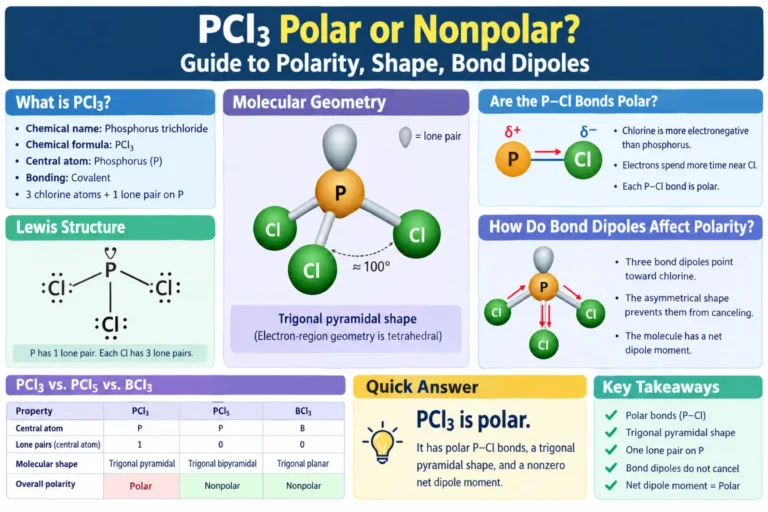
PCl3 polar or nonpolar? Phosphorus trichloride (PCl3) is a polar molecule because it has an uneven distribution of electrical charge. Its molecular shape plays a key role in this property. Although each phosphorus-chlorine bond is polar, the molecule’s overall polarity depends on how these bonds are arranged.
In this guide, you will learn why PCl3 is polar in simple terms. We will explore its Lewis structure, molecular geometry, bond dipoles, and lone pair of electrons. You will also see how PCl3 compares with similar molecules.
Understanding molecular polarity helps you predict how substances interact with each other. It also helps you answer common chemistry questions with confidence. By the end, you will know how to identify PCl3’s polarity and explain your answer in an exam.
Quick Summary: Is PCl3 Polar or Nonpolar?
- PCl3 is polar.
- Its chemical name is phosphorus trichloride.
- Phosphorus (P) is the central atom.
- Three chlorine (Cl) atoms bond to phosphorus.
- Phosphorus has one lone pair of electrons.
- PCl3 has a trigonal pyramidal molecular shape.
- Each P–Cl bond is polar.
- The bond dipoles do not cancel out.
- The molecule has a net dipole moment.
Featured snippet answer: PCl3 is a polar molecule because it has a trigonal pyramidal shape and one lone pair on its central phosphorus atom. Its polar P–Cl bonds do not cancel, creating a net dipole moment.
1. What Is PCl3? Meaning and Definition
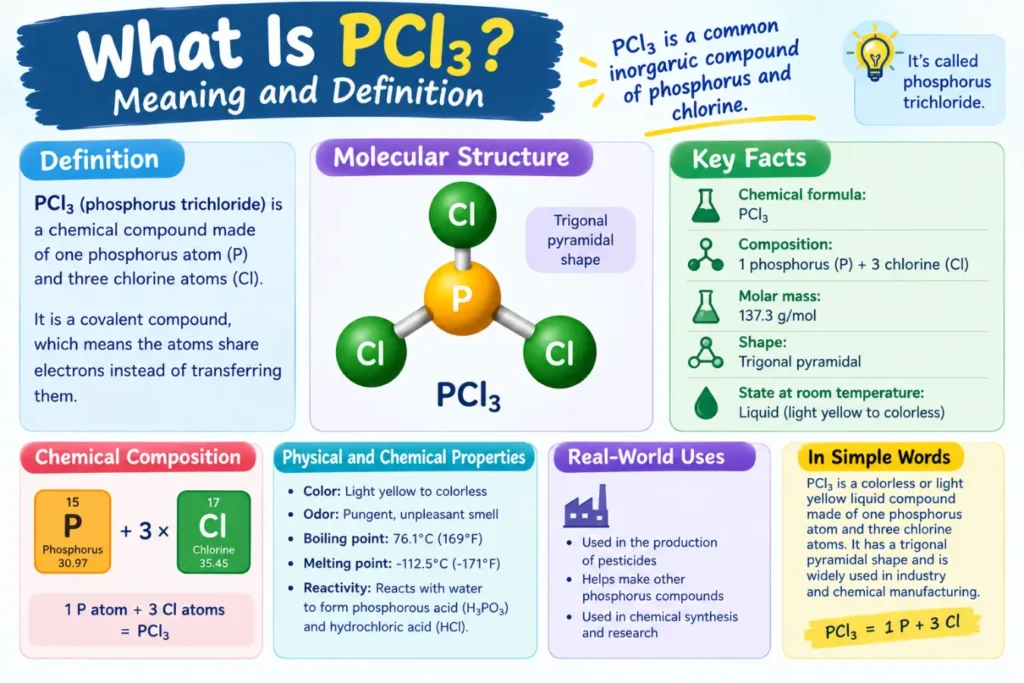
PCl3 is the chemical formula for phosphorus trichloride. It contains one phosphorus atom and three chlorine atoms.
Phosphorus belongs to Group 15 of the periodic table. Chlorine belongs to Group 17. Both elements form covalent bonds in this molecule.
A covalent bond forms when atoms share electrons. However, atoms do not always share these electrons equally. This unequal sharing can create polar bonds.
In PCl3, chlorine attracts shared electrons more strongly than phosphorus. This creates partial charges across the P–Cl bonds. The molecule’s three-dimensional shape then determines its overall polarity.
Key facts about PCl3:
- Chemical name: Phosphorus trichloride
- Chemical formula: PCl3
- Central atom: Phosphorus
- Bonding: Covalent
- Number of P–Cl bonds: Three
- Lone pairs on phosphorus: One
- Molecular geometry: Trigonal pyramidal
- Molecular polarity: Polar
These facts help explain why PCl3 has an uneven charge distribution.
OpenStax
+1
2. Why Is PCl3 Polar?
PCl3 is polar because its polar bonds create an overall dipole moment. Its trigonal pyramidal shape prevents the bond dipoles from canceling completely.
Three main factors explain this result.
First, phosphorus and chlorine have different electronegativities. Chlorine attracts the shared bonding electrons more strongly. Therefore, each P–Cl bond has a dipole.
Second, phosphorus has one lone pair of electrons. This lone pair affects the arrangement of the atoms around phosphorus.
Third, PCl3 has an asymmetrical molecular shape. Its three bond dipoles do not cancel each other. As a result, the molecule has a net dipole moment.
Think of three arrows pointing from phosphorus toward chlorine. Their sideways components partly cancel, but their combined effect does not disappear. The remaining dipole makes PCl3 polar.
The important rule is simple: molecular polarity depends on both bond polarity and molecular geometry.
OpenStax
+1
3. PCl3 Lewis Structure and Lone Pairs
The Lewis structure shows how atoms share electrons and where lone pairs occur.
To draw the Lewis structure of PCl3, follow these steps:
- Count the valence electrons. Phosphorus contributes five, and three chlorine atoms contribute 21.
- Add the electrons together. The molecule has 26 valence electrons.
- Place phosphorus in the center.
- Connect phosphorus to each chlorine with a single bond.
- Complete the octets of the three chlorine atoms.
- Place the remaining two electrons as one lone pair on phosphorus.
Each single bond contains two shared electrons. The three bonds use six electrons, while the chlorine lone pairs use 18. The remaining two electrons form phosphorus’s lone pair.
Simplified PCl3 Lewis structure

Look for three P–Cl single bonds and one lone pair on the central phosphorus atom.
The central phosphorus atom has four electron regions: three bonding regions and one lone-pair region. These regions explain the molecule’s shape.
The lone pair matters because it occupies space around phosphorus. It also makes the arrangement of atoms different from a flat, symmetrical triangle.
OpenStax
+1
4. What Is the Molecular Geometry of PCl3?
PCl3 has a trigonal pyramidal molecular geometry. Its shape resembles a three-sided pyramid with phosphorus near the top and chlorine atoms around the base.
The shape follows the valence-shell electron-pair repulsion (VSEPR) theory. This theory states that electron regions arrange themselves to reduce repulsion.
Phosphorus has four electron regions in PCl3. Three regions form bonds with chlorine. The fourth region contains a lone pair.
The electron-region geometry is tetrahedral, but the molecular geometry is trigonal pyramidal. These terms describe different things.
- Electron-region geometry: Includes bonds and lone pairs.
- Molecular geometry: Describes the positions of atoms only.
The Cl–P–Cl bond angle is approximately 100°, rather than the ideal tetrahedral angle of 109.5°. Lone-pair repulsion helps explain this smaller angle. Experimental structural research reports an equilibrium angle near 100.18°.
ACS Publications
+1
This three-dimensional shape is central to understanding why PCl3 is polar.
5. Are P–Cl Bonds Polar?
Yes, each P–Cl bond is polar because chlorine has a higher electronegativity than phosphorus.
Electronegativity measures how strongly an atom attracts shared electrons in a chemical bond. When two bonded atoms have different electronegativities, their electron distribution becomes uneven.
In PCl3, the bonding electrons spend more time near chlorine. This gives chlorine a partial negative charge, written as δ−. Phosphorus develops a partial positive charge, written as δ+.
The bond dipole therefore points toward chlorine.
| Bond feature | PCl3 |
|---|---|
| Bond type | Covalent |
| Electronegativity difference | Nonzero |
| Electron distribution | Uneven |
| Chlorine end | Partial negative charge |
| Phosphorus end | Partial positive charge |
| Bond polarity | Polar |
However, polar bonds alone do not guarantee that an entire molecule is polar. Molecular shape determines whether the individual bond dipoles cancel.
OpenStax
+1
6. How Do Bond Dipoles Affect PCl3 Polarity?
A bond dipole represents the separation of electrical charge across a bond. You can picture it as an arrow pointing toward the more electronegative atom.
PCl3 has three P–Cl bond dipoles. Each arrow points from the phosphorus side toward a chlorine atom.
Because the molecule has a trigonal pyramidal shape, these arrows do not cancel completely. Their combined effect produces a net molecular dipole.
Imagine three people pulling a rope from different directions. If their pulls do not balance, the rope experiences a net force. Bond dipoles behave similarly when you combine them as vectors.
In PCl3, the three bond dipoles combine to produce a nonzero result. This confirms that the molecule is polar.
Remember these two rules:
- Symmetrical arrangements can cancel bond dipoles.
- Asymmetrical arrangements may leave a net dipole.
Always consider the molecule’s three-dimensional shape before deciding whether it is polar or nonpolar.
OpenStax
+1
7. PCl3 vs. PCl5 vs. BCl3: Comparison Table
Comparing PCl3 with similar molecules makes molecular polarity easier to understand.
| Property | PCl3 | PCl5 | BCl3 |
|---|---|---|---|
| Name | Phosphorus trichloride | Phosphorus pentachloride | Boron trichloride |
| Central atom | P | P | B |
| Atoms bonded to center | 3 | 5 | 3 |
| Central lone pairs | 1 | 0 | 0 |
| Molecular shape | Trigonal pyramidal | Trigonal bipyramidal | Trigonal planar |
| Bond polarity | Polar bonds | Polar bonds | Polar bonds |
| Overall polarity | Polar | Nonpolar in its ideal gas-phase molecular structure | Nonpolar |
PCl3 has a lone pair that creates a trigonal pyramidal shape. Its bond dipoles do not cancel.
PCl5 has a symmetrical trigonal bipyramidal structure in the gas phase. Its bond dipoles cancel because of its symmetry.
BCl3 has a flat, trigonal planar structure. Its three identical B–Cl bond dipoles cancel each other.
These examples show why you must examine the whole molecule. Even when bonds are polar, a molecule can still be nonpolar.
Pearson
+1
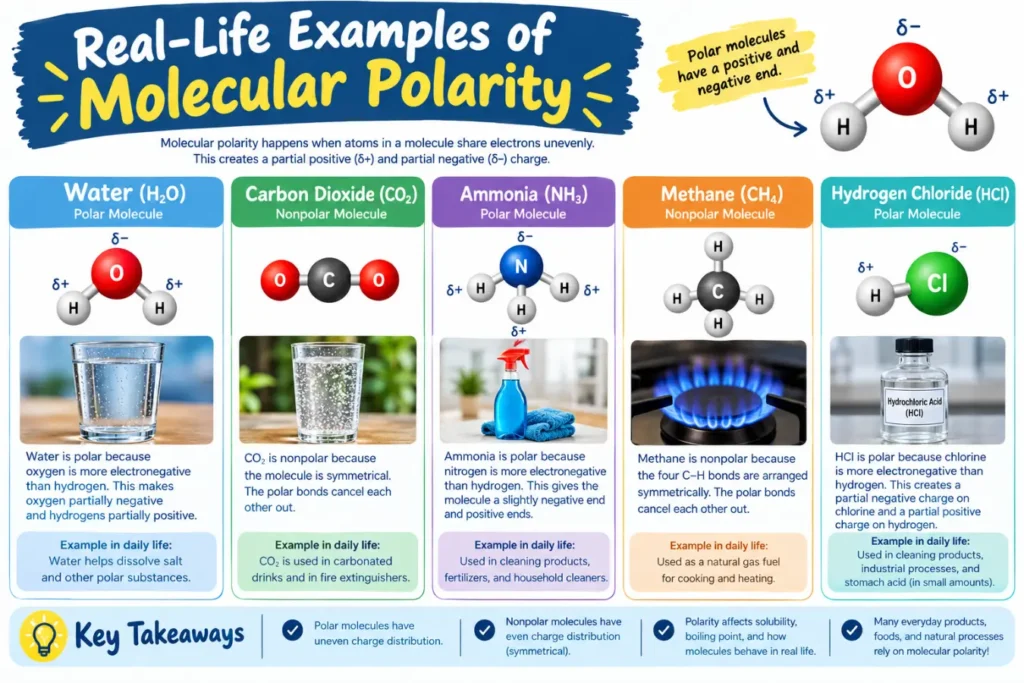
8. Real-Life Examples of Molecular Polarity
Molecular polarity helps explain how substances interact, dissolve, and behave in chemical reactions. PCl3 provides a useful example of these principles.
Here are three practical examples.
Example 1: Water and oil
Water is polar, while many oils are nonpolar. These substances generally do not mix well because their intermolecular interactions differ. This illustrates the familiar rule that substances with similar polarity often mix more readily.
Example 2: Polar and nonpolar molecules
Carbon dioxide (CO2) has polar C=O bonds, but its linear shape makes the bond dipoles cancel. Water has a bent shape, so its bond dipoles do not cancel.
Example 3: Phosphorus trichloride in chemistry
PCl3 serves as a chemical reagent in the production of organophosphorus compounds and other phosphorus-containing chemicals. Its molecular structure helps chemists understand its bonding and chemical behavior.
PCl3 is also hazardous and reacts with moisture. It can release hydrogen chloride when it reacts with water, so it requires appropriate laboratory controls.
OpenStax
+1
These examples demonstrate how polarity connects basic chemistry concepts with real chemical processes.
9. Common Mistakes When Identifying PCl3 Polarity
Students often confuse polar bonds with overall molecular polarity. Avoid these common errors when solving chemistry questions.
Mistake 1: Assuming three bonds make a molecule nonpolar.
The number of bonds does not determine polarity by itself. Their spatial arrangement matters more.
Mistake 2: Ignoring the lone pair on phosphorus.
The lone pair changes the molecular shape. Without considering it, you may incorrectly predict trigonal planar geometry.
Mistake 3: Calling PCl3 tetrahedral.
PCl3 has tetrahedral electron-region geometry, but its molecular geometry is trigonal pyramidal. The distinction is important.
Mistake 4: Assuming all polar bonds create polar molecules.
Some molecules have polar bonds but remain nonpolar because their dipoles cancel. Carbon dioxide and boron trichloride are common examples.
Mistake 5: Confusing PCl3 with PCl5.
PCl3 has three chlorine atoms and one lone pair on phosphorus. PCl5 has five chlorine atoms and a different molecular shape.
To avoid these mistakes, follow the same process each time: draw the Lewis structure, determine the shape, identify polar bonds, and check for dipole cancellation.
10. Tips and Tricks to Remember PCl3 Polarity
Use these simple strategies to answer molecular polarity questions faster.
- Count the bonds: PCl3 has three P–Cl bonds.
- Check the lone pairs: Phosphorus has one lone pair.
- Name the shape: Three bonds and one lone pair give a trigonal pyramidal shape.
- Check electronegativity: Chlorine attracts electrons more strongly than phosphorus.
- Combine the dipoles: The bond dipoles do not cancel completely.
- State the result: PCl3 is polar.
A useful memory trick is to associate a lone pair with an altered molecular shape. Lone pairs often make a molecule less symmetrical, although the exact effect depends on the geometry.
For exam answers, explain both the polar bonds and the net dipole. Simply writing “PCl3 is polar” may not earn full marks when a question asks you to justify your answer.
11. Synonyms and Related SEO Keywords
Readers and search engines may use different phrases to describe the same chemistry question. These related terms can help organize supporting content naturally.
| Keyword variation | Search intent |
|---|---|
| Is PCl3 polar or nonpolar? | Direct polarity answer |
| Is phosphorus trichloride polar? | Chemical-name variation |
| PCl3 molecular polarity | Overall charge distribution |
| PCl3 molecular geometry | Molecular shape |
| PCl3 Lewis dot structure | Electron arrangement |
| PCl3 dipole moment | Molecular dipole |
| PCl3 bond angle | Molecular geometry detail |
| Why is PCl3 polar? | Scientific explanation |
| PCl3 polar bonds | Bond polarity |
| Difference between PCl3 and PCl5 | Molecular comparison |
These phrases are related search terms, not exact synonyms for the molecule’s polarity. Use them where they help answer a reader’s question.
For a stronger content strategy, link this article to supporting guides on Lewis structures, VSEPR theory, electronegativity, and molecular dipole moments.
12. Expert Insights: Why PCl3 Polarity Matters
A reliable polarity analysis combines three concepts: electronegativity, molecular geometry, and vector addition.
First, electronegativity explains why each P–Cl bond has uneven electron sharing. Second, VSEPR theory predicts the trigonal pyramidal shape. Third, vector addition explains why the three bond dipoles produce a nonzero net dipole.
This approach is more reliable than memorizing lists of polar and nonpolar molecules. It also works for many other molecules, including NH3, H2O, CO2, and BCl3.
For stronger scientific accuracy, distinguish between a molecule’s geometry and its electron-region geometry. Also avoid claiming that a lone pair always makes a molecule polar. The final result depends on the entire arrangement of atoms and bond dipoles.
OpenStax
+1
Recommended internal links
If you publish chemistry content on WordPress, consider linking to these related articles:
- How to Draw a Lewis Structure
- VSEPR Theory and Molecular Geometry Explained
- How to Identify Polar and Nonpolar Molecules
- Electronegativity and Bond Polarity
- PCl3 vs. PCl5: Structure and Properties
Use descriptive anchor text and link only to relevant pages that actually exist on your website.
13. Frequently Asked Questions About PCl3 Polarity
1. Is PCl3 polar or nonpolar?
PCl3 is polar. Its trigonal pyramidal shape prevents the three polar P–Cl bond dipoles from canceling completely.
2. Why is PCl3 a polar molecule?
PCl3 is polar because chlorine attracts bonding electrons more strongly than phosphorus. Its asymmetrical molecular shape produces a net dipole moment.
3. What is the molecular geometry of PCl3?
PCl3 has a trigonal pyramidal molecular geometry. Its central phosphorus atom forms three bonds and has one lone pair.
4. How many lone pairs does PCl3 have?
The central phosphorus atom has one lone pair. Each chlorine atom also has three lone pairs in the usual Lewis structure.
5. Are the bonds in PCl3 polar?
Yes. Each P–Cl bond is polar because chlorine has a higher electronegativity than phosphorus.
6. Does PCl3 have a dipole moment?
Yes. PCl3 has a nonzero molecular dipole moment because its bond dipoles do not cancel completely.
7. Why is PCl3 polar but BCl3 nonpolar?
PCl3 has a trigonal pyramidal shape, while BCl3 has a symmetrical trigonal planar shape. The bond dipoles cancel in BCl3 but not in PCl3.
8. Is PCl3 ionic or covalent?
PCl3 is a covalent molecular compound. Its phosphorus and chlorine atoms share electrons through covalent bonds.
Conclusion: Is PCl3 Polar or Nonpolar?
PCl3 is a polar molecule because its three P–Cl bond dipoles do not cancel. The difference in electronegativity between phosphorus and chlorine makes each bond polar.
The central phosphorus atom has one lone pair of electrons. This lone pair gives PCl3 a trigonal pyramidal molecular shape rather than a flat, symmetrical shape. As a result, the molecule has a net dipole moment.
When answering questions about molecular polarity, remember to examine both bond polarity and molecular geometry. A molecule can contain polar bonds and still be nonpolar if its bond dipoles cancel.
The key takeaway is simple: PCl3 is polar because it has polar bonds, a trigonal pyramidal shape, and a nonzero net dipole moment. Use these three facts to explain your answer confidently in chemistry exams.