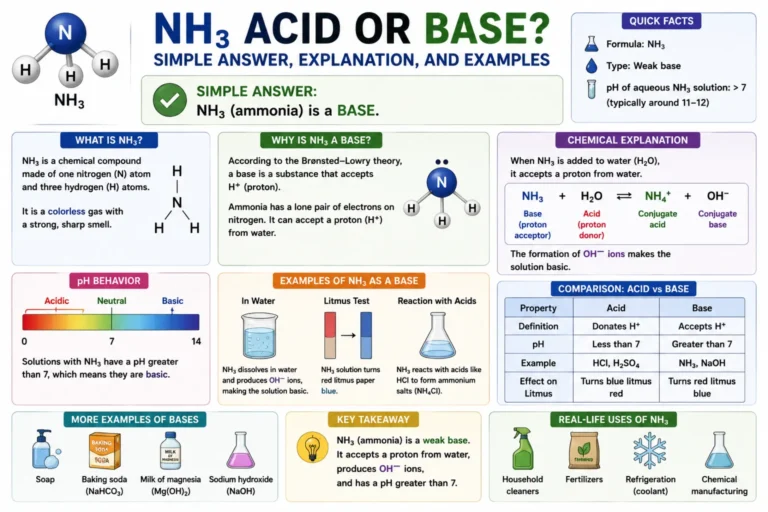
NH3 acid or base? NH3, also called ammonia, is mainly a weak base in water. It accepts a proton from water and forms ammonium ions. This reaction also produces hydroxide ions. That makes an ammonia solution basic. NH3 does not usually act as an acid in water. However, its behavior can change in special chemical reactions. Understanding this idea helps with acids, bases, pH, and chemical equations. It also makes many chemistry questions easier to solve. In this guide, you will learn why NH3 is a base. You will also see how it behaves under different acid-base theories. Simple equations and real-life examples will make the topic clear. By the end, you will know how to identify NH3 in common chemistry problems.
Quick Summary: Is NH3 an Acid or Base?
- NH3 is ammonia.
- NH3 acts as a weak base in water.
- It accepts a proton, H⁺, from water.
- It forms NH4⁺, called the ammonium ion.
- The reaction also forms OH⁻, which makes the solution basic.
- NH3 has a lone pair of electrons.
- That lone pair helps NH3 accept a proton.
- NH3 is a Brønsted-Lowry base.
- NH3 is also a Lewis base.
- In special reactions, NH3 can donate a proton.
- For normal school chemistry, the answer is NH3 is a weak base.
What Does NH3 Mean?
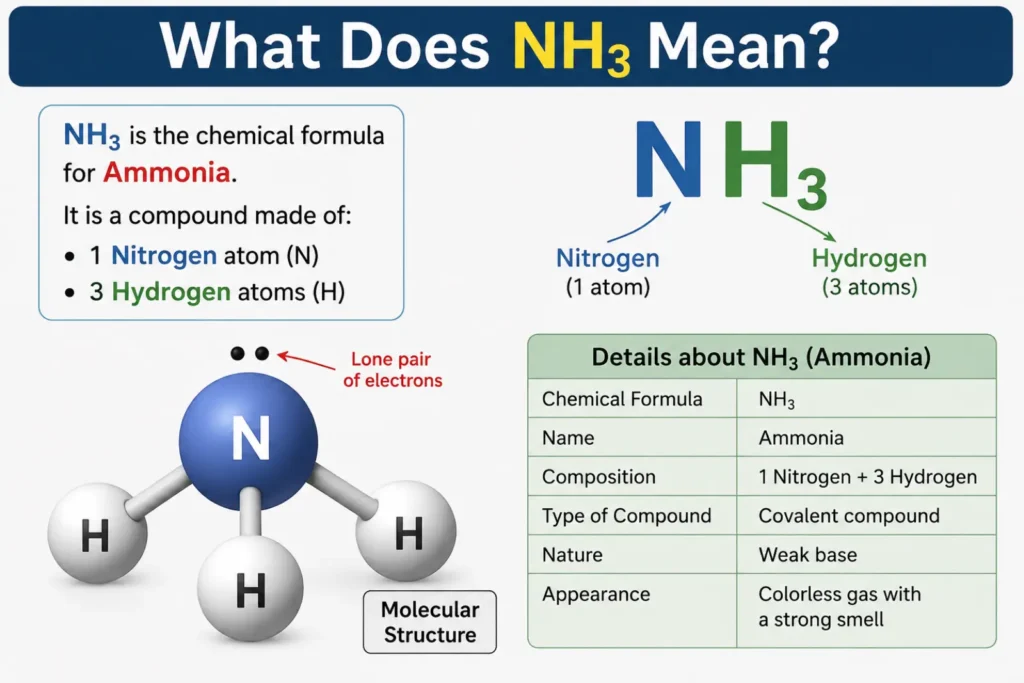
NH3 is the chemical formula for ammonia.
One nitrogen atom bonds with three hydrogen atoms. Nitrogen also has one lone pair of electrons.
This lone pair plays an important role in acid-base reactions.
Ammonia has no electrical charge. Therefore, NH3 is a neutral molecule.
However, a neutral molecule can still act as a base.
In water, ammonia reacts with water molecules. It accepts a hydrogen ion from water.
The reaction looks like this:
NH3 + H2O ⇌ NH4⁺ + OH⁻
This equation explains why ammonia makes water basic.
Why Is NH3 a Base?
NH3 acts as a base because it accepts a proton.
A proton is represented as H⁺.
The nitrogen atom in NH3 has a lone pair. This lone pair can form a bond with H⁺.
So, NH3 accepts H⁺ and becomes NH4⁺.
The simple reaction is:
NH3 + H⁺ → NH4⁺
This behavior matches the Brønsted-Lowry definition of a base.
A Brønsted-Lowry base accepts a proton.
Therefore, NH3 is a Brønsted-Lowry base.
Is NH3 a Strong or Weak Base?
NH3 is a weak base.
This point often causes confusion.
A weak base does not mean that ammonia cannot act as a base. It means that ammonia reacts only partly with water.
The reaction reaches an equilibrium:
NH3 + H2O ⇌ NH4⁺ + OH⁻
Only some NH3 molecules form NH4⁺ and OH⁻.
Most NH3 molecules remain unchanged.
This partial reaction makes ammonia different from strong bases such as sodium hydroxide.
For example, sodium hydroxide separates almost completely into ions in water.
Ammonia does not behave this way.
NH3 as a Brønsted-Lowry Base
The Brønsted-Lowry theory defines acids and bases by proton transfer.
- An acid donates H⁺.
- A base accepts H⁺.
NH3 accepts H⁺ from water.
Therefore, NH3 acts as a Brønsted-Lowry base.
Consider this reaction:
NH3 + H2O ⇌ NH4⁺ + OH⁻
Here, NH3 accepts H⁺.
Water donates H⁺.
Therefore:
- NH3 = base
- H2O = acid
- NH4⁺ = conjugate acid
- OH⁻ = conjugate base
This example clearly shows the proton-transfer process.
NH3 as a Lewis Base
The Lewis theory uses electron pairs instead of proton transfer.
A Lewis base donates an electron pair.
NH3 has a lone pair on nitrogen.
It can donate this pair to another species.
For example:
NH3 + H⁺ → NH4⁺
The nitrogen lone pair forms a new bond with H⁺.
Therefore, NH3 is also a Lewis base.
This definition explains ammonia’s basic behavior using electron movement.
Can NH3 Act as an Acid?
Under normal water-based chemistry, NH3 acts as a base.
However, chemistry can become more interesting under different conditions.
NH3 can donate a proton in reactions with very strong bases.
For example, a very strong base can remove a hydrogen from NH3.
This produces the amide ion, NH2⁻.
The general reaction is:
NH3 + strong base → NH2⁻ + conjugate acid
So, NH3 can show acidic behavior in special situations.
Still, this does not change the usual school-level answer.
NH3 is classified as a weak base in aqueous solution.
Is NH3 Amphoteric or Amphiprotic?
This question needs careful wording.
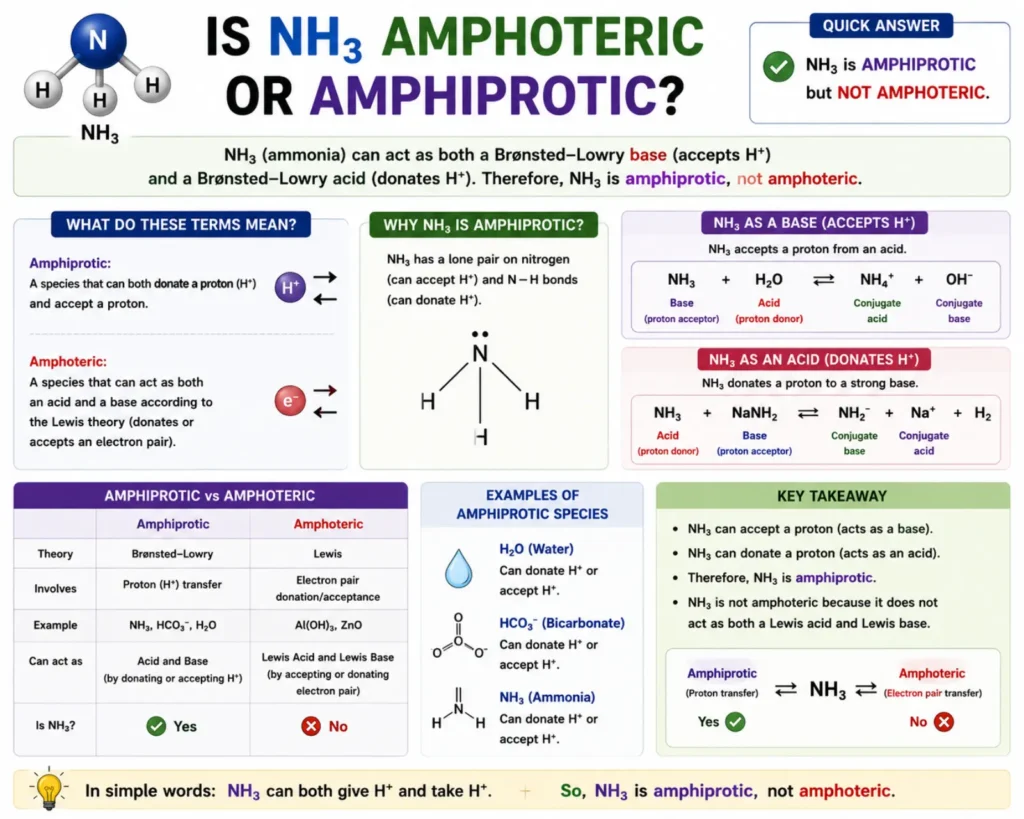
An amphiprotic substance can both accept and donate a proton.
NH3 can accept a proton easily:
NH3 + H⁺ → NH4⁺
Under suitable conditions, it can also donate a proton and form NH2⁻.
Therefore, NH3 can show both behaviors in the right chemical environment.
However, in typical aqueous acid-base questions, you should identify NH3 as a weak base.
Do not label NH3 as an acid simply because it can show acidic behavior in unusual reactions.
Always consider the reaction and the substances involved.
NH3 vs NH4⁺: What Is the Difference?
NH3 and NH4⁺ are closely related but behave differently.
| Feature | NH3 | NH4⁺ |
|---|---|---|
| Name | Ammonia | Ammonium |
| Charge | 0 | +1 |
| Main role | Weak base | Conjugate acid |
| Proton behavior | Accepts H⁺ | Can donate H⁺ |
| Nitrogen bonds | 3 | 4 |
| Lone pair | Present | Used in bonding |
| Common in water | Yes | Yes |
The key difference is one proton.
When NH3 accepts H⁺, it becomes NH4⁺.
NH3 + H⁺ → NH4⁺
This relationship helps explain conjugate acid-base pairs.
NH3 vs Strong Bases
Comparing ammonia with a strong base can make its behavior easier to understand.
| Property | NH3 | Strong base |
| Base strength | Weak | Strong |
| Reaction with water | Partial | Usually much more complete |
| Produces OH⁻ in water | Yes | Yes |
| Proton acceptor | Yes | Yes |
| Example | NH3 | NaOH |
| Equilibrium | Important | Often less important |
The most important point is this:
Both can produce basic solutions, but they do not have equal base strength.
A common mistake involves confusing a basic solution with a strong base.
A solution can be basic even when its base is weak.
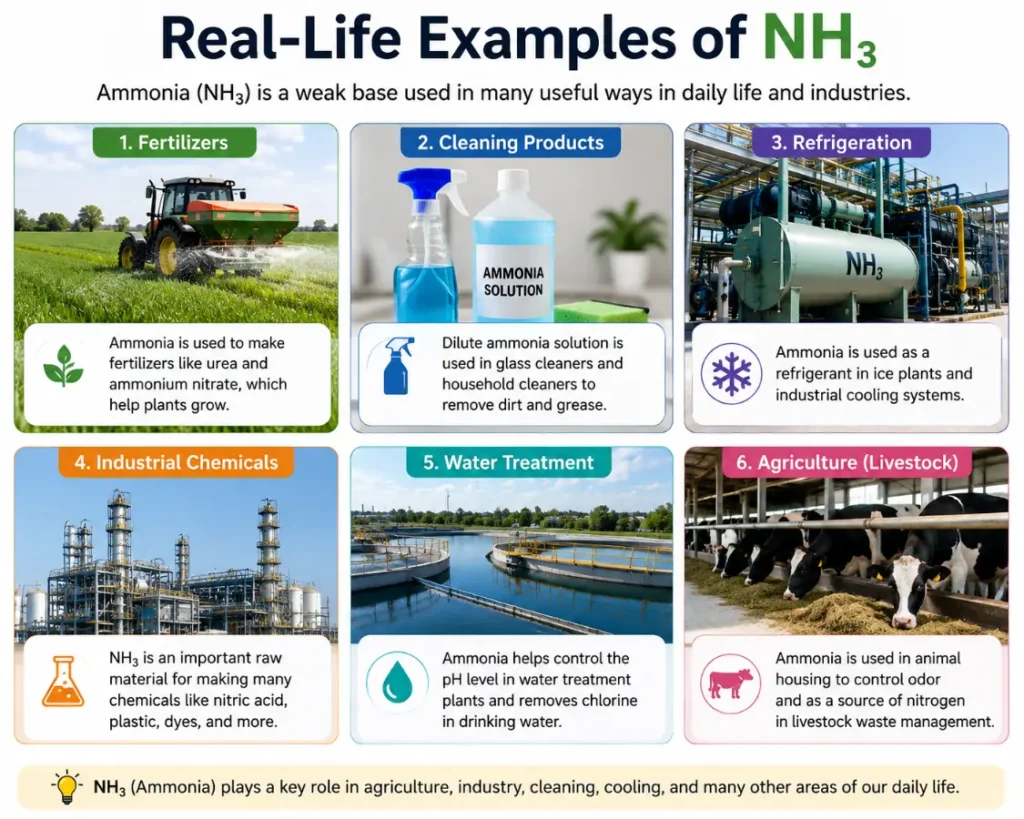
Real-Life Examples of NH3
Ammonia has several practical uses.
1. Cleaning products
Ammonia solutions have been used in some household cleaning products.
Their basic nature helps with certain cleaning tasks.
However, cleaning chemicals require careful handling and should never be mixed randomly.
2. Fertilizer production
Ammonia plays a major role in making nitrogen fertilizers.
Plants need nitrogen for healthy growth.
Ammonia provides an important starting material for many nitrogen-based products.
3. Industrial chemicals
Industries use ammonia to make many useful chemicals.
These include compounds used in fertilizers, plastics, textiles, and other products.
4. Laboratory chemistry
Students and scientists use ammonia solutions in acid-base experiments.
They can demonstrate weak-base behavior and equilibrium.
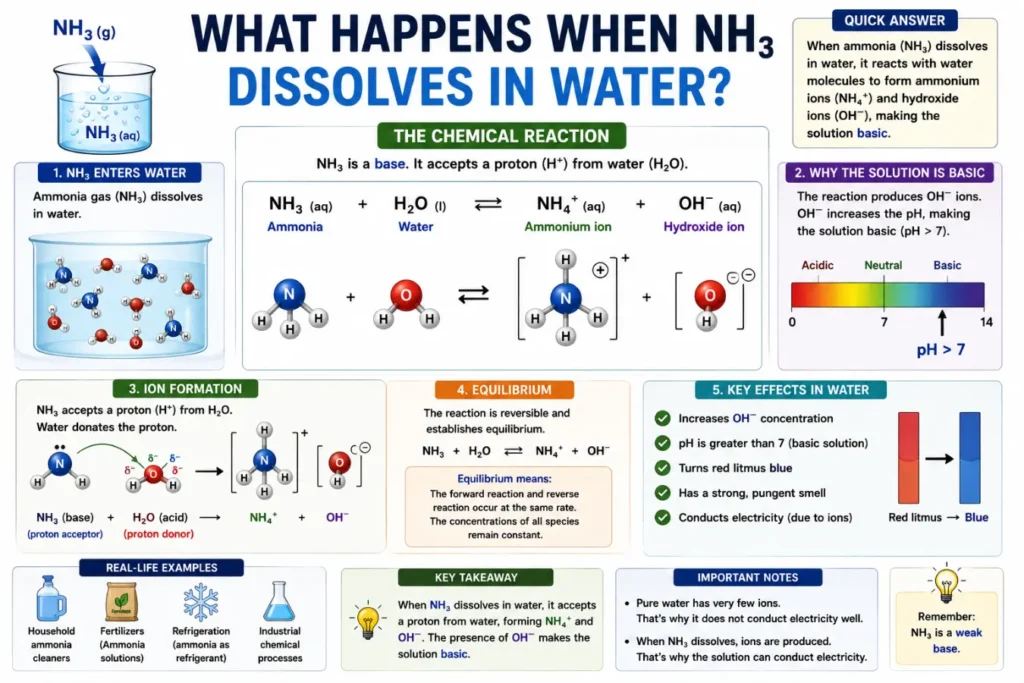
What Happens When NH3 Dissolves in Water?
When ammonia enters water, it reacts with some water molecules.
The reaction is:
NH3 + H2O ⇌ NH4⁺ + OH⁻
The double arrow matters.
It shows that the reaction reaches equilibrium.
Some ammonia molecules accept protons.
Other molecules remain as NH3.
The formation of OH⁻ increases the solution’s basicity.
Therefore, an aqueous ammonia solution has a pH above 7 under ordinary conditions.
The exact pH depends on concentration and other conditions.
Common Mistakes About NH3
Mistake 1: Calling NH3 a strong base
NH3 is a weak base.
Do not confuse it with strong bases such as NaOH.
Mistake 2: Saying NH3 contains OH⁻
NH3 does not contain an OH⁻ group.
Instead, it reacts with water and causes OH⁻ to form.
Mistake 3: Calling NH4⁺ ammonia
NH3 is ammonia.
NH4⁺ is ammonium.
They are different chemical species.
Mistake 4: Ignoring the reaction
The question may ask whether NH3 acts as an acid or base.
Always look at what happens during the reaction.
Mistake 5: Confusing weak with neutral
A weak base is still a base.
“Weak” describes its degree of ionization or reaction strength.
It does not mean “neutral.”
Tips for Identifying NH3 in Chemistry Questions
Use these simple steps.
Step 1: Look at NH3.
Check whether it can accept a proton.
Step 2: Find the nitrogen lone pair.
Nitrogen has a lone pair in NH3.
Step 3: Look for H⁺ transfer.
If NH3 accepts H⁺, it acts as a base.
Step 4: Check the product.
NH3 usually becomes NH4⁺ after accepting H⁺.
Step 5: Check the water reaction.
If you see NH3 + H2O ⇌ NH4⁺ + OH⁻, NH3 is the base.
These steps can help you answer many acid-base questions quickly.
NH3 and pH
Ammonia solutions are basic.
They have a pH greater than 7 under ordinary aqueous conditions.
However, the pH does not stay the same for every ammonia solution.
A more concentrated solution generally contains more dissolved ammonia.
The actual pH depends on concentration, temperature, and equilibrium conditions.
This is why you should not assume one fixed pH for every NH3 solution.
The important rule is simple:
NH3 in water produces OH⁻ and gives a basic solution.
NH3 Acid or Base: The Easy Rule
If a chemistry question asks, “Is NH3 an acid or base?”, use this rule:
NH3 is a weak base because it accepts H⁺.
In water:
NH3 + H2O ⇌ NH4⁺ + OH⁻
This reaction gives the clearest evidence.
NH3 takes H⁺ from H2O.
Therefore, NH3 acts as the base.
Water gives away H⁺.
Therefore, water acts as the acid.
This simple pattern can help you identify the roles of both substances.
Synonyms and Related SEO Terms
You may see several related terms when studying this topic.
- NH3 acid or base
- ammonia acid or base
- ammonia weak base
- NH3 weak base
- is NH3 a base
- is ammonia an acid
- NH3 Brønsted-Lowry base
- NH3 Lewis base
- ammonia in water
- NH3 and H2O reaction
- NH3 pH
- ammonium ion
- NH4⁺ conjugate acid
- ammonia base strength
- weak bases in chemistry
- acid-base reactions
- ammonia equilibrium
These terms describe closely related ideas.
They can also help students connect different chemistry concepts.
Expert Insights: Why NH3 Matters
The best way to understand NH3 is to focus on proton transfer.
Do not memorize only the phrase “NH3 is a base.”
Instead, understand why it behaves as a base.
Nitrogen has a lone pair.
That lone pair allows NH3 to accept H⁺.
This explains its Brønsted-Lowry and Lewis base behavior.
It also explains why NH3 forms NH4⁺.
Another important idea involves equilibrium.
NH3 reacts with water only partially.
That is why ammonia is a weak base.
This reasoning gives you a stronger understanding than memorizing a single answer.
FAQs About NH3 Acid or Base
Is NH3 an acid or a base?
NH3 is mainly a weak base in water. It accepts H⁺ and forms NH4⁺.
Why is NH3 a base?
NH3 has a lone pair on nitrogen. It uses this lone pair to accept a proton.
Is NH3 a strong base?
No. NH3 is a weak base because it reacts only partly with water.
Is NH3 a Lewis base?
Yes. NH3 is a Lewis base because it can donate its lone electron pair.
Is NH3 a Brønsted-Lowry base?
Yes. NH3 is a Brønsted-Lowry base because it accepts a proton.
Does NH3 produce OH⁻ in water?
Yes. NH3 reacts with water and produces some OH⁻.
NH3 + H2O ⇌ NH4⁺ + OH⁻
Is NH4⁺ an acid or base?
NH4⁺ is the conjugate acid of NH3. It can donate a proton to form NH3.
Can NH3 ever act as an acid?
Yes, under suitable conditions with a sufficiently strong base. However, in normal aqueous chemistry, NH3 acts as a weak base.
Conclusion: Is NH3 Acid or Base?
So, is NH3 acid or base? The simple answer is that NH3 is a weak base in water. It accepts a proton from water and forms NH4⁺. The reaction also produces OH⁻, which makes the solution basic.
The key reaction is:
NH3 + H2O ⇌ NH4⁺ + OH⁻
NH3 works as both a Brønsted-Lowry base and a Lewis base. Its nitrogen atom has a lone pair that helps it accept H⁺. Although NH3 can show acidic behavior under special conditions, that is not its usual role in water.
The easiest rule to remember is simple: NH3 accepts H⁺, so NH3 acts as a weak base.