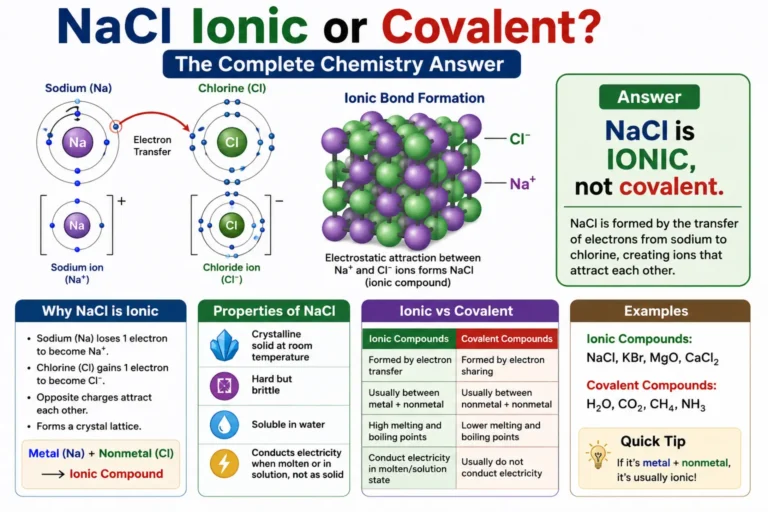
NaCl is ionic, not covalent. Sodium chloride forms when sodium gives one electron to chlorine. This electron transfer creates two charged ions. Sodium becomes a positive sodium ion, Na⁺. Chlorine becomes a negative chloride ion, Cl⁻. These opposite charges attract each other strongly. This attraction forms an ionic bond.
Many students confuse ionic and covalent bonds. The difference becomes simple when you check the elements involved. Sodium is a metal. Chlorine is a nonmetal. Metals and nonmetals usually form ionic compounds. Both atoms also reach a more stable electron arrangement. NaCl is therefore a classic example of an ionic compound.
In this guide, you will learn why NaCl is ionic. You will also see its structure, properties, examples, and common mistakes.
Quick Summary: Is NaCl Ionic or Covalent?
- NaCl is an ionic compound.
- NaCl stands for sodium chloride.
- Sodium is a metal.
- Chlorine is a nonmetal.
- Sodium loses one electron and forms Na⁺.
- Chlorine gains one electron and forms Cl⁻.
- Na⁺ and Cl⁻ attract through an ionic bond.
- NaCl forms a large ionic crystal lattice.
- Table salt is a common example of NaCl.
- NaCl does not contain individual covalent NaCl molecules.
What Does NaCl Mean?
NaCl is the chemical formula for sodium chloride.
Sodium has the chemical symbol Na. Chlorine has the symbol Cl.
The formula shows a 1:1 ratio of sodium ions to chloride ions. It does not mean that one sodium atom forms a separate molecule with one chlorine atom.
Instead, NaCl forms an extended ionic structure. Each sodium ion attracts nearby chloride ions. Each chloride ion attracts nearby sodium ions.
This repeating pattern creates a strong crystal lattice.
Is NaCl Ionic or Covalent?
NaCl is ionic.
The main reason involves electron transfer.
Sodium has one electron in its outer shell. It can lose this electron easily. After losing it, sodium forms Na⁺.
Chlorine needs one electron to complete its outer shell. It gains sodium’s electron and forms Cl⁻.
The resulting ions have opposite charges.
Their attraction creates an ionic bond.
So, the basic process looks like this:
Na → Na⁺ + e⁻
Cl + e⁻ → Cl⁻
Then:
Na⁺ + Cl⁻ → NaCl
This electron transfer makes NaCl ionic rather than covalent.
Why Is NaCl Ionic?
Several clues show that NaCl has ionic bonding.
1. Sodium is a metal
Sodium belongs to the alkali metals. Metals often lose electrons during chemical reactions.
2. Chlorine is a nonmetal
Chlorine belongs to the halogens. Nonmetals often gain electrons during ionic bonding.
3. Electron transfer occurs
Sodium transfers one electron to chlorine.
This creates charged particles called ions.
4. Opposite charges attract
Na⁺ carries a positive charge. Cl⁻ carries a negative charge.
These opposite charges attract strongly.
5. NaCl forms a crystal lattice
Solid sodium chloride has a repeating three-dimensional ionic structure.
These clues strongly support an ionic classification.
How Does Ionic Bonding in NaCl Work?
Let’s look at the bonding process step by step.
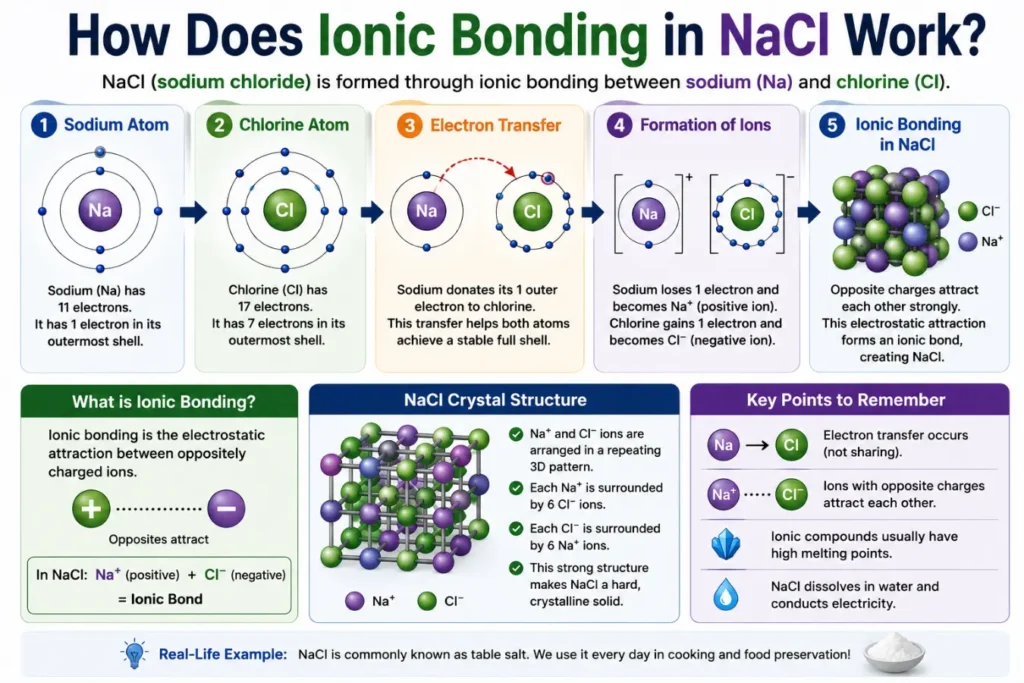
Sodium has 11 electrons. Its electron arrangement is:
2, 8, 1
The final electron is relatively easy to remove.
Chlorine has 17 electrons. Its arrangement is:
2, 8, 7
Chlorine needs one more electron for a full outer shell.
Sodium gives its outer electron to chlorine.
Sodium then becomes:
2, 8
Chlorine becomes:
2, 8, 8
Both ions now have stable outer electron arrangements.
The positive Na⁺ ion attracts the negative Cl⁻ ion. This electrostatic attraction produces ionic bonding.
NaCl Ionic Bond vs Covalent Bond
Ionic and covalent bonds work differently.
| Feature | NaCl Ionic Bond | Covalent Bond |
|---|---|---|
| Bonding process | Electron transfer | Electron sharing |
| Elements | Metal + nonmetal | Usually nonmetal + nonmetal |
| Charged ions | Yes | Usually no |
| NaCl example | Yes | No |
| Crystal lattice | Yes | Not usually |
| Electrical conduction when molten | Yes | Usually no |
| Example | NaCl | H₂O |
| Main force | Attraction between ions | Shared electrons |
The key difference is simple.
Ionic bonding transfers electrons. Covalent bonding shares electrons.
NaCl involves electron transfer, so it is ionic.
Is the Bond Between Na and Cl Covalent?
No. The bonding between sodium and chlorine in NaCl is ionic.
Sodium does not share its outer electron equally with chlorine.
Instead, sodium transfers that electron to chlorine.
This creates Na⁺ and Cl⁻.
Their electrostatic attraction holds the ionic structure together.
Some chemistry discussions mention that real bonds can have partial covalent character. However, introductory chemistry correctly classifies NaCl as an ionic compound.
For school-level questions, the answer remains:
NaCl = ionic compound.
Is NaCl a Molecule?
Strictly speaking, solid NaCl does not consist of separate NaCl molecules.
It forms a giant ionic lattice.
Each Na⁺ ion has several nearby Cl⁻ ions. The same pattern continues throughout the crystal.
Therefore, chemists often describe NaCl using a formula unit rather than a molecule.
The formula unit represents the simplest ratio of ions.
For NaCl, that ratio is:
1 Na⁺ : 1 Cl⁻
This ratio gives the compound electrical neutrality.
Properties of NaCl That Show Ionic Bonding
NaCl has several properties that match ionic compounds.
High melting point
Strong attractions hold the ions together. Therefore, NaCl needs substantial heat to melt.
Solid at room temperature
NaCl forms a stable crystal lattice under normal conditions.
Brittle structure
When the layers shift, similarly charged ions can become aligned. Their repulsion can split the crystal.
Conducts electricity when molten
In liquid NaCl, ions can move freely. These moving ions carry electric charge.
Conducts electricity in solution
When NaCl dissolves in water, it separates into mobile ions.
Does not conduct well as a solid
The ions cannot move freely through the solid lattice.
These properties provide useful evidence for ionic bonding.
Real-Life Examples of NaCl
NaCl appears in many familiar situations.
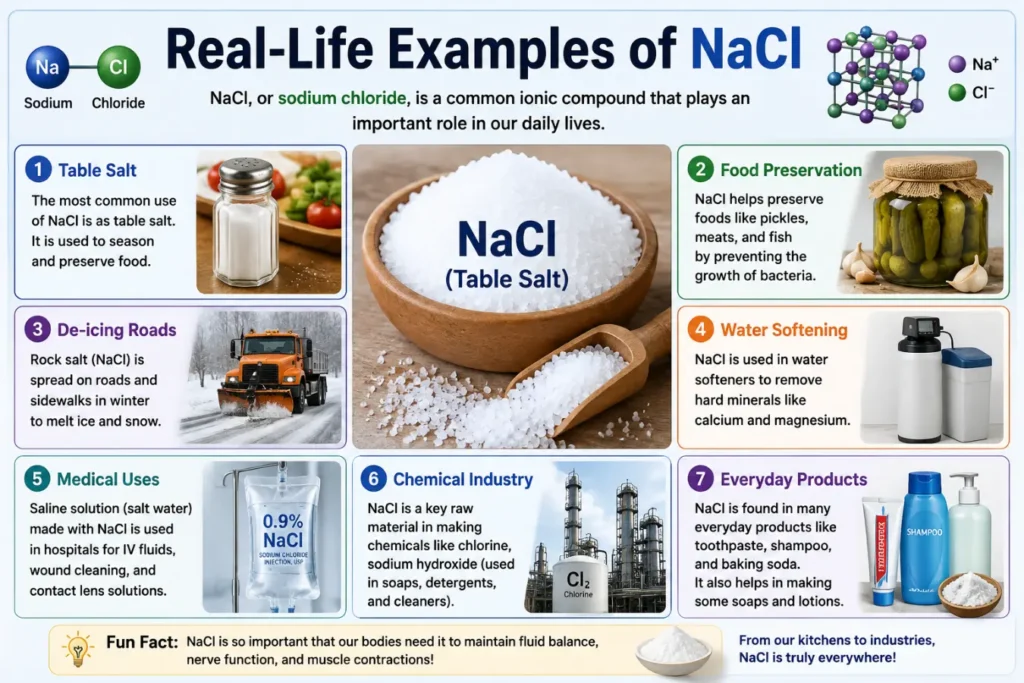
Table salt
Most people know NaCl as ordinary table salt. Food uses it for flavor and preservation.
Salt water
Seawater contains dissolved salts, including sodium chloride.
Food preservation
Salt can help preserve certain foods by reducing available water for microorganisms.
Medical saline
Healthcare uses carefully prepared sodium chloride solutions for several purposes.
De-icing
Some regions use salt to lower the freezing point of water on roads.
These examples show how chemistry connects with everyday life.
How to Tell If a Compound Is Ionic
You can use a simple rule in many basic chemistry problems.
Check the elements first.
If a compound contains:
Metal + nonmetal → usually ionic
Examples include:
- NaCl
- KBr
- MgO
- CaCl₂
- LiF
If it contains:
Nonmetal + nonmetal → usually covalent
Examples include:
- H₂O
- CO₂
- CH₄
- SO₂
- NH₃
This rule works well for introductory chemistry.
However, advanced chemistry includes exceptions and more complex bonding.
Common Mistakes About NaCl Bonding
Students often make a few common errors.
Mistake 1: Calling NaCl covalent
Some students think every chemical bond involves electron sharing.
That is incorrect.
Ionic bonding involves electron transfer.
Mistake 2: Saying NaCl contains NaCl molecules
Solid NaCl forms an ionic lattice.
Use formula unit instead of molecule in this context.
Mistake 3: Thinking ions share electrons
Na⁺ and Cl⁻ result from electron transfer.
Their attraction then holds the structure together.
Mistake 4: Confusing dissolving with melting
NaCl dissolves in water because water interacts strongly with its ions.
Melting requires enough energy to disrupt the solid lattice.
Mistake 5: Thinking all compounds with two elements are ionic
The number of elements does not determine bonding type.
You must examine the elements and their bonding behavior.
Tips for Remembering That NaCl Is Ionic
Use these simple memory tricks.
Remember the metal rule
Metal + nonmetal = ionic in most basic chemistry questions.
Na is a metal. Cl is a nonmetal.
Therefore, NaCl is ionic.
Remember electron transfer
Think:
Na gives. Cl takes.
Sodium gives one electron. Chlorine takes one electron.
Remember the charges
Sodium becomes Na⁺.
Chlorine becomes Cl⁻.
Opposite charges attract.
Remember table salt
Table salt is NaCl. It is a familiar ionic compound.
These tricks can help during chemistry tests.
NaCl and Covalent Compounds: Key Differences
The biggest difference involves what happens to electrons.
In NaCl, sodium transfers an electron to chlorine. This creates charged ions.
In a covalent compound, atoms usually share electrons.
For example, water contains covalent bonds between hydrogen and oxygen.
Carbon dioxide also contains covalent bonds.
NaCl behaves differently because sodium and chlorine have different bonding tendencies.
This distinction helps explain their different physical properties.
NaCl Synonyms and Related Chemistry Terms
Several terms relate closely to this topic.
Useful semantic keywords include:
- sodium chloride
- table salt
- ionic compound
- ionic bond
- ionic bonding
- covalent bond
- covalent compound
- electron transfer
- electron sharing
- sodium ion
- chloride ion
- Na⁺ ion
- Cl⁻ ion
- crystal lattice
- formula unit
- chemical bonding
- metal and nonmetal
- ionic structure
These terms help explain the topic without repeating the same keyword too often.
Expert Insights: Why This Topic Matters
Understanding NaCl helps build a strong chemistry foundation.
The same reasoning applies to many other ionic compounds.
First, identify the elements. Then check whether one can lose electrons and the other can gain them.
Next, consider the resulting ions.
Finally, think about how opposite charges attract.
This approach helps students understand chemistry instead of memorizing isolated answers.
Expert tip: Do not identify bonding from the formula alone. Always examine the elements and their electron behavior.
Another useful tip: Learn the difference between an ionic formula unit and a covalent molecule.
That distinction becomes important in later chemistry topics.
FAQs About Whether NaCl Is Ionic or Covalent
Is NaCl ionic or covalent?
NaCl is an ionic compound. Sodium transfers one electron to chlorine.
Why is NaCl called an ionic compound?
NaCl contains Na⁺ and Cl⁻ ions. Their opposite charges create ionic attraction.
Does NaCl have covalent bonds?
For basic chemistry classification, NaCl has ionic bonding. It does not have a typical covalent Na–Cl bond.
Is NaCl a molecule?
No. Solid NaCl forms a crystal lattice. Chemists use the term formula unit for its simplest ion ratio.
What happens when NaCl dissolves in water?
NaCl separates into hydrated Na⁺ and Cl⁻ ions. These ions move freely through the solution.
Can solid NaCl conduct electricity?
Solid NaCl does not conduct electricity well. Its ions cannot move freely through the solid lattice.
Why does molten NaCl conduct electricity?
Molten NaCl contains mobile ions. These ions carry electric charge through the liquid.
Is table salt an ionic compound?
Yes. Ordinary sodium chloride, or NaCl, is an ionic compound.
Conclusion: Is NaCl Ionic or Covalent?
NaCl is ionic, not covalent. Sodium and chlorine form Na⁺ and Cl⁻ ions through electron transfer. Their opposite charges create strong ionic attraction. This attraction produces the crystal lattice found in solid sodium chloride.
NaCl also shows typical ionic properties. It has a high melting point and forms a brittle crystal. It conducts electricity when molten or dissolved in water. These properties support its ionic classification.
The easiest way to remember the answer is simple. Sodium is a metal, while chlorine is a nonmetal. Sodium gives away an electron, and chlorine accepts it.
So, when asked “Is NaCl ionic or covalent?”, the clear answer is:
NaCl is an ionic compound formed by electron transfer between sodium and chlorine.