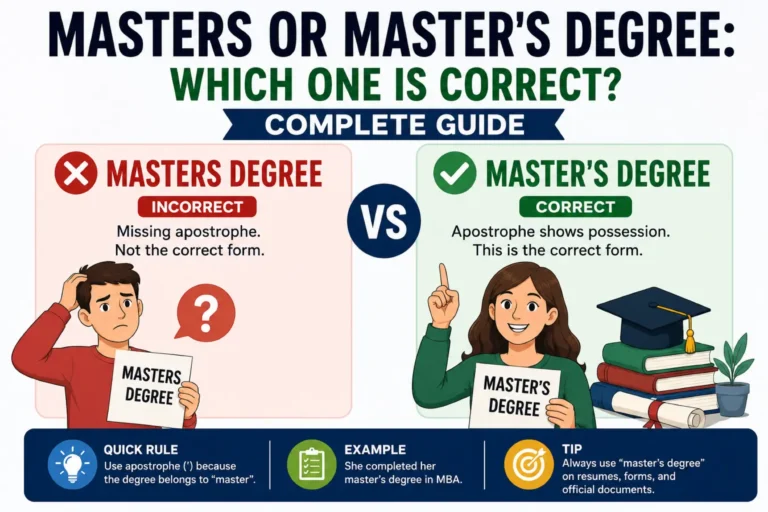
Masters or master’s degree is a question many students and professionals ask. Both terms appear online, which creates confusion. The correct form depends on how you use the phrase.
In most cases, master’s degree is the correct and standard expression. It includes an apostrophe because the degree belongs to the level called “master.”
However, many people shorten the phrase and simply say master’s. Others mistakenly write masters degree without the apostrophe.
This guide explains the difference in simple words. You will learn the correct grammar, see examples, and avoid common mistakes. Whether you are writing a resume, college application, or blog post, this article will help you use the term correctly.
Quick Summary Box
- Master’s degree is the correct standard form.
- The apostrophe is important.
- Masters degree without an apostrophe is incorrect.
- People often shorten it to master’s.
- Use the correct form on resumes and applications.
- Most universities use master’s degree officially.
What Is a Master’s Degree?
A master’s degree is a graduate-level academic qualification.
Students earn it after completing a bachelor’s degree.
A master’s program usually takes:
- One to three years
- Specialized coursework
- Research or practical training
Examples include:
- Master of Science (MS)
- Master of Arts (MA)
- Master of Business Administration (MBA)
Masters or Master’s Degree: Which Is Correct?
The correct phrase is:
✔ Master’s degree
Incorrect:
✘ Masters degree
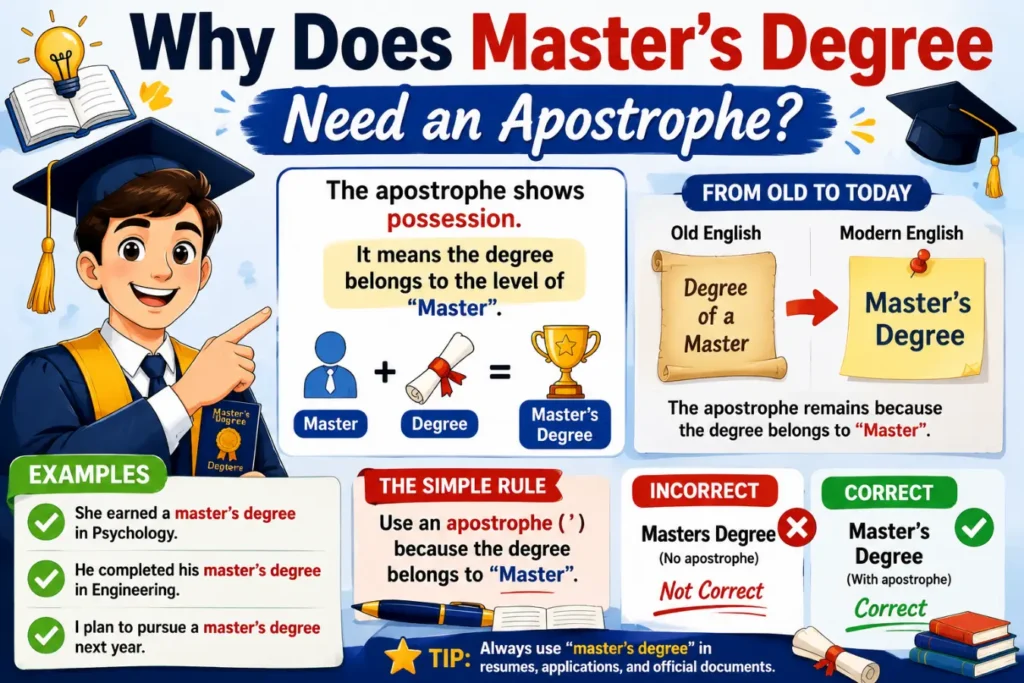
The apostrophe shows possession. It means the degree belongs to the level called “master.”
Examples:
- She earned a master’s degree in psychology.
- He completed his master’s degree in engineering.
- I plan to pursue a master’s degree next year.
Why Does “Master’s Degree” Need an Apostrophe?
The apostrophe comes from historical grammar rules.
Originally, people said:
Degree of a master
Over time, English shortened it to:
Master’s degree
The apostrophe remains because the degree belongs to the category of “master.”
Can You Simply Say “Master’s”?
Yes.
Many people shorten the phrase in everyday conversation.
Examples:
- I’m studying for my master’s.
- She finished her master’s last year.
- He plans to start a master’s in finance.
This form is natural and widely accepted.
Masters vs Master’s Degree Comparison Table
| Feature | Master’s Degree | Masters Degree |
|---|---|---|
| Grammar | Correct | Incorrect |
| Apostrophe | Yes | No |
| Used by universities | Yes | No |
| Appropriate for resumes | Yes | No |
| Standard English | Yes | No |
Real-Life Examples
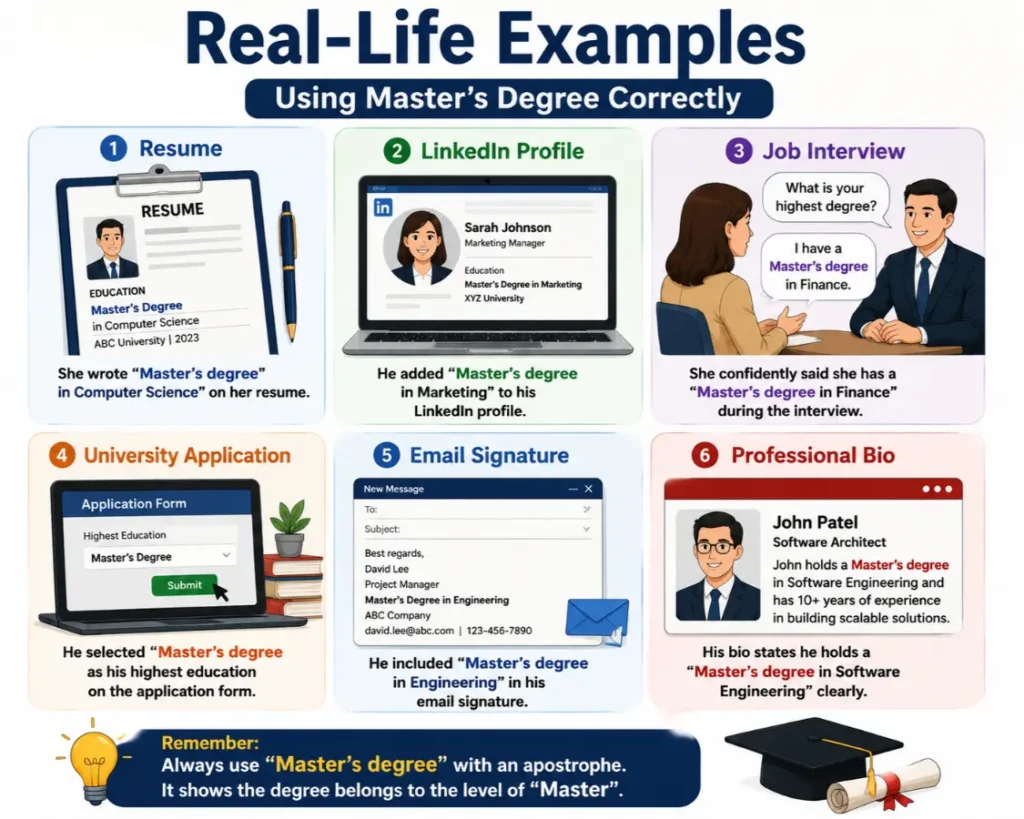
Resume Example
✔ Master’s degree in Computer Science
LinkedIn Profile
✔ Master’s degree in Marketing
College Application
✔ Completed a master’s degree in education
Professional Bio
✔ Holds a master’s degree in public health
Common Types of Master’s Degrees
Popular graduate degrees include:
Master of Science (MS)
Focuses on science and technical fields.
Master of Arts (MA)
Covers humanities and social sciences.
Master of Business Administration (MBA)
Prepares students for leadership roles.
Master of Education (MEd)
Designed for teachers and educators.
Master of Engineering (MEng)
Focuses on advanced engineering skills.
Common Mistakes People Make
Writing “Masters Degree”
Many people forget the apostrophe.
Wrong:
- Masters degree in biology
Correct:
- Master’s degree in biology
Adding an Extra Apostrophe
Wrong:
- Master’s degree’s program
Correct:
- Master’s degree program
Capitalizing Every Word
Only capitalize official degree names.
Correct:
- master’s degree in history
- Master of Science in Data Science
How to Write a Master’s Degree on a Resume
Use clear and professional wording.
Examples:
Education Section
Master of Science in Computer Science
University Name | 2025
Or:
Master’s Degree in Computer Science
Both formats work well.
Usage in Daily Life
People use the term in many situations.
Examples:
- Job interviews
- University applications
- LinkedIn profiles
- Email signatures
- Professional biographies
- Scholarship forms
Correct grammar creates a better impression.
Benefits of Earning a Master’s Degree
A graduate degree may help you:
- Increase earning potential
- Develop specialized skills
- Access leadership roles
- Change careers
- Improve job opportunities
- Expand professional networks
Many industries value advanced education.
Synonyms and Related Keywords
LSI Keywords
- graduate degree
- postgraduate degree
- master’s program
- advanced degree
- master’s qualification
- higher education degree
- graduate studies
- postgraduate education
Long-Tail Keywords
- is it masters or master’s degree
- how to write master’s degree correctly
- apostrophe in master’s degree
- master’s degree grammar rules
- master’s degree on resume examples
Expert Insight
Grammar experts and universities consistently use master’s degree with an apostrophe.
Using the correct form improves:
- Professional credibility
- Resume quality
- Academic writing
- Search engine trust
- Reader confidence
Small grammar details can make your writing look more polished.
Frequently Asked Questions
Is it masters or master’s degree?
Master’s degree is correct.
Why is there an apostrophe in master’s degree?
The apostrophe shows possession and follows traditional English grammar.
Can I say just “master’s”?
Yes. Many people use this shorter form in conversation.
Is “masters degree” wrong?
Yes. Standard English requires the apostrophe.
Should I capitalize master’s degree?
Usually, no.
Example:
✔ master’s degree in psychology
How do I write a master’s degree on my resume?
Use either:
- Master’s Degree in Accounting
- Master of Science in Accounting
Is MBA considered a master’s degree?
Yes. An MBA is a type of master’s degree.
Internal Linking Suggestions
Link this article to:
- Bachelor’s Degree or Bachelors Degree
- Associate Degree vs Bachelor’s Degree
- How to List Education on a Resume
- Graduate Degree Meaning Explained
- Master’s vs PhD Differences
Conclusion
The debate over masters or master’s degree is easy to solve. The correct form is master’s degree because it follows standard English grammar rules.
The apostrophe matters. Without it, the phrase becomes incorrect. You can also shorten the expression and simply say master’s in everyday conversation.
Using the proper wording helps your resume, applications, and professional writing look more credible. Most universities and employers expect this standard format.
The easiest rule to remember is simple:
Always use “master’s degree” with an apostrophe.