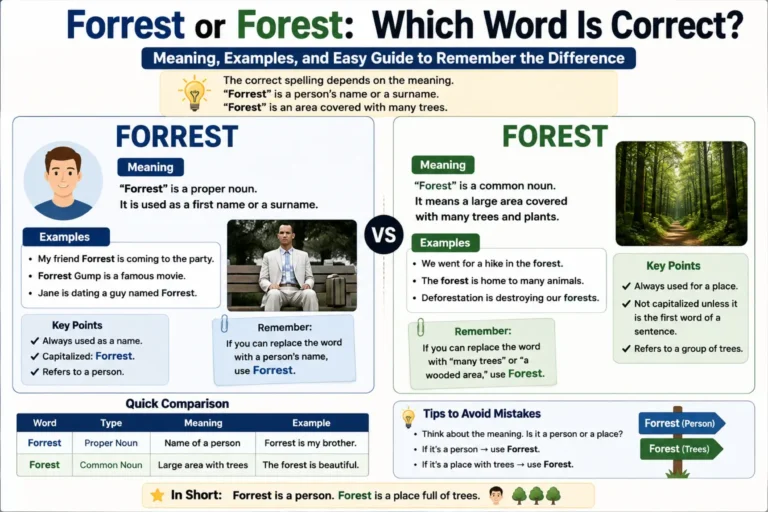
Forrest or forest can be confusing because both words look and sound very similar. However, they have very different meanings. Forest is a common English word for a large area filled with trees. Forrest is usually a person’s name or surname. Knowing the difference helps you avoid spelling mistakes in writing, schoolwork, emails, and online searches. In this guide, you will learn when to use forest and when to use Forrest. You will also see simple examples and useful memory tricks. By the end, choosing the right word will feel easy. Let’s start with the basic difference and then explore common mistakes, examples, synonyms, and expert tips.
Quick Summary: Forrest or Forest?
- Forest means a large area covered with many trees.
- Forrest is usually a person’s first name or family name.
- Use forest when talking about trees, woodland, or nature.
- Use Forrest when referring to a person named Forrest.
- “We walked through the forest” is correct.
- “Forrest is my friend” is correct when the person’s name is Forrest.
- The extra r in “Forrest” makes it different from “forest.”
- A simple trick is to remember that Forrest often refers to a person.
Forrest vs. Forest: What Is the Difference?
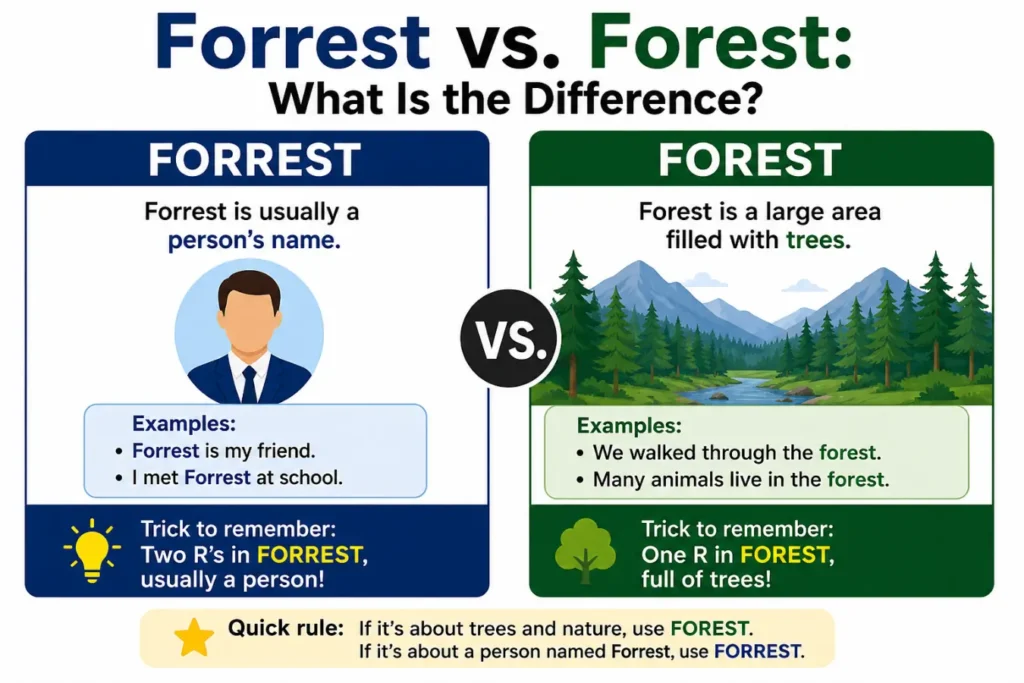
The main difference is meaning.
Forest is a regular English noun. It describes an area with many trees and other plants.
Forrest is normally a proper noun. It commonly appears as a person’s first name or surname.
Here is the easiest way to remember it:
Forest = trees and nature.
Forrest = usually a person’s name.
The words sound almost identical in many accents. That causes confusion.
However, their spelling and use are different.
For example:
- We explored a forest during our trip.
- Forrest joined our team last year.
The first sentence describes nature. The second sentence identifies a person.
What Does Forest Mean?
Forest means a large area where many trees grow together.
Forests can cover small or huge areas. They can contain trees, plants, animals, insects, rivers, and other natural features.
The word forest can work as a noun.
Examples include:
- The children walked through the forest.
- Many animals live in the forest.
- The forest looks beautiful after the rain.
- We saw several birds near the forest.
- Forests help support many forms of wildlife.
The word also appears in many common phrases.
Examples include:
- tropical forest
- rain forest
- forest fire
- forest floor
- forest animals
- forest ecosystem
- forest conservation
So, when your sentence involves trees or woodland, forest is usually the correct choice.
What Does Forrest Mean?
Forrest is most often used as a name.
It can be a first name or a family name. Like other names, it usually starts with a capital letter.
For example:
- Forrest is coming to dinner.
- I spoke with Forrest yesterday.
- Forrest lives near my office.
- Mr. Forrest teaches English.
You may also see Forrest in the names of famous people, fictional characters, businesses, or places.
One famous example is Forrest Gump, the main character from the novel and film Forrest Gump.
The capital letter provides another useful clue.
Forest usually describes nature.
Forrest usually identifies a person.
Forrest or Forest: Comparison Table
| Feature | Forest | Forrest |
|---|---|---|
| Meaning | An area with many trees | Usually a person’s name |
| Word type | Common noun | Proper noun |
| Capital letter | Usually lowercase | Usually uppercase |
| Refers to nature? | Yes | Usually no |
| Refers to a person? | Rarely | Yes |
| Example | “The forest is large.” | “Forrest is here.” |
| Common use | Trees, woodland, wildlife | First name or surname |
This simple comparison solves most spelling questions.
If you mean a place filled with trees, choose forest.
If you mean someone named Forrest, choose Forrest.
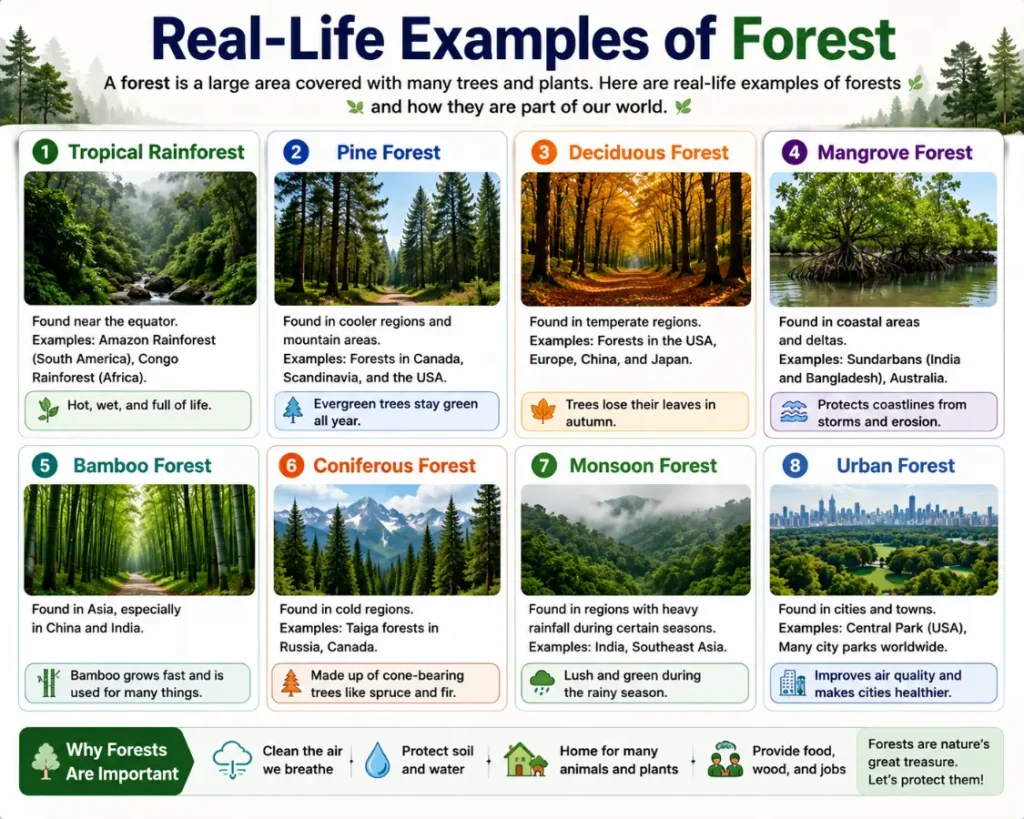
Real-Life Examples of Forest
Understanding real situations makes the difference easier.
Imagine you are hiking in a wooded area.
You could say:
“We spent three hours walking through the forest.”
You could also write:
“The forest was full of tall trees.”
Now imagine you meet someone named Forrest.
You could say:
“I met Forrest at the conference.”
Here are more examples:
- The forest contains hundreds of plant species.
- We heard birds singing in the forest.
- A forest fire damaged the area.
- Forrest called me after work.
- Forrest enjoys hiking and photography.
- The forest becomes quiet at night.
Notice how the meaning changes with the spelling.
Common Mistakes With Forrest and Forest
Many people make the same spelling mistakes.
Mistake 1: Using “Forrest” for trees
Incorrect:
We went camping in the Forrest.
Correct:
We went camping in the forest.
The word describes a natural area. Therefore, use forest.
Mistake 2: Using “forest” as someone’s name
Incorrect:
I spoke to forest yesterday.
Correct:
I spoke to Forrest yesterday.
The person has the name Forrest. Therefore, capitalize it.
Mistake 3: Adding an extra “r”
Some writers type forrest when they mean forest.
Remember the spelling:
F-O-R-E-S-T
Forest has only one r.
F-O-R-R-E-S-T
Forrest has two r’s.
Mistake 4: Ignoring capitalization
Names need capital letters.
Write:
Forrest is my neighbor.
Do not write:
forrest is my neighbor.
Capitalization can help readers understand the word’s role.
How to Remember the Difference
You do not need a difficult grammar rule.
Use this simple memory trick:
One R = trees. Two Rs = usually a person.
- Forest → one R → trees
- Forrest → two Rs → name
You can also connect Forrest with famous names.
For example, remember Forrest Gump.
If you are talking about trees, think about a forest.
If you are talking about someone named Forrest, use Forrest.
This trick works well for students, writers, and English learners.
Forrest or Forest in Daily Life
You may see both words in everyday writing.
For example, travel websites often discuss forests.
You may read phrases like:
- forest trail
- forest park
- forest reserve
- forest wildlife
- forest adventure
Meanwhile, Forrest may appear in:
- names
- contact lists
- school records
- books
- movie titles
- company names
- historical records
Context usually makes the correct spelling clear.
Ask yourself one question:
Am I talking about trees or a person?
If the answer is trees, use forest.
If the answer is a person named Forrest, use Forrest.
Forest Synonyms and Related Words
The word forest has several related terms.
These words can describe similar ideas, depending on context:
- woodland
- woods
- grove
- jungle
- timberland
- wilderness
- tree-covered area
- wooded area
These words are not always exact synonyms.
For example, jungle usually suggests dense tropical vegetation.
Grove often means a small group of trees.
Woodland can describe land covered with trees and is often smaller than a large forest.
Useful semantic keywords related to forest include:
- trees
- woodland
- nature
- wildlife
- ecosystem
- environment
- vegetation
- conservation
- hiking
- outdoors
- natural habitat
These terms help explain the topic naturally without repeating the same keyword too often.
Is Forrest Ever Used as a Common Word?
In modern English, Forrest is mainly used as a proper name.
It can appear as a surname or given name.
Therefore, you should not normally use Forrest when you mean a wooded area.
For example:
Correct:
“The forest is full of wildlife.”
Usually incorrect:
“The Forrest is full of wildlife.”
However, a specific place could have Forrest as part of its official name.
In that case, the capitalized spelling is correct because it forms part of the proper name.
Always check the context before changing a name’s spelling.
Forrest or Forest: Which One Should You Use?
Use forest when your sentence talks about trees, woodland, or nature.
Use Forrest when the word identifies a person or forms part of a proper name.
Here is a quick test:
Question: Are you describing a place with many trees?
- Yes → forest
Question: Are you naming a person?
- Yes → Forrest, if that is their correct name.
Examples
Forest:
The forest covers thousands of acres.
Forrest:
Forrest lives in California.
Forest:
We saw deer in the forest.
Forrest:
Forrest sent me a message.
This rule handles most everyday situations.
Expert Insights: Why This Difference Matters
Correct spelling builds trust.
A small spelling error can change the meaning of a sentence. It can also make professional writing look careless.
This difference matters most in:
- academic writing
- business communication
- website content
- journalism
- school assignments
- resumes
- social media
- SEO content
An expert writing tip is simple: check the meaning before checking the spelling.
Do not only ask whether a word looks right.
Ask what the word means in your sentence.
This approach helps you catch many confusing word pairs.
Examples include:
- their vs. there
- your vs. you’re
- affect vs. effect
- advice vs. advise
- principal vs. principle
- forest vs. Forrest
Meaning should always guide your word choice.
SEO Keywords and Semantic Variations
People search for this topic in many different ways.
Useful secondary and long-tail keywords include:
- forrest or forest difference
- forest vs forrest
- is it forrest or forest
- forrest vs forest spelling
- how to spell forest
- how to spell forrest
- what does forest mean
- what does Forrest mean
- forest definition
- Forrest name meaning
- forest spelling
- correct spelling of forest
- difference between Forrest and forest
- when to use forest
- when to use Forrest
These variations match different search intents.
They also help create natural, useful content.
Frequently Asked Questions About Forrest or Forest
Is it forest or forrest?
Forest is correct when you mean an area filled with trees. Forrest is usually a person’s name.
Is Forrest a correct spelling?
Yes. Forrest is a correct spelling when it is used as a person’s name or surname.
How do you spell the place with many trees?
The correct spelling is forest: F-O-R-E-S-T.
Why does Forrest have two Rs?
Forrest is a name that uses two Rs. It is different from the common noun forest.
Is Forrest a boy’s name?
Yes. Forrest is traditionally used as a masculine given name. It can also appear as a surname.
What is the difference between Forrest and forest?
Forest means a wooded area. Forrest usually refers to a person’s name.
How can I remember forest spelling?
Remember: forest has one R. Think of trees and nature. Forrest has two Rs and usually names a person.
Is “Forrest” a synonym for forest?
No. In standard English, Forrest is not normally a synonym for forest. It is mainly a proper name.
Conclusion: Forrest or Forest?
The difference between forrest or forest is simple once you know the meaning. Forest is the correct word for a large area filled with trees. Forrest is usually a person’s first name or surname. The extra r changes the word and its purpose.
When writing, first ask what you are describing. If you mean trees, woodland, or nature, choose forest. If you mean someone named Forrest, use Forrest with a capital letter.
The easiest memory trick is also the best one: one R means forest and trees; two Rs usually mean Forrest, a name. Use this rule in schoolwork, emails, blogs, and everyday writing. Once you connect each spelling with its meaning, this common English confusion becomes easy to avoid.