Leach or leech can confuse even strong English speakers. These words sound almost the same, but they have different meanings. Leach usually describes a process where liquid removes something from a material. Leech usually refers to a blood-feeding animal or a person who takes too much.
The difference becomes easier when you see both words in real examples. You may find leach in science, gardening, soil, and environmental writing. You may find leech in biology and everyday speech.
This guide explains leach or leech in simple English. You will learn their meanings, uses, spelling, examples, and common mistakes. You will also get an easy memory trick.
By the end, you should know exactly which word to choose. You will also understand related words and common phrases.
Quick Summary: Leach or Leech?
- Leach means to remove a substance through liquid.
- Leach often describes soil, chemicals, minerals, or waste.
- Leech means a blood-feeding aquatic animal.
- Leech can also describe someone who takes advantage of others.
- Leach works mainly as a verb.
- Leech works as both a noun and a verb.
- Use leach for a process involving liquid.
- Use leech for the animal or a person who exploits others.
- A simple trick is: leech has “ee” like the blood-feeding creature’s sound.
What Does Leach Mean?
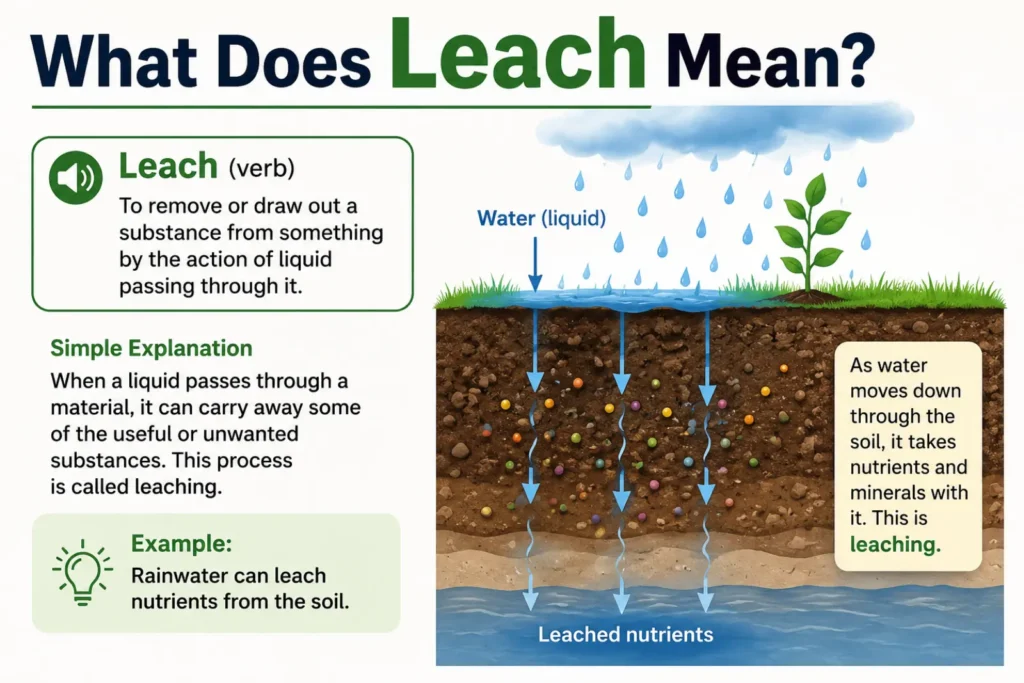
Leach means to remove a soluble substance from a material using liquid.
The word often appears in science and environmental topics. Water can move through soil and carry minerals away. This process is called leaching.
For example:
Heavy rain can leach nutrients from the soil.
Here, rainwater removes nutrients from the soil.
The word can also describe chemicals moving from waste into water. This use often appears in environmental reports.
For example:
Chemicals may leach into groundwater.
In this sentence, chemicals move from one material into water.
Leach can also describe the liquid process itself. The meaning depends on the sentence.
Simple definition
Leach means to remove something from a material through the action of liquid.
What Does Leech Mean?
Leech has two main meanings.
First, a leech is a small animal that lives in water or damp environments. Some leeches feed on blood.
For example:
A leech attached itself to the swimmer’s leg.
Second, leech can describe a person who takes from others without giving much back.
For example:
He became known as a leech because he always borrowed money.
This second meaning sounds negative. It suggests selfish or exploitative behavior.
The word leech can also work as a verb.
For example:
He tried to leech off his friends.
This means he tried to benefit from his friends without making a fair contribution.
Simple definition
Leech means a blood-feeding animal or a person who unfairly depends on others.
Leach vs Leech: What Is the Difference?
The biggest difference involves meaning.
| Word | Meaning | Common Use | Example |
|---|---|---|---|
| Leach | Remove something through liquid | Science and environment | Water can leach minerals from soil. |
| Leech | Blood-feeding animal | Biology | A leech lived in the pond. |
| Leech | A person who takes unfairly | Everyday speech | Nobody likes a leech. |
| Leech | To take from others unfairly | Informal English | He leeches off his friends. |
The spelling also provides a useful clue.
Leach contains “ea.”
Leech contains “ee.”
When you mean the animal, choose leech.
When you mean removing something with liquid, choose leach.
Leach vs Leech Examples in Real Life
Real examples make the difference easier to remember.
Example 1: Gardening
Too much rain can leach nutrients from garden soil.
Here, leach describes nutrients leaving the soil.
Example 2: Environmental science
Toxic substances can leach into groundwater.
Again, leach describes movement caused by liquid.
Example 3: Biology
The researcher found a leech near the pond.
Here, leech means the animal.
Example 4: Everyday conversation
He is a leech who never pays for anything.
Here, leech describes a person who takes unfair advantage.
Example 5: Informal verb
She does not want to leech off her parents.
Here, leech means to depend on someone unfairly.
These examples show why context matters.
How to Use Leach in a Sentence
Use leach when a liquid removes a substance.
Common sentence patterns include:
- Water can leach minerals from soil.
- Rain may leach nutrients from farmland.
- Chemicals can leach into groundwater.
- The process helps leach unwanted substances from the material.
- Heavy rainfall can cause nutrients to leach away.
The related noun is leaching.
For example:
Soil leaching can reduce the amount of available nutrients.
The word often appears with soil, water, chemicals, minerals, nutrients, metals, and groundwater.
How to Use Leech in a Sentence
Use leech when you mean the animal or an exploitative person.
Examples include:
- A leech attached to the person’s skin.
- The pond contains several leeches.
- He acted like a leech at the party.
- She does not want to leech off her family.
- Some people called him a leech because he always wanted free things.
The plural form is leeches.
For the animal, you may also see words such as blood-feeding leech or medicinal leech.
Leach or Leech: Common Mistakes
Many mistakes happen because these words sound similar.
Mistake 1: Using leech for soil
Incorrect:
Rain can leech nutrients from the soil.
Better:
Rain can leach nutrients from the soil.
Use leach because liquid removes the nutrients.
Mistake 2: Using leach for the animal
Incorrect:
A leach attached to his skin.
Better:
A leech attached to his skin.
Use leech for the animal.
Mistake 3: Confusing leech with “leach off”
Incorrect:
He leached off his friends.
This spelling can confuse readers.
Better:
He leeched off his friends.
Use leeched when describing unfair dependence on others.
Mistake 4: Assuming similar spelling means similar meaning
The words sound similar. Their meanings differ sharply.
Always check the context before choosing the spelling.
Easy Trick to Remember Leach or Leech
Try this simple memory trick:
Leach = liquid.
Leech = living creature.
You can connect the “a” in leach with “away.”
Liquid makes substances move away from a material.
You can connect the “ee” in leech with the animal.
This trick will not explain the spelling history. However, it makes everyday writing easier.
Another quick test can help.
Ask yourself:
“Am I talking about liquid removing something?”
If yes, use leach.
Ask:
“Am I talking about an animal or a person who takes too much?”
If yes, use leech.
Leach and Leech in Daily Life
You may encounter both words outside textbooks.
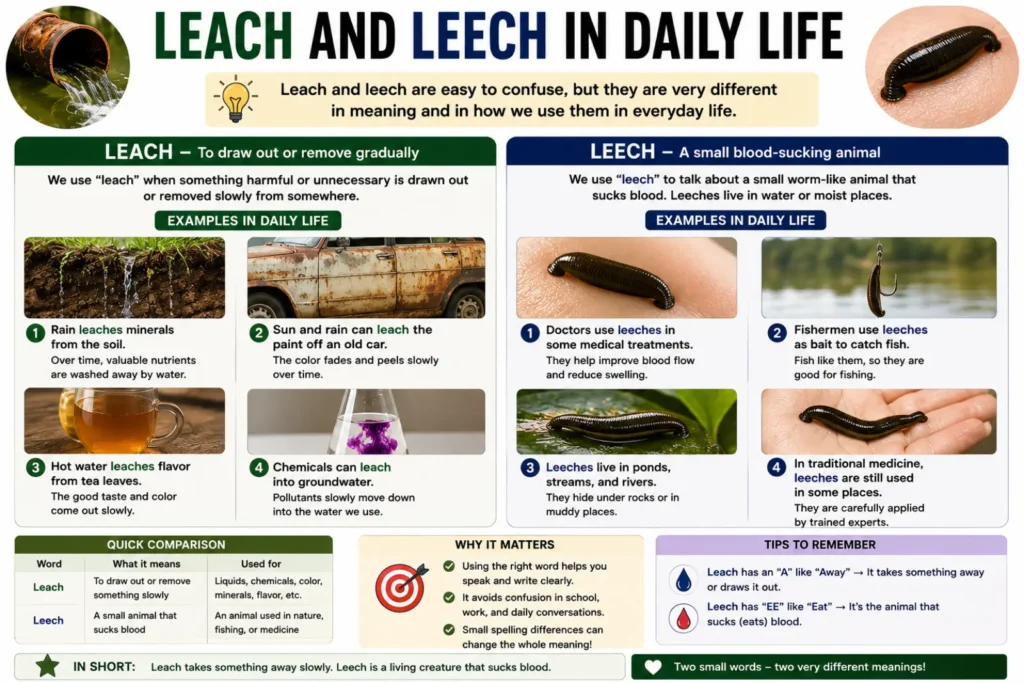
Leach appears in:
- Gardening articles
- Farming guides
- Environmental reports
- Chemistry lessons
- Soil science
- Water pollution discussions
- Waste management
- Groundwater studies
Leech appears in:
- Biology lessons
- Nature guides
- Medical history
- Outdoor stories
- Informal conversations
- Fiction and literature
Understanding the context makes each word easier to recognize.
For example, a gardening article may discuss nutrient leaching. A nature guide may discuss leeches in freshwater habitats.
The topic often gives you the answer.
Leach vs Leech: Synonyms and Related Terms
Knowing related words can improve vocabulary and search understanding.
Words related to leach
Depending on the context, related terms include:
- Remove
- Extract
- Wash out
- Drain
- Dissolve
- Filter through
- Leaching
- Nutrient loss
- Chemical migration
These words do not always mean exactly the same thing. Context still matters.
Words related to leech
Related terms include:
- Blood-feeding worm
- Parasite
- Bloodsucker
- Exploiter
- Freeloader
- Moocher
- User
- Dependent
Some terms can sound rude or insulting. Use them carefully.
Semantic keywords
Search engines may connect leach or leech with terms such as:
- leach meaning
- leech meaning
- leach definition
- leech definition
- leach vs leech
- difference between leach and leech
- leach spelling
- leech spelling
- leaching meaning
- leech animal
- leach into water
- leech off someone
- leech off meaning
These related phrases help explain the topic naturally.
Leach or Leech in Science
Science uses leach in a specific way.
Water can pass through soil and dissolve certain substances. The water then carries those substances deeper into the ground.
Scientists call this leaching.
For example, fertilizer can move through soil after heavy rainfall. This movement can affect water quality and soil nutrients.
Scientists may also study chemicals that leach from waste materials. These chemicals can enter soil or groundwater.
The word therefore has an important role in environmental science.
Key science phrase
Leach into groundwater means a substance moves into groundwater through liquid movement.
For example:
Pollutants may leach into groundwater after heavy rain.
This usage differs completely from leech.
Leech in Biology and Medicine
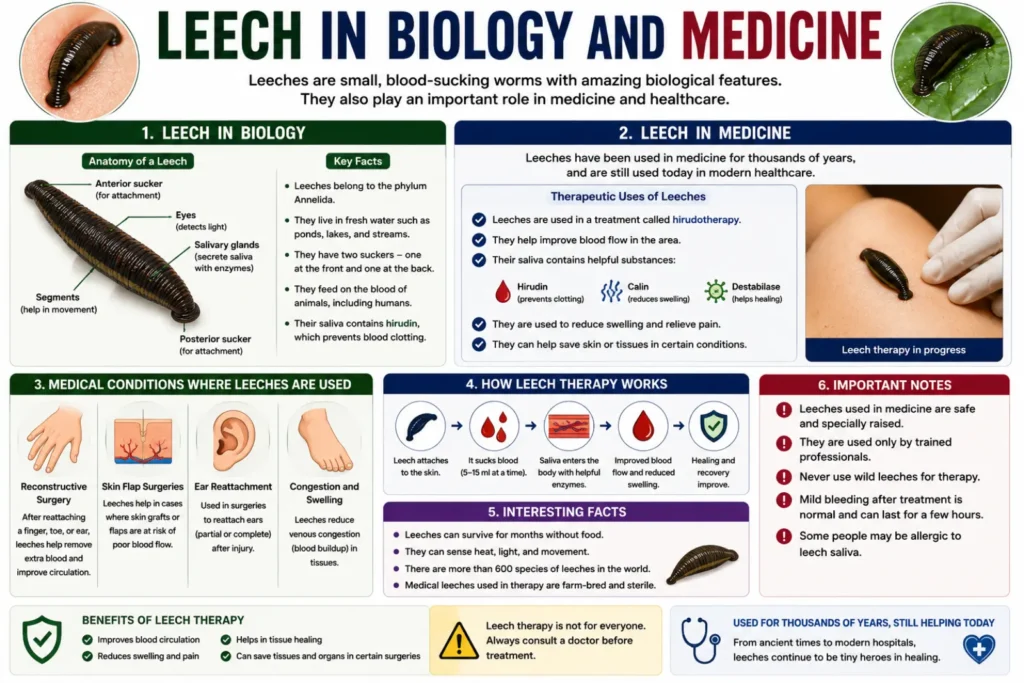
A leech is a type of segmented worm. Many species live in freshwater environments.
Some species feed on blood. Other species have different feeding habits.
Leeches have also had medical uses throughout history. Modern medicine still uses specially raised medicinal leeches in limited clinical situations.
The animal meaning gives us the spelling leech.
This distinction matters because leach does not name an animal.
Therefore:
A leech can live in water.
Not:
A leach can live in water.
Expert Insights: Why the Difference Matters
Clear word choice strengthens professional writing.
The words leach and leech have different meanings. A spelling mistake can change your sentence completely.
This matters most in technical writing.
A science article needs accurate terms. An environmental report needs precise language. A biology lesson also needs correct spelling.
Here are three expert writing tips:
- Check the meaning before checking the spelling.
- Use context to choose between similar words.
- Read the complete sentence after making your choice.
For SEO writers, precise wording also improves content quality. Search engines aim to understand meaning, not just repeated keywords.
Good content answers the reader’s question directly. It also uses related terms naturally.
When Should You Use Leach or Leech?
Use this quick decision guide.
Choose “leach” when:
- Liquid removes something.
- You discuss soil or nutrients.
- Chemicals move into water.
- You discuss environmental processes.
- You describe extraction through liquid.
Choose “leech” when:
- You mean the animal.
- You describe a blood-feeding creature.
- You describe an exploiter.
- You use the phrase “leech off.”
- You describe someone who takes unfairly.
This simple rule covers most everyday situations.
Frequently Asked Questions About Leach or Leech
Is it leach or leech?
Both words are correct, but they have different meanings. Leach describes removal through liquid. Leech means an animal or an exploitative person.
What is the difference between leach and leech?
Leach usually describes a liquid process. Leech usually describes a blood-feeding animal or someone who takes unfair advantage.
Is a leech an animal?
Yes. A leech is a type of segmented worm. Many leeches live in freshwater or damp environments.
What does leach mean in simple English?
Leach means to remove a substance by passing liquid through it.
What does “leech off someone” mean?
It means to depend on someone unfairly while taking their money, help, resources, or effort.
What is an example of leach?
“Rain can leach nutrients from the soil.”
The sentence describes nutrients leaving soil because of water.
What is an example of leech?
“A leech attached itself to the swimmer.”
Here, leech means the animal.
How can I remember leach and leech?
Remember leach = liquid and leech = living creature. This quick association helps prevent spelling mistakes.
SEO Keywords and Search Intent
The main search intent behind leach or leech is informational.
Readers usually want to know which spelling fits their sentence.
Primary keyword:
- leach or leech
Secondary keywords:
- leach vs leech
- difference between leach and leech
- leach meaning
- leech meaning
- leach definition
- leech definition
- leach spelling
- leech spelling
- leech off meaning
- leach into groundwater
Long-tail keywords:
- when to use leach or leech
- is it leach or leech
- what is the difference between leach and leech
- how to remember leach vs leech
- leach or leech in a sentence
- leach vs leech examples
Use these terms naturally. Avoid repeating them in every paragraph.
Conclusion
Leach or leech can look confusing because both words sound similar. Their meanings, however, are very different.
Use leach when liquid removes or carries a substance away. You may see it in gardening, science, farming, and environmental writing.
Use leech for the blood-feeding animal. You can also use it for someone who takes unfair advantage of others.
The easiest memory trick is simple: leach means liquid action, while leech means a creature or exploiter.
Context can also guide your choice. Soil, water, chemicals, and nutrients usually point to leach. Animals, blood, and unfair dependence usually point to leech.
When you know the meaning, the spelling becomes much easier.