Is Islam monotheistic or polytheistic? Islam is strictly monotheistic. Muslims believe in one God, called Allah in Arabic. This belief forms the heart of Islamic faith. Islam teaches that God has no partners, equals, or rivals. Muslims also believe that only God deserves worship.
The Quran repeatedly teaches the oneness of God. This belief is known as Tawhid. Tawhid means affirming that God is one and unique.
Understanding this idea helps explain many Islamic beliefs and practices. It also helps clear up common misunderstandings about Allah, prophets, and worship.
In simple terms, Islam teaches one God and one ultimate Creator. Prophets do not share God’s divine status. Angels also do not receive worship.
This article explains Islamic monotheism in simple language. It also compares monotheism with polytheism and answers common questions.
Quick Summary
- Islam is monotheistic, not polytheistic.
- Muslims believe in one God, known as Allah.
- Muslims believe God has no partners or equals.
- Tawhid means the oneness and uniqueness of God.
- Muslims worship God alone.
- Muhammad is considered a prophet, not a god.
- Jesus is honored as a prophet and Messiah, but not worshiped as God.
- Angels are created beings, not divine beings.
- Associating partners with God is called shirk in Islamic terminology.
- The central Islamic belief is that God alone deserves worship.
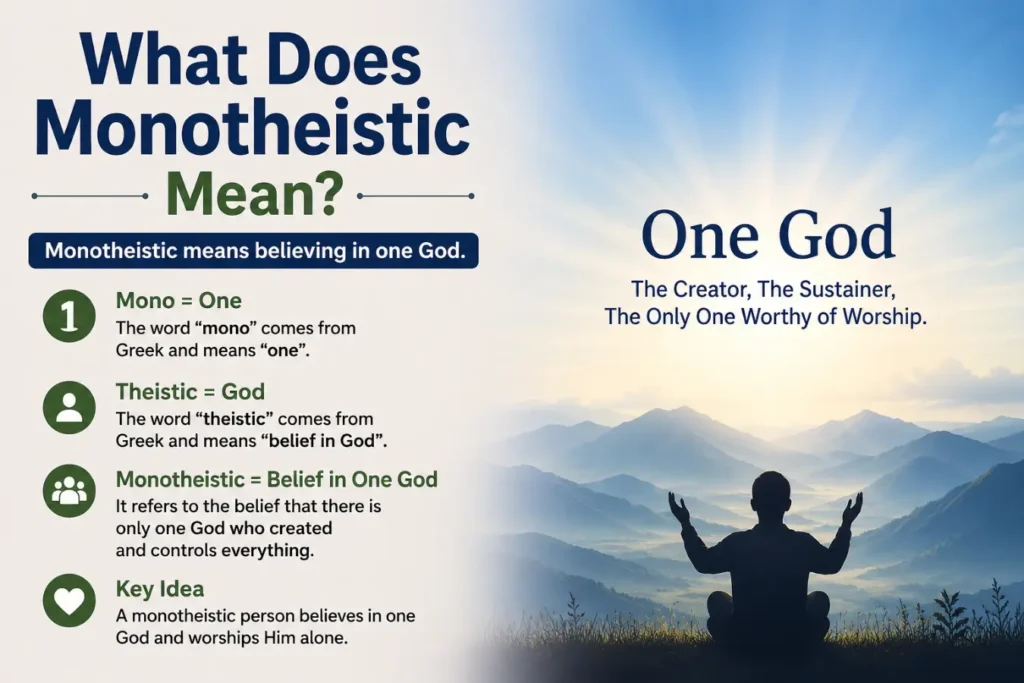
What Does Monotheistic Mean?
Monotheism means belief in one God.
The word comes from two Greek terms. “Mono” means one, while “theism” relates to belief in God.
A monotheistic religion teaches that one God stands above all creation. It does not treat several gods as separate divine beings.
Islam strongly teaches this belief. Muslims believe that Allah created and sustains everything.
This belief affects Islamic worship, prayer, ethics, and daily life.
For Muslims, God is not one god among many gods. God is the only true deity.
What Does Polytheistic Mean?
Polytheism means belief in multiple gods.
A polytheistic religion may recognize several gods or divine beings. Different gods may have different roles or powers.
For example, some ancient religions had separate gods connected with nature, war, wisdom, or fertility.
Islam rejects this idea.
Islam teaches that creation has one ultimate Creator. Therefore, Muslims do not worship multiple gods.
This difference makes Islam clearly monotheistic.
Why Is Islam Considered Monotheistic?
Islam is considered monotheistic because it teaches the worship of one God.
The Quran emphasizes God’s absolute oneness. Surah Al-Ikhlas, Chapter 112, focuses especially on this belief.
The Islamic concept of Tawhid gives this teaching its central place.
Muslims believe God created everything. They also believe God alone controls ultimate matters such as creation and judgment.
Therefore, Islamic worship belongs to God alone.
Muslims may respect prophets, parents, teachers, and other people. However, respect does not make those people divine.
That distinction is important when understanding Islamic belief.
What Is Tawhid in Islam?
Tawhid means affirming the oneness of Allah.
Muslim scholars often explain Tawhid through several related ideas. These explanations help describe God’s uniqueness and authority.
One common framework discusses three areas:
- Oneness of God’s lordship — God alone creates and sustains everything.
- Oneness of worship — Muslims direct worship to God alone.
- Oneness of God’s names and attributes — Muslims affirm God’s revealed names and attributes without making Him like creation.
Different scholars may explain these categories in slightly different ways.
The main idea remains simple.
God is one, unique, and alone worthy of worship.
Is Allah the Same God in Islam?
In Islamic belief, Allah is the one God worshiped by prophets such as Abraham, Moses, and Jesus.
“Allah” is simply the Arabic word used for God. Arabic-speaking Christians also use the word Allah when referring to God.
Islam teaches continuity between earlier prophets and Muhammad.
Muslims believe Abraham was a monotheist. They also believe Moses and Jesus called people toward worship of God.
Islam therefore presents itself as part of the Abrahamic tradition.
The key Islamic claim is that God is one and has no partners.
Do Muslims Believe Muhammad Is God?
No.
Muslims believe Muhammad was a human prophet and messenger of God.
They respect Muhammad and follow his teachings. However, Muslims do not worship him.
This distinction is essential to Islamic theology.
In Islam, prophets communicate God’s message. They do not become gods.
Muhammad is considered the final prophet in Islamic tradition.
Therefore, Islamic devotion to Muhammad does not change Islam’s monotheistic belief.
Do Muslims Worship Jesus?
No.
Muslims deeply respect Jesus, known in Islam as Isa.
Islam teaches that Jesus was a prophet and the Messiah. Muslims also believe in his miraculous birth.
However, Islamic theology does not treat Jesus as God.
Muslims believe worship belongs to God alone.
This point creates an important theological difference between Islam and Christianity.
Christian traditions differ in their teachings about Jesus, while Islam rejects the idea that Jesus is divine.
Islam vs. Polytheism: Key Differences
| Belief | Islam | Polytheism |
|---|---|---|
| Number of gods | One | Multiple |
| Worship | God alone | May involve several gods |
| Creator | One ultimate Creator | May involve multiple divine beings |
| Divine partners | None | May include several gods |
| Islamic term | Tawhid | Shirk refers to associating partners with God |
| Prophets | Human messengers | Some traditions may treat divine beings differently |
| Core idea | God’s absolute oneness | Multiple divine beings |
This table gives a basic comparison. Specific polytheistic traditions have different beliefs, so they should not all be treated alike.
Real-Life Examples of Islamic Monotheism
Islamic monotheism appears in many everyday practices.
1. Daily Prayer
Muslims perform Salah, or formal prayer, toward the Kaaba in Mecca.
They pray to God, not to the Kaaba itself.
The Kaaba serves as the direction of prayer.
2. Personal Supplication
Muslims often make dua, meaning personal supplication.
They ask God for help, forgiveness, guidance, and other needs.
The act of asking God reflects Islamic monotheism.
3. Giving Thanks
Muslims thank God for blessings.
They may also thank other people for their kindness. These actions do not conflict with monotheism.
The ultimate source of creation and blessing remains God.
4. Asking for Forgiveness
Muslims seek God’s forgiveness directly.
They do not need to worship another god to reach God.
This reflects the Islamic emphasis on God’s unique authority.

Common Mistakes About Islamic Monotheism
Several misunderstandings appear in discussions about Islam.
Mistake 1: Thinking Allah Is a Different God
“Allah” is the Arabic word for God.
The term itself does not mean a separate Islamic deity.
Theological beliefs about God can differ between religions. However, Arabic speakers use Allah when referring to God.
Mistake 2: Thinking Muslims Worship Muhammad
Muslims do not worship Muhammad.
They regard him as God’s messenger and final prophet.
Mistake 3: Thinking Muslims Worship the Kaaba
Muslims do not worship the Kaaba.
They face the Kaaba during formal prayer.
The object of worship remains God.
Mistake 4: Thinking Angels Are Gods
Islam describes angels as created beings.
They serve God and follow His commands.
Muslims do not worship angels.
Mistake 5: Assuming Respect Means Worship
Muslims can respect prophets, parents, scholars, and other people.
Respect does not automatically mean worship.
Islam makes a strong distinction between honoring someone and worshiping them.
What Is Shirk in Islam?
Shirk generally means associating partners with God.
It stands in direct opposition to Tawhid.
For example, Islamic theology considers directing worship to another being alongside God a form of shirk.
The concept has a major place in Islamic teachings about faith.
However, specific theological discussions about shirk can become complex.
Different scholars discuss its forms and degrees in different ways.
For a basic understanding, remember one principle:
Tawhid affirms God’s oneness, while shirk contradicts that oneness.
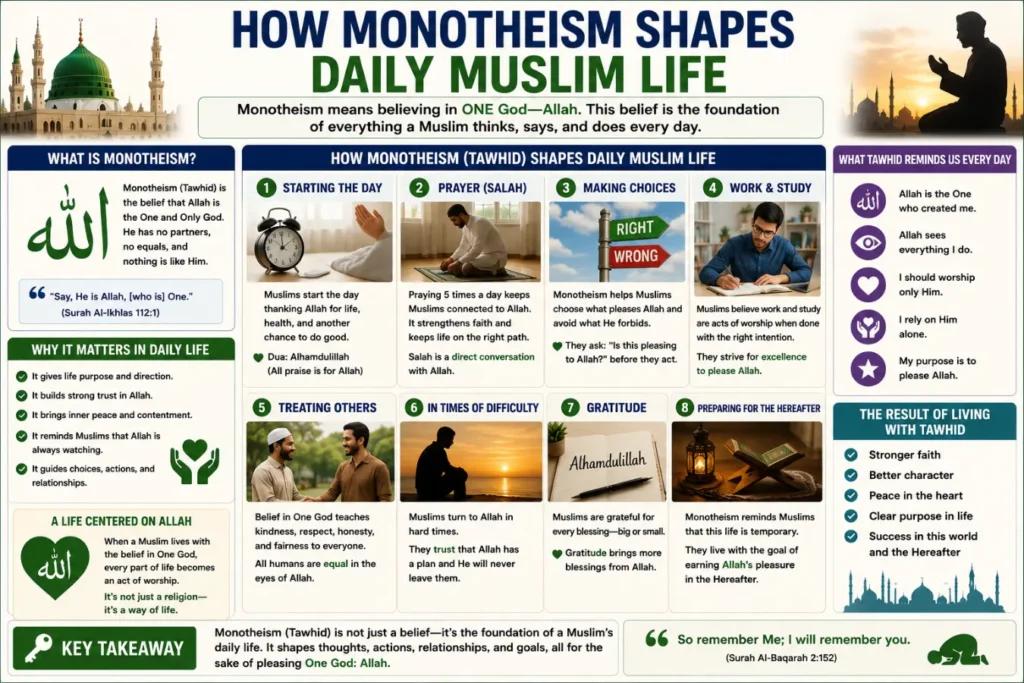
How Monotheism Shapes Daily Muslim Life
Islamic monotheism is more than a theological statement.
It can shape how Muslims understand daily life.
Muslims may connect success, gratitude, hardship, and hope with their relationship with God.
For example, a Muslim might thank God after receiving good news.
A Muslim may also pray for guidance before making an important decision.
During difficult times, prayer can provide spiritual comfort.
Islamic monotheism can therefore influence personal values and behavior.
It encourages Muslims to recognize God as the highest authority in their lives.
Important Islamic Terms and Synonyms
Understanding related terms can make Islamic theology easier to study.
Monotheism
Belief in one God.
Tawhid
The Islamic concept of God’s oneness and uniqueness.
Allah
The Arabic word for God.
Shirk
Associating partners with God.
Ibadah
Worship or acts of devotion directed toward God.
Aqidah
Islamic creed or core matters of belief.
Abrahamic faiths
A broad term often used for Judaism, Christianity, and Islam because of their historical connection with Abraham.
These terms often appear in searches about Islamic monotheism.
Expert Insights: Why This Topic Matters
A useful way to understand Islam is to start with its core belief.
Islamic theology places God’s oneness at the center of faith.
The Quran’s opening chapter and other passages repeatedly direct believers toward God.
The declaration of faith also reflects this principle. It begins by affirming that there is no deity worthy of worship except God.
This idea connects belief with practice.
Prayer, fasting, charity, and other Islamic practices exist within a broader relationship with God.
For accurate religious writing, context also matters.
Islam has many schools of thought and scholarly traditions. Therefore, complex theological questions can have detailed interpretations.
For general readers, however, the central answer remains clear:
Islam teaches monotheism.
Tips for Understanding Islamic Monotheism
Use these simple steps when studying the subject:
- Start with the concept of Tawhid.
- Separate worship from respect.
- Learn what Muslims believe about prophets.
- Understand the meaning of Allah.
- Study the difference between Tawhid and shirk.
- Read reliable translations of Islamic sources.
- Compare religions fairly and avoid broad stereotypes.
- Remember that different Islamic scholars may explain details differently.
These steps can help prevent common misunderstandings.
Frequently Asked Questions
Is Islam monotheistic or polytheistic?
Islam is monotheistic. Muslims believe in one God and worship God alone.
What is the Islamic word for monotheism?
The main Islamic term is Tawhid. It refers to God’s oneness and uniqueness.
Do Muslims believe in more than one god?
No. Muslims believe there is only one God.
Is Allah one God?
Yes. Muslims believe Allah is the one God, the Creator and Sustainer of everything.
Do Muslims worship Muhammad?
No. Muslims believe Muhammad was a prophet and messenger of God. They do not worship him.
Do Muslims worship the Kaaba?
No. Muslims face the Kaaba during prayer, but they worship God alone.
What is shirk?
Shirk means associating partners with God. Islamic teachings strongly reject this concept.
Are angels gods in Islam?
No. Muslims believe angels are created beings who serve God.
Conclusion
Is Islam monotheistic or polytheistic? Islam is firmly monotheistic.
Muslims believe in one God, Allah, who has no partners or equals. This belief is known as Tawhid.
Islam teaches that God alone deserves worship. Prophets remain human messengers, while angels remain created beings.
Muhammad holds an important role in Islam, but Muslims do not worship him. Muslims also honor Jesus as a prophet without considering him divine.
The Kaaba provides a direction for prayer, but Muslims do not worship the Kaaba.
These points help explain why Islam belongs among the world’s major monotheistic religions.