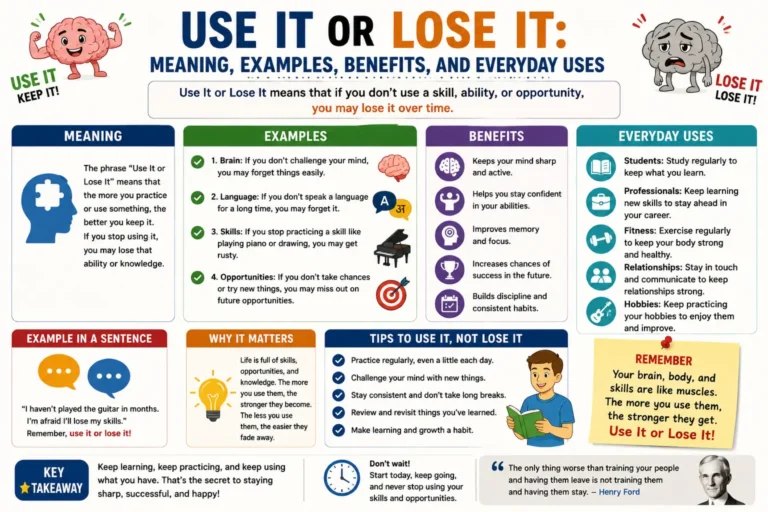
Use it or lose it means that skills, knowledge, strength, or abilities can fade without regular use. This simple phrase applies to many parts of life. You may forget a language if you never speak it. may lose fitness if you stop moving. You may also forget facts when you stop practicing them. The idea encourages regular action and practice. It reminds us that unused skills can become weaker over time. However, this does not mean you lose everything forever. Practice can often help you rebuild a skill. In this guide, you will learn the use it or lose it meaning, real-life examples, common mistakes, and useful tips. You will also see how this phrase applies to learning, fitness, memory, work, and daily life.
Quick Summary
- Use it or lose it means unused skills or abilities may become weaker.
- Regular practice helps keep skills fresh and useful.
- The phrase applies to memory, fitness, language, work, and hobbies.
- Small amounts of practice can make a big difference.
- You can often rebuild a skill after a long break.
- Consistency matters more than long practice sessions.
- The phrase encourages action instead of neglect.
What Does “Use It or Lose It” Mean?
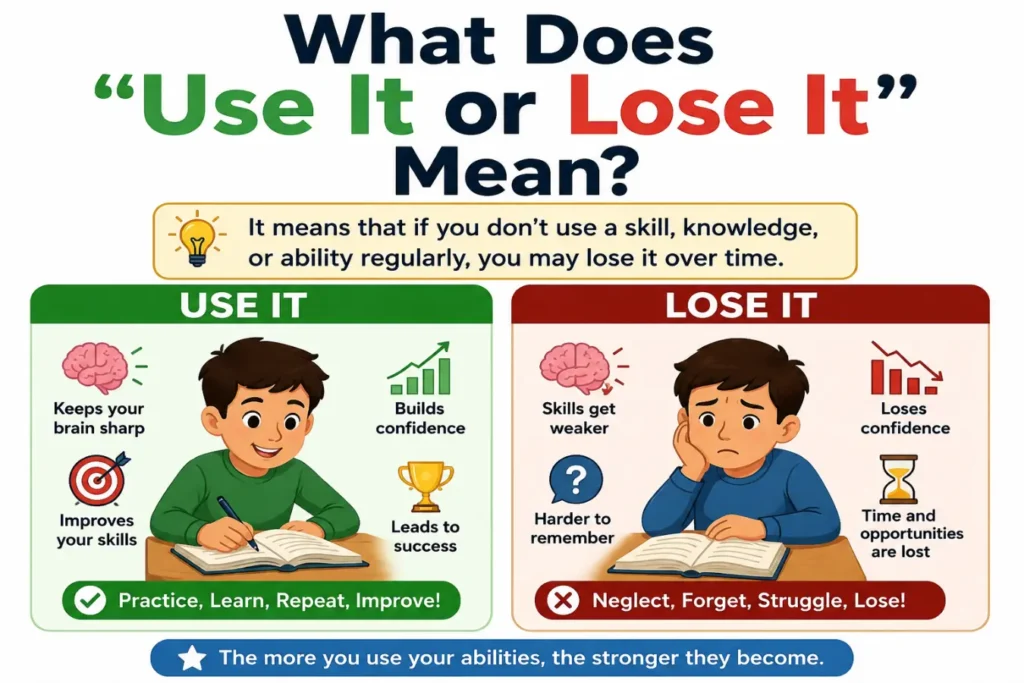
The use it or lose it meaning is simple.
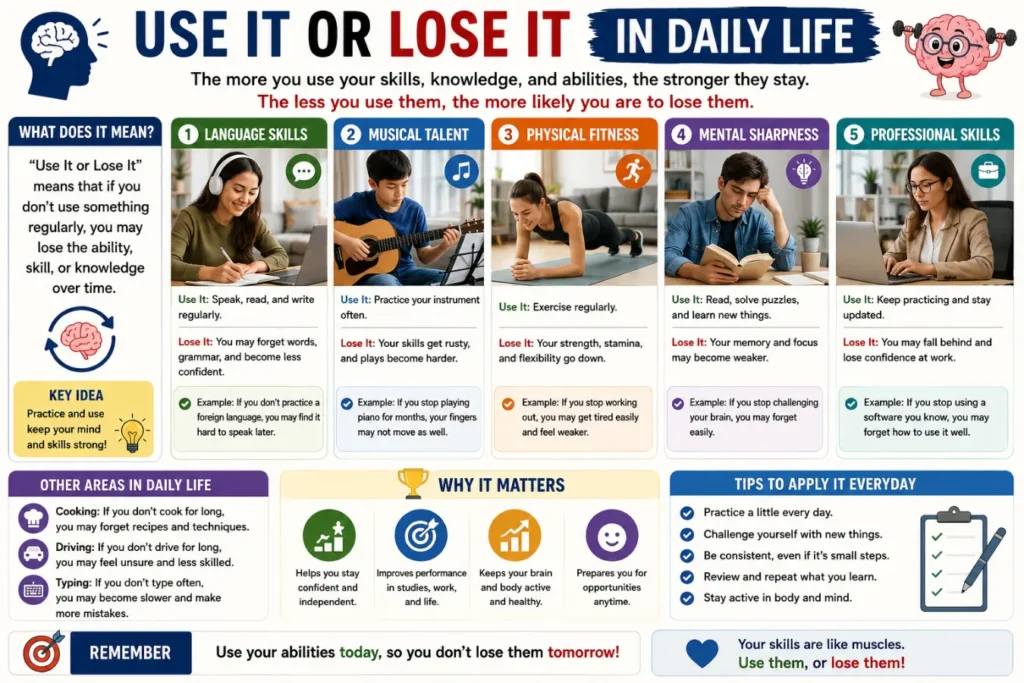
It suggests that abilities may weaken when we do not use them regularly.
The phrase often describes skills, knowledge, memory, strength, or physical ability. It can also describe opportunities or resources in some situations.
For example, imagine learning Spanish at school. You become good at basic conversations after months of practice. Then you stop using Spanish for several years.
You may forget many words. Speaking may also feel harder.
This example shows the basic idea behind use it or lose it.
The phrase does not always mean permanent loss. Many skills can return with practice.
Use It or Lose It Explained in Simple Words
Think of a skill like a path through a forest.
The more often you walk the path, the easier it becomes to follow. If you stop using it, plants may cover parts of the path.
Your brain works in a similar way with learned information.
Regular practice keeps important skills active. Lack of practice can make those skills harder to access.
This idea appears in education, sports, music, language learning, and many other areas.
For example:
- Reading often can support reading skills.
- Speaking a language keeps vocabulary active.
- Playing an instrument keeps techniques familiar.
- Exercise helps maintain physical fitness.
- Solving problems keeps certain thinking skills active.
The key message remains simple: regular use helps maintain ability.
Where Did the Phrase “Use It or Lose It” Come From?
“Use it or lose it” is an old English expression.
People commonly use it to describe the need for continued practice or activity.
The phrase became especially common when discussing physical fitness and mental ability. Today, people use it in many different situations.
You may hear it at school, work, the gym, or during conversations about hobbies.
The phrase works well because it communicates a complex idea in only four words.
It also creates a strong reminder to stay active.
Real-Life Examples of Use It or Lose It
The phrase becomes easier to understand through everyday examples.
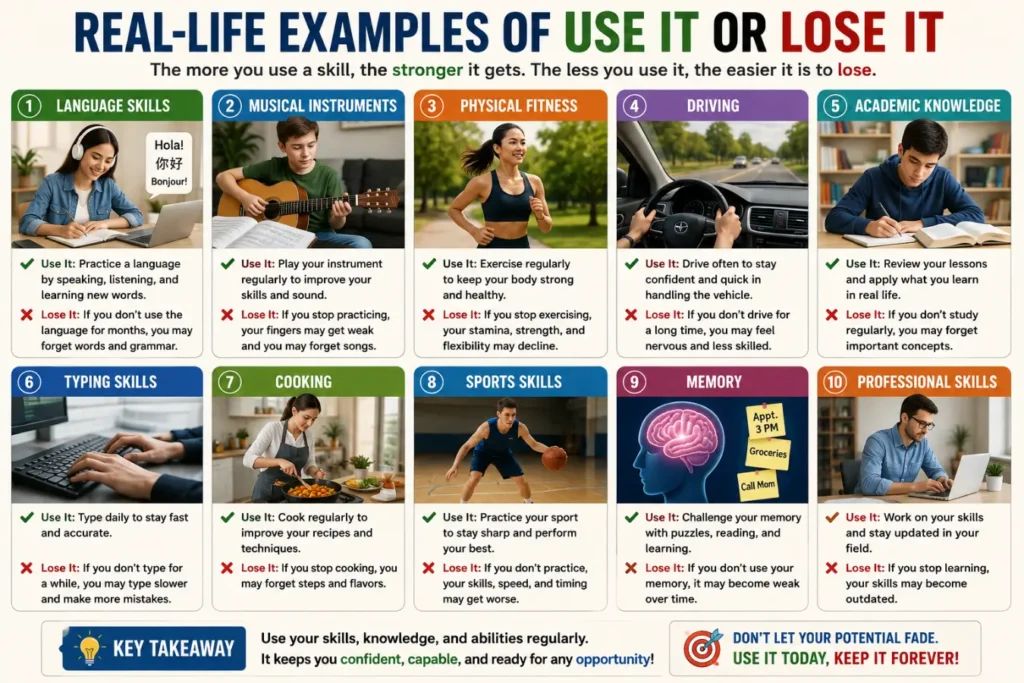
1. Learning a Language
You study French for two years. Then you stop speaking it.
After a long break, you may struggle to remember words.
Regular conversation can help keep your language skills active.
2. Playing Music
You learn to play the guitar.
You practice several times each week and improve steadily. Later, you stop playing for months.
When you return, some chords may feel less natural.
Practice can help restore your confidence.
3. Physical Fitness
You exercise regularly for several months.
Then you stop being active for a long period. Your strength and endurance may decline.
Gradually returning to activity can help you rebuild fitness.
4. School Subjects
You learn multiplication tables in school.
If you rarely use them, quick recall may become slower.
Regular practice can make those facts easier to remember again.
5. Public Speaking
You regularly speak in front of groups.
Over time, you become more comfortable.
If you stop speaking publicly for years, you may feel nervous again.
Small speaking opportunities can help maintain confidence.
Use It or Lose It in Learning and Memory
Learning is one of the most common areas where this phrase applies.
Your brain constantly processes and stores information. Practice gives you chances to retrieve and use what you learned.
This explains why repetition matters.
For example, reading a new word once may not create strong recall. Using that word several times gives you more opportunities to remember it.
Active recall can also help.
Instead of only reading your notes, try answering questions without looking at them.
You can also explain a topic to someone else. Teaching forces you to retrieve and organize information.
These methods make learning more active.
Use It or Lose It in Fitness
Fitness provides another clear example.
Muscles and physical abilities respond to regular activity. When activity decreases for a long time, fitness can decline.
However, the answer does not require extreme workouts.
Simple activities can help you stay active.
Walking, cycling, playing a sport, stretching, or doing age-appropriate exercises can add movement to your routine.
The important point is consistency.
If you take a long break, return gradually. Your body may need time to adjust.
Avoid trying to regain lost fitness too quickly.
Use It or Lose It in Work and Career Skills
The phrase also applies to professional skills.
Technology changes quickly. Workplace tools and methods can change too.
A skill you used every day may become less familiar after a long break.
For example, a designer may stop using a certain software program. Returning to it later may require some practice.
The same can happen with writing, coding, public speaking, research, or data analysis.
Regular practice can help keep valuable skills fresh.
You do not always need a large project.
A short practice task can provide useful repetition.
Use It or Lose It in Daily Life
You can apply this idea without changing your entire routine.
Look at skills you want to maintain.
Maybe you enjoy drawing. Perhaps you speak another language. You may play chess or cook certain dishes.
Try using those skills regularly.
Even short sessions can create useful practice.
For example, you could:
- Read for 15 minutes.
- Practice a language during a conversation.
- Solve a few puzzles.
- Play an instrument.
- Write a short paragraph.
- Practice a useful school skill.
- Take part in a favorite sport.
Small habits can keep important abilities active.
Use It or Lose It vs. “Practice Makes Perfect”
These phrases sound similar, but they have different meanings.
| Phrase | Main idea | Example |
|---|---|---|
| Use it or lose it | Unused abilities may weaken | Speak a language regularly |
| Practice makes perfect | Repeated practice can improve performance | Practice piano regularly |
| Keep at it | Continue despite difficulty | Keep studying a hard topic |
| Use it regularly | Frequent use helps maintain familiarity | Use a skill every week |
“Use it or lose it” focuses more on maintaining a skill.
“Practice makes perfect” focuses more on improving a skill through practice.
Both ideas support consistent action.
Common Mistakes People Make
People often misunderstand the phrase.
Here are some common mistakes.
Mistake 1: Thinking You Must Practice Every Day
Daily practice can help, but it is not always necessary.
A realistic schedule often works better.
Mistake 2: Practicing for Too Long
Long sessions can become tiring.
Short, focused practice may feel easier to maintain.
Mistake 3: Expecting Instant Results
Skills may return gradually after a long break.
Give yourself time to rebuild confidence.
Mistake 4: Avoiding a Skill After Losing Progress
A setback does not mean the skill is gone forever.
Start again with simple tasks.
Mistake 5: Practicing Without Purpose
Practice works better when you know what you want to improve.
Choose a clear goal before you begin.
Tips for Putting “Use It or Lose It” Into Practice
You can turn the idea into a simple habit.
Set a Small Goal
Choose one skill you want to maintain.
For example, practice a language for ten minutes three times each week.
Create a Routine
Attach practice to something you already do.
You could read after breakfast or practice music after school.
Use Active Practice
Do not only watch or read.
Try performing the skill yourself.
Track Your Progress
A simple calendar can show your practice pattern.
Seeing progress can also keep you motivated.
Make Practice Enjoyable
Choose activities you actually enjoy.
Enjoyable habits are easier to maintain.
Start Small After a Break
Do not expect your old ability to return immediately.
Begin with simple tasks and increase difficulty over time.
Synonyms and LSI Keywords for “Use It or Lose It”
Several related phrases can support the topic.
Useful semantic keywords include:
- use it or lose it meaning
- use it or lose it phrase
- use it or lose it definition
- use it or lose it examples
- skills fade without practice
- practice and repetition
- maintaining skills
- memory and learning
- regular practice
- skill retention
- keeping skills sharp
- learning through repetition
- maintaining physical fitness
- improving memory
- brain training
- consistent practice
These terms help explain the topic naturally without repeating the main keyword too often.
Expert Insights: Why the Idea Matters
The biggest lesson is not that every unused skill disappears.
Human abilities can change with practice, experience, and time.
Regular use gives you more opportunities to maintain familiarity and performance.
Experts in learning often emphasize retrieval, repetition, and practical use. These approaches make information easier to access later.
The same principle applies to many physical skills.
However, individual results vary.
Some abilities may return quickly after a break. Others may require more practice.
That makes one point especially important: do not confuse a temporary struggle with permanent loss.
If a skill feels rusty, practice can help.
How to Use “Use It or Lose It” in a Sentence
You can use the phrase in casual and professional writing.
Here are some examples:
- “I need to keep practicing Spanish. Use it or lose it.”
- “Regular reading helps maintain strong reading habits.”
- “He returned to the piano after years away. It really is use it or lose it.”
- “I still practice coding because I believe in the use it or lose it idea.”
- “She keeps playing tennis to maintain her skills.”
The phrase usually works best in informal conversation.
It can also appear in articles, speeches, and educational content.
Frequently Asked Questions
What does “use it or lose it” mean?
It means that a skill or ability may become weaker when you stop using it regularly.
Is “use it or lose it” a real rule?
No. It is an expression, not a strict scientific rule.
Skills respond differently to practice, breaks, age, and other factors.
What is an example of “use it or lose it”?
A person may forget vocabulary after stopping a language for several years.
Regular speaking can help maintain that skill.
Does “use it or lose it” apply to memory?
Yes. Regularly recalling and using information can help keep it accessible.
However, memory changes for many reasons.
Does “use it or lose it” apply to fitness?
Yes. Long periods of inactivity can reduce fitness.
Gradual, regular activity can help maintain physical abilities.
Can you regain a skill after losing it?
Often, yes.
Previous experience can make relearning easier, although the time needed varies.
How often should you practice a skill?
It depends on the skill and your goal.
A realistic schedule that you can maintain usually works better than occasional long sessions.
What is the opposite idea of “use it or lose it”?
A related idea is “practice makes perfect.”
That phrase focuses more on improving skills through repeated practice.”
Conclusion
Use it or lose it is a simple phrase with a useful message. Skills often need regular use to stay fresh and familiar.
This idea applies to learning, memory, fitness, hobbies, languages, and work skills.
You do not need to practice for hours. Small, regular actions can help you stay connected to important skills.
A long break does not always mean permanent loss. You can often rebuild an ability through patient practice.
The best approach is simple. Choose a skill that matters to you. Use it regularly. Start small and stay consistent.
In the end, the use it or lose it idea is less about fear and more about action.