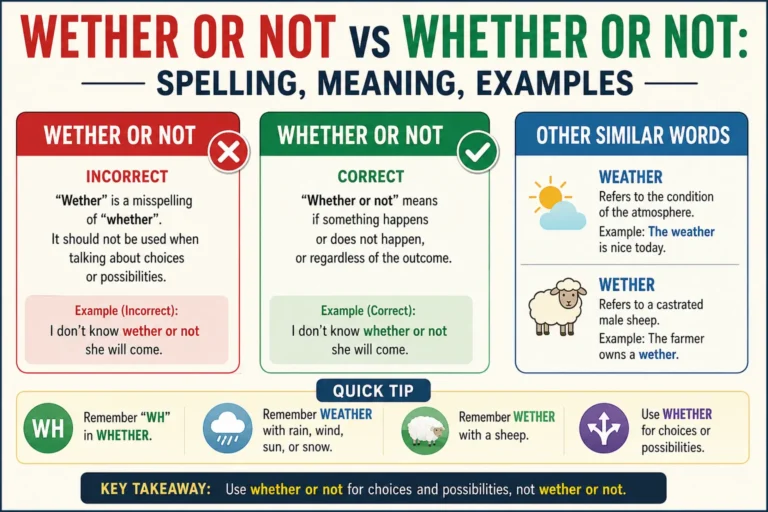
Wether or not is a common spelling mistake for the phrase “whether or not.” The correct phrase is whether or not. It means “if something happens or does not happen” or “regardless of whether something happens.” Many people confuse whether, weather, and wether because they sound alike. However, these words have different meanings and uses. In this guide, you will learn the difference between wether or not and whether or not. You will also see simple examples, common mistakes, grammar tips, and everyday uses. By the end, you will know exactly which phrase to use in writing and speech. This guide also explains when to use whether, weather, and wether. So, if you searched for wether or not, you are in the right place.
Quick Summary
- Whether or not is the correct spelling.
- Wether or not is a common spelling error.
- Whether introduces two possible choices or conditions.
- Weather means outdoor conditions like rain or sunshine.
- Wether means a castrated male sheep.
- Use whether or not when discussing possibilities or choices.
- Example: I do not know whether or not she will come.
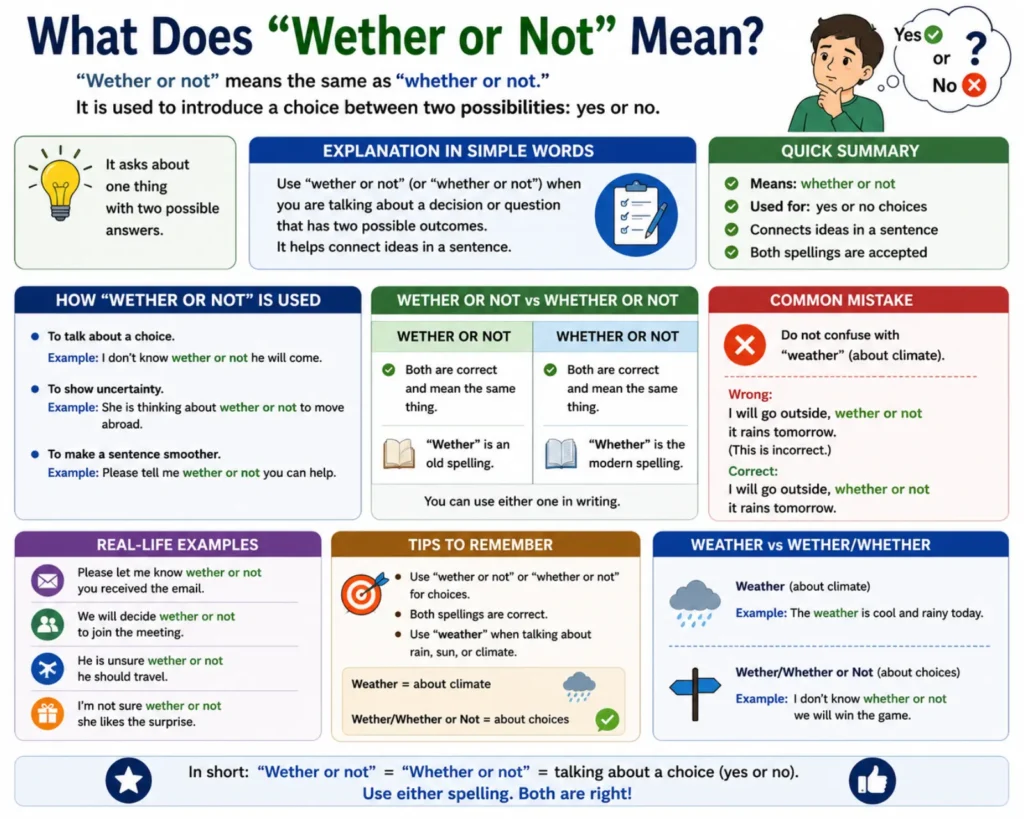
What Does “Wether or Not” Mean?
“Wether or not” is usually a misspelling of “whether or not.”
The phrase whether or not talks about two possibilities. It shows that something may happen or may not happen.
For example:
I will go whether or not it rains.
This means:
I will go if it rains, and I will also go if it does not rain.
The word wether has a different meaning. It refers to a male sheep that has been castrated.
Therefore, you should not use wether or not when you mean whether or not.
What Is the Correct Spelling?
The correct spelling is:
Whether or not
Here is the correct sentence:
I do not know whether or not he will attend.
Here is the incorrect version:
I do not know wether or not he will attend.
The incorrect version uses wether instead of whether.
Always remember the extra h in whether.
Whether or Not Meaning in Simple English
Whether or not means “if something is true or not” or “regardless of what happens.”
Consider this example:
We will continue whether or not they agree.
This means the action will continue in both situations.
They may agree.
They may not agree.
The decision remains the same.
Another example is:
Tell me whether or not you need help.
This means:
Tell me if you need help or if you do not need help.
So, whether or not often presents two possible outcomes.
Whether vs Weather vs Wether
These three words sound similar. However, their meanings differ.
| Word | Meaning | Example |
|---|---|---|
| Whether | Shows a choice or possibility | I wonder whether she will come. |
| Weather | Outdoor conditions | The weather is sunny today. |
| Wether | A castrated male sheep | The farmer owns a wether. |
The easiest way to remember them is simple.
Whether relates to choices.
Weather relates to rain, wind, and sunshine.
Wether relates to sheep.
Whether or Not vs Weather or Not
Many people also write weather or not by mistake.
The phrase weather or not is usually incorrect when you mean whether or not.
For example:
❌ I do not know weather or not he will come.
✅ I do not know whether or not he will come.
However, weather can appear in a sentence with whether.
For example:
I do not know whether the weather will improve.
This sentence uses both words correctly.
Here, whether introduces uncertainty.
Weather refers to outdoor conditions.
Whether or Not vs Wether or Not: Comparison
| Phrase | Correct? | Meaning |
|---|---|---|
| Whether or not | Yes | A possibility or choice |
| Wether or not | Usually no | A spelling mistake |
| Weather or not | Usually no | A spelling mistake |
| Whether | Yes | Shows alternatives or uncertainty |
| Weather | Yes | Outdoor conditions |
| Wether | Yes | A male sheep |
The correct phrase depends on your meaning.
If you discuss a choice, use whether.
If you discuss rain or sunshine, use weather.
If you discuss a sheep, use wether.
How to Use “Whether or Not” in a Sentence
You can use whether or not in several ways.
1. To Show Two Possibilities
I do not know whether or not she will attend.
This sentence presents two possibilities.
She may attend.
She may not attend.
2. To Show That Something Will Happen Anyway
I will finish the project whether or not you help me.
The speaker will finish the project in both situations.
3. To Ask About a Choice
Please tell me whether or not you agree.
The speaker wants a clear answer.
4. To Show Uncertainty
We need to decide whether or not this plan will work.
The speaker does not know the final result.
Whether or Not Examples
Here are simple examples for everyday writing.
- I will call you whether or not I arrive early.
- She will attend whether or not her friends come.
- We need to decide whether or not to continue.
- He asked whether or not the store was open.
- Tell me whether or not you need assistance.
- I cannot decide whether or not to buy it.
- They will play whether or not the weather changes.
- We will travel whether or not it rains.
- She wondered whether or not he knew the truth.
- The team will continue whether or not they win.
Each sentence uses whether or not correctly.
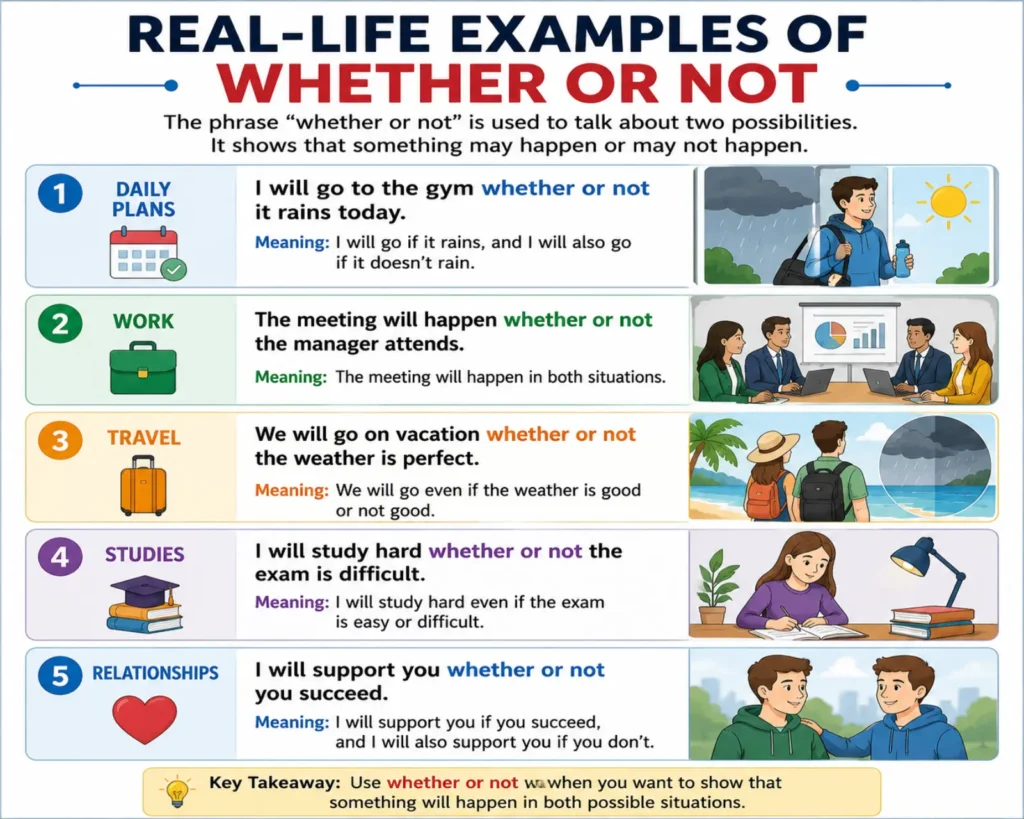
Real-Life Examples of Whether or Not
Example 1: School
I will complete my homework whether or not my friends finish theirs.
The speaker will complete the work regardless of others.
Example 2: Work
The meeting will happen whether or not the manager attends.
The meeting will happen in both situations.
Example 3: Travel
We will go on the trip whether or not it rains.
The weather will not change the decision.
Example 4: Shopping
I cannot decide whether or not to buy this phone.
The speaker feels unsure about the purchase.
Example 5: Daily Conversation
Let me know whether or not you are coming.
The speaker wants confirmation.
Common Mistakes With “Whether or Not”
Many writers make mistakes with this phrase.
Mistake 1: Writing “Wether or Not”
❌ I do not know wether or not he is coming.
✅ I do not know whether or not he is coming.
Wether refers to a sheep.
It does not express a choice or possibility.
Mistake 2: Writing “Weather or Not”
❌ I will go weather or not it rains.
✅ I will go whether or not it rains.
Weather refers to atmospheric conditions.
It does not mean “if.”
Mistake 3: Confusing “Whether” With “If”
Sometimes, whether and if have similar meanings.
For example:
I do not know whether he will come.
You can also say:
I do not know if he will come.
However, whether works better when you clearly discuss two possibilities.
Mistake 4: Forgetting the Second Option
The phrase whether or not clearly shows two possibilities.
For example:
I do not know whether she will come or not.
This sentence is clear.
However, many sentences can simply use whether.
For example:
I do not know whether she will come.
The meaning remains clear from the context.
Whether or Not vs Whether
Both forms can be correct.
Whether
I do not know whether he will come.
Whether or Not
I do not know whether or not he will come.
The second version emphasizes both possibilities.
The first version sounds shorter and more natural in many situations.
Use whether or not when you want to clearly highlight the two possible outcomes.
Is “Whether or Not” Grammatically Correct?
Yes, whether or not is grammatically correct.
It is a standard English phrase.
You can use it in:
- Formal writing
- Academic writing
- Business writing
- Everyday conversation
- Emails
- Articles
- Reports
For example:
The decision will remain the same whether or not the customer agrees.
This sentence is grammatically correct.
Can You Start a Sentence With “Whether or Not”?
Yes, you can start a sentence with whether or not.
For example:
Whether or not you agree, the rules still apply.
This sentence means the rules apply in both situations.
Another example is:
Whether or not she attends, the event will continue.
Starting with this phrase can make your writing sound clear and direct.
Whether or Not in Daily Life
People use whether or not every day.
You may use it when discussing:
- Plans
- Decisions
- Work
- School
- Travel
- Relationships
- Shopping
- Business
- Weather-related choices
For example:
I will go whether or not the weather is good.
Notice the difference.
Whether introduces the choice.
Weather describes outdoor conditions.
Both words can appear in the same sentence.
Synonyms and Related Keywords
Several phrases have similar meanings to whether or not.
These include:
- If or not
- Regardless of whether
- No matter whether
- In either case
- Either way
- Regardless
- If
- Whether
For example:
I will attend whether or not you come.
You can also say:
I will attend regardless of whether you come.
Or:
I will attend either way.
The best choice depends on the sentence.
Expert Insights
Correct word choice improves your writing.
A spelling mistake can change the meaning of a sentence.
For example:
I will go whether or not it rains.
This sentence correctly describes a choice.
But:
I will go wether or not it rains.
The word wether refers to a sheep.
Therefore, the sentence contains a spelling mistake.
Professional writers should always check commonly confused words.
Tools can help find spelling errors.
However, context still matters.
A spell checker may not catch every mistake.
For example, wether is a real English word.
Therefore, software may not always mark it as incorrect.
Human review remains important.
Tips to Remember the Correct Spelling
Use these simple memory tricks.
Tip 1: Remember “WH” in Whether
The correct word contains wh:
whether
Tip 2: Connect Weather With Nature
Weather means rain, wind, sunshine, or snow.
Tip 3: Connect Wether With Sheep
A wether is a type of male sheep.
Tip 4: Use “Whether” for Choices
If your sentence discusses two possible outcomes, choose whether.
For example:
I do not know whether to stay or leave.
Tip 5: Check the Sentence Meaning
Ask yourself:
Am I talking about a choice?
If yes, you probably need whether.
Am I talking about outdoor conditions?
If yes, you probably need weather.
Am I talking about a sheep?
If yes, you may need wether.
Frequently Asked Questions
Is “wether or not” correct?
Usually, no. Wether or not is normally a misspelling of whether or not.
What is the correct phrase, “whether or not” or “wether or not”?
The correct phrase is whether or not.
What does “whether or not” mean?
It means if something happens or does not happen. It can also mean regardless of whether something happens.
Is “weather or not” correct?
Usually, no. Use whether or not when you mean a choice or possibility.
What does “wether” mean?
A wether is a castrated male sheep.
What does “weather” mean?
Weather describes outdoor conditions. Examples include rain, wind, snow, and sunshine.
Can I use “whether” instead of “whether or not”?
Yes. In many sentences, whether alone works correctly.
Example:
I do not know whether she will come.
Which is better for formal writing?
Both whether and whether or not can work. Choose the phrase that best fits your sentence.
Conclusion
Wether or not is usually an incorrect spelling of whether or not. The correct phrase is whether or not. It describes two possibilities or situations. It can also mean that something will happen regardless of the result. The word weather refers to outdoor conditions. The word wether refers to a male sheep. These words sound similar, but their meanings differ. Remember this simple rule: use whether for choices, weather for nature, and wether for sheep. If you searched for wether or not, the correct spelling you need is whether or not. Use the correct phrase in your writing for clearer, more professional English.