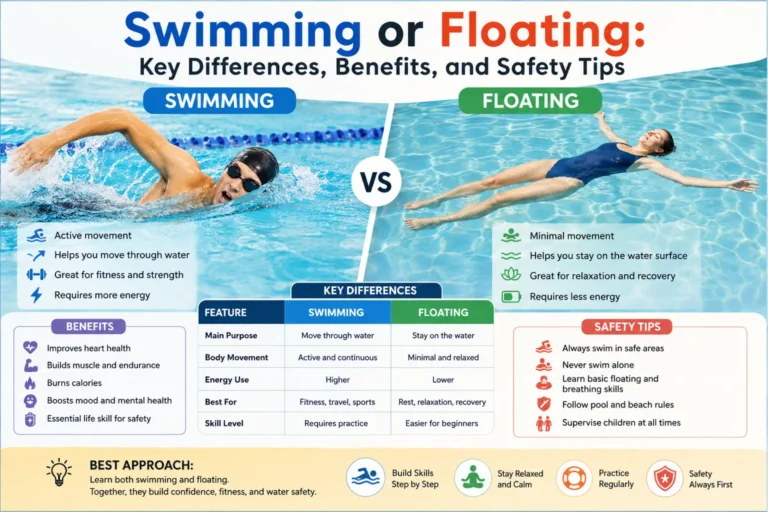
Swimming or floating are two different ways to move and stay in water. Swimming helps you move from one place to another. Floating helps you stay on the water’s surface with little effort. Both skills matter for fun, fitness, and water safety. However, they serve different purposes.
Many beginners wonder which skill they should learn first. The answer depends on your goal. You may want to relax, exercise, learn water safety, or travel in water. This guide explains swimming and floating in simple terms. You will learn their main differences, benefits, uses, common mistakes, and safety tips. You will also discover which skill beginners should learn first. By the end, you will understand when swimming or floating works best.
Quick Summary
- Swimming means moving through water with your body and limbs.
- Floating means staying on the water’s surface without sinking.
- Swimming requires more active body movement.
- Floating usually requires less energy.
- Floating can help beginners feel comfortable in water.
- Swimming offers stronger exercise benefits.
- Both skills support water safety.
- Beginners should learn basic floating and breathing skills first.
- Swimming works best when you need to travel through water.
- Floating works best when you need to rest or stay calm.
What Is Swimming?
Swimming means moving through water using your arms, legs, and body. Different swimming strokes create different movement patterns. Common strokes include freestyle, breaststroke, backstroke, and butterfly.
Swimmers use coordinated movements to push water backward. This action moves the body forward. Good swimming also requires proper breathing and body position.
Swimming can serve many purposes. People swim for exercise, sports, recreation, and safety. Some people also swim competitively.
A beginner may start with simple arm and leg movements. Later, they can learn formal swimming strokes.
What Is Floating?
Floating means staying on the surface of water without sinking. The body stays supported by the water.
Your body naturally floats because water pushes upward. This force helps support your weight. However, body position and breathing can affect floating.
Many people float on their back. This position helps them rest while staying above water. Some people also float face down while practicing swimming skills.
Floating does not usually require strong movement. Instead, relaxation plays an important role. Tensing your body can make floating more difficult.
Swimming or Floating: What Is the Difference?
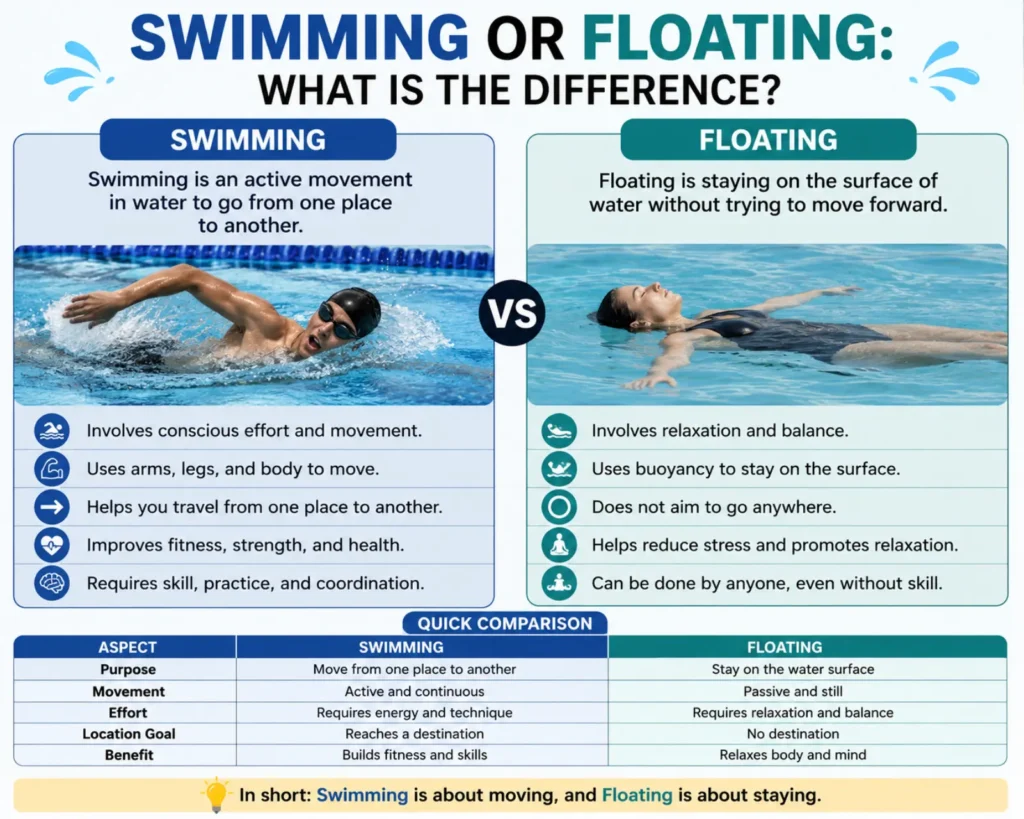
The main difference involves movement.
Swimming helps you move through water. Floating helps you remain in one place.
Swimming requires active body movement. You use your arms, legs, and core muscles. Floating needs little movement once your body finds balance.
Swimming also uses more energy. Floating usually helps conserve energy.
Here is a simple comparison:
| Feature | Swimming | Floating |
|---|---|---|
| Main purpose | Move through water | Stay on the water |
| Energy use | Higher | Lower |
| Body movement | Active | Limited |
| Skill level | Often requires practice | Usually easier to learn |
| Exercise value | High | Low to moderate |
| Water safety | Helps with movement | Helps with rest |
| Best for | Fitness and travel | Relaxation and recovery |
Both skills have value. The best choice depends on your situation.
How Does Swimming Work?
Swimming works through coordinated movement and water resistance.
arms pull or push water. legs create additional force. body position helps reduce resistance.
Good technique helps you move efficiently. Poor technique can make swimming tiring.
Breathing also matters. Swimmers must learn when to breathe. They must also keep their body relaxed.
Different strokes create different movement styles. Freestyle often provides fast forward movement. Breaststroke uses a wider arm and leg pattern.
Beginners should focus on basic skills first. These skills include breathing, kicking, balance, and body position.
How Does Floating Work?
Floating depends on buoyancy and body balance.
Water creates an upward force against your body. This force can support much of your weight.
Your lungs also help your body stay buoyant. Taking a calm breath can improve your floating position.
Relaxation makes a major difference. A relaxed body often floats more easily. A tense body may sink lower in the water.
Your body composition also affects floating. However, everyone can learn better water balance with practice.
Back floating is often a useful beginner skill. It allows you to rest while keeping your face above the water.
Swimming or Floating: Which Is Better for Beginners?
For most beginners, floating is a useful first skill.
Floating helps you understand how water supports your body. It also builds confidence.
Beginners can then learn basic kicking and arm movements. These skills gradually lead to swimming.
However, floating does not replace swimming lessons. A person who can float may still struggle to move safely.
The best learning path combines both skills.
Start with:
- Water comfort
- Breathing practice
- Floating
- Kicking
- Arm movements
- Basic swimming strokes
This step-by-step approach can make learning easier.
Swimming vs Floating for Exercise
Swimming provides a stronger workout than floating.
uses several major muscle groups. These include the shoulders, arms, legs, back, and core.
Regular swimming can also improve cardiovascular fitness. It may support strength, endurance, and overall physical activity.
Floating provides gentle movement and relaxation. It can help reduce physical strain.
Some people use floating during recovery or relaxation sessions. However, it usually burns less energy than active swimming.
Therefore, choose swimming for a more active workout. Choose floating for rest and gentle water relaxation.
Swimming vs Floating for Water Safety
Both skills can support water safety.
Swimming helps you move toward safety. You may need to reach the pool edge or another safe area.
Floating helps you rest. It can help conserve energy while you wait for assistance.
This makes floating an important survival skill. However, floating alone does not guarantee safety.
Water conditions can change quickly. Strong currents, waves, and cold water create additional risks.
People should always follow local water safety rules. Children should receive close supervision around water.
Learning both skills provides better preparation than learning only one.
Real-Life Examples of Swimming or Floating
Example 1: A Beginner in a Pool
A beginner enters shallow water. They feel nervous and tense.
Learning to float can help them relax. After that, they can practice kicking.
Over time, they may begin swimming short distances.
Example 2: A Person Exercising
Someone wants a full-body workout. They choose swimming.
They swim several laps using different strokes. This activity requires constant movement.
Floating would provide less active exercise.
Example 3: A Person Resting in Water
A swimmer becomes tired. They stop moving and float on their back.
This action helps them rest. They can then decide what to do next.
Example 4: A Person Learning Water Safety
A beginner learns to float first. They then practice moving toward the pool edge.
These skills work together. Floating provides rest, while swimming provides movement.
Common Mistakes When Learning to Float
1. Holding Your Body Too Tightly
Many beginners tense their muscles. This can make floating harder.
Try to relax your shoulders and body.
2. Lifting Your Head Too High
Lifting your head can lower your hips. This may make your body position less comfortable.
Keep your head relaxed.
3. Panicking When Water Touches Your Face
Many beginners fear water near their face. Calm breathing can help.
Practice slowly in a safe environment.
4. Trying to Move Too Much
Floating requires balance. Too much movement can disturb your position.
Use small movements when needed.
5. Practicing Without Supervision
Beginners should practice in safe areas. A qualified instructor can provide helpful guidance.
Common Mistakes When Learning to Swim
1. Moving Too Fast
Beginners often try to swim quickly. Speed can create poor technique.
Focus on controlled movements first.
2. Forgetting to Breathe Properly
Poor breathing can make swimming tiring.
Practice breathing separately when possible.
3. Keeping the Body Too Stiff
A stiff body increases effort.
Try to stay relaxed while maintaining control.
4. Using Only the Arms
Swimming requires coordinated movement.
Your legs and body position also matter.
5. Ignoring Technique
Strength alone does not create efficient swimming.
Good technique helps reduce wasted energy.
Tips for Improving Swimming and Floating Skills
Practice Breathing
Calm breathing helps you feel more comfortable in water.
Practice breathing exercises with proper supervision.
Improve Body Position
A balanced body position can make swimming easier.
It can also improve floating ability.
Stay Relaxed
Relaxation helps reduce unnecessary effort.
This benefit matters during both swimming and floating.
Practice Regularly
Short, regular practice sessions can improve skill.
Consistency often works better than rare, long sessions.
Learn From a Qualified Instructor
A trained instructor can identify technique problems.
They can also teach important safety skills.
Practice in a Safe Environment
Use suitable swimming areas. Follow local safety rules.
Never rely on swimming ability alone in dangerous water.
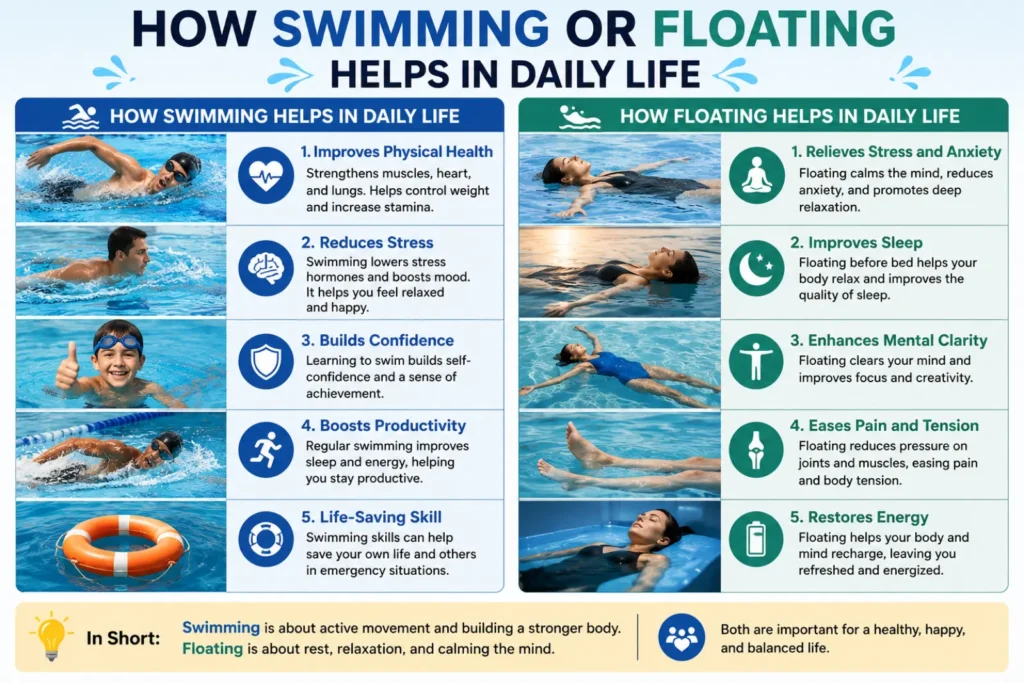
How Swimming or Floating Helps in Daily Life
Swimming and floating can support many daily activities.
People may use swimming during vacations. They may also swim at pools, beaches, and water parks.
Floating can help people relax in water. It can also help them rest during swimming.
These skills may also support confidence. People who feel comfortable in water may enjoy more activities.
Swimming can also become part of a regular fitness routine.
However, water skills should always match the environment. A swimming pool differs from a river, lake, or ocean.
Swimming or Floating: Which One Should You Choose?
Choose swimming when you need to:
- Move through water
- Exercise your body
- Improve endurance
- Practice water sports
- Travel short distances in water
Choose floating when you need to:
- Rest in water
- Conserve energy
- Build water confidence
- Practice body balance
- Stay on the water’s surface
In many situations, you should learn both skills.
Swimming gives you movement. Floating gives you rest.
Together, they create a stronger foundation for water confidence and safety.
Synonyms and Related Keywords for Swimming or Floating
Search engines understand related terms and natural language. Use these semantic keywords naturally throughout your content:
- swimming vs floating
- difference between swimming and floating
- floating in water
- swimming in water
- how to float in water
- how to learn swimming
- swimming for beginners
- floating for beginners
- swimming skills
- water safety skills
- swimming techniques
- benefits of swimming
- benefits of floating
- floating vs swimming
- can you swim by floating
- does floating help you learn swimming
- beginner water skills
These terms can support topical relevance. Avoid repeating them unnaturally.
Expert Insights
Water confidence develops through practice and understanding.
Many beginners focus only on swimming speed. However, floating provides an important foundation.
A person who understands buoyancy may feel more comfortable in water. This comfort can improve learning.
Swimming also requires more than physical strength. Breathing, balance, coordination, and technique all matter.
Experts generally recommend gradual learning. Beginners should build comfort before attempting difficult skills.
Safety also remains essential. People should never overestimate their abilities.
The best approach combines basic floating, controlled breathing, swimming technique, and safety awareness.
Frequently Asked Questions
Is floating easier than swimming?
Floating is often easier for beginners. It requires less active movement. However, comfort and body position still require practice.
Can you learn swimming by learning to float?
Floating can help you learn swimming. It improves water confidence and body awareness. However, you must also learn movement and breathing skills.
Is swimming better than floating for exercise?
Yes, swimming usually provides more exercise. It uses more muscles and requires continuous movement.
Can floating help you rest while swimming?
Yes, floating can help you rest. Many swimmers use gentle floating to conserve energy.
Why do some people float more easily?
Body composition, lung capacity, and relaxation can affect floating. However, everyone can improve their water balance.
Should children learn floating or swimming first?
Children can begin with basic water comfort and floating skills. They should then learn swimming through safe, supervised instruction.
Is floating a water safety skill?
Yes, floating can help a person rest in water. However, it should form part of broader water safety training.
Which is better, swimming or floating?
Neither is always better. Swimming works best for movement and exercise. Floating works best for rest and water balance.
conclusion
Swimming or floating can both improve your comfort and confidence in water. However, they serve different purposes. Swimming helps you move through water. Floating helps you stay supported on the surface. Swimming usually requires more energy and coordination. Floating usually requires more relaxation and balance.
For beginners, learning both skills can provide the best foundation. Start with water comfort and basic floating. Then practice breathing, kicking, and simple swimming movements. Always learn in a safe environment. Follow local water safety rules and seek qualified instruction when needed.