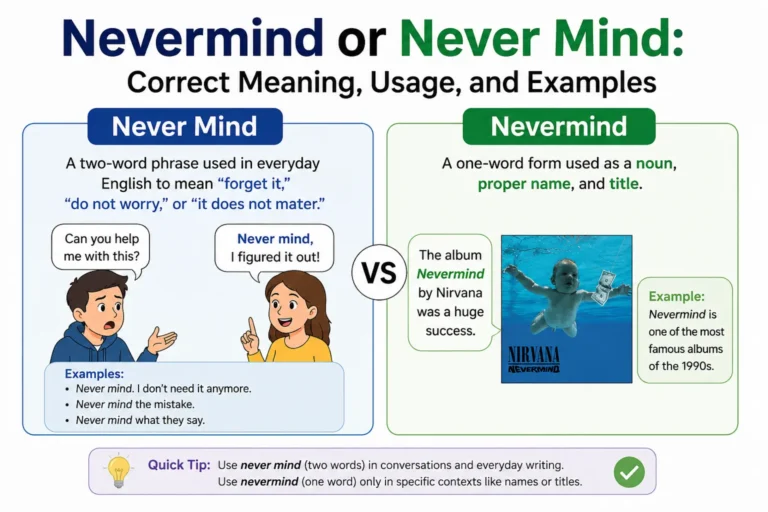
Nevermind or never mind is a common English question. Many people wonder which spelling is correct. The answer depends on how you use the phrase. “Never mind” is the standard spelling in most cases. It means “forget it,” “do not worry,” or “it does not matter.” “Nevermind” can also appear as one word. However, it has a different use and meaning in some contexts. This guide explains the difference in simple English. You will learn the correct spelling, meaning, examples, common mistakes, and usage rules. We will also compare never mind vs nevermind. By the end, you will know which form to use in emails, texts, schoolwork, and everyday conversations.
Quick Summary
- Never mind is the standard phrase in everyday English.
- It can mean “forget it,” “do not worry,” or “it does not matter.”
- Nevermind is usually a noun or a proper name.
- Use never mind when telling someone to forget something.
- Use nevermind only when the context supports the one-word form.
- In formal writing, never mind is usually the safest choice.
- The phrase can sound polite, casual, annoyed, or dismissive.
- Always check the sentence meaning before choosing the spelling.
What Does “Never Mind” Mean?
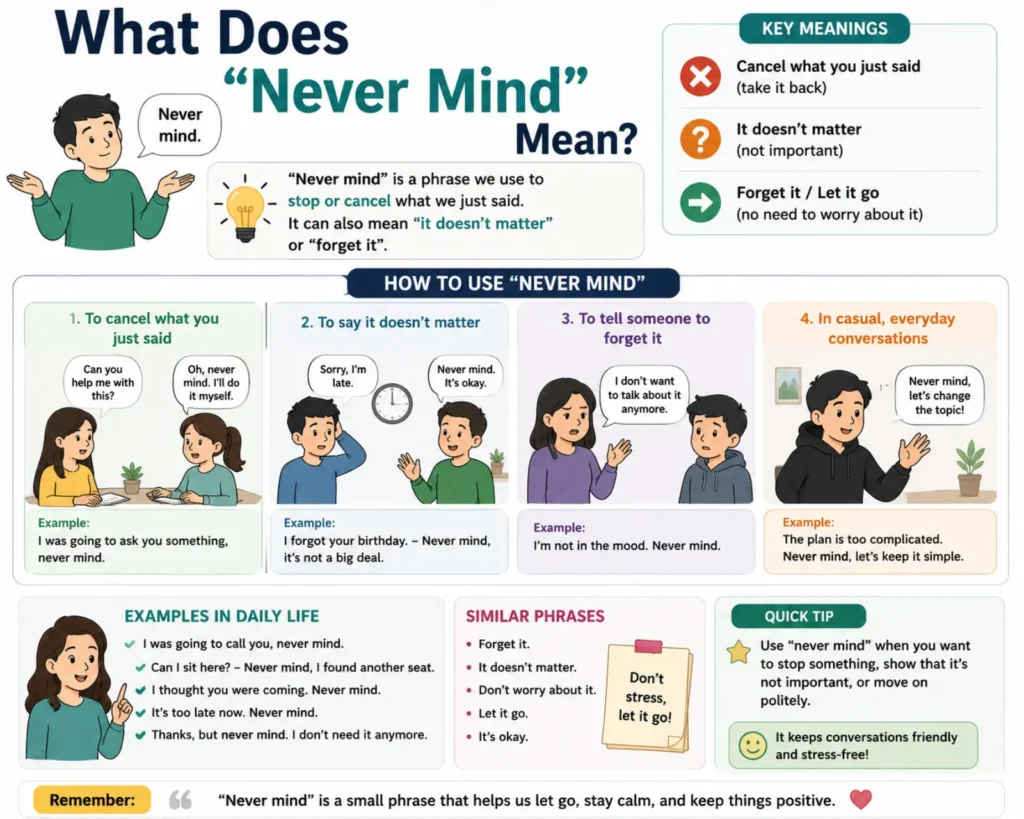
“Never mind” is a phrase that tells someone not to worry about something.
It can also mean that something is no longer important.
Examples
- “Never mind. I found my keys.”
- “Never mind the noise.”
- “Never mind. I will do it myself.”
- “Never mind what they say.”
The exact meaning depends on the sentence and tone.
In everyday speech, people often use never mind when they change their mind.
For example:
“Can you help me with this?”
Then, after solving the problem:
“Never mind. I figured it out.”
Here, never mind means “forget my request.”
Is “Never Mind” or “Nevermind” Correct?
In most everyday situations, never mind is correct.
The two-word form works as a common English phrase.
Correct examples
- Never mind. I understand now.
- Never mind the mistake.
- Never mind what happened.
- Never mind. It is not important.
The one-word form, nevermind, has more limited uses.
It may appear as a noun or a proper name.
Therefore, choose never mind for most conversations and standard writing.
Never Mind vs Nevermind: Key Difference
| Form | Main Use | Example |
|---|---|---|
| Never mind | Common phrase | “Never mind. I solved it.” |
| Nevermind | Noun or proper name in certain contexts | “The band released Nevermind.” |
The difference looks small.
However, spelling can change the grammatical role of the word.
“never mind” as a phrase
Use it when you mean:
- Forget it
- Do not worry
- It does not matter
- Ignore that
- Leave it alone
Use “nevermind” as a noun or name
The one-word form can appear in specific contexts.
For example, Nevermind is the title of a well-known album by Nirvana.
In that case, Nevermind is a proper title.
Why Do People Confuse “Never Mind” and “Nevermind”?
The confusion comes from everyday speech.
People often pronounce both forms in the same way.
They also use the phrase frequently in casual conversations.
English contains many expressions that changed over time.
Some phrases become one word in certain uses.
However, never mind remains the safest standard spelling for the common expression.
This rule helps writers avoid most mistakes.
How to Use “Never Mind” in a Sentence
You can use never mind in several common ways.
1. To say “forget it”
Example:
“Can you send me the file?”
“Never mind. I found it.”
2. To say “do not worry”
Example:
“Sorry I made a mistake.”
“Never mind. Everyone makes mistakes.”
3. To say “it does not matter”
Example:
“Which movie should we watch?”
“Never mind. You can choose.”
4. To tell someone to ignore something
Example:
“Never mind what he said.”
5. To stop a conversation
Example:
“Why did you leave early?”
“Never mind.”
This last use can sound rude or secretive.
Your tone matters.
Real-Life Examples of “Never Mind”
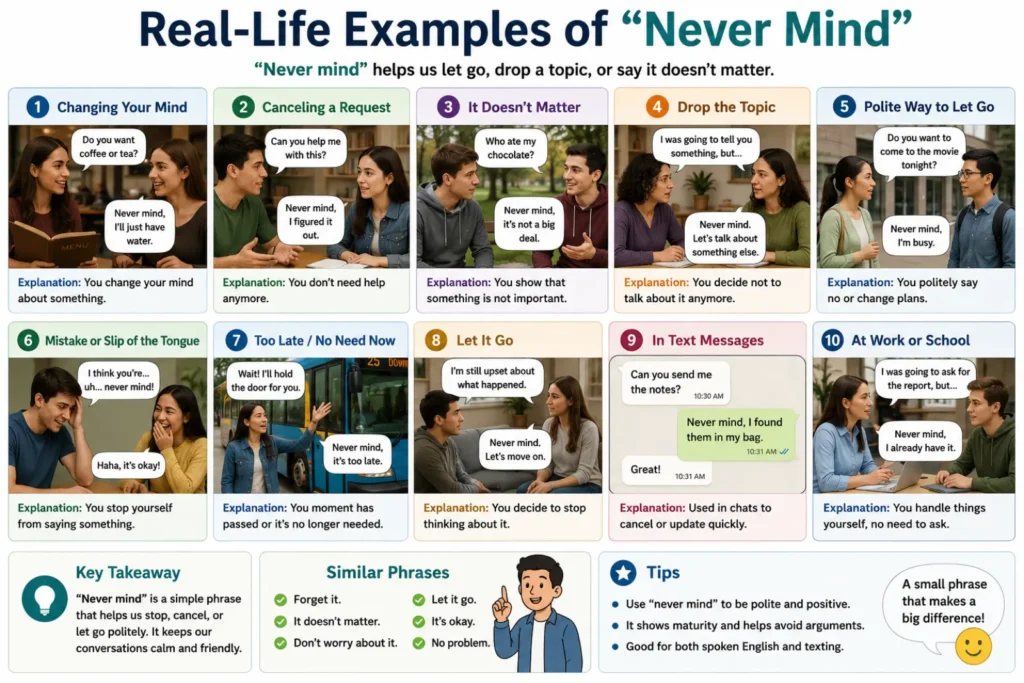
Here are common examples from daily life.
At home
Person A: Did you buy milk?
Person B: Never mind. I just remembered we still have some.
At school
Student: Can you explain this question?
Teacher: Of course.
Student: Never mind. I understand it now.
At work
Employee: Can you send me the report?
Coworker: Sure.
Employee: Never mind. I found it in my email.
In text messages
Friend: Are you coming tonight?
You: Never mind. I just saw your update.
During a conversation
Person A: What did you want to ask?
Person B: Never mind. It is not important.
These examples show the phrase’s flexible meaning.
Is “Nevermind” Ever Correct?
Yes, nevermind can be correct in specific situations.
However, it does not replace never mind in every sentence.
The one-word form may work as:
- A noun
- A proper title
- A name
- A creative or informal spelling
For example:
“The album Nevermind became famous.”
Here, the word acts as a title.
In standard everyday writing, however, use never mind for the phrase.
Common Mistakes With “Never Mind”
Many writers make the same spelling mistakes.
Mistake 1: Using “nevermind” in every sentence
Incorrect for standard usage:
“Nevermind, I found it.”
Better:
“Never mind, I found it.”
Mistake 2: Confusing meaning and spelling
Some people think the one-word form always looks more modern.
That does not make it grammatically correct.
Choose the spelling based on the sentence.
Mistake 3: Using the phrase too often
“Never mind” can sound dismissive.
For example:
“Never mind. You would not understand.”
This sentence may sound rude.
Mistake 4: Ignoring tone
The same phrase can sound friendly or annoyed.
Compare:
“Never mind! I figured it out!”
with:
“Never mind.”
The first may sound casual.
The second may sound cold.
Tips for Using “Never Mind” Correctly
Follow these simple tips.
Tip 1: Use two words for the common phrase
When you mean “forget it,” write never mind.
Tip 2: Check the sentence meaning
Ask yourself what the word does in the sentence.
Is it a phrase?
If yes, never mind usually works.
Tip 3: Use punctuation carefully
Common forms include:
- Never mind.
- Never mind!
- Never mind, I found it.
- Never mind what they say.
Tip 4: Consider your tone
Use softer language in professional situations.
Instead of:
“Never mind.”
You could write:
“No problem. I found the information.”
Tip 5: Remember proper titles
A title or name may use Nevermind as one word.
Always keep official titles unchanged.
“Never Mind” in Formal and Informal English
The phrase appears in both formal and informal communication.
However, it works better in casual writing.
Informal examples
- Never mind, I got it.
- Never mind. I will handle it.
- Never mind the details.
More professional alternatives
In formal emails, you might write:
- Please disregard my previous message.
- No further action is needed.
- I found the information.
- Please ignore my earlier request.
These alternatives often sound more professional.
Synonyms and Related Expressions
Several phrases have similar meanings.
Synonyms for “never mind”
- Forget it
- Do not worry
- It does not matter
- No problem
- Leave it
- Ignore it
- It is fine
- Do not bother
- Let it go
- No need
The best synonym depends on the situation.
Example
Never mind. I found the answer.
Similar versions include:
- Forget it. I found the answer.
- No problem. I found the answer.
- Do not worry. I found the answer.
Each phrase creates a slightly different tone.
“Never Mind” vs “Forget It”
These phrases often share the same meaning.
However, “forget it” can sound stronger.
Never mind
This often sounds softer.
“Never mind. I solved the problem.”
Forget it
This may sound annoyed.
“Forget it. I do not want to discuss it.”
Therefore, never mind can be a better choice in friendly conversations.
“Never Mind” vs “No Worries”
These expressions also have similar meanings.
“No worries” usually reassures someone.
“Sorry I am late.”
“No worries.”
“Never mind” often tells someone to forget something.
“Can you help me?”
“Never mind. I solved it.”
The meaning depends on the situation.
SEO Keywords and Semantic Variations
This topic naturally connects with several related search terms.
Useful semantic keywords include:
- nevermind or never mind
- never mind meaning
- nevermind meaning
- never mind definition
- is nevermind one word
- is never mind two words
- never mind vs nevermind
- correct spelling of never mind
- how to use never mind
- never mind in a sentence
- never mind grammar
- never mind examples
- nevermind spelling
- never mind phrase meaning
- should I write nevermind or never mind
These variations help search engines understand the topic.
Use them naturally.
Avoid repeating the same keyword too often.
Expert Insights
Small grammar choices can affect clarity.
They can also affect how professional your writing appears.
The phrase never mind has a long history in standard English usage.
Most style guides treat the common expression as two words.
However, English changes over time.
Some dictionaries record one-word forms in specific contexts.
That explains why both spellings appear online.
The best strategy remains simple.
Use never mind for the everyday phrase.
Use nevermind when it functions as a specific name, title, or noun.
This approach gives your writing clarity.
It also helps you avoid unnecessary spelling mistakes.
Frequently Asked Questions
Is “never mind” one word or two?
Never mind is usually written as two words when used as a common phrase.
Is “nevermind” grammatically correct?
Yes, nevermind can be correct in specific contexts. However, never mind is the standard everyday phrase.
What does “never mind” mean?
It can mean “forget it,” “do not worry,” or “it does not matter.”
Which is correct: nevermind or never mind?
For most everyday sentences, never mind is the correct choice.
Can I use “never mind” in formal writing?
Yes, but formal alternatives may sound more professional. Try “please disregard” or “no further action is needed.”
Is “never mind” rude?
It depends on your tone and context. A short “Never mind” can sometimes sound dismissive.
What is the difference between nevermind and never mind?
Never mind is the common phrase. Nevermind appears mainly in specific one-word uses, names, or titles.
How do I use never mind in a sentence?
You can write: “Never mind. I found the answer.”
Conclusion
The difference between nevermind or never mind is simple once you understand the context. “Never mind” is the standard spelling for the common English phrase. It can mean “forget it,” “do not worry,” or “it does not matter.” The one-word form, “nevermind,” can appear in specific contexts. It may function as a name, title, or noun. For everyday conversations, emails, schoolwork, and most standard writing, choose never mind. Always consider the meaning and context before choosing the spelling. The easiest rule is simple: When you mean “forget it,” write “never mind.”