Color Gray or Grey: Which Spelling Is Correct? Complete Guide
Color gray or grey is a common question for writers, students, and English learners. Both spellings are correct. However, each spelling is more common in different parts of the world. Many people wonder which version …
Written by: Lily Watson
Published on:
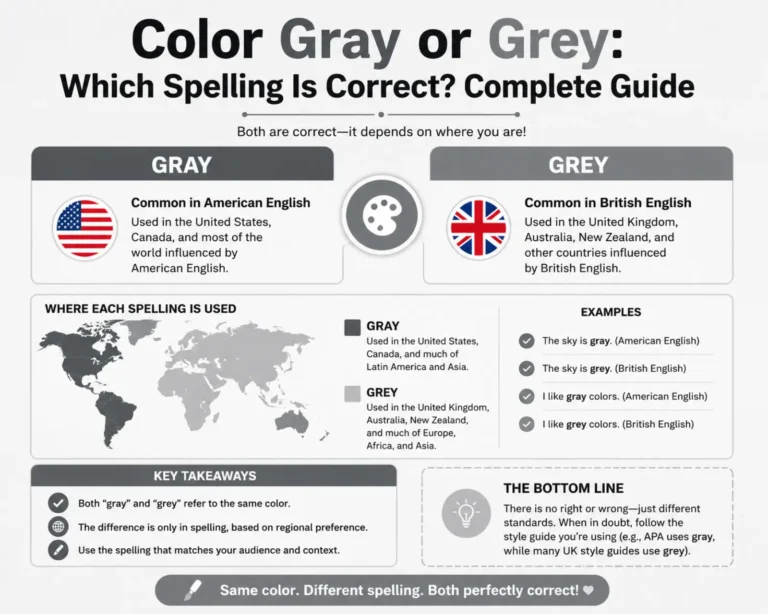
Color gray or grey is a common question for writers, students, and English learners. Both spellings are correct. However, each spelling is more common in different parts of the world.
Many people wonder which version they should use. The answer depends on your audience and writing style. American English usually prefers gray. British English usually prefers grey.
This guide explains the difference in simple words. You will learn when to use each spelling. You will also see real-life examples, common mistakes, and expert tips. By the end, you will know exactly which spelling fits your writing.
Quick Summary
Gray and grey have the same meaning.
Both describe the color between black and white.
Gray is the preferred spelling in American English.
Grey is the preferred spelling in British English.
Neither spelling is wrong.
Stay consistent throughout your writing.
Choose the spelling based on your audience.
What Does Color Gray or Grey Mean?
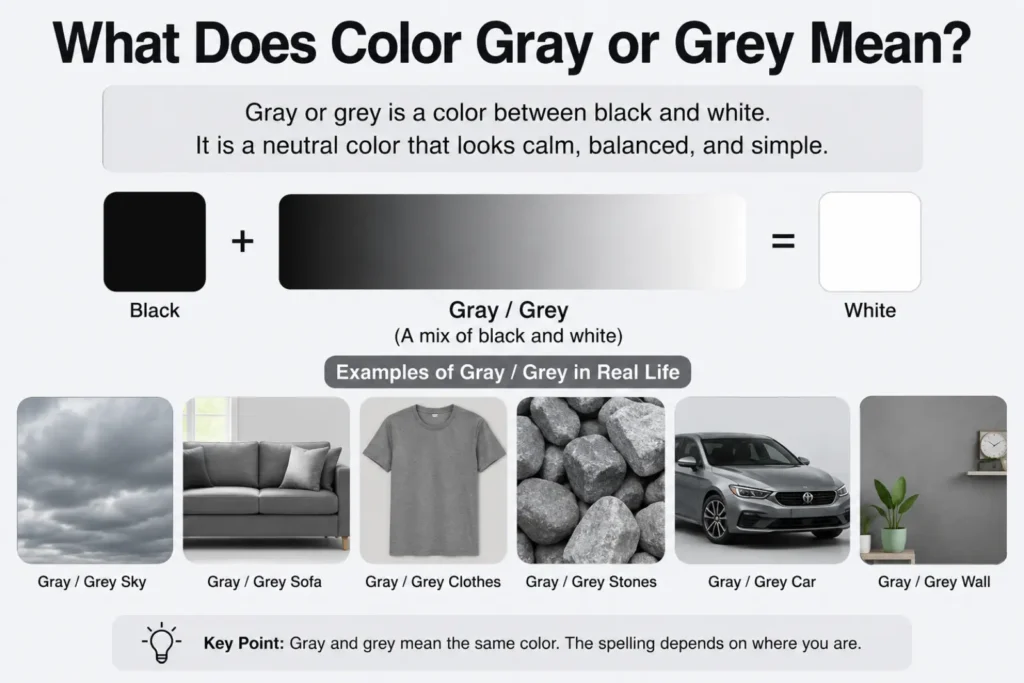
The color gray or grey is a neutral color between black and white.
It appears in nature, clothing, technology, and design. The spelling changes depending on the type of English you use.
Simple definition
Gray or grey is the color between black and white. Both spellings mean exactly the same thing.
Is Gray or Grey Correct?
Yes. Both spellings are correct.
The only difference is regional English.
Americans usually write gray.
British people usually write grey.
Canadians often use grey, although gray also appears.
Australians and New Zealanders generally use grey.
Your choice depends on where your readers live.
Gray vs Grey Comparison Table
Feature
Gray
Grey
Meaning
Color between black and white
Color between black and white
American English
✅ Preferred
Less common
British English
Less common
✅ Preferred
Canadian English
Used sometimes
More common
Australian English
Rare
Preferred
Dictionary Meaning
Same
Same
Pronunciation
Same
Same
Key takeaway
The spelling changes, but the meaning never changes.
Why Are There Two Spellings?
English has changed over hundreds of years.
American English developed its own spelling rules. British English kept many older spellings.
Many words have two accepted versions.
Examples include:
American English
British English
Color
Colour
Favorite
Favourite
Gray
Grey
Center
Centre
Theater
Theatre
This difference is normal in English.
When Should You Use Gray?
Use gray if your audience mainly lives in the United States.
Examples:
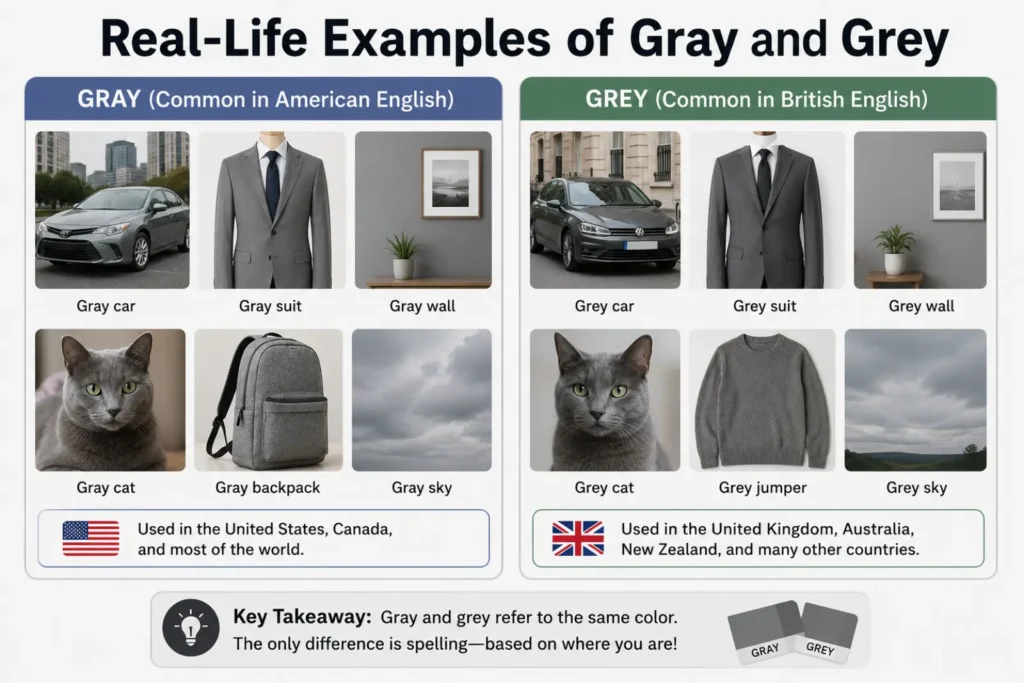
The sky looks gray today.
I bought a gray sweater.
The walls are painted gray.
My car is light gray.
American companies, schools, and publishers usually prefer this spelling.
When Should You Use Grey?
Use grey if your readers are in:
United Kingdom
Australia
New Zealand
Ireland
Most Commonwealth countries
Examples:
The sky is grey today.
She wore a grey jacket.
We painted the room light grey.
His hair turned grey with age.
British publications almost always use this version.
Real-Life Examples of Gray and Grey
Here are everyday situations.
In the United States
A paint store advertises:
Modern Gray Paint Collection
In the United Kingdom
A furniture company promotes:
Elegant Grey Sofas
In Fashion
American brand:
Gray hoodie
British brand:
Grey hoodie
In School Writing
American student:
Gray elephant
British student:
Grey elephant
Both are correct.
Gray or Grey in Design and Branding
Many companies choose one spelling based on their target market.
For example:
American websites
Gray background
Gray theme
Dark gray mode
British websites
Grey background
Grey theme
Dark grey finish
Consistency matters more than the spelling itself.
Common Mistakes People Make
Many writers confuse these spellings.
Avoid these mistakes.
Mixing both spellings
❌ The wall is gray and the ceiling is grey.
Choose one version and keep it throughout your article.
Thinking one spelling is wrong
Many people believe only one spelling is correct.
That is false.
Both spellings are accepted.
Ignoring the audience
American readers expect gray.
British readers expect grey.
Choose accordingly.
Using different spellings for SEO
Some writers switch between gray and grey only for keywords.
This hurts readability.
Use the primary spelling naturally.
Tips for Choosing the Right Spelling
These tips make writing easier.
Know your audience
Write gray for Americans.
Write grey for British readers.
Stay consistent
Do not switch spellings in one article.
Follow your style guide
Many businesses have writing rules.
Always follow them.
Check website language
Match the language used across your website.
This improves professionalism.
Gray or Grey in Everyday Life
You see this color everywhere.
Examples include:
Gray or grey cars
Office walls
Winter skies
Computer icons
Hair color
Furniture
Clothing
Stone buildings
Electronics
It is one of the world’s most popular neutral colors.
Gray or Grey in Digital Marketing and SEO
Choosing the right spelling helps your SEO strategy.
If your audience is American:
Target keywords like:
gray color
dark gray
light gray
gray paint
If your audience is British:
Target keywords like:
grey colour
dark grey
light grey
grey paint
Localized spelling improves user experience.
Synonyms and Related Keywords
Synonyms
Ash
Slate
Silver
Charcoal
Smoke
Steel
Neutral color
Related Search Terms
gray vs grey
gray color meaning
grey color meaning
is gray correct
is grey correct
American spelling gray
British spelling grey
gray or grey difference
gray vs grey spelling
color spelling guide
These terms help improve topical relevance.
Featured Snippet Answer
Gray or Grey: Which Is Correct?
Both gray and grey are correct spellings for the color between black and white. Gray is preferred in American English, while grey is preferred in British English and many Commonwealth countries. Choose the spelling that matches your audience and use it consistently.
Expert Insights
Professional writers focus on consistency.
Search engines value content that matches user intent.
Regional spelling builds trust with readers.
SEO experts recommend using the spelling your audience naturally searches.
If your website targets the United States, use gray throughout the article.
If your audience is mainly British, use grey instead.
This small choice improves readability and user experience.
Frequently Asked Questions
Is gray or grey more correct?
Neither is more correct. Both spellings are accepted.
Why do Americans use gray?
American English adopted gray as the standard spelling.
Why do British people use grey?
British English kept grey as the preferred spelling.
Is gray the same color as grey?
Yes. They describe the exact same color.
Which spelling should I use for SEO?
Use the version your audience searches most often.
Can I use both spellings in one article?
It is better not to. Pick one spelling and stay consistent.
Is gray older than grey?
The two spellings have existed for centuries. Modern regional preferences developed over time.
Does pronunciation change?
No. Both spellings have the same pronunciation.
Conclusion
The question color gray or grey has a simple answer. Both spellings are correct, and both refer to the same color between black and white. The only real difference is location. American English prefers gray, while British English prefers grey.
Always think about your readers before choosing a spelling. Then use that version consistently across your article, website, or document. This approach improves readability, builds trust, and supports better SEO performance. Whether you write gray or grey, your message remains clear when you match the spelling to your audience.
Lily Watson is a content writer and digital researcher who specializes in creating simple, helpful, and reader-focused content. She writes about compression tools, file optimization, and practical online solutions with clarity and accuracy. Her goal is to make technical topics easy to understand for everyday users.
Lily Watson is a content writer and digital researcher who specializes in creating simple, helpful, and reader-focused content. She writes about compression tools, file optimization, and practical online solutions with clarity and accuracy. Her goal is to make technical topics easy to understand for everyday users.