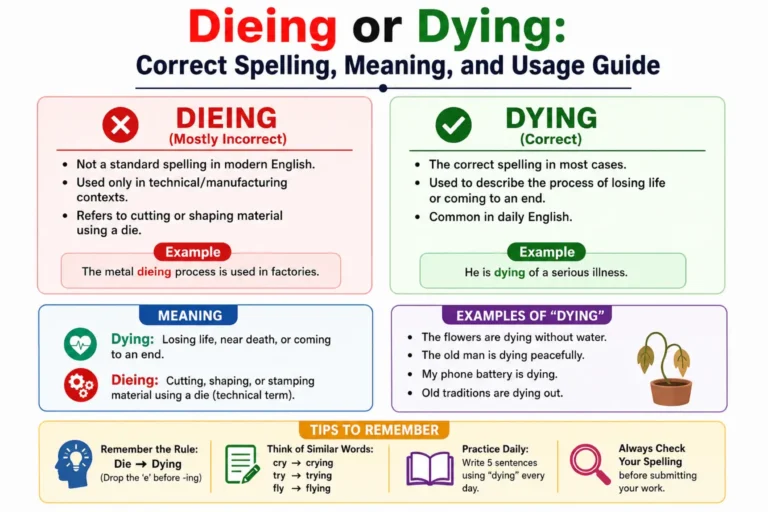
Dieing or dying is one of the most common spelling mistakes in English. Many learners search for dieing or dying because both words look similar and confusing.
In simple English, “dying” is the correct spelling in most cases. It comes from the verb “die,” which means to stop living or to come to an end.
The confusion happens because English spelling rules are not always consistent. Also, both words sound almost the same when spoken. This makes it harder for beginners to identify the correct form.
However, only one spelling is correct for daily English writing. The other is rarely used and belongs to a technical field.
In this guide, you will learn the meaning, correct usage, examples, and common mistakes. This will help you avoid errors in exams, writing, and daily communication.
Quick Summary Box
- “Dying” is the correct spelling in most cases
- “Dieing” is mostly incorrect in modern English
- “Dying” means losing life or ending
- “Dieing” is only used in technical manufacturing terms
- It is a very common English spelling mistake
- Example: “He is dying” ✔ correct
- Example: “He is dieing” ✘ usually wrong
What Does “Dying” Mean?
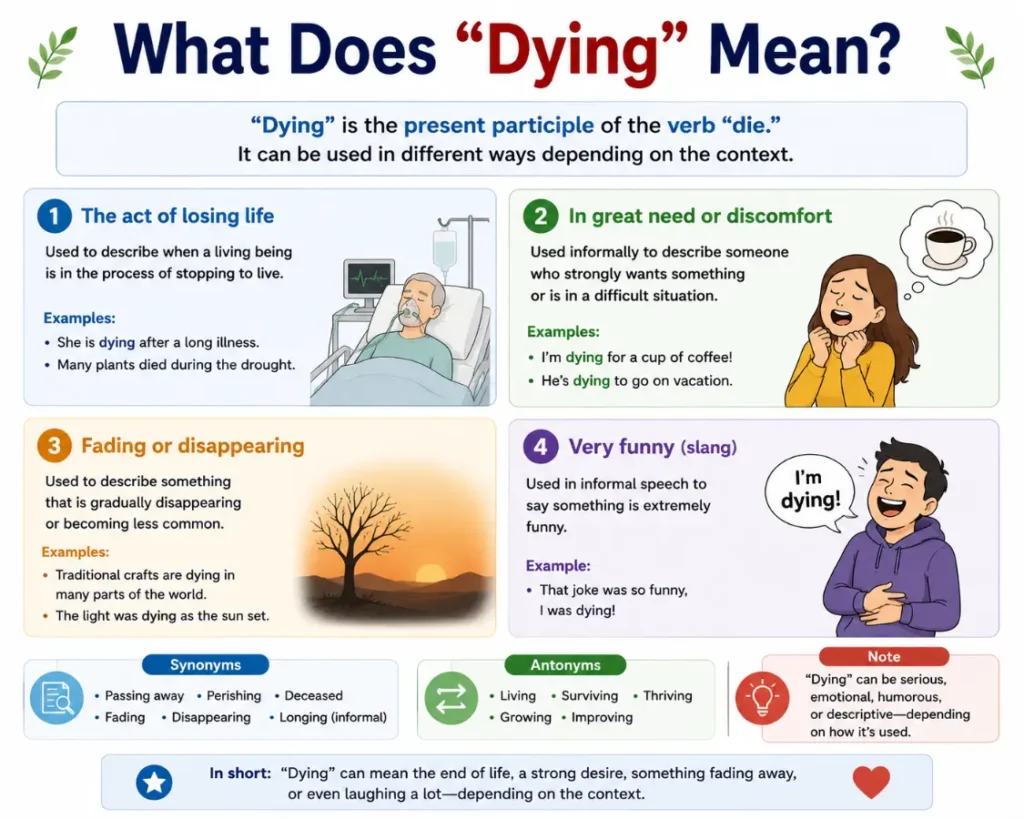
“Dying” is the present participle form of the verb “die.”
It means:
- The process of losing life
- Something coming to an end
- Gradual stopping or fading
Simple examples:
- The old man is dying in the hospital.
- The plant is dying without sunlight.
- The battery is dying fast.
The word is very common in both spoken and written English.
It is also used in emotional, medical, and general situations.
What Does “Dieing” Mean?
“Dieing” is not used in normal English writing.
It has a special technical meaning in engineering and manufacturing.
It refers to the process of cutting, shaping, or stamping materials using a “die” tool.
Example usage:
- Metal dieing process in factories
- Industrial dieing machine for shaping parts
However, this usage is very rare.
Most people never use this word in daily life.
So, in almost all cases, you should avoid “dieing.”
Why People Get Confused Between Dieing or Dying
Many learners mix these words due to simple reasons.
Main causes of confusion:
- Both words look almost identical
- English pronunciation does not clearly show spelling difference
- Learners assume “e” is needed in verb forms
- Fast typing leads to mistakes
- Autocorrect does not always fix it
Another reason is lack of grammar practice.
When learners see similar words like “trying” or “crying,” they assume “dieing” might also be correct.
But English rules do not support that spelling.
Correct Usage of “Dying” in Sentences
The word “dying” is widely used in everyday English.
Here are simple examples:
- The flowers are dying بسبب heat.
- He is dying from illness.
- My phone is dying quickly.
- The tradition is dying out in modern society.
Important point:
“Dying” is not only about life.
It can also mean ending or disappearing.
This makes it a flexible and powerful English word.
Common Mistakes People Make
Many learners repeat the same errors when using this word.
Most common mistakes:
- Writing “dieing” instead of “dying”
- Using wrong spelling in exams
- Thinking both forms are correct
- Not checking spelling before submitting writing
- Confusing verb forms like die, died, dying
How to avoid mistakes:
Always double-check your writing.
Read sentences slowly before final submission.
Simple Memory Trick to Remember Correct Spelling
You can easily remember the correct form with this trick:
Rule:
“Die → Dying (drop the ‘e’)”
Easy pattern:
- cry → crying
- try → trying
- fly → flying
- die → dying
This pattern helps you remember spelling naturally.
Practice writing it daily for better memory retention.
Usage of “Dying” in Daily Life
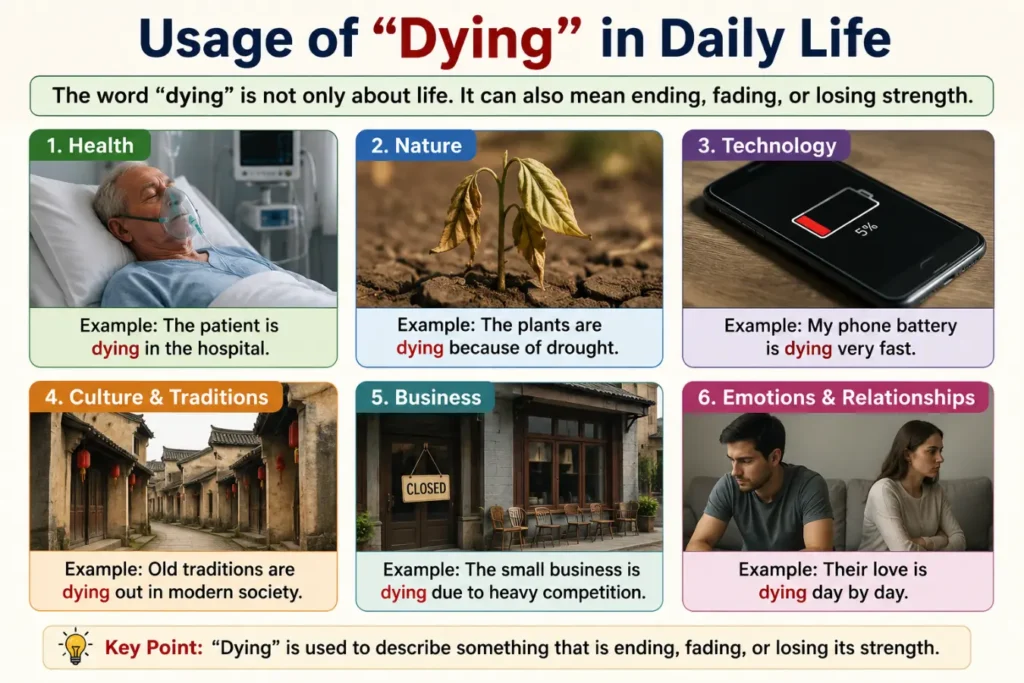
The word “dying” is used in many real-life situations.
Examples:
- Health: “The patient is dying.”
- Nature: “Trees are dying due to drought.”
- Technology: “My laptop is dying.”
- Culture: “Old customs are dying out.”
This shows the word is not limited to medical use only.
It is also used in emotional and everyday conte
Comparison Table: Dieing vs Dying
Understanding the difference becomes easy with a clear comparison.
| Feature | Dying | Dieing |
|---|---|---|
| Correct spelling | Yes | No (mostly incorrect) |
| Usage in daily English | Very common | Rare |
| Main meaning | Losing life or ending | Cutting/shaping material |
| Context | Medical, emotional, general | Engineering/manufacturing |
| Example sentence | He is dying in hospital | Metal dieing process |
| Suitable for exams | Yes | No |
Simple conclusion:
Always use “dying” in normal writing.
Avoid “dieing” unless you study technical engineering topics.
Synonyms and Related Words (LSI Keywords)
These words help improve your vocabulary and SEO understanding.
Common synonyms of “dying”:
- Passing away
- Near death
- Expiring
- Fading away
- Losing life
- End of life
Related phrases (LSI keywords):
- dying meaning in English
- correct spelling of dying
- dieing vs dying difference
- grammar confusion words
- English spelling mistakes
- present participle of die
These terms often appear in Google searches and “People Also Ask” sections.
Common Mistakes Learners Make
Even advanced learners sometimes make errors with this word.
Frequent mistakes:
- Writing “dieing” in essays
- Confusing pronunciation with spelling
- Using wrong form in exams
- Not checking grammar rules
- Assuming both forms are correct
Why this happens:
English has many irregular verbs.
This creates confusion for learners.
But “die” follows a simple rule:
👉 Drop “e” and add “ing.”
Tips to Remember the Correct Spelling
Here are easy tricks to avoid mistakes:
1. Think of pattern words
- cry → crying
- try → trying
- fly → flying
- die → dying
2. Use a memory rule
👉 “Die loses ‘e’ before adding -ing.”
3. Practice daily
Write 5 sentences using “dying” every day.
4. Read more English
Reading improves natural spelling accuracy.
FAQs
1. Which is correct: dieing or dying?
“Dying” is correct in most situations.
2. Is dieing ever correct in English?
Yes, but only in technical engineering contexts.
3. What does dying mean in simple English?
It means losing life or something coming to an end.
4. Why do people write dieing instead of dying?
Because of spelling confusion and fast typing mistakes.
5. Can dying be used for objects?
Yes, like “battery dying” or “light dying.”
6. Is dying a verb or adjective?
It is a verb form (present participle).
7. What is the easiest way to remember it?
Think: “die → dying (drop the e).”
8. Is dying formal English?
Yes, it is used in both formal and informal writing.
Expert Insights
Language experts agree that correct spelling improves communication clarity and trust.
Using “dying” correctly shows strong grammar knowledge. It also improves academic writing scores and professional communication.
From an SEO perspective, correct spelling helps content rank higher. Google prefers clear and accurate language usage.
This topic is important because small spelling mistakes can change meaning and reduce credibility.
Key takeaway from experts:
Good writing = clear spelling + simple grammar + correct usage
Conclusion
The confusion between dieing or dying is very common among English learners. However, the correct spelling in almost all cases is “dying.”
This word is widely used in daily English to describe life ending, something fading, or something coming to an end. On the other hand, “dieing” is rarely used and mostly appears in technical engineering contexts.
Understanding this difference helps improve your writing, grammar accuracy, and communication skills. It also prevents common spelling mistakes in exams and professional writing.
The easiest way to remember is simple: “die → dying (drop the ‘e’).”
By practicing this rule regularly, you can avoid confusion and write more confidently in English.