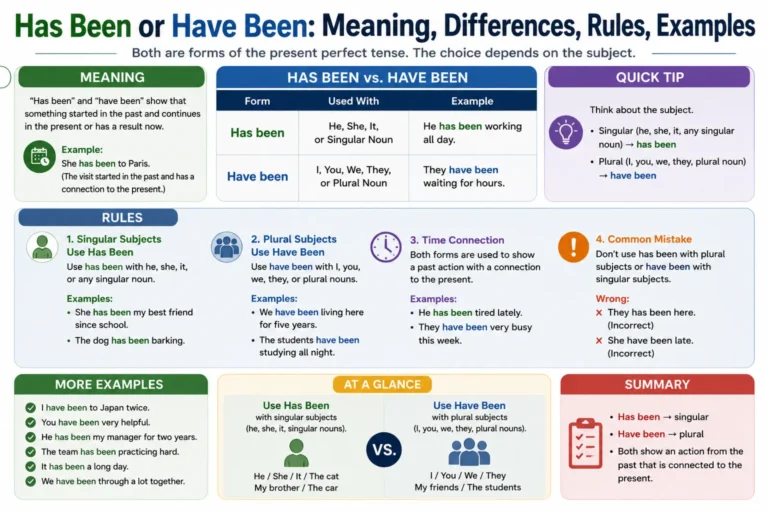
Has been or have been is one of the most searched grammar topics in English. Many learners struggle to know which phrase is correct. The good news is that the rule is simple. Once you understand it, you can use both phrases with confidence.
These two expressions belong to the present perfect tense. They describe actions, situations, or experiences that started in the past and have a connection to the present. The only difference is the subject that comes before them. Has been goes with singular subjects, while have been goes with plural subjects and the pronouns I and you.
Whether you are a student, writer, teacher, or professional, using the correct grammar helps you communicate clearly. In this guide, you will learn the meaning of has been or have been, the basic rules, simple examples, and practical tips. By the end, you will know exactly which one to use in every situation.
Quick Summary
- Has been is used with singular subjects.
- Have been is used with plural subjects.
- The pronouns I and you always take have been.
- Both phrases are part of the present perfect tense.
- They connect the past with the present.
- The correct choice depends on the subject, not the object.
- Learning the rule improves both spoken and written English.
What Does “Has Been or Have Been” Mean?
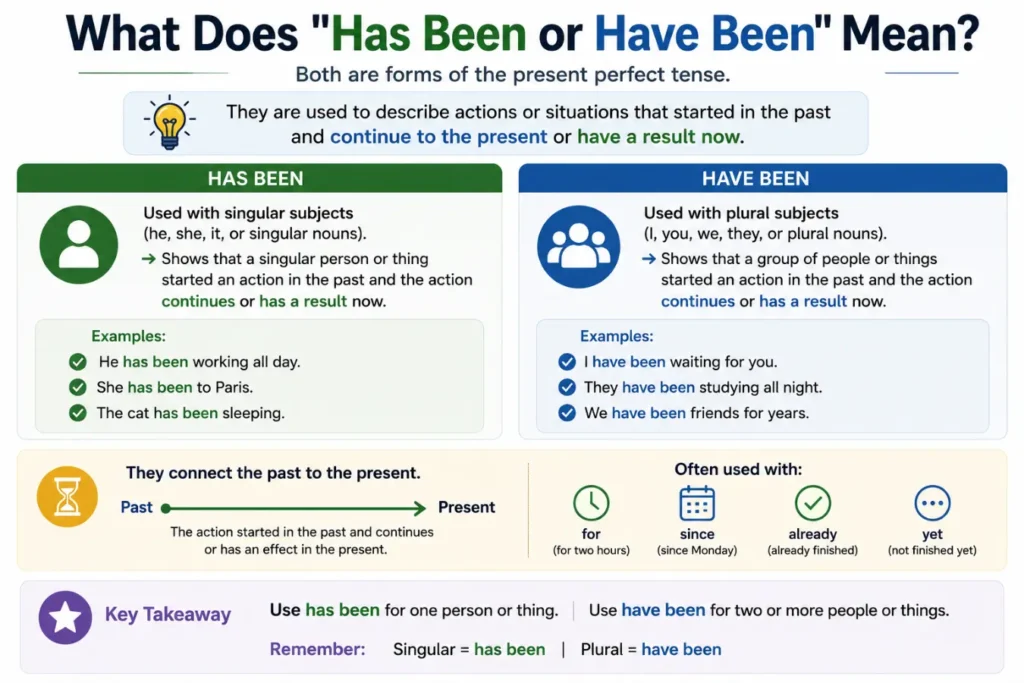
The phrases has been and have been are forms of the verb to be in the present perfect tense. They describe a state, action, or experience that started in the past and still has meaning in the present.
In simple words, they show that something happened before now and still matters today.
Simple Definition
- Has been = used with one person, one thing, or one place.
- Have been = used with more than one person or thing, and with I and you.
Both phrases use the past participle been. The helping verb changes between has and have depending on the subject.
Basic Examples
- She has been happy all week.
- He has been busy at work.
- The dog has been sleeping.
- I have been tired today.
- We have been friends for years.
- They have been practicing every evening.
Notice that every sentence refers to something that began in the past and continues or remains important now.
Understanding the Present Perfect Tense
To understand has been and have been, you should first know the present perfect tense.
The present perfect tense connects the past with the present. It does not focus on the exact time an action happened. Instead, it focuses on the result or the ongoing effect.
Structure
Subject + has/have + past participle
For the verb to be, the past participle is been.
Examples:
- She has been busy.
- They have been helpful.
- I have been to Dubai.
- The weather has been cold this week.
These sentences tell us something about the present because of something that happened in the past.
When We Use the Present Perfect
We use it to talk about:
- Experiences
- Ongoing situations
- Recent actions
- Changes over time
- Actions with present results
Examples:
- I have been to Turkey twice.
- He has been sick since Monday.
- They have been friends for ten years.
- The store has been closed all morning.
Has Been vs Have Been
The difference between has been and have been is simple. It depends on whether the subject is singular or plural.
| Feature | Has Been | Have Been |
|---|---|---|
| Subject | Singular | Plural |
| Pronouns | He, She, It | I, You, We, They |
| Grammar | Present Perfect | Present Perfect |
| Example | She has been studying. | They have been studying. |
| Usage | One person or thing | More than one person or thing |
Easy Rule
Remember this simple formula.
- One person or thing = Has been
- More than one person or thing = Have been
This rule works in almost every sentence.
When to Use “Has Been”
Use has been when your subject is singular.
This includes:
- He
- She
- It
- One person
- One animal
- One place
- One object
- One company
- One organization
Examples
- He has been working since morning.
- She has been very kind.
- It has been raining all day.
- My brother has been sick.
- The school has been closed.
- The company has been successful.
- The cat has been sleeping.
- My phone has been slow today.
- The movie has been popular.
- The restaurant has been busy all week.
Every subject in these examples is singular.
Subjects That Always Use “Has Been”
Some common singular subjects include:
- My mother
- Your father
- The teacher
- The doctor
- The manager
- The child
- The baby
- The book
- The city
- The country
Example Sentences
- The teacher has been absent today.
- My mother has been cooking since noon.
- The doctor has been very helpful.
- The baby has been sleeping quietly.
- The city has been crowded this weekend.
- The country has been growing quickly.
When to Use “Have Been”
Use have been with plural subjects and the pronouns I and you.
Subjects That Use “Have Been”
- I
- You
- We
- They
- Friends
- Students
- Parents
- Teachers
- Dogs
- Books
Examples
- I have been learning English.
- You have been very patient.
- We have been waiting for you.
- They have been studying together.
- My friends have been supportive.
- The students have been practicing.
- The players have been training.
- My parents have been traveling.
- The children have been playing outside.
- The books have been useful.
Each subject refers to more than one person or thing, except I and you, which always use have.
Why Do “I” and “You” Use “Have Been”?
Many learners ask why I does not use has.
The answer is simple.
English grammar follows special subject-verb agreement rules.
The helping verb have is always used with:
- I
- You
- We
- They
Examples:
- I have been busy today.
- You have been amazing.
- We have been neighbors for years.
- They have been very friendly.
These forms never change.
Incorrect:
- I has been busy.
- You has been waiting.
Correct:
- I have been busy.
- You have been waiting.
Simple Formula to Remember
You do not need to memorize hundreds of grammar rules.
Just remember these two formulas.
Formula 1
Singular Subject + Has + Been
Examples
- She has been cooking.
- The dog has been barking.
- My brother has been studying.
- The phone has been ringing.
Formula 2
Plural Subject + Have + Been
Examples
- We have been practicing.
- They have been working.
- My friends have been waiting.
- The students have been learning.
These formulas work for thousands of English sentences.
Real-Life Examples of Has Been and Have Been
Understanding grammar becomes easier when you see it in everyday situations.
School
- The teacher has been explaining the lesson.
- The students have been asking questions.
- The principal has been busy today.
- We have been preparing for exams.
Work
- My manager has been supportive.
- Our team has been working hard.
- The office has been quiet.
- The employees have been attending training sessions.
Home
- My mother has been cooking dinner.
- My parents have been cleaning the house.
- The baby has been sleeping peacefully.
- We have been watching a movie.
While Traveling
- I have been to Malaysia.
- She has been to Canada.
- They have been to many countries.
- My cousin has been abroad twice.
During Daily Conversations
- He has been very busy lately.
- You have been helpful today.
- We have been friends since childhood.
- The weather has been wonderful this week.
- The roads have been crowded because of the festival.

Key Takeaways So Far
Before moving to the next section, remember these important points:
- Use has been with singular subjects.
- Use have been with plural subjects.
- I and you always take have been.
- Both phrases belong to the present perfect tense.
- Always identify the subject before choosing the correct phrase.
- Practice with simple sentences to build confidence.
Common Mistakes When Using Has Been or Have Been
Even advanced English learners make mistakes with has been and have been. Most errors happen because people choose the helping verb based on the wrong noun. Learning these common mistakes will help you write and speak more accurately.
Mistake 1: Using Have Been with a Singular Subject
❌ He have been busy.
✅ He has been busy.
The subject he is singular, so it always takes has been.
Mistake 2: Using Has Been with a Plural Subject
❌ They has been waiting.
✅ They have been waiting.
The subject they is plural, so it always takes have been.
Mistake 3: Forgetting That “I” Uses Have
❌ I has been tired.
✅ I have been tired.
Although I refers to one person, English grammar always uses have with I.
Mistake 4: Using Has with “You”
❌ You has been helpful.
✅ You have been helpful.
The pronoun you always uses have, whether it refers to one person or many people.
Mistake 5: Looking at the Wrong Noun
❌ The group of students have been noisy.
✅ The group of students has been noisy.
The subject is group, which is singular. Ignore the words after of when choosing has or have.
Has Been vs Have Been vs Had Been
Many learners also confuse has been, have been, and had been. Each one belongs to a different tense.
| Phrase | Tense | When to Use | Example |
|---|---|---|---|
| Has been | Present Perfect | Singular subject | She has been happy all day. |
| Have been | Present Perfect | Plural subjects, I, You | They have been working since morning. |
| Had been | Past Perfect | Action happened before another past action | He had been waiting before the bus arrived. |
Example Comparison
- She has been sick since Monday. (She is still sick.)
- They have been friends for years. (They are still friends.)
- She had been sick before she visited the doctor. (Both events happened in the past.)
Easy Trick
- Has been = Singular + Present
- Have been = Plural + Present
- Had been = Past before another past event
Tips to Remember the Difference
Learning grammar becomes easier with simple habits.
Follow these tips whenever you write.
- Find the subject first.
- Ignore extra words in the sentence.
- Ask yourself if the subject is singular or plural.
- Remember that I always uses have.
- Remember that you always uses have.
- Read your sentence aloud.
- Practice a few examples every day.
- Learn grammar through real conversations.
The more you practice, the faster the rule becomes automatic.
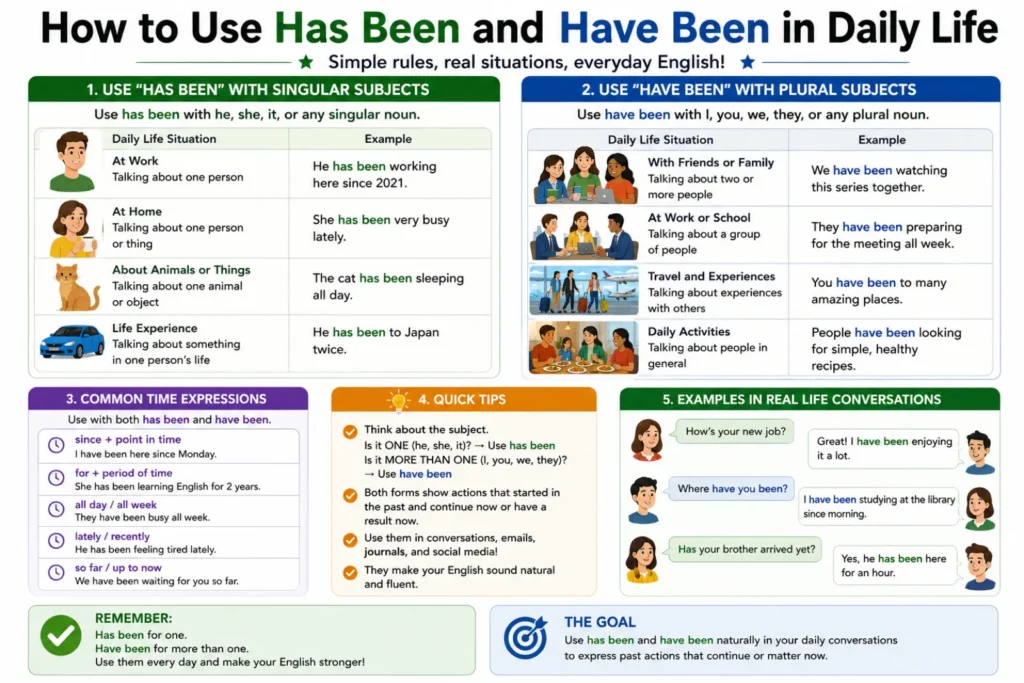
How to Use Has Been and Have Been in Daily Life
You will hear these phrases every day.
School
- The teacher has been absent.
- The students have been studying for exams.
- Our class has been very active.
Work
- My manager has been supportive.
- We have been working on the project.
- The clients have been satisfied.
At Home
- Mom has been cooking all afternoon.
- My brothers have been cleaning their room.
- The baby has been sleeping peacefully.
While Traveling
- I have been to Singapore.
- She has been to London twice.
- They have been to several countries.
In Everyday Conversations
- He has been busy lately.
- You have been very helpful.
- We have been neighbors for years.
- The weather has been wonderful this week.
These examples show how common these phrases are in daily English.
Synonyms and Related Grammar Topics
Although has been and have been do not have direct synonyms, learning related grammar topics will strengthen your English.
Related Grammar Topics
- Present Perfect Tense
- Present Perfect Continuous
- Subject-Verb Agreement
- Helping Verbs
- Auxiliary Verbs
- Past Participles
- English Verb Forms
- Tense Rules
Related Search Terms (LSI Keywords)
Use these naturally when learning or writing about this topic:
- has been meaning
- have been meaning
- has been vs have been
- when to use has been
- when to use have been
- present perfect grammar
- present perfect examples
- subject-verb agreement
- English grammar rules
- grammar for beginners
- has and have exercises
- present perfect sentences
These related keywords help readers understand the topic better and improve topical coverage.
(FAQs)
1. What is the difference between has been and have been?
Has been is used with singular subjects. Have been is used with plural subjects and the pronouns I and you.
2. Is it correct to say “I has been”?
No. The correct form is I have been.
3. Can “you” use has been?
No. You always uses have been, whether it refers to one person or many.
4. When should I use has been?
Use has been with he, she, it, or any singular noun.
Example:
The teacher has been busy today.
5. When should I use have been?
Use have been with I, you, we, they, and plural nouns.
Example:
The students have been studying all day.
6. Is has been part of the present perfect tense?
Yes. Both has been and have been belong to the present perfect tense.
7. What is the difference between have been and had been?
Have been refers to the present perfect tense, while had been belongs to the past perfect tense and describes an earlier past action.
8. How can I remember the rule easily?
Remember this simple formula:
- One person or thing = Has been
- More than one person or thing = Have been
Also remember:
Conclusion
Understanding has been or have been is an important step toward mastering English grammar. The rule is straightforward: use has been with singular subjects like he, she, it, or a singular noun, and use have been with plural subjects as well as I and you. Both forms belong to the present perfect tense and connect past actions or situations with the present.
The best way to remember the difference is to identify the subject before choosing the helping verb. Then practice by reading, writing, and speaking English every day. Over time, using has been and have been correctly will become natural. Strong grammar improves your confidence, makes your writing clearer, and helps you communicate more effectively in school, at work, and in everyday life.