You’re welcome or your welcome is one of the most confusing English grammar questions. Many people mix these two phrases in writing and speech.
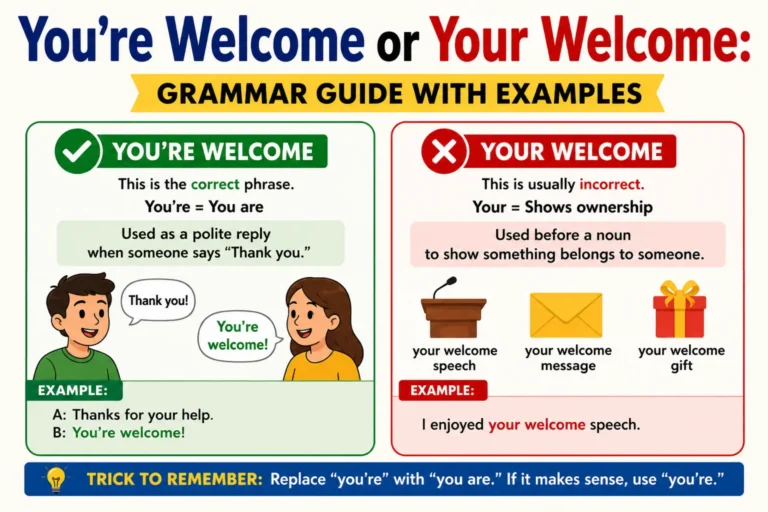
The correct phrase is you’re welcome. It is used when someone thanks you. The word you’re means you are, while your shows ownership.
This small difference changes the meaning completely. That is why many learners get confused.
In this guide, you will learn the correct usage in very simple English. You will see examples, common mistakes, and easy tricks to remember the right form.
By the end, you will clearly understand when to use you’re welcome and why your welcome is usually wrong.
Quick Summary Box
- Correct phrase: You’re welcome
- Wrong phrase: Your welcome (in most cases)
- You’re = You are
- Your = Shows ownership
- Use “You’re welcome” after “Thank you”
- Replace “You’re” with “You are” to check correctness
What Does “You’re Welcome” Mean?
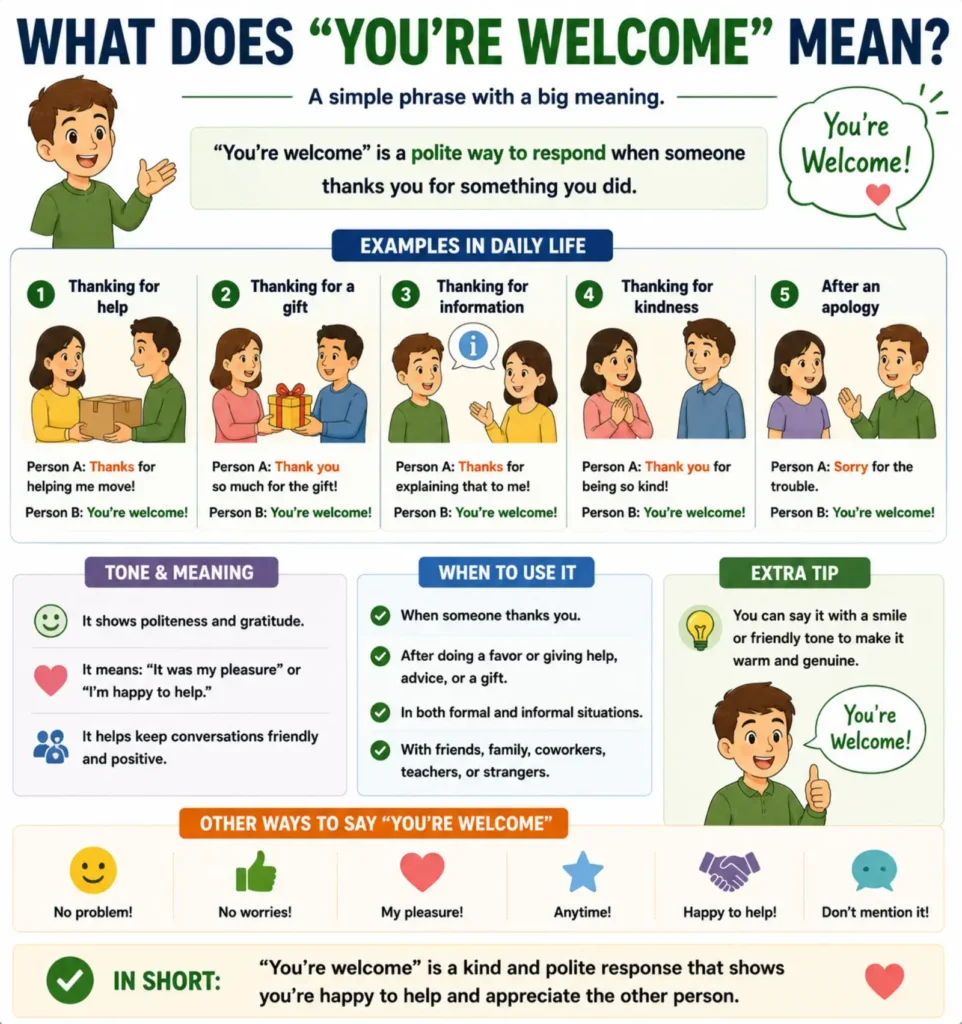
You’re welcome is a polite response used after someone thanks you.
It shows kindness and respect. It means helping was not a problem.
Examples
- Thank you. → You’re welcome.
- Thanks for your help. → You’re welcome.
- Thank you so much. → You’re welcome.
People use it in daily conversations, messages, emails, and professional communication.
What Does “Your Welcome” Mean?
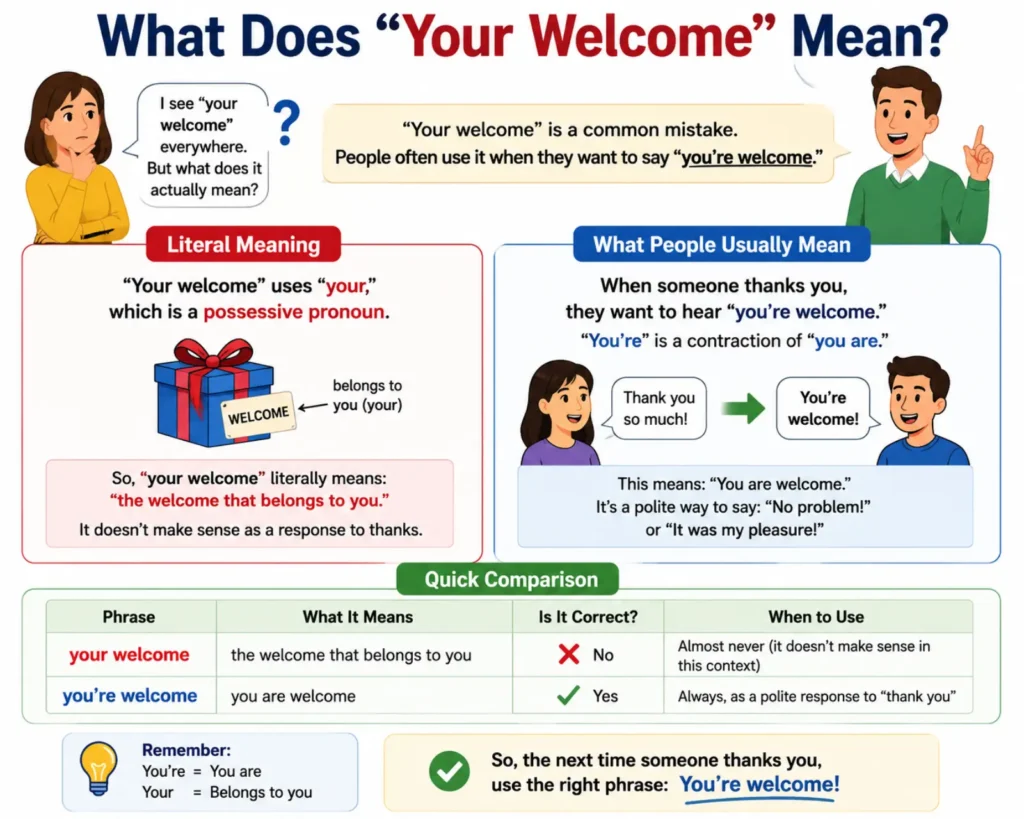
Your welcome is usually incorrect when used as a reply.
However, it can be correct in rare cases where “welcome” is a noun.
Correct usage examples:
- I liked your welcome speech.
- We enjoyed your welcome message.
- She read your welcome letter.
In these examples, “welcome” is part of a noun phrase, not a reply.
You’re Welcome vs Your Welcome (Simple Comparison)
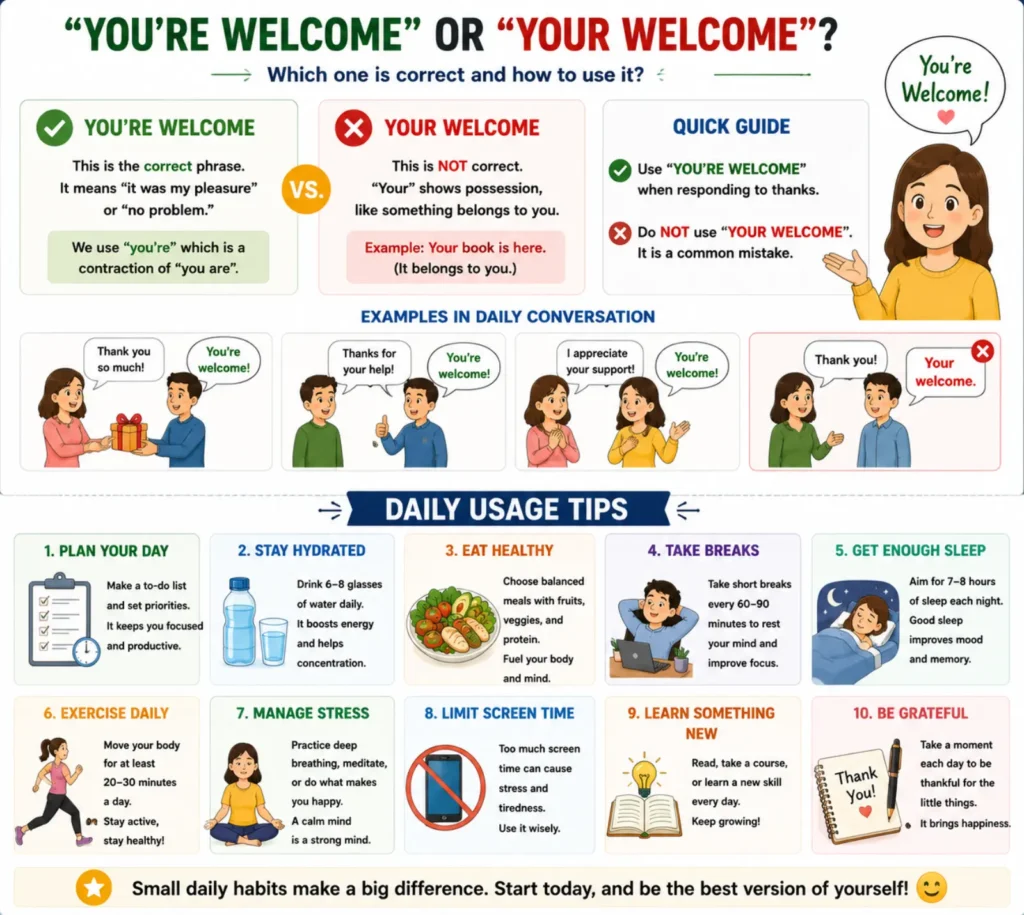
| Feature | You’re Welcome | Your Welcome |
|---|---|---|
| Grammar | Correct | Usually wrong |
| Meaning | You are welcome | Ownership phrase |
| Used after “Thank you” | Yes | No |
| Common usage | Very common | Rare |
Why People Get Confused
Many people confuse these words because they sound the same.
These are called homophones.
Main reasons for mistakes:
Simple Trick to Remember
Replace you’re with you are.
If the sentence still makes sense, it is correct.
Example:
- You’re welcome → You are welcome ✔
- Your welcome → Your are welcome ✘
Real-Life Examples
At School
Teacher: Thank you for your help.
Student: You’re welcome.
At Home
Mom: Thanks for cleaning.
Child: You’re welcome.
Online Chat
Friend: Thanks!
You: You’re welcome!
Common Mistakes with You’re Welcome or Your Welcome
Many learners make simple grammar errors when using these phrases.
Mistake 1: Using “your welcome” after thanks
❌ Thanks! Your welcome
✅ Thanks! You’re welcome
This is the most common error.
Mistake 2: Confusing you’re and your in sentences
❌ Your amazing
✅ You’re amazing
❌ Your right
✅ You’re right
Mistake 3: Writing fast on social media
People often skip grammar rules on:
- TikTok comments
This increases mistakes.
Is It Polite to Say “You’re Welcome”?
Yes, saying “you’re welcome” is polite and appropriate in most situations. People commonly use it after someone says “thank you.” It shows that you are happy to help and that you appreciate their thanks.
The phrase works well in both casual and professional conversations. For example, a friend might say, “Thanks for helping me,” and you can reply, “You’re welcome.”
In formal situations, “you’re welcome” also sounds respectful. However, you can choose other phrases depending on the situation. “My pleasure,” “glad to help,” and “of course” can sound warm and friendly.
When Should You Say “You’re Welcome”?
Use “you’re welcome” when:
- Someone thanks you for your help.
- Someone appreciates a favor you did.
- Someone thanks you for a gift or kind action.
- You want to respond in a friendly and respectful way.
Is “You’re Welcome” Too Formal?
No. “You’re welcome” is not too formal or too casual. It fits most everyday conversation
Is “You’re Welcome” Always the Right Response?
Not always. “You’re welcome” is polite, but the best response depends on the situation. It works well when someone thanks you for helping them, giving them something, or doing a kind favor.
However, other responses may sound more natural in casual conversations. For example, you can say “No problem,” “Of course,” “My pleasure,” or “Anytime.”
In professional settings, “You’re welcome” and “My pleasure” are usually safe choices. With friends, casual phrases can feel warmer and more relaxed.
The key is to match your response to the situation and your relationship with the other person. A simple, sincere response is usually better than choosing a phrase that feels unnatural.
Tips to Remember the Correct Usage
Use these simple tricks to avoid confusion:
Tip 1: The “You are” test
Replace you’re with you are.
- You’re welcome → You are welcome ✔
- Your welcome → Your are welcome ✘
Tip 2: Focus on meaning
- You’re = You are
- Your = Belonging
Tip 3: Slow down while typing
Many errors happen due to fast typing.
Tip 4: Read your sentence aloud
If it sounds wrong, it probably is wrong.
Synonyms of
You can also use other polite responses.
Formal options
- My pleasure
- It was my pleasure
- You’re very welcome
- Happy to help
Informal options
- No problem
- No worries
- Anytime
- Sure
Friendly tone
- Glad to help
- Don’t mention it
- Of course
Usage in Daily Life
At school
Teacher: Thanks for helping
Student: You’re welcome
At work
Manager: Thanks for finishing early
Employee: You’re welcome
Customer service
Agent: You’re welcome. Have a great day.
Online chats
Friend: Thanks!
You: You’re welcome!
Expert Insight (EEAT Section)
Correct grammar improves trust and communication.
Even small mistakes like your vs you’re can affect:
- Emails
- Job applications
- Academic writing
- Business communication
Using you’re welcome correctly shows:
- Attention to detail
- Strong communication skills
- Language accuracy
This is important for students, professionals, and content creators.
(FAQs)
1. Is it you’re welcome or your welcome?
It is you’re welcome when replying to “thank you.”
2. Why is your welcome wrong?
Because “your” shows ownership, not “you are.”
3. Can your welcome ever be correct?
Yes, only in phrases like your welcome speech or your welcome message.
4. What does you’re mean?
It means you are.
5. How do I remember the difference?
Replace “you’re” with “you are.” If it fits, it is correct.
6. Is you’re welcome formal or informal?
It works in both formal and informal situations.
7. What are other ways to say you’re welcome?
Expert Insights: Why This Grammar Topic Matters
Many people think small grammar mistakes do not matter. That is not true.
Correct usage of you’re welcome or your welcome shows strong English skills.
This matters in real life because:
- It improves communication clarity
- It builds trust in writing
- It helps in job applications
- It improves academic scores
- It strengthens professional emails
Even small mistakes like your vs you’re can change meaning completely.
Learning this rule is part of mastering basic English grammar.
Conclusion
Understanding you’re welcome or your welcome is simple once you know the rule.
The correct phrase is you’re welcome, which means you are welcome. It is used when someone thanks you.
The phrase your welcome is mostly incorrect in this situation. It only works when “welcome” is part of a noun phrase like your welcome speech or your welcome message.
The key rule is easy:
- You’re = You are
- Your = Shows ownership
Whenever someone says “thank you,” always reply with you’re welcome.
With practice, this difference becomes natural. Using the correct form improves your grammar, communication, and confidence in English writing.