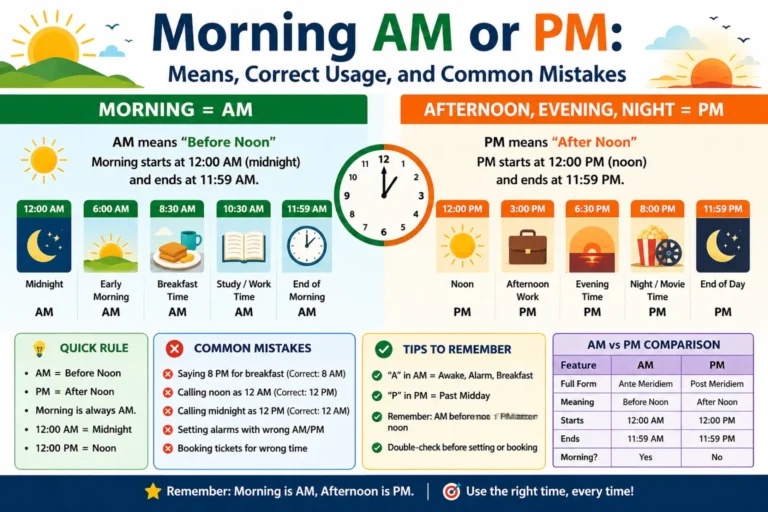
Morning AM or PM is a common question that confuses many people. You may see AM and PM on clocks, phones, schedules, and calendars every day. Still, many people wonder which one belongs to the morning.
The answer is simple. Morning uses AM, not PM.
However, things become confusing around 12:00 AM and 12:00 PM. Many people mix them up. This can lead to missed meetings, late flights, or incorrect alarms.
In this guide, you will learn the meaning of AM and PM in simple words. You will also discover easy examples, comparison tables, expert tips, and common mistakes to avoid. By the end, you will know exactly when to use AM and PM with confidence.
Quick Summary Box
- Morning is AM.
- AM means before noon.
- PM means after noon.
- Morning starts at 12:00 AM (midnight).
- Morning ends at 11:59 AM.
- 12:00 PM is noon, not morning.
- Use AM for all morning times.
- Use PM for afternoon, evening, and night.
What Does Morning AM or PM Mean?
Morning always uses AM.
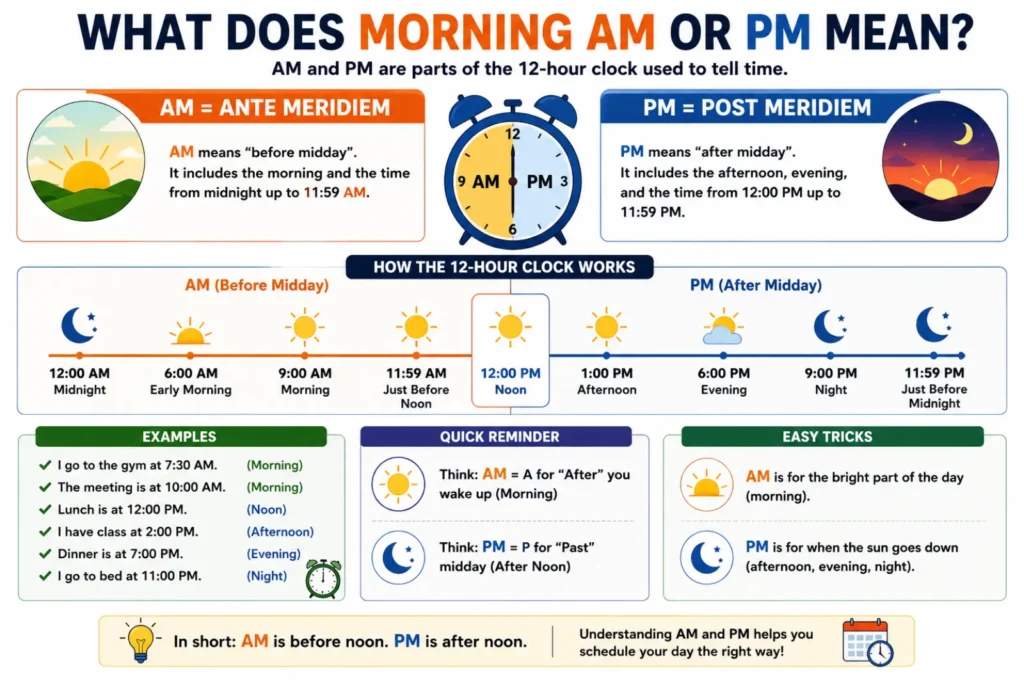
AM and PM divide the day into two 12-hour periods.
- AM = Before noon
- PM = After noon
Morning includes every hour from midnight until just before noon.
Morning Time Range
| Time | AM or PM | Part of Day |
|---|---|---|
| 12:00 AM | AM | Midnight |
| 1:00 AM | AM | Early morning |
| 6:00 AM | AM | Morning |
| 8:30 AM | AM | Morning |
| 11:59 AM | AM | Late morning |
| 12:00 PM | PM | Noon |
Featured Snippet Answer
Morning uses AM. AM covers the time from 12:00 AM (midnight) until 11:59 AM. PM begins at 12:00 PM (noon).
What Do AM and PM Stand For?
AM and PM come from Latin.
| Term | Full Form | Meaning |
|---|---|---|
| AM | Ante Meridiem | Before midday |
| PM | Post Meridiem | After midday |
The word meridiem means midday or noon.
So:
- Ante = Before
- Post = After
That makes remembering them much easier.
Is Morning AM or PM?
Morning is always AM.
Here are common morning times:
- 5:00 AM
- 6:30 AM
- 7:15 AM
- 8:45 AM
- 9:00 AM
- 10:30 AM
- 11:59 AM
These are all morning hours.
The moment the clock reaches 12:00 PM, afternoon begins.
Morning AM vs PM Comparison
| Feature | AM | PM |
|---|---|---|
| Meaning | Before noon | After noon |
| Starts | 12:00 AM | 12:00 PM |
| Ends | 11:59 AM | 11:59 PM |
| Morning? | Yes | No |
| Afternoon? | No | Yes |
| Evening? | No | Yes |
| Night? | Partly | Yes |
Quick Memory Trick
- AM = Awake and Morning
- PM = Past Midday
This simple trick helps many students remember the difference.
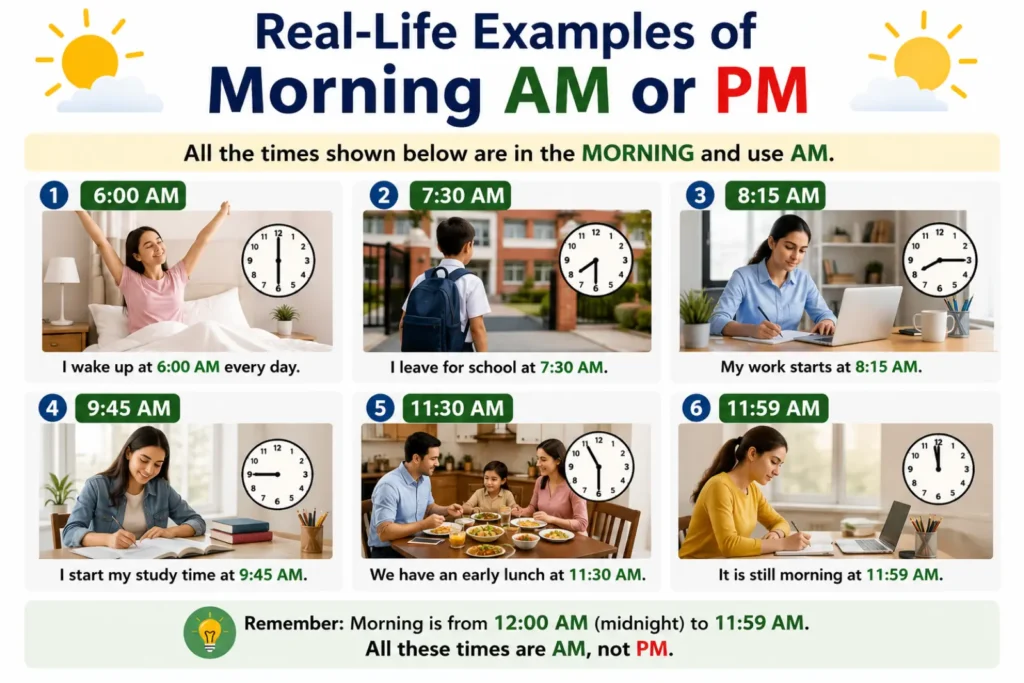
Real-Life Examples of Morning AM or PM
Understanding AM and PM becomes easier with daily examples.
Example 1
School starts at 8:00 AM.
That is morning.
Example 2
A doctor’s appointment is at 10:30 AM.
You should arrive before noon.
Example 3
Lunch begins at 12:00 PM.
This is no longer morning.
Example 4
A meeting starts at 3:00 PM.
That is afternoon.
Example 5
A movie begins at 8:00 PM.
That is evening.
Why Do People Confuse AM and PM?
Many people make mistakes because of two times:
- 12:00 AM
- 12:00 PM
These are the most confusing hours.
Easy Rule
- 12:00 AM = Midnight
- 12:00 PM = Noon
Everything before noon is AM.
Everything after noon is PM.
Common Mistakes to Avoid
Avoid these common errors.
Mistake 1
Writing 8 PM for breakfast.
Correct:
8 AM
Mistake 2
Calling noon 12 AM.
Correct:
12 PM
Mistake 3
Calling midnight 12 PM.
Correct:
12 AM
Mistake 4
Setting alarms incorrectly.
Always double-check AM and PM before saving.
Mistake 5
Booking flights for the wrong time.
Review the ticket carefully before confirming.
Tips to Remember Morning AM or PM
These simple tricks work well.
Remember “A”
AM starts with A.
Think:
- Awake
- Alarm
- Breakfast
These happen in the morning.
Remember “P”
PM starts with P.
Think:
- Picnic
- Play
- Party
These often happen later in the day.
Use Your Phone
Digital clocks clearly display AM and PM.
Always check before setting reminders.
Learn the 12 O’Clock Rule
- Midnight = 12 AM
- Noon = 12 PM
This solves most confusion.
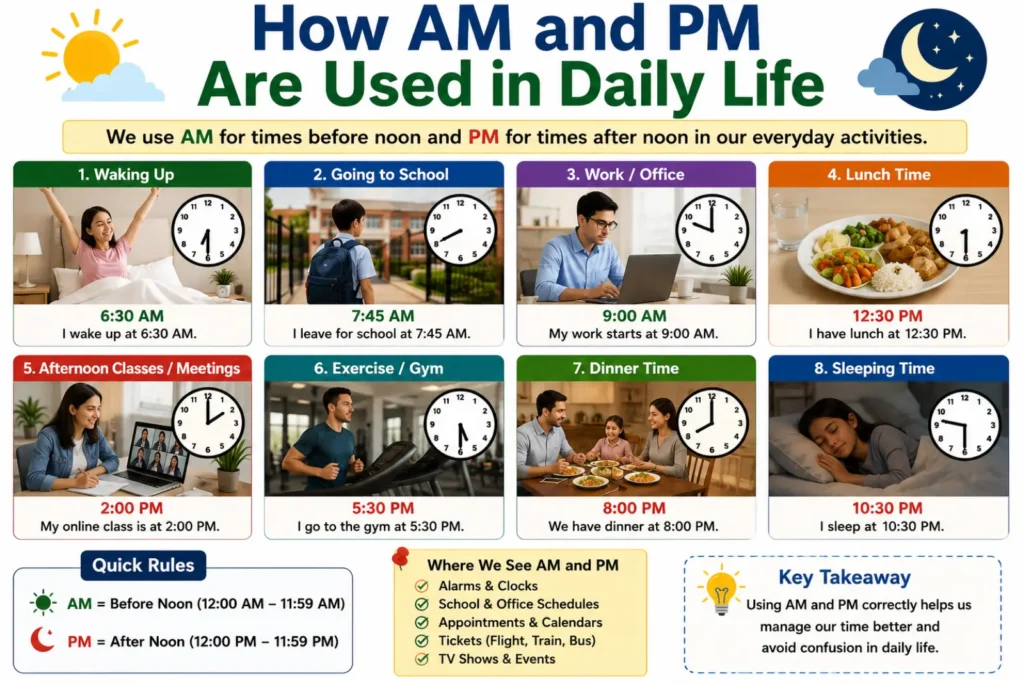
How AM and PM Are Used in Daily Life
People use AM and PM almost everywhere.
Examples include:
- School schedules
- Office meetings
- Hospital appointments
- Flight tickets
- TV programs
- Mobile alarms
- Online classes
- Restaurant reservations
Correct usage prevents missed appointments.
Morning AM or PM in Different Countries
Some countries use the 12-hour clock.
Examples include:
- United States
- Canada
- Australia
- Philippines
Other countries often use the 24-hour clock.
Examples include:
- Germany
- France
- Italy
- Japan
- India (common in transport and military)
Example
| 12-Hour | 24-Hour |
|---|---|
| 8:00 AM | 08:00 |
| 12:00 PM | 12:00 |
| 3:00 PM | 15:00 |
| 10:00 PM | 22:00 |
The 24-hour clock removes confusion.
Synonyms and Related Keywords
These related terms help explain the topic naturally.
Secondary Keywords
- morning time AM
- AM meaning
- PM meaning
- before noon
- after noon
- 12-hour clock
- morning hours
- afternoon time
- midnight vs noon
- AM vs PM
- time format
- digital clock
- morning schedule
Semantic Keywords
- clock notation
- daily schedule
- time system
- morning routine
- noon
- midnight
- calendar time
- work schedule
Expert Insights
Time mistakes seem small. However, they can create real problems.
Using the correct AM or PM helps you:
- Arrive on time.
- Avoid missing appointments.
- Schedule meetings correctly.
- Book travel without confusion.
- Communicate clearly.
Professionals often recommend using the 24-hour clock for travel, healthcare, and business. It reduces mistakes and improves accuracy.
If you use the 12-hour clock, always double-check the AM or PM label before confirming a schedule.
Frequently Asked Questions
Is morning AM or PM?
Morning is AM. It lasts from 12:00 AM until 11:59 AM.
Is 12 PM morning?
No.
12 PM is noon. Morning ends before noon.
Is 12 AM midnight?
Yes.
12 AM represents midnight and starts a new day.
Is 11:59 AM still morning?
Yes.
Morning continues until 11:59 AM.
Does PM mean night?
Not always.
PM includes afternoon, evening, and part of the night.
Why do people confuse 12 AM and 12 PM?
The change happens exactly at noon and midnight. These two times often confuse people.
Should I use the 24-hour clock?
Yes, if you want to avoid confusion. It clearly separates morning and afternoon times.
Conclusion
Understanding morning AM or PM is easier than many people think. Morning always uses AM, which covers the time from 12:00 AM (midnight) to 11:59 AM. After that, 12:00 PM marks the start of the afternoon. Remembering the difference between midnight and noon helps you avoid common scheduling mistakes. Whether you are setting an alarm, booking a flight, attending school, or planning a meeting, using the correct time notation is important. If you ever feel unsure, remember this simple rule: AM comes before noon, and PM comes after noon. With this knowledge, you can read and use the 12-hour clock accurately every day.