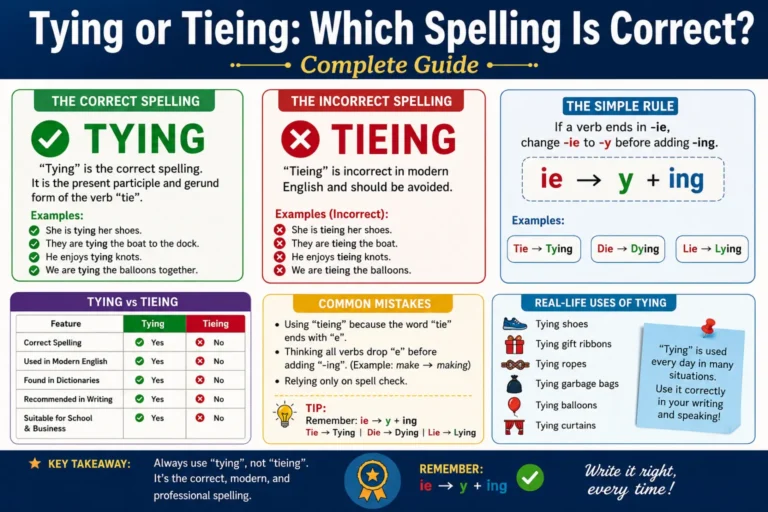
Tying or tieing is a common spelling question in English. Many people wonder which form is correct. The short answer is simple. Tying is the correct spelling. Tieing is almost always incorrect in modern English.
This spelling rule confuses students, writers, and even native English speakers. The word “tie” ends with the letter e, so many expect the ending to become tieing. However, English follows a different rule here. When adding -ing to tie, the e changes to y, creating tying.
This guide explains the difference in simple words. You will also see examples, spelling rules, common mistakes, expert tips, and answers to popular questions.
Quick Summary
- Correct spelling: Tying ✅
- Incorrect spelling: Tieing ❌
- Meaning: The act of making a knot or fastening something.
- Rule: The verb tie changes to tying when adding -ing.
- Example: She is tying her shoes.
- Remember: English spelling changes the ending for this word.
What Does “Tying” Mean?
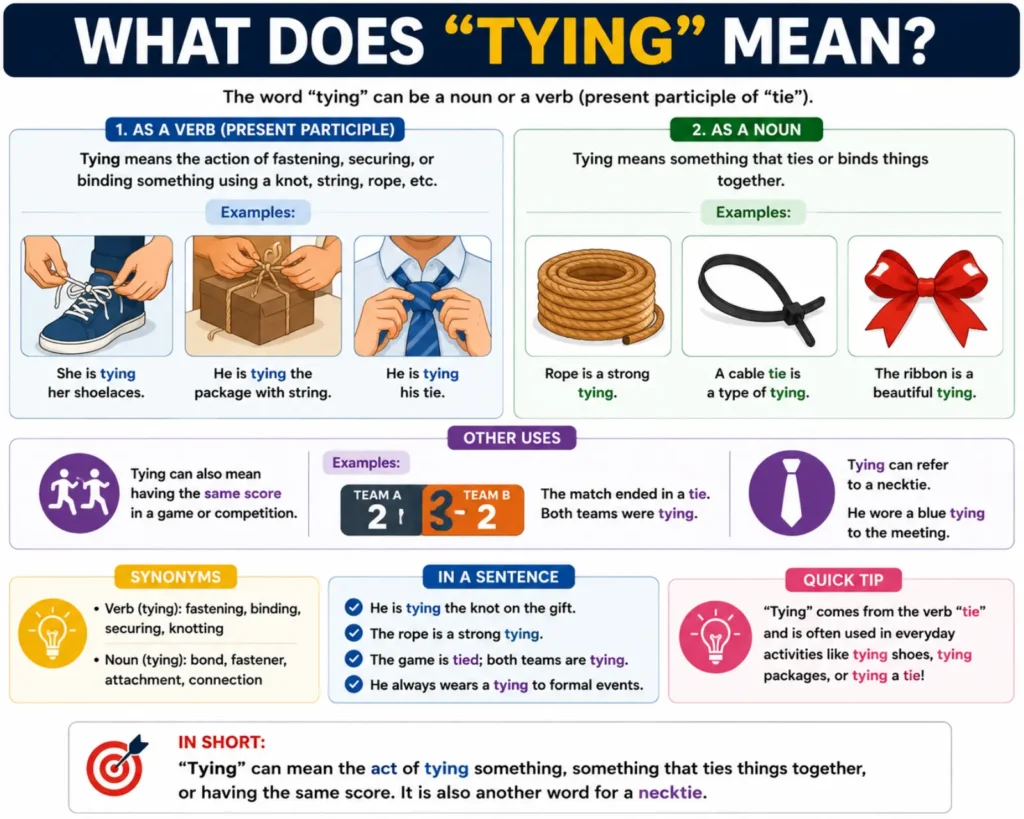
Tying is the present participle and gerund form of the verb tie.
It means:
- Making a knot
- Fastening something
- Connecting objects together
- Securing an item with string, rope, ribbon, or similar material
Examples
- He is tying his shoelaces.
- They are tying the boat to the dock.
- She enjoys tying gift ribbons.
- We are tying the balloons together.
Is “Tieing” a Word?
In modern English, tieing is considered incorrect.
Most dictionaries, grammar guides, and style manuals recommend using tying.
Some very old documents used tieing, but modern writing almost never accepts it.
Correct
- I am tying my shoes.
Incorrect
- I am tieing my shoes.
Tying vs Tieing: Comparison Table
| Feature | Tying | Tieing |
|---|---|---|
| Correct spelling | ✅ Yes | ❌ No |
| Used in modern English | ✅ Yes | ❌ Rare |
| Found in dictionaries | ✅ Yes | ❌ Usually no |
| Recommended in writing | ✅ Yes | ❌ No |
| Suitable for school and business | ✅ Yes | ❌ No |
Why Is “Tying” Correct?
English has many spelling rules.
Most verbs ending in e simply drop the e before adding -ing.
Examples:
- Make → Making
- Bake → Baking
- Smile → Smiling
However, tie is an exception.
Instead of becoming tieing, it changes to:
- Tie → Tying
The same happens with similar words.
Examples:
- Die → Dying
- Lie → Lying
This spelling makes the word easier to read and pronounce.
Simple Rule to Remember
Use this easy rule:
If the verb ends in -ie, change ie to y before adding -ing.
Examples:
| Base Verb | Correct -ing Form |
|---|---|
| Tie | Tying |
| Die | Dying |
| Lie | Lying |
This rule helps avoid common spelling mistakes.
Real-Life Examples of Tying
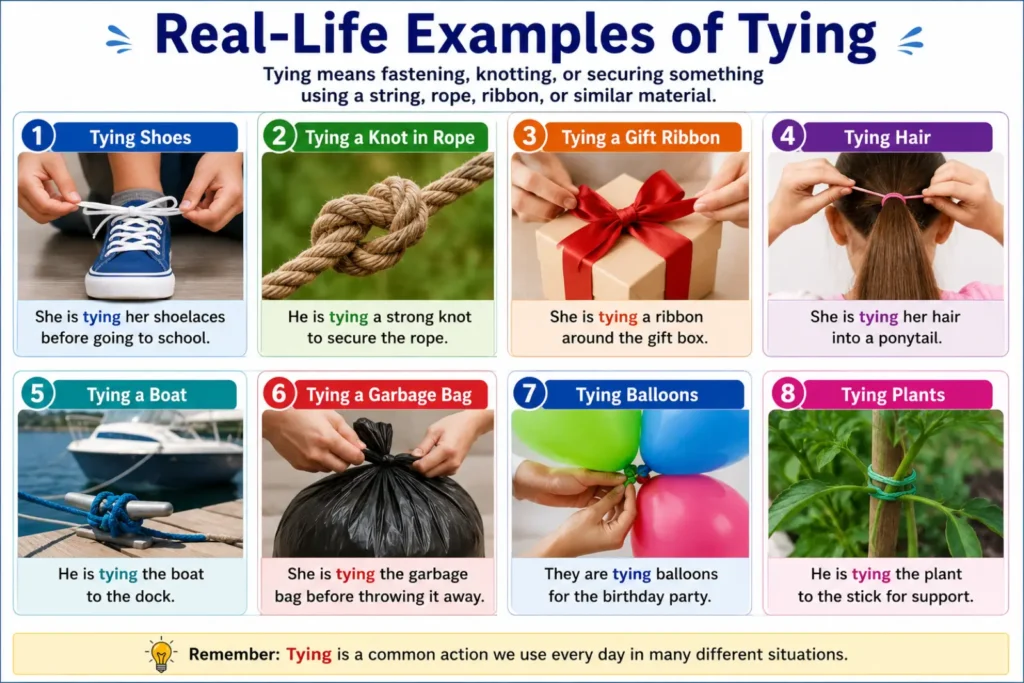
Here are everyday situations where people use tying.
At Home
- She is tying the trash bag.
- Dad is tying the curtains.
At School
- The teacher is tying a ribbon around the project.
- Students are tying craft materials together.
In Sports
- Players spend time tying their shoes.
- Climbers practice tying secure knots.
At Work
- Workers are tying cables together.
- Florists enjoy tying flower bouquets.
Common Mistakes People Make
Many learners write tieing because they apply the wrong spelling rule.
Mistake 1
❌ Tieing
✅ Tying
Mistake 2
Thinking every verb ending with e only drops the e.
This works for:
- Bake → Baking
But not for:
- Tie → Tying
Mistake 3
Using spell check alone.
Some outdated software may not flag every error.
Always verify unusual spellings.
Tying in Daily Life
You probably use the word tying every day.
Examples include:
- Tying shoes
- Tying gift ribbons
- Tying fishing hooks
- Tying garbage bags
- Tying hair
- Tying ropes
- Tying balloons
- Tying camping knots
Because it appears so often, learning the correct spelling is important.
Examples in Sentences
Here are more examples.
- She is tying her apron.
- We are tying the rope tightly.
- The child is tying his first knot.
- He finished tying the package.
- They kept tying decorations around the room.
- I learned tying techniques in camping class.
- She enjoys tying friendship bracelets.
- They are tying vines to support poles.
Synonyms and Related Keywords
These words relate to tying.
Synonyms
- Fastening
- Securing
- Binding
- Knotting
- Connecting
- Attaching
- Wrapping
- Joining
- Linking
- Fixing
Related Search Terms
- tying meaning
- tying definition
- tying spelling
- tieing vs tying
- how to spell tying
- correct spelling of tying
- tying grammar
- tie spelling rule
- tying examples
- tying in English
Grammar Rule Explained Simply
Let’s simplify it.
When a verb ends with -ie, replace ie with y before adding -ing.
Formula:
Verb + ie → y + ing
Examples:
- Tie → Tying
- Die → Dying
- Lie → Lying
This rule prevents awkward spellings and improves readability.
Why This Spelling Matters
Correct spelling builds trust.
Whether you write emails, school assignments, blogs, or business documents, using tying shows attention to detail.
Incorrect spelling can:
- Reduce credibility
- Cause confusion
- Hurt academic writing
- Affect professional communication
- Lower SEO quality if repeated throughout online content
Good spelling improves both readability and search engine performance.
Expert Insights
Professional editors and grammar experts agree on one point.
Always use tying in modern English.
Here are a few best practices:
- Learn the ie → y spelling rule.
- Read your work before publishing.
- Use trusted dictionaries for confirmation.
- Avoid copying outdated spellings from old texts.
- Practice with real sentences.
Writers who use correct grammar create stronger content. Search engines also favor clear, high-quality writing that helps readers.
Frequently Asked Questions
Is tying or tieing correct?
Tying is correct. Tieing is considered incorrect in modern English.
Why is it spelled tying instead of tieing?
Because verbs ending in -ie change ie to y before adding -ing.
Is tieing ever acceptable?
It appears in some historical texts, but modern English uses tying.
How do you remember the spelling?
Remember this rule:
ie → y + ing
Tie becomes tying.
Is tying a verb?
Yes. It is the present participle and gerund form of tie.
What is an example of tying?
Example:
“She is tying her shoelaces before school.”
Do dictionaries recognize tieing?
Most modern dictionaries recommend tying as the correct spelling.
Is tying used in formal writing?
Yes. It is the standard spelling for academic, business, and professional writing.
Conclusion
Many people ask whether tying or tieing is correct. The answer is clear. Tying is the standard spelling used in modern English. The form tieing is outdated and should be avoided in school, work, and everyday writing.
The easiest way to remember the rule is this: verbs ending in -ie change ie to y before adding -ing. That is why tie becomes tying, just as die becomes dying and lie becomes lying. Once you understand this pattern, you can spell these words with confidence. Using the correct form improves clarity, strengthens your writing, and helps you communicate more effectively.