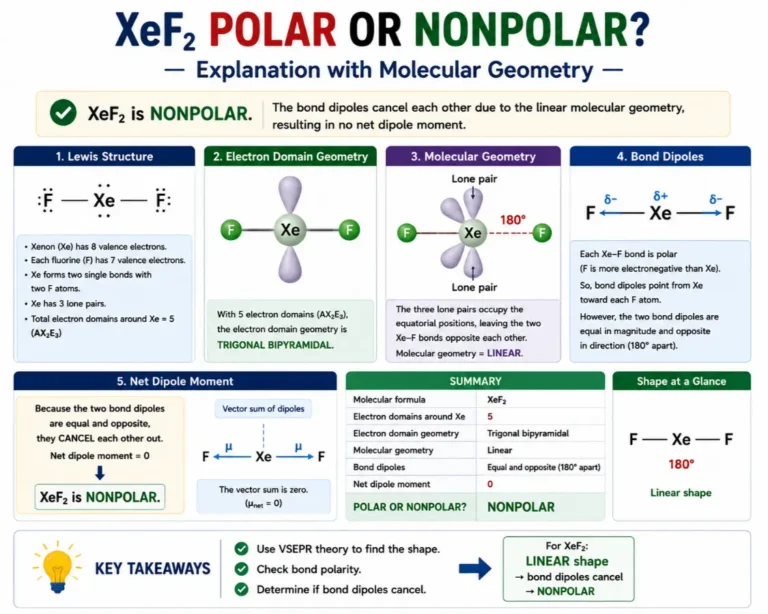
XeF2 polar or nonpolar is a common chemistry question for students learning molecular polarity. The answer depends on both bond polarity and molecular shape. Xenon difluoride (XeF2) contains two fluorine atoms bonded to one xenon atom. Although each Xe–F bond is polar, the molecule has a symmetrical linear shape. This symmetry causes the bond dipoles to cancel each other. As a result, XeF2 is a nonpolar molecule.
Understanding why XeF2 is nonpolar helps you solve similar chemistry questions. It also builds a strong foundation for topics like molecular geometry, electronegativity, and chemical bonding. In this guide, you will learn the structure, polarity, and properties of XeF2 using simple language and practical examples.
Quick Summary
Is XeF2 Polar or Nonpolar?
- XeF2 is a nonpolar molecule.
- It contains two polar Xe–F bonds.
- The molecule has a linear shape.
- Three lone pairs remain on the xenon atom.
- Bond dipoles cancel each other.
- The overall dipole moment is zero.
- Molecular geometry determines its polarity.
What Is XeF2?
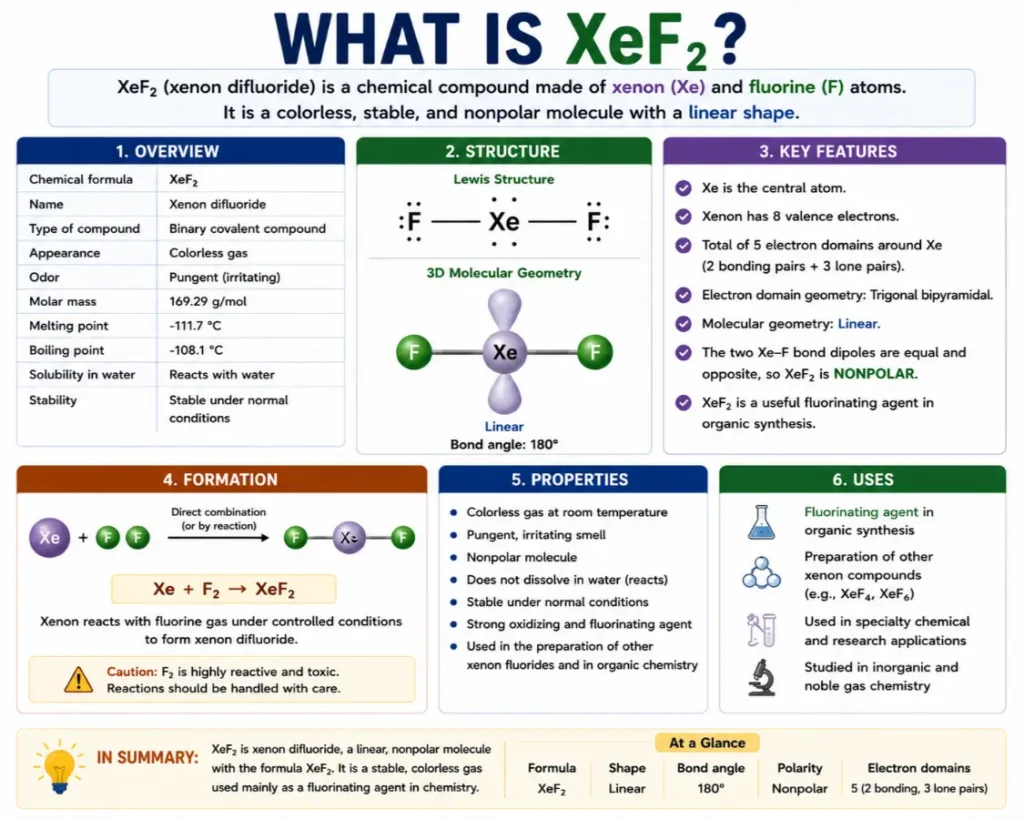
XeF2 stands for xenon difluoride.
It is a compound made from:
- One xenon atom (Xe)
- Two fluorine atoms (F)
XeF2 belongs to the group of noble gas compounds. Xenon, once considered completely inert, can form compounds with highly electronegative elements like fluorine.
Key Facts
| Property | Value |
|---|---|
| Chemical Formula | XeF2 |
| Central Atom | Xenon (Xe) |
| Bond Type | Polar covalent |
| Molecular Geometry | Linear |
| Electron Geometry | Trigonal bipyramidal |
| Polarity | Nonpolar |
| Dipole Moment | Zero |
Why Is XeF2 Nonpolar?
XeF2 contains two polar covalent bonds.
Fluorine attracts shared electrons more strongly than xenon.
This creates bond dipoles.
However, polarity depends on the entire molecule, not only individual bonds.
The fluorine atoms lie directly opposite each other.
Their bond dipoles point in opposite directions.
Since they have equal strength, they cancel completely.
Therefore, XeF2 has no permanent dipole moment.
Simple Rule
Polar bonds + Symmetrical shape = Nonpolar molecule
Understanding the Lewis Structure of XeF2
The Lewis structure explains how atoms and electrons are arranged.
XeF2 has:
- One xenon atom
- Two fluorine atoms
- Three lone pairs on xenon
- Three lone pairs on each fluorine atom
The lone pairs occupy the equatorial positions.
The fluorine atoms occupy opposite axial positions.
This arrangement minimizes electron repulsion.
As a result, the molecule becomes linear.
Molecular Geometry of XeF2
Molecular geometry describes the shape of a molecule.
XeF2 has five regions of electron density around xenon.
These include:
- Two bonding pairs
- Three lone pairs
According to VSEPR theory, five electron regions create a trigonal bipyramidal electron geometry.
However, the three lone pairs occupy the equatorial positions.
Only the two fluorine atoms remain visible in the molecular shape.
Therefore, XeF2 has a linear molecular geometry.
Shape Summary
- Electron Geometry: Trigonal bipyramidal
- Molecular Geometry: Linear
- Bond Angle: 180°
Electronegativity and Bond Polarity
Electronegativity measures how strongly an atom attracts shared electrons.
Fluorine is the most electronegative element.
Approximate values are:
- Xenon = 2.60
- Fluorine = 3.98
Electronegativity Difference
3.98 − 2.60 = 1.38
This difference creates polar Xe–F bonds.
However, because the molecule is perfectly symmetrical, the bond dipoles cancel.
The molecule remains nonpolar.
Does XeF2 Have a Dipole Moment?
No.
XeF2 has an overall dipole moment of zero.
Each Xe–F bond has its own dipole.
The two dipoles point in opposite directions.
Since they have equal magnitude, they cancel each other.
The result is a molecule with no permanent dipole.
This explains why XeF2 is classified as nonpolar.
Bond Polarity vs Molecular Polarity
Many students confuse these two concepts.
They are not the same.
Bond Polarity
Bond polarity depends on the electronegativity difference between two bonded atoms.
The Xe–F bond is polar.
Molecular Polarity
Molecular polarity depends on:
- Bond polarity
- Molecular shape
- Dipole cancellation
Even though XeF2 contains polar bonds, the overall molecule is nonpolar because its shape is symmetrical.
Real-Life Importance of XeF2
XeF2 is mainly used in chemistry laboratories and the electronics industry.
Some applications include:
Semiconductor Manufacturing
XeF2 etches silicon during microchip production.
It removes silicon without damaging many other materials.
Chemical Research
Scientists use XeF2 to study noble gas chemistry.
It helped prove that noble gases can form stable compounds.
Fluorinating Agent
XeF2 transfers fluorine atoms during certain chemical reactions.
This property makes it useful in organic and inorganic chemistry.
Understanding its polarity helps chemists predict how it behaves during these reactions.
XeF2 vs XeF4 vs XeF6: Polarity Comparison
Many students compare XeF2 with other xenon fluorides. Their molecular shapes determine whether they are polar or nonpolar.
| Molecule | Molecular Shape | Polar or Nonpolar? | Reason |
|---|---|---|---|
| XeF2 | Linear | Nonpolar | Bond dipoles cancel completely. |
| XeF4 | Square planar | Nonpolar | Symmetrical structure cancels dipoles. |
| XeF6 | Distorted octahedral | Polar | Asymmetrical shape creates a net dipole. |
| CO2 | Linear | Nonpolar | Opposite bond dipoles cancel. |
| H2O | Bent | Polar | Dipoles do not cancel. |
What Can You Learn?
A molecule may contain polar bonds but still be nonpolar.
The final answer depends on molecular geometry and dipole cancellation.
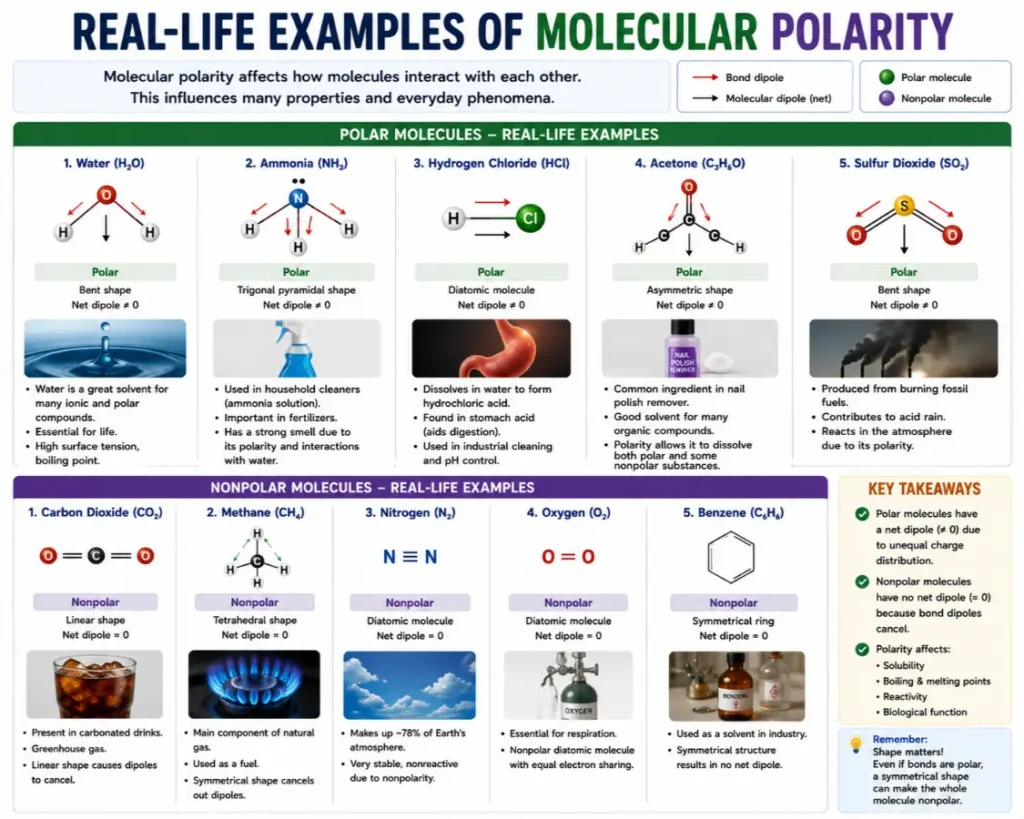
Real-Life Examples of Molecular Polarity
Understanding polarity helps explain many everyday chemical behaviors.
Water
Water is polar.
Its polarity allows it to dissolve many substances.
Carbon Dioxide
Carbon dioxide is nonpolar.
Its linear shape cancels the bond dipoles.
Oxygen
Oxygen gas is nonpolar because it contains identical atoms.
Xenon Difluoride
XeF2 is another example of a nonpolar molecule with polar bonds.
These examples show why molecular shape is just as important as bond polarity.
Common Mistakes Students Make
Students often make simple mistakes when determining molecular polarity.
Mistake 1: Looking Only at Bond Polarity
Polar bonds do not always produce a polar molecule.
Always examine the complete molecular shape.
Mistake 2: Ignoring Lone Pairs
Lone pairs affect molecular geometry.
Ignoring them often leads to the wrong answer.
Mistake 3: Confusing Electron Geometry with Molecular Geometry
Electron geometry and molecular geometry are different.
For XeF2:
- Electron geometry is trigonal bipyramidal.
- Molecular geometry is linear.
Mistake 4: Forgetting Dipole Cancellation
Always ask whether the bond dipoles cancel each other.
If they cancel completely, the molecule is nonpolar.
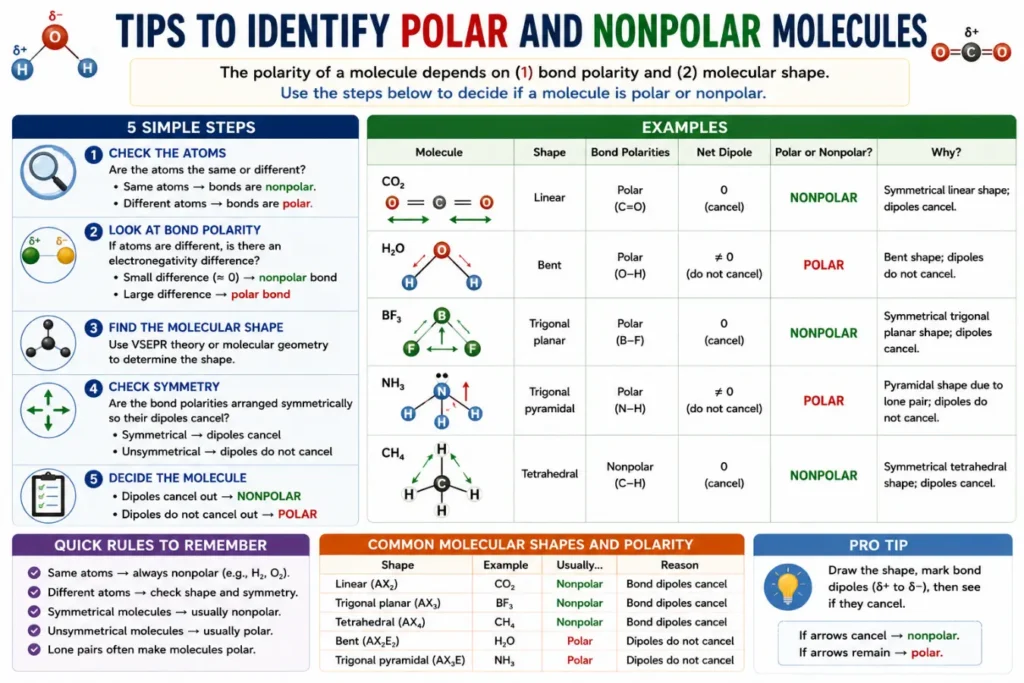
Tips to Identify Polar and Nonpolar Molecules
Use these simple steps whenever you study molecular polarity.
Step 1
Draw the Lewis structure.
Step 2
Determine the electron geometry using VSEPR theory.
Step 3
Find the molecular geometry.
Step 4
Identify polar bonds.
Step 5
Check whether the dipoles cancel.
Following these steps makes polarity questions much easier.
Synonyms and Related Keywords
Using related keywords naturally improves topical relevance and SEO.
Some useful LSI keywords include:
- XeF2 polarity
- xenon difluoride polarity
- is XeF2 polar
- XeF2 molecular geometry
- XeF2 Lewis structure
- XeF2 bond polarity
- nonpolar molecules
- polar molecules
- molecular polarity
- VSEPR theory
- electronegativity
- dipole moment
- chemical bonding
- noble gas compounds
- XeF2 structure
Include these terms naturally throughout your content.
Expert Insight
Professional chemists determine molecular polarity by combining three key concepts.
- Bond polarity
- Molecular geometry
- Dipole moment
XeF2 is an excellent example because it teaches that polar bonds alone do not determine molecular polarity.
Many chemistry students remember this molecule because its linear shape perfectly cancels the two Xe–F bond dipoles.
Mastering XeF2 also makes it easier to understand molecules such as CO2, XeF4, XeF6, and SF6.
Frequently Asked Questions
Is XeF2 polar or nonpolar?
XeF2 is a nonpolar molecule because its linear shape cancels the bond dipoles.
Why is XeF2 nonpolar?
Its two Xe–F bond dipoles point in opposite directions and cancel each other.
Is the Xe–F bond polar?
Yes. Fluorine attracts electrons more strongly than xenon, making each bond polar.
What is the molecular geometry of XeF2?
XeF2 has a linear molecular geometry.
Does XeF2 have a dipole moment?
No. Its overall dipole moment is zero.
Why does XeF2 have three lone pairs?
Xenon has enough valence electrons to accommodate three lone pairs while forming two bonds.
Is XeF2 ionic or covalent?
XeF2 is a covalent compound with polar covalent bonds.
Why is XeF6 polar but XeF2 is nonpolar?
XeF6 has an asymmetrical molecular shape.
XeF2 has a symmetrical linear structure that cancels dipoles.
Conclusion
The answer to “XeF2 polar or nonpolar” is straightforward. XeF2 is a nonpolar molecule because its linear molecular geometry causes the two polar Xe–F bond dipoles to cancel completely. Although fluorine is much more electronegative than xenon, the molecule remains symmetrical, resulting in a zero net dipole moment.
When determining molecular polarity, always consider more than bond polarity. Draw the Lewis structure, identify the molecular geometry, and check whether the dipoles cancel. This method works for XeF2 and many other molecules. Understanding these concepts will improve your knowledge of chemical bonding, molecular geometry, and VSEPR theory while helping you answer chemistry questions with confidence.