Worst or worse is a common grammar question that confuses many English learners and native speakers. These two words look similar, but they have different meanings and uses. Knowing the difference helps you write and speak more clearly.
Many people use these words in emails, schoolwork, social media, and daily conversations. However, using the wrong one can change the meaning of your sentence.
In this guide, you will learn the meaning of worst and worse in simple English. You will also see examples, comparison tables, common mistakes, expert tips, and answers to common questions. By the end, you will know exactly when to use each word with confidence.
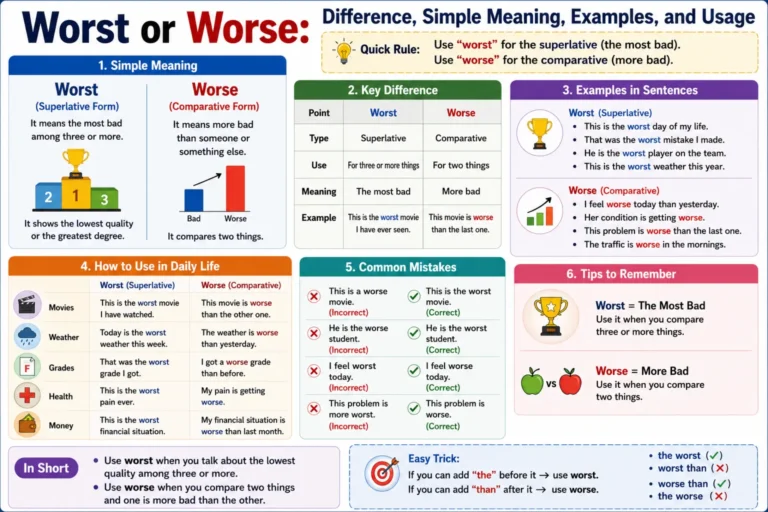
Quick Summary Box
- Worse compares two things.
- Worst compares three or more things.
- Worse is the comparative form of bad.
- Worst is the superlative form of bad.
- Use worse when something is less good than another.
- Use worst when something is the least good of all.
- Remember: Bad → Worse → Worst
Featured Snippet: Worst vs Worse
| Word | Meaning | When to Use | Example |
|---|---|---|---|
| Worse | More bad than another | Compare two things | Today is worse than yesterday. |
| Worst | Most bad of all | Compare three or more things | This is the worst movie I have seen. |
What Does “Worst or Worse” Mean?
Many people search for worst or worse because they are unsure which word fits their sentence.
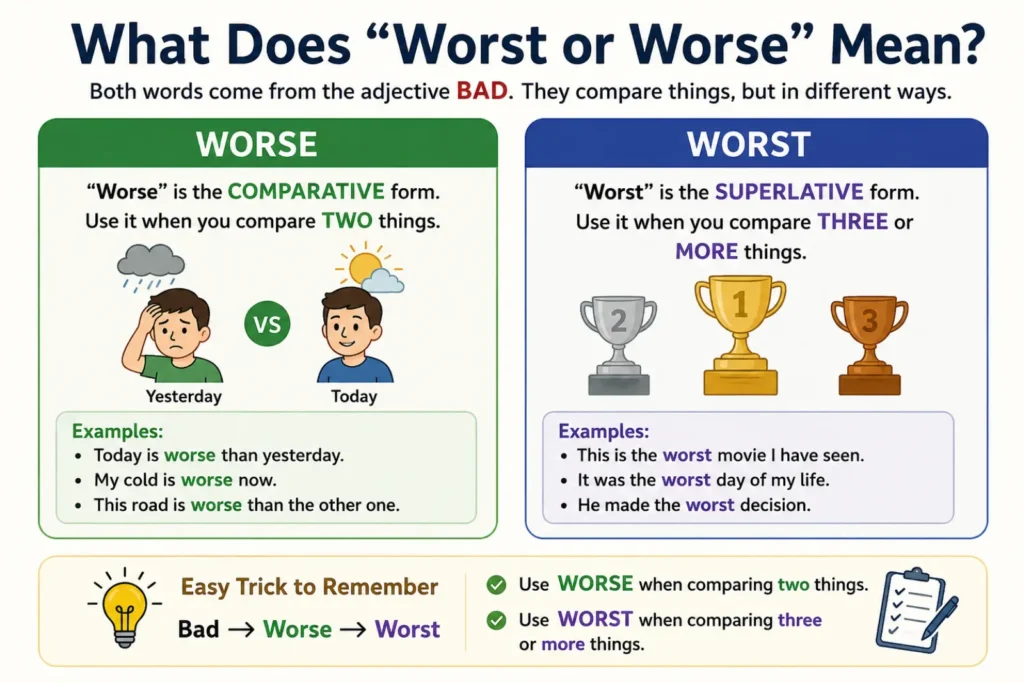
Both words come from the adjective bad.
The forms are:
- Bad
- Worse
- Worst
Think of it like this:
- Good
- Better
- Best
Similarly:
- Bad
- Worse
- Worst
The difference depends on how many things you compare.
What Is “Worse”?
Worse is the comparative adjective.
Use it when you compare two people, places, things, or situations.
Formula
Subject + is + worse + than + another subject
Examples
- Today feels worse than yesterday.
- My headache is worse now.
- This road is worse than the other one.
- Her grades became worse this semester.
- Winter is worse than autumn for driving.
Notice that every sentence compares two things.
What Is “Worst”?
Worst is the superlative adjective.
Use it when you compare three or more things or talk about the lowest level.
Examples
- This is the worst day of my life.
- It was the worst hotel in the city.
- He made the worst decision.
- That was the worst meal I have ever eaten.
- This is our team’s worst performance this year.
Here, the speaker chooses one item as the lowest among many.
Worst vs Worse: Complete Comparison Table
| Feature | Worse | Worst |
|---|---|---|
| Grammar form | Comparative | Superlative |
| Compares | Two things | Three or more things |
| Meaning | More bad | Most bad |
| Often used with | Than | The |
| Example | This phone is worse than mine. | This is the worst phone here. |
| Degree | Higher than bad | Highest level of bad |
Easy Trick to Remember the Difference
A simple memory trick makes this grammar rule easy.
Think about the endings.
- Worse has fewer letters.
- It compares only two things.
Worst ends with -st, just like:
- Best
- Fastest
- Smallest
- Strongest
Words ending in -st often show the highest or lowest degree.
Remember this pattern:
Bad → Worse → Worst
Real-Life Examples of Worst and Worse
At School
✅ My math score is worse than last week’s.
✅ This was my worst exam.
At Work
✅ Business became worse this month.
✅ It was the worst sales year.
Health
✅ My cough feels worse today.
✅ That was the worst headache I ever had.
Weather
✅ Today’s weather is worse than yesterday’s.
✅ Last winter was the worst in years.
Sports
✅ Our defense became worse after halftime.
✅ That was our team’s worst loss.
Common Mistakes People Make
Many English learners mix these words.
Here are common mistakes.
Mistake 1
❌ This is worse movie.
✅ This is the worst movie.
Mistake 2
❌ Today is worst than yesterday.
✅ Today is worse than yesterday.
Mistake 3
❌ She is the worse player.
✅ She is the worst player.
Mistake 4
❌ That was my worse mistake.
✅ That was my worst mistake.
Mistake 5
❌ This food is the worse.
✅ This food is the worst.
Tips to Use Worst and Worse Correctly
Follow these simple tips.
Use “worse” when:
- Comparing two choices.
- You see the word than.
- Something becomes more bad.
Examples:
- This route is worse than the other.
- My cold became worse.
Use “worst” when:
- Talking about the lowest quality.
- Comparing three or more things.
- Using phrases like “the worst.”
Examples:
- This is the worst option.
- He had the worst luck.
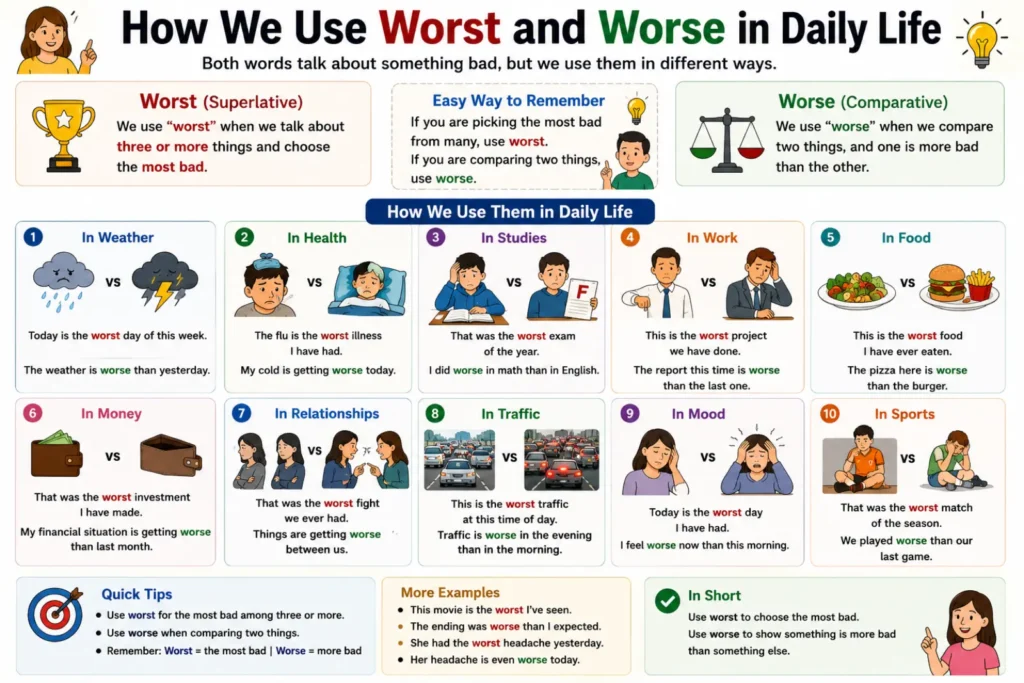
How We Use Worst and Worse in Daily Life
These words appear everywhere.
Conversations
- My internet is worse today.
- That was the worst traffic ever.
School
- This chapter is worse than the last.
- It was the worst project.
Business
- Sales became worse.
- Last quarter was the worst.
News
- Conditions became worse overnight.
- It was the worst storm in decades.
Synonyms and Related Keywords
Using related words improves your vocabulary.
Synonyms for Worse
- Poorer
- Inferior
- More difficult
- More harmful
- Less effective
- More unpleasant
Synonyms for Worst
- Poorest
- Lowest
- Most harmful
- Most difficult
- Most disappointing
- Least effective
Related Search Terms
- worse meaning
- worst meaning
- worst vs worse
- difference between worst and worse
- when to use worse
- when to use worst
- grammar rules for worse and worst
- worse or worst examples
- comparative and superlative adjectives
- English grammar guide
Grammar Rule Explained Simply
English adjectives often have three forms.
| Positive | Comparative | Superlative |
|---|---|---|
| Good | Better | Best |
| Bad | Worse | Worst |
| Small | Smaller | Smallest |
| Fast | Faster | Fastest |
This pattern helps you choose the correct word.
Expert Insights: Why This Grammar Rule Matters
Grammar mistakes can affect clarity.
Using worse and worst correctly makes your writing easier to understand. It also helps in school assignments, job applications, professional emails, and online content.
Search engines also reward high-quality content with clear grammar and better readability. Accurate word choice improves user trust, which supports Google’s Experience, Expertise, Authoritativeness, and Trustworthiness (E-E-A-T) principles.
A simple grammar improvement can make your communication look more polished and professional.
(FAQs)
Is it “worse” or “worst”?
Use worse to compare two things. Use worst to compare three or more things or describe the lowest level.
Which is correct: worse than or worst than?
Worse than is correct.
Example:
“My health is worse than yesterday.”
Can I say “the worse”?
Usually, no.
Most sentences need the worst.
Example:
“This is the worst option.”
Is worse an adjective?
Yes.
It is the comparative form of bad.
Is worst a superlative adjective?
Yes.
It describes the lowest or most negative quality among three or more items.
What is the order?
The correct order is:
Bad → Worse → Worst
Can “worse” be an adverb?
Yes.
Example:
“He sings worse than his brother.”
Why do people confuse worst and worse?
They sound similar and both come from bad. However, one compares two things, while the other compares three or more.
Conclusion
Understanding worst or worse becomes easy once you know the basic rule. Use worse when comparing two things. Use worst when talking about the lowest point among three or more things. Remember the simple pattern: Bad → Worse → Worst. This rule applies in everyday conversations, academic writing, business communication, and online content.
Practice by writing your own sentences and checking whether you compare two things or many. Over time, choosing the correct word will become natural. Small grammar improvements make your writing clearer, more professional, and easier for readers to understand.