Benefitting or benefiting is a common spelling question that confuses many English learners and writers. Both spellings exist, but they are not always used in the same places. The correct choice often depends on the type of English you use. Understanding the difference helps you write with confidence. It also makes your writing look more professional. In this guide, you will learn the meaning of both spellings, when to use each one, and how to avoid common mistakes. We will also look at examples, grammar rules, and expert writing tips. By the end, you will know exactly which spelling fits your audience and writing style.
Quick Summary Box
- Benefiting is the standard American English spelling.
- Benefitting is commonly accepted in British English.
- Both words mean receiving an advantage or gaining something helpful.
- The difference comes from regional spelling rules.
- Always stay consistent throughout your writing.
- Choose the spelling based on your target audience.
What Does “Benefiting” Mean?
The word benefiting comes from the verb benefit.
It means:
- Receiving help
- Gaining an advantage
- Improving because of something
- Getting positive results
Simple Definition
Benefiting means gaining something useful or helpful from a person, action, or situation.
Examples
- Students are benefiting from online learning.
- Many families are benefiting from lower energy bills.
- Small businesses are benefiting from digital marketing.
What Does “Benefitting” Mean?
Benefitting has the same meaning as benefiting.
The only difference is the spelling.
British English often doubles the final t before adding -ing.
Examples
- Local schools are benefitting from extra funding.
- Many workers are benefitting from flexible schedules.
- Farmers are benefitting from improved irrigation systems.
The meaning never changes.
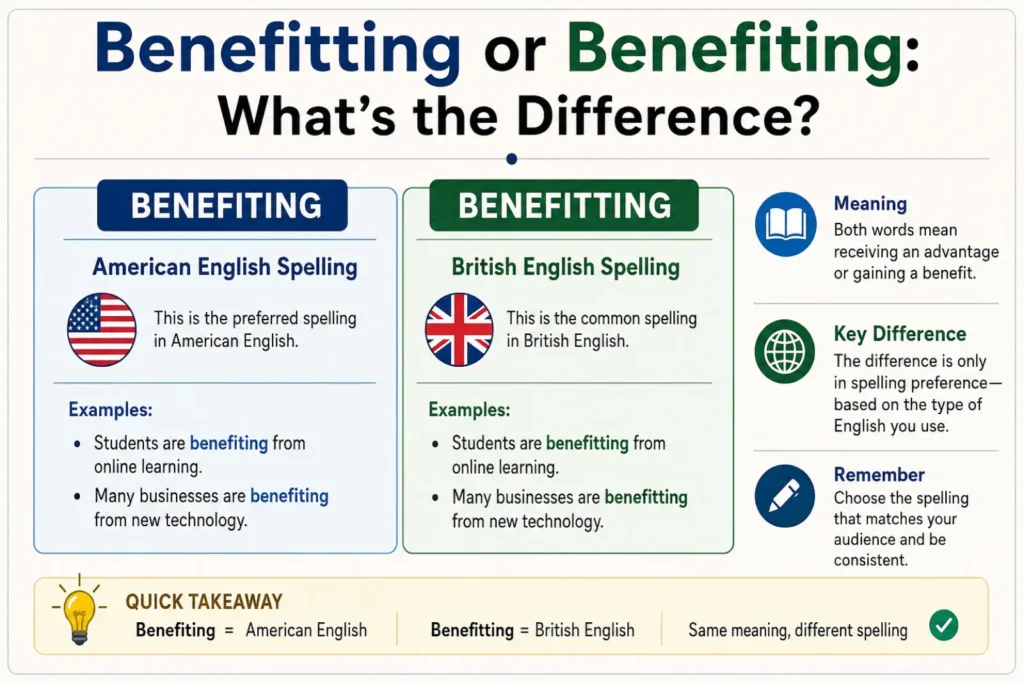
Benefitting or Benefiting: What’s the Difference?
The biggest difference is regional spelling.
| Feature | Benefiting | Benefitting |
|---|---|---|
| Meaning | Receiving an advantage | Receiving an advantage |
| American English | ✅ Preferred | Rare |
| British English | Accepted | ✅ More common |
| Formal writing | Recommended in US | Recommended in UK |
| Pronunciation | Same | Same |
Quick Answer
- Writing for an American audience? Use benefiting.
- Writing for a British audience? Use benefitting.
Why Are There Two Spellings?
English follows different spelling conventions.
American English usually avoids doubling the last consonant unless grammar rules require it.
British English often doubles the final consonant before adding endings like:
- -ing
- -ed
This creates spellings such as:
- travelling
- cancelled
- benefitting
Meanwhile, American English often prefers:
- traveling
- canceled
- benefiting
Neither spelling changes the meaning.
When Should You Use “Benefiting”?
Use benefiting when writing:
- American English articles
- Academic papers in the US
- Business reports
- Marketing content
- SEO blogs targeting US readers
Examples
- Patients are benefiting from new treatments.
- Our customers are benefiting from faster shipping.
- Children are benefiting from better nutrition.
When Should You Use “Benefitting”?
Choose benefitting when your audience uses British English.
This includes:
- UK websites
- Australian publications
- Some Canadian publications
- International organizations following British spelling
Examples
- Residents are benefitting from new transport links.
- The charity is benefitting many families.
- Schools are benefitting from government grants.
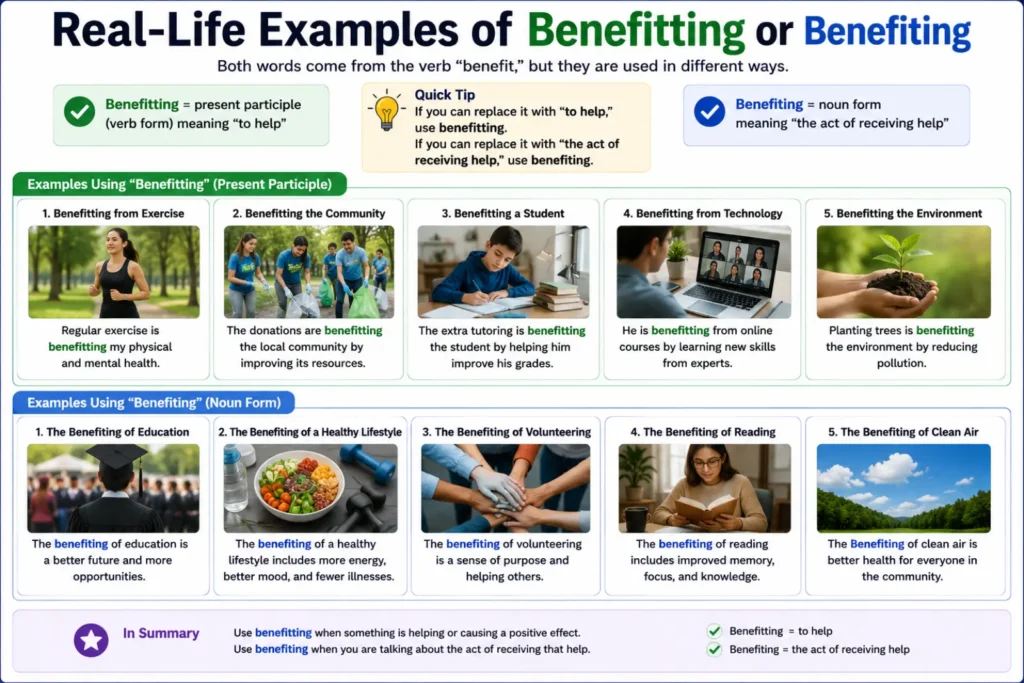
Real-Life Examples
Education
Students are benefiting from free online courses.
Healthcare
Patients are benefiting from modern medical technology.
Business
Companies are benefiting from artificial intelligence.
Environment
Communities are benefiting from cleaner energy.
Personal Finance
Families are benefiting from lower interest rates.
Each sentence works with benefitting if you follow British English spelling.
Common Grammar Rule Behind the Spelling
Many people wonder why one version doubles the letter t.
The answer comes from spelling conventions.
Some British English words double the final consonant before adding -ing.
Examples include:
| Base Word | American English | British English |
|---|---|---|
| Travel | Traveling | Travelling |
| Cancel | Canceling | Cancelling |
| Fuel | Fueling | Fuelling |
| Benefit | Benefiting | Benefitting |
This is simply a style difference.
Common Mistakes People Make
Mixing Both Spellings
Do not switch between benefiting and benefitting in the same article.
Stay consistent.
Assuming One Is Wrong
Both spellings are correct.
Only the regional preference changes.
Ignoring Your Audience
Always match the spelling style your readers expect.
Following Autocorrect Blindly
Your software may use American English by default.
Check language settings before publishing.
Tips for Remembering the Correct Spelling
- Writing for the US? Use benefiting.
- Writing for the UK? Use benefitting.
- Stay consistent in one document.
- Follow your company’s style guide.
- Match the spelling used throughout your website.
Using Benefiting or Benefitting in Daily Life
These words appear often in everyday communication.
Emails
We are benefiting from your support.
News
Residents are benefiting from new public services.
School
Children are benefiting from extra reading time.
Workplace
Employees are benefiting from flexible work policies.
Social Media
Thousands of users are benefiting from this free app.
Synonyms and Related Keywords
Using synonyms improves readability and supports SEO.
Synonyms
- gaining
- receiving
- profiting
- improving
- enjoying advantages
- making use of
- getting help
- thriving
Related LSI Keywords
- benefit meaning
- benefit grammar
- benefiting spelling
- benefitting spelling
- American vs British English
- English spelling differences
- grammar guide
- spelling rules
- correct English usage
- benefit verb examples
Expert Insights
Professional writers always think about their audience before choosing a spelling.
American readers expect benefiting.
British readers often expect benefitting.
Search engines also value consistency.
Using one spelling throughout your content improves readability and creates a better user experience.
Editors recommend following a recognized style guide, such as AP Style for American English or a British English style guide for UK publications. Consistency builds trust and supports strong writing quality.
Frequently Asked Questions
Is benefiting correct?
Yes. It is the preferred American English spelling.
Is benefitting also correct?
Yes. It is commonly accepted in British English.
Which spelling should I use for SEO?
Use the spelling that matches your target audience. If you target US readers, use benefiting. If you target UK readers, use benefitting.
Do both words have the same meaning?
Yes. Both mean receiving an advantage or gaining something helpful.
Which spelling appears more often online?
Benefiting appears more often because American English dominates much of the web. However, benefitting remains common on British and Commonwealth websites.
Can I use both spellings in one article?
No. Choose one spelling style and use it consistently.
Is benefitting a spelling mistake?
No. It is a valid British English spelling.
Featured Snippet Box
Benefitting or benefiting?
- Benefiting is the preferred spelling in American English.
- Benefitting is commonly used in British English.
- Both spellings have the same meaning: receiving an advantage or gaining something helpful.
- Choose the spelling that matches your audience and use it consistently.
Conclusion
Understanding benefitting or benefiting is easier than it first appears. Both spellings are correct and carry the same meaning. The key difference lies in regional English. Benefiting is the standard choice in American English, while benefitting is more common in British English. Your audience should guide your decision. Most importantly, remain consistent throughout your writing. Doing so improves readability, strengthens your credibility, and supports a better user experience. Whether you write blog posts, business documents, academic papers, or everyday emails, choosing the correct spelling for your audience will make your writing clearer and more professional.