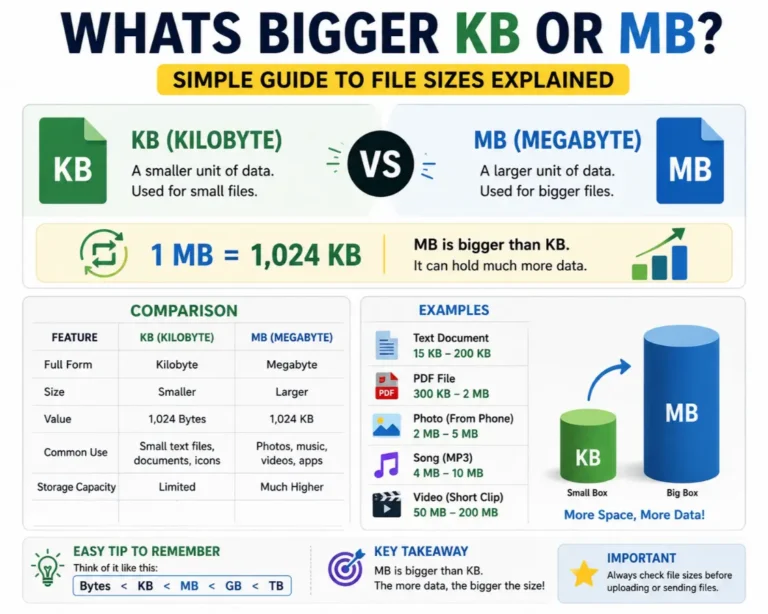
Whats bigger KB or MB is a common question people ask when dealing with files, photos, videos, and storage space. Understanding file sizes helps you manage your devices better.
Many people see KB and MB every day. However, they often wonder which one is larger.
The answer is simple. A megabyte (MB) is bigger than a kilobyte (KB).
This guide explains the difference in easy words. You will also learn how KB and MB work in real life. Plus, you will see examples, common mistakes, and useful tips.
By the end of this article, you will understand file sizes with confidence.
Quick Summary Box
- MB is bigger than KB.
- 1 MB equals 1,024 KB.
- KB stands for Kilobyte.
- MB stands for Megabyte.
- Photos, videos, and apps often use MB.
- Small text files usually use KB.
- MB stores much more data than KB.
What Does KB and MB Mean?
KB means Kilobyte.
MB means Megabyte.
Both units measure digital data.
People use them to describe:
- File sizes
- Storage space
- Downloads
- Documents
- Photos and videos
Computers use these measurements every day.

Whats Bigger KB or MB?
The answer is easy:
MB is bigger than KB.
A megabyte contains many kilobytes.
Conversion:
1 MB = 1,024 KB
Therefore, MB can hold much more information.
For example:
- 500 KB is smaller than 1 MB.
- 5 MB is much larger than 500 KB.
Understanding File Size in Simple Words
Think of file sizes like containers.
- KB is a small box.
- MB is a bigger box.
The larger the file, the more storage it needs.
Small files use KB.
Larger files use MB.
KB vs MB Comparison Table
| Feature | KB (Kilobyte) | MB (Megabyte) |
|---|---|---|
| Full Name | Kilobyte | Megabyte |
| Size | Smaller | Larger |
| Value | 1,024 bytes | 1,024 KB |
| Common Use | Text files | Photos and music |
| Storage Capacity | Limited | Much higher |
| Example Size | Resume PDF | Smartphone photo |
How Many KB Are in One MB?
One megabyte contains:
1 MB = 1,024 KB
Some systems use:
1 MB = 1,000 KB
However, computers commonly use 1,024 KB.
This rule helps calculate file sizes correctly.
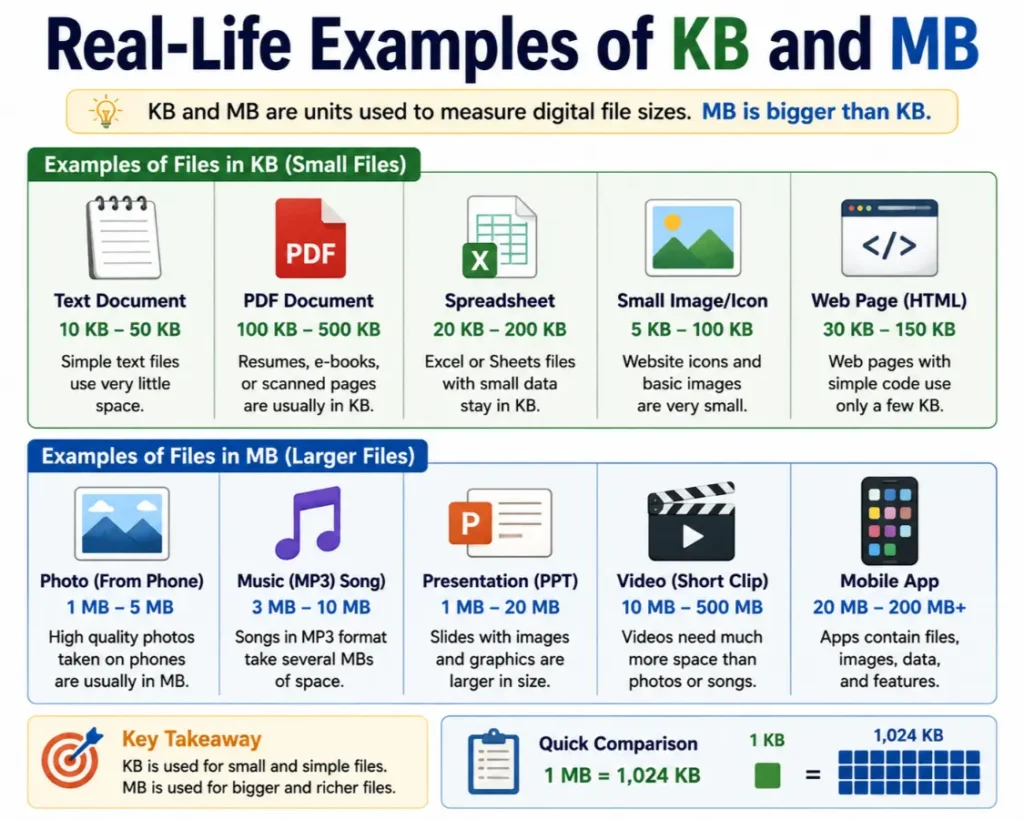
Real-Life Examples of KB and MB
Text Document
A simple text file may be:
- 20 KB
- 100 KB
PDF File
A resume PDF may be:
- 300 KB
- 800 KB
Photo
A phone picture may be:
- 2 MB
- 5 MB
Song
An MP3 file may be:
- 4 MB
- 10 MB
Video
A short video can be:
- 50 MB
- 200 MB
Why File Size Matters
Knowing file sizes helps you:
- Save storage space.
- Upload files faster.
- Avoid email attachment limits.
- Manage phone memory.
- Understand download speeds.
This knowledge makes technology easier to use.
Usage in Daily Life
People encounter KB and MB every day.
Examples include:
Email Attachments
Small documents use KB.
Smartphone Photos
Most images use MB.
Social Media Uploads
Videos often require many MB.
Cloud Storage
Google Drive and Dropbox show file sizes in KB and MB.
Computer Downloads
Apps and software use MB.
Common Mistakes People Make
Mistake 1: Thinking KB Is Bigger
Many beginners assume KB is larger because they see it more often.
Actually, MB is larger.
Mistake 2: Confusing MB with Mbps
MB measures storage.
Mbps measures internet speed.
They are different units.
Mistake 3: Ignoring File Size Limits
Large MB files may exceed upload limits.
Always check file size before sending.
Easy Tricks to Remember the Difference
Use this order:
Bytes → KB → MB → GB → TB
Think of it like steps on a ladder.
Each step becomes larger.
Another trick:
- K = small
- M = medium
- G = giant
This makes remembering easier.
Which Files Usually Use KB?
Files commonly measured in KB include:
- Text files
- Small PDFs
- Spreadsheets
- Word documents
- Website icons
These files contain less information.
Which Files Usually Use MB?
Files commonly measured in MB include:
- Photos
- Music files
- PowerPoint presentations
- Mobile apps
- Videos
These files require more storage.
Expert Insight
Understanding digital storage improves everyday technology use.
As a content and technology writer, I recommend learning file size basics early.
This knowledge helps when:
- Sending files
- Buying storage devices
- Managing cloud storage
- Uploading content online
Knowing the difference between KB and MB prevents confusion and saves time.
Frequently Asked Questions
Whats bigger KB or MB?
MB is bigger than KB.
How many KB are in one MB?
One MB equals 1,024 KB.
Is 500 KB larger than 1 MB?
No. One MB is larger.
What does KB stand for?
KB stands for Kilobyte.
What does MB stand for?
MB stands for Megabyte.
Are photos measured in KB or MB?
Most photos use MB.
Which is bigger, MB or GB?
GB is bigger than MB.
Why are some files measured in KB?
Small files need less storage.
Conclusion
Understanding whats bigger KB or MB is important for everyday technology use. The answer is simple. A megabyte is larger than a kilobyte.
One MB contains 1,024 KB. Therefore, files measured in MB store much more data.
Small documents usually use KB. Photos, songs, and videos often use MB.
Learning these basic storage units helps you manage files, save space, and avoid confusion.
The easiest thing to remember is this:
MB is bigger than KB.
Once you know that rule, understanding digital storage becomes much easier.