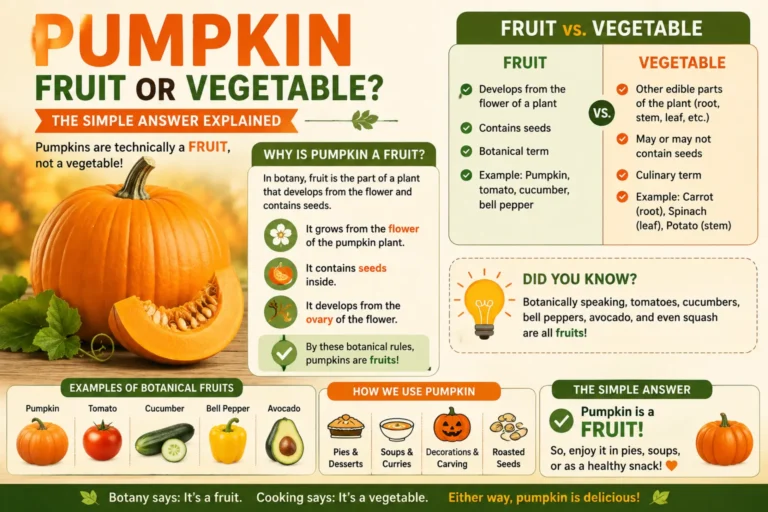
Pumpkin fruit or vegetable? Botanically, a pumpkin is a fruit. It develops from the flower of a pumpkin plant and contains seeds. However, many people call pumpkin a vegetable because they use it in savory meals. This difference can seem confusing at first. The answer depends on how you define a fruit. Botanists use plant structure to classify fruits. Cooks often use taste and food preparation instead. Pumpkin fits the botanical definition of a fruit. It belongs to the same plant family as cucumbers, melons, and squash. You may eat pumpkin in soups, curries, pies, breads, and roasted dishes. So, pumpkin has two common identities in everyday life. Scientifically, it is a fruit. In the kitchen, people often treat it like a vegetable.
Quick Summary
- Pumpkin is botanically a fruit.
- A pumpkin grows from the flower of the plant.
- It contains seeds, which supports its fruit classification.
- Cooks often treat pumpkin like a vegetable.
- Pumpkin belongs to the squash family.
- Cucumbers, melons, and zucchini also count as botanical fruits.
- Pumpkin can work in both sweet and savory dishes.
- The difference comes from botany versus culinary use.
What Is a Pumpkin?
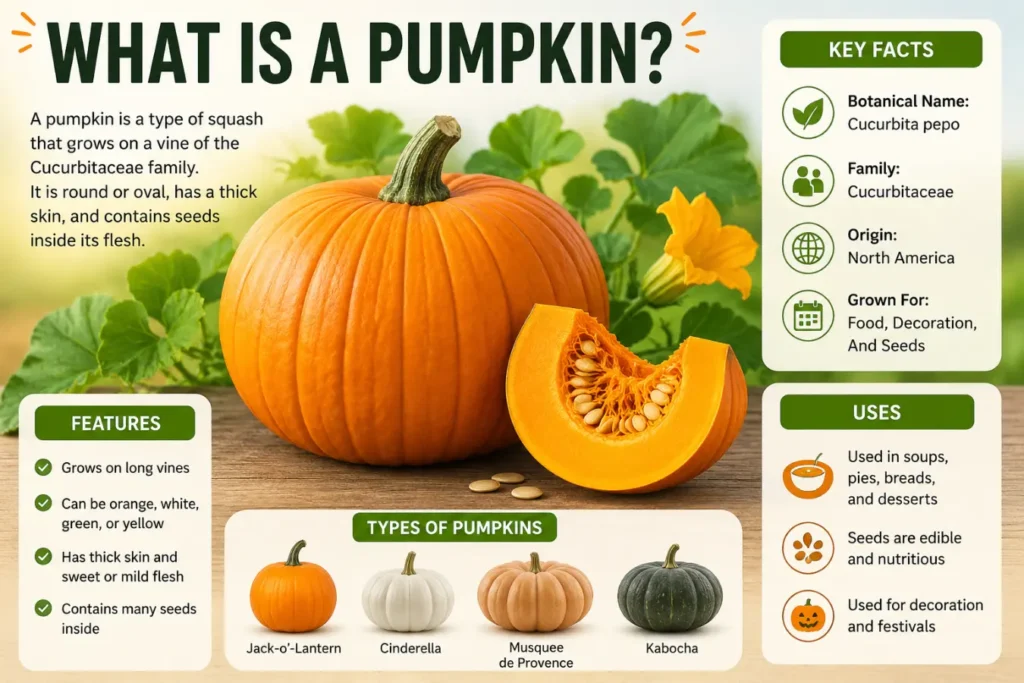
A pumpkin is a type of squash from the Cucurbitaceae plant family.
This family includes several familiar foods. These include cucumbers, melons, zucchini, and other squash varieties.
Pumpkins grow on plants with long vines. The plants produce yellow or orange flowers. After pollination, some flowers develop into pumpkins.
The fruit protects the seeds inside. This role helps plants reproduce.
Pumpkins come in many sizes, shapes, and colors. Some have orange skin, while others appear white, green, or striped.
People use pumpkins in many ways. They can roast, bake, boil, steam, or blend them.
So, pumpkin has an important place in both botany and cooking.
Is Pumpkin a Fruit or Vegetable?
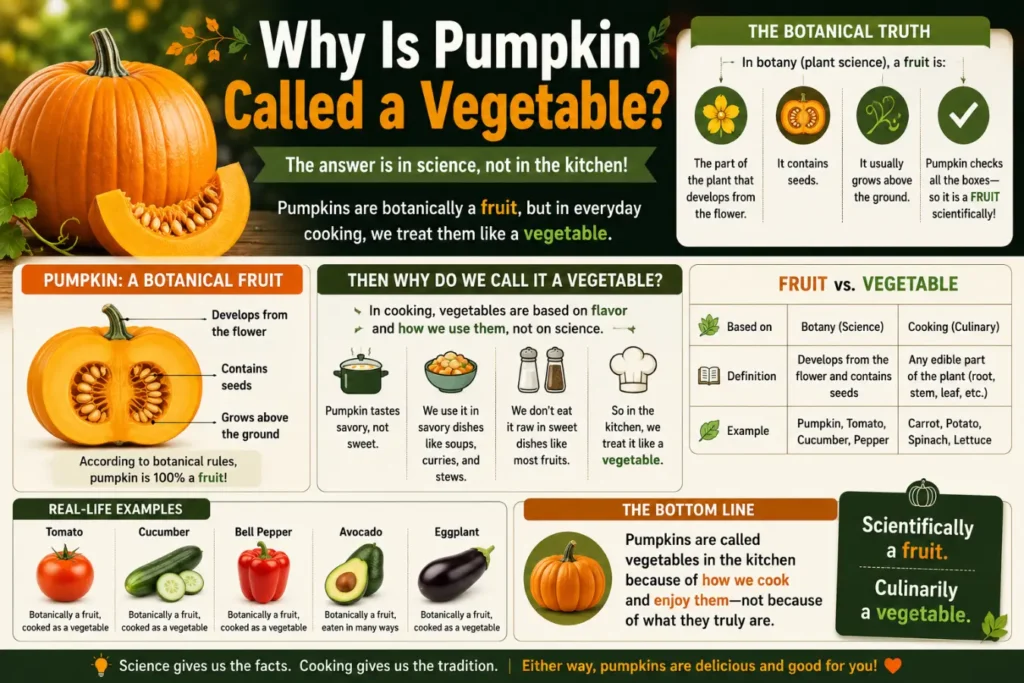
Pumpkin is a fruit from a botanical point of view.
Botanists classify fruits based on how they develop. A fruit usually grows from the ovary of a flowering plant.
Pumpkins develop from flowers. They also contain seeds.
That makes pumpkin a botanical fruit.
Vegetables usually refer to other edible plant parts. These can include roots, stems, leaves, and bulbs.
For example, carrots are roots. Lettuce comes from leaves. Celery mainly comes from stems.
Pumpkin does not fit those categories.
Therefore, the scientific answer is simple:
Pumpkin is a fruit.
Why Is Pumpkin Called a Vegetable?
The confusion comes from everyday cooking.
People often group foods by taste and use. Sweet foods often get called fruits. Savory foods often get called vegetables.
Pumpkin often appears in savory recipes. People add it to soups, stews, curries, and roasted dishes.
Its mild flavor also works well with spices and herbs.
For this reason, many people think pumpkin is a vegetable.
This does not change its botanical classification.
The same thing happens with other foods. Tomatoes are botanically fruits, but cooks often treat them as vegetables.
Therefore, culinary use and botanical classification can differ.
How Do Botanists Define a Fruit?
Botanists use plant structure rather than taste.
A fruit develops from the reproductive part of a flowering plant. More specifically, it usually develops from the flower’s ovary after fertilization.
The developing fruit protects or carries seeds.
Pumpkins follow this process.
First, the pumpkin plant produces flowers. Pollination then allows the flower to begin developing a fruit.
The pumpkin grows around its seeds.
This process explains why scientists classify pumpkin as a fruit.
It also explains why several foods surprise people.
Tomatoes, cucumbers, peppers, eggplants, and pumpkins are all botanical fruits.
They may taste savory, but their plant structure determines their scientific classification.
Pumpkin Fruit vs Vegetable: Key Differences
The easiest way to understand the issue is to compare the two classifications.
| Feature | Pumpkin | Typical Vegetable |
|---|---|---|
| Botanical classification | Fruit | Usually another plant part |
| Develops from a flower | Yes | Not usually |
| Contains seeds | Yes | Not usually |
| Culinary use | Sweet and savory | Mostly savory |
| Example | Pumpkin | Carrot |
| Scientific basis | Flower and seed development | Root, leaf, stem, or other part |
This table shows why pumpkin belongs to the fruit category botanically.
However, cooking uses a different system.
That is why both descriptions can appear in everyday conversations.
Real-Life Examples of Pumpkin as a Fruit
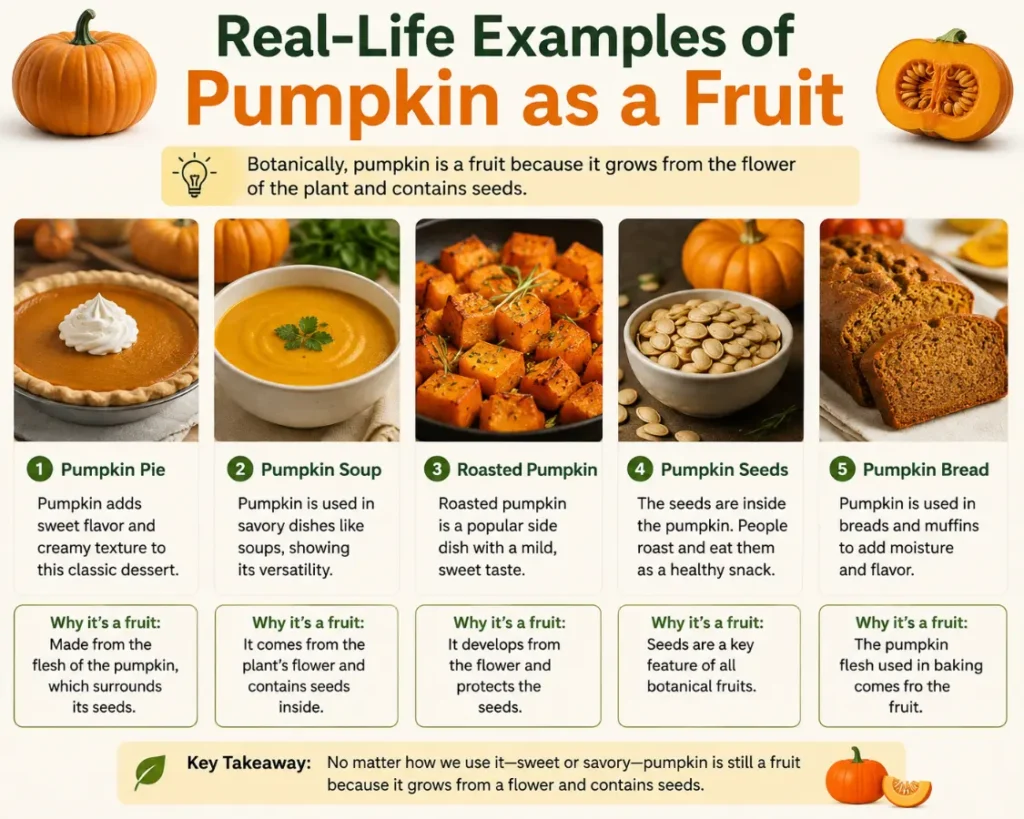
You can see pumpkin’s fruit classification in several real-life examples.
Pumpkin pie
Pumpkin pie uses pumpkin as a sweet ingredient. Its texture works well with spices and creamy fillings.
Pumpkin soup
Soup provides an example of culinary vegetable use. Cooks often combine pumpkin with onions, herbs, and other vegetables.
Roasted pumpkin
Roasted pumpkin can appear as a side dish. People often season it with herbs and spices.
Pumpkin seeds
The seeds sit inside the pumpkin fruit. People can clean, roast, and eat them.
These examples show an important point.
The way you eat pumpkin does not determine its botanical classification.
Is Pumpkin a Fruit Like an Apple?
Yes, pumpkin and apple are both botanical fruits.
However, they belong to different plant groups.
An apple develops from a flower and contains seeds. A pumpkin also develops from a flower and contains seeds.
Their structures differ in many ways.
Pumpkins are classified as a type of pepo. A pepo is a specialized berry with a firm outer rind.
Cucumbers and melons also fall into this general fruit type.
So, pumpkin is a fruit, but it does not look or taste like common fruits such as apples or oranges.
Pumpkin, Squash, and Gourds: Are They Related?
Pumpkins, squash, and gourds belong to related plant groups.
Many pumpkin varieties are types of squash.
The word “pumpkin” often describes certain round or traditional squash varieties.
Different varieties can have different colors, shapes, sizes, and textures.
This makes pumpkin classification even more interesting.
The broader squash group includes many foods that people use as vegetables.
Yet several of these foods are botanically fruits.
So, squash can be a culinary vegetable while remaining a botanical fruit.
Common Mistakes About Pumpkin Classification
Several common mistakes cause confusion.
Mistake 1: Assuming sweet foods are fruits
Taste does not decide botanical classification.
Some fruits taste savory. Tomatoes provide a common example.
Mistake 2: Assuming all vegetables contain no seeds
Some foods called vegetables contain seeds.
Their culinary name does not always match botanical terminology.
Mistake 3: Thinking cooking changes classification
Cooking does not change what plant part the food is.
A roasted pumpkin remains a botanical fruit.
Mistake 4: Confusing culinary and scientific definitions
These systems answer different questions.
Botany focuses on plant structure. Cooking focuses on taste and use.
Mistake 5: Thinking pumpkin must be a vegetable because recipes say so
Recipe categories often follow cooking traditions.
They do not necessarily follow scientific classification.
Tips to Remember the Answer
Use these simple tricks to remember the classification.
Think flowers.
If an edible part develops from a flower and carries seeds, it may be a fruit.
Think seeds.
Pumpkins contain seeds inside their flesh.
Think botany versus cooking.
Botany calls pumpkin a fruit. Cooking often treats it like a vegetable.
Remember similar examples.
Tomatoes, cucumbers, peppers, and eggplants can also create confusion.
A simple memory rule works well:
Pumpkin grows from a flower and contains seeds, so it is a fruit.
How People Use Pumpkin in Daily Life
Pumpkin has many everyday uses.
People add pumpkin to breakfast foods, soups, snacks, desserts, and side dishes.
You may find pumpkin in:
- Soups
- Curries
- Pies
- Breads
- Cakes
- Smoothies
- Roasted dishes
- Purees
- Sauces
- Baby foods
Pumpkin also provides edible seeds.
Different cultures prepare pumpkin in different ways. Some use it in sweet recipes, while others use it in savory meals.
This wide range of uses explains its confusing identity.
A food can be a fruit in science and a vegetable in the kitchen.
Pumpkin Nutrition: Why Does It Matter?
Pumpkin can provide several useful nutrients.
It contains water, fiber, vitamins, minerals, and naturally occurring plant compounds.
Its bright orange color often comes from carotenoids. Beta-carotene is one well-known carotenoid found in many orange foods.
Your body can convert beta-carotene into vitamin A.
Pumpkin also tends to be relatively low in calories when prepared without large amounts of added sugar or fat.
However, preparation matters.
A simple roasted pumpkin dish differs nutritionally from a dessert with added sugar and cream.
For nutrition advice, consider the entire recipe rather than one ingredient alone.
Pumpkin Synonyms and Related Search Terms
People use many terms when searching for this topic.
Useful semantic keywords include:
- Is pumpkin a fruit?
- Is pumpkin a vegetable?
- Pumpkin classification
- Botanical fruit
- Culinary vegetable
- Pumpkin fruit or vegetable
- Is pumpkin technically a fruit?
- What type of fruit is pumpkin?
- Is squash a fruit?
- Pumpkin botanical classification
- Pumpkin plant
- Types of squash
- Fruits that are vegetables
- Fruits used as vegetables
These terms help explain the topic naturally.
They also cover different search intents without repeating the main keyword too often.
Expert Insight: Why the Difference Matters
The fruit-versus-vegetable question teaches an important lesson about classification.
A single food can have different classifications depending on the system.
Botany uses scientific characteristics. Cooking uses practical food categories.
Neither system is wrong.
They simply have different purposes.
For SEO content, this distinction also matters. Searchers may ask the same question for different reasons.
Some want a quick scientific answer. Others want help with cooking or nutrition.
A useful article should answer the main question first. Then, it should explain the reason clearly.
That approach improves understanding and builds topical authority.
For trustworthy food content, use clear scientific definitions. Avoid treating culinary traditions as scientific facts.
FAQs About Pumpkin Fruit or Vegetable
Is pumpkin a fruit or vegetable?
Pumpkin is a fruit botanically. It develops from a flower and contains seeds.
Why do people call pumpkin a vegetable?
People often call pumpkin a vegetable because they use it in savory dishes.
Is pumpkin a type of squash?
Yes. Pumpkins belong to the broader squash group.
Is pumpkin a berry?
Botanically, pumpkin is a type of pepo. A pepo is a specialized berry.
Is pumpkin a fruit like a tomato?
Yes. Both are botanical fruits. However, they belong to different plant groups.
Are pumpkin seeds part of the fruit?
Yes. Pumpkin seeds develop inside the pumpkin fruit.
Is cooked pumpkin still a fruit?
Yes. Cooking does not change its botanical classification.
What other vegetables are actually fruits?
Several foods called vegetables are botanical fruits. Examples include tomatoes, cucumbers, peppers, eggplants, and zucchini.
Conclusion
So, is pumpkin a fruit or vegetable? The scientific answer is clear. Pumpkin is a fruit because it develops from a flower and contains seeds.
However, people often use pumpkin like a vegetable. It appears in soups, curries, roasted dishes, and other savory recipes.
This creates the common confusion.
The key is to understand the difference between botanical and culinary classifications. Botany focuses on how a plant part develops. Cooking focuses on how people prepare and eat it.
Pumpkin also belongs to the squash family. Many related squash varieties receive the same culinary treatment.
The easiest takeaway is simple: pumpkin is a fruit botanically, but people often treat it as a vegetable in the kitchen.